
Over-voltage protection is a safety shutdown, not proof that your inverter is broken. It watches the DC input, battery, solar (PV) input and sometimes the AC output, and it turns the inverter off when voltage goes above its rated limit. Hooking up the wrong battery-bank voltage is a different problem, because that can cause permanent damage the protection cannot stop. This guide covers what triggers the fault, safe voltage limits for 12V, 24V and 48V systems, and how to find the cause with a multimeter.
Quick answer
Your inverter shut down because a voltage it monitors went above the cutoff in its manual. Measure the battery voltage at the inverter terminals and compare it with that cutoff. Then switch off each charging source (solar, alternator, shore charger) one at a time until the voltage drops. The source that makes it drop is your cause.
- Over-voltage protection can watch four different things: battery or DC input voltage, PV input voltage, AC output voltage and DC ripple. Each one has its own fault.
- Cutoff points differ by model. Victron lists 65.5 V for one 48V-class inverter, while an older Atlas 24V model shuts down above 33 V.
- The cause is almost always a charging source, such as a faulty charger, a wrong chemistry setting, an alternator regulator or cold-weather solar voltage. The inverter itself is rarely to blame.
- Many inverters restart on their own after a delay or once voltage drops to a lower restart point.
- A protective shutdown leaves no damage. Connecting a 48V bank to a 24V inverter can destroy it.
- What does over-voltage protection mean on a power inverter?
- What is the difference between battery, PV and AC output over-voltage?
- What voltage is too high for a 12V, 24V or 48V system?
- Common causes of an over-voltage fault
- Shutdown, alarm, delay and restart behavior
- How can I safely measure and confirm inverter input over-voltage?
- What should I do when an inverter shuts down for high voltage?
- When to stop and call an electrician
- How can I choose an inverter with effective over-voltage protection?
- Preventive maintenance and charger checklist
- Frequently Asked Questions
What does over-voltage protection mean on a power inverter?
Over-voltage protection is a circuit that shuts the inverter off when a voltage it watches climbs past a set limit. Inside the inverter, parts like capacitors (small energy-storage parts) and MOSFETs (fast electronic switches) are built for a certain voltage. Push them past it and they can fail.
The protection works in three steps:
- Sense. The control board reads the voltage many times a second.
- Compare. It checks that reading against a threshold stored in its firmware.
- Act. If the reading stays too high, it stops making AC power, shows an alarm and waits.
Victron’s documentation lists high battery voltage as one of several built-in protections. The others are low battery voltage, overload, short circuit, over-temperature, AC voltage on the inverter output and high DC ripple. So a high-voltage alarm is one specific fault. It is not the same as a general error.
What is the difference between battery, PV and AC output over-voltage?
Each type watches a different point in your system and points to a different cause. Many guides lump them together as “high voltage.” That sends people chasing the wrong part.
| Fault type | What is measured | Usual cause | Where to look first |
|---|---|---|---|
| Battery / DC input over-voltage | Voltage at the inverter’s DC terminals | Charger, alternator or solar controller pushing the bank too high | Every charging source on the battery |
| PV input over-voltage | Voltage from solar panels into a built-in or separate charge controller | Too many panels in series, or cold weather raising panel voltage | Panel wiring and the controller’s maximum PV voltage |
| AC output over-voltage | Voltage on the inverter’s AC output side | Shore power or a generator feeding back into the output, or a wiring mistake | Transfer switch and AC wiring |
| High DC ripple | How much the DC voltage swings up and down under load | Thin or long battery cables, loose connections, weak batteries | Cable size, lugs and battery health |
DC ripple is the quick wobble in battery voltage when the inverter pulls heavy, pulsing current. Victron treats high ripple as its own protection. Poor wiring can make the voltage peaks look high even when the average is normal.
What voltage is too high for a 12V, 24V or 48V system?
Voltage is too high once it passes the highest correct charging voltage for your battery type. The inverter trips when voltage reaches the cutoff printed in its manual. The table below is a rough guide only. Your manufacturer’s numbers always win.
| Nominal system | Normal charging range (most lead-acid and LiFePO4 profiles) | Published cutoff examples | Investigate if you see |
|---|---|---|---|
| 12V | About 13.6-14.8 V | 16 V (Victron Smart BatteryProtect example) | Steady readings above your charger’s absorption setting |
| 24V | About 27.2-29.6 V | 32 V (Victron BatteryProtect example); 33 V shutdown, 31 V restart (Atlas 24/2500) | Readings above about 30 V that don’t fall when charging ends |
| 48V | About 54.4-59.2 V | 65.5 V DC input disconnect (Victron Inverter RS Smart) | Readings above about 60 V |
The charging ranges are typical figures for float and absorption on common battery types. Flooded lead-acid batteries on an equalize cycle (a deliberate overcharge used to balance cells) can go higher for a short time. Some inverters trip during equalization for that reason. You can check the 48V figure on Victron’s Inverter RS Smart technical specifications page.
Common causes of an over-voltage fault
The inverter only reports high voltage. Something else creates it. These are the usual sources, roughly from most to least common:
- Wrong charger profile. A shore charger or DC-DC charger set to flooded lead-acid or equalize while it charges lithium or AGM batteries.
- Failed charger or regulator. A charger that never drops to float, or an alternator regulator that lets voltage climb with engine speed.
- Solar controller settings. The absorption voltage is set too high, or the controller is set for the wrong system voltage.
- Loose or corroded wiring. A bad connection can cause spikes when a charger or load switches on or off.
- Battery disconnected while charging. If a BMS or switch opens while the charger runs, voltage can jump with no battery to absorb it.
- Surges. Lightning nearby, generator start-up, or shore power swinging high.
- Wrong system voltage. A battery bank wired for a higher voltage than the inverter is rated for.
Solar charge-controller settings and cold weather
Solar causes trouble in two ways. First, a controller set to the wrong battery type or voltage will push the bank too high, and the inverter trips on battery over-voltage. Second, the PV voltage from the panels can go over the controller’s own maximum.
Victron’s solar-charger documentation is blunt about it: PV voltage must never exceed the charger’s maximum rated PV voltage. If it does, the charger stops charging and shows overvoltage error 33. It starts again only once PV voltage falls 5 V below the rated maximum.
Cold weather is the hidden trap. Solar panels make more voltage when they are cold. Panel datasheets list this as a temperature coefficient of open-circuit voltage (Voc, the voltage with nothing connected). In the US, the National Electrical Code (NEC 690.7) requires designers to correct maximum PV voltage for the lowest expected temperature.
Worked example
A cabin owner wires three panels in series. Each panel has a Voc of 45 V at 25°C (77°F). The controller is rated for 150 V maximum PV input.
- Voc at 25°C: 3 × 45 V = 135 V. That looks safe.
- The panel datasheet lists a Voc coefficient of −0.30% per °C. The coldest winter morning is −10°C (14°F).
- Temperature difference: 25 − (−10) = 35°C.
- Voltage rise: 35 × 0.30% = 10.5%.
- Cold Voc: 135 V × 1.105 = 149.2 V.
That leaves less than 1 V of margin. Add an even colder morning, and the controller goes over 150 V and shuts down. Under Victron’s rule it would not restart until PV voltage fell to 145 V. The fix is two panels in series instead of three, or a controller rated for higher PV voltage. Use your own panel’s Voc, its coefficient and your local record low to redo this.

Wrong battery-bank voltage: shutdown vs. damage
Over-voltage protection is built to catch a charger running a few volts high. It is not built to survive double its rated input. Connect a 24V inverter to a 48V bank and the input capacitors and switching parts can fail in a moment, often with a bang, before any shutdown can act. Treat the two cases differently:
- Protective shutdown: alarm shows, unit restarts once voltage drops, everything works normally afterward.
- Damage: no display, burning smell, blown internal fuse, or the unit won’t power on at a correct voltage. That needs repair or replacement, and it is usually not covered by warranty.
Shutdown, alarm, delay and restart behavior
Most modern inverters restart on their own once voltage returns to normal, but the rules differ by model. Here are three documented examples:
- The Victron Inverter RS Smart manual says the inverter waits 30 seconds after a high-battery-voltage shutdown, then tries again once voltage is acceptable.
- The Atlas 24/2500 manual describes shutdown above 33 VDC and restart only after input falls to 31 VDC.
- Victron solar chargers resume only when PV voltage is 5 V below their maximum rating.
That gap between the trip point and the restart point is called hysteresis. It stops the inverter from clicking on and off every second. It also explains a common mix-up: voltage dips just below the cutoff, yet the inverter stays off. It isn’t stuck. It is waiting for the lower restart point or for its timer.
Some budget inverters do not restart on their own at all. You have to switch them off and on. Check your manual so you know which kind you own.
How can I safely measure and confirm inverter input over-voltage?
Use a digital multimeter on the DC volts setting, and measure at two points: the inverter’s DC terminals and the battery posts. Comparing the two tells you whether the problem is the battery voltage itself or the wiring between them.
- Wear safety glasses and take off rings and watches. Battery banks can deliver huge current through a dropped tool.
- Set the meter to DC volts, on a range above your system voltage.
- Put the red probe on positive and the black on negative at the inverter terminals. Write down the reading.
- Repeat at the battery posts.
- Take both readings again with chargers on, then with chargers off.
- Compare with the cutoff in your manual. Don’t compare with a figure from the internet.
If both readings match and they are high, a charging source is overcharging the battery. If the inverter reads much higher or jumps around while the battery reads steady, suspect loose connections or ripple.
Worked example
An RV has a 24V battery bank and an inverter whose manual lists shutdown above 33 V and restart at 31 V, the same as the Atlas 24/2500. The inverter keeps tripping. Three charging sources are connected: a solar controller, the engine alternator, and a shore-power charger.
- Inverter terminals: 33.4 V. Battery posts: 33.3 V. The readings match, so wiring is not the cause.
- Solar switched off at the PV breaker: still 33.3 V. Solar is cleared.
- Engine off, so the alternator stops: still 33.2 V. Alternator is cleared.
- Shore charger unplugged: voltage drops to 27.0 V within a few minutes. The shore charger is the source.
The charger’s settings show it is on an equalize profile. The correct absorption setting for this bank is about 28.4 V. After fixing the profile, the owner waits for the inverter’s restart, then reconnects each source one at a time while watching the meter.
What should I do when an inverter shuts down for high voltage?
Isolate the charging sources first, then measure, then fix the setting, then restart with care. Don’t keep resetting the inverter. Each trip means something is still pushing voltage too high.
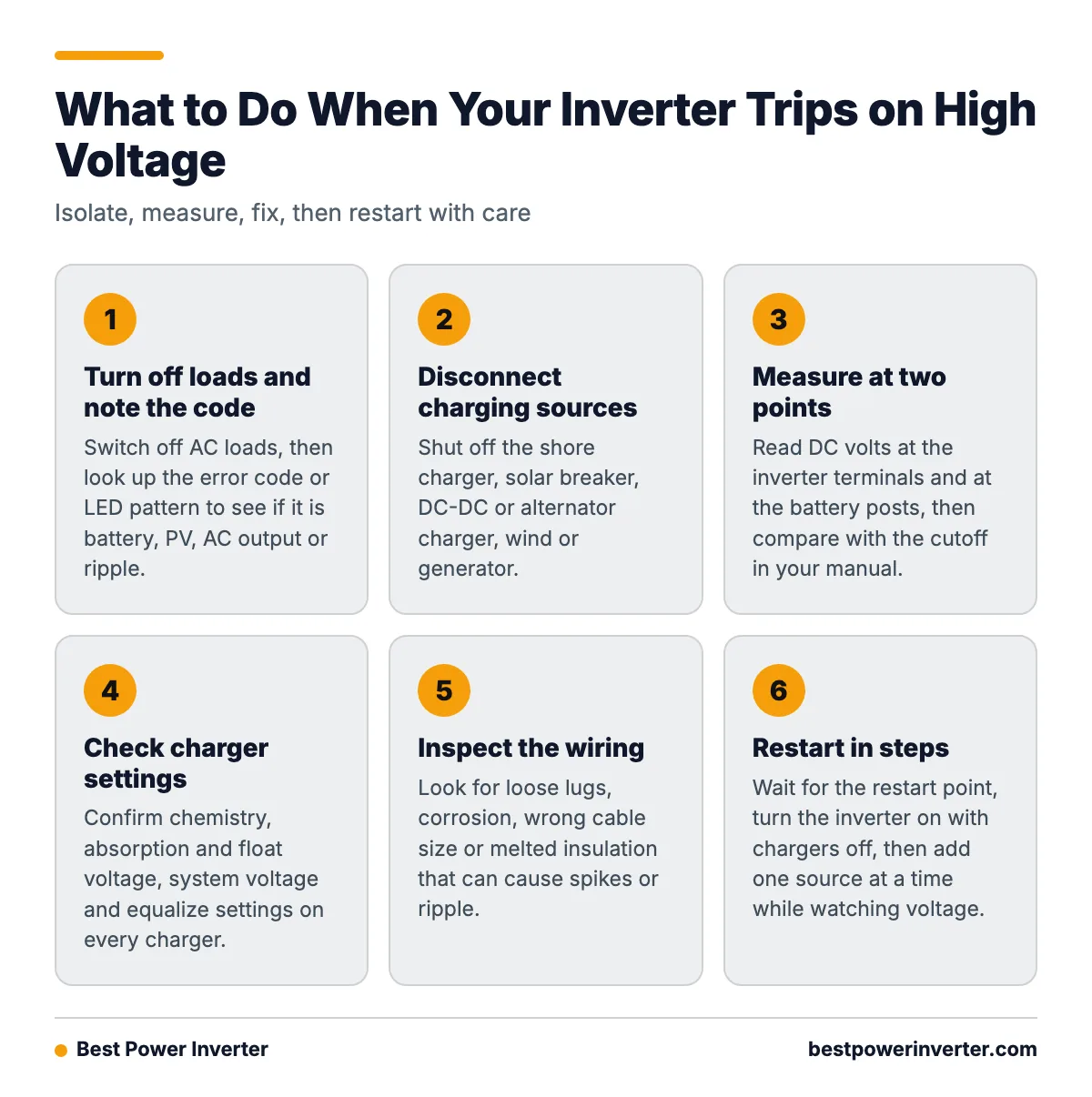
- Turn off AC loads plugged into the inverter.
- Note the error code or LED pattern and look it up in the manual. It tells you whether the fault is battery, PV, AC output or ripple.
- Disconnect charging sources: shore charger, solar breaker, DC-DC or alternator charger, wind or generator.
- Measure voltage at the inverter and at the battery.
- Check configuration: charger chemistry, absorption and float voltage, system voltage, and equalize settings on every charger.
- Inspect wiring: tight lugs, no corrosion, correct cable size, no melted insulation.
- Let it cool and settle. Wait for the restart delay in your manual and for voltage to fall below the restart point.
- Restart in steps. Turn the inverter on with chargers still off, then add one charging source at a time and watch the voltage.
If voltage is high at the battery and drops when one charger is switched off: fix or replace that charger’s settings.
If voltage is normal at the battery but high or unstable at the inverter: tighten and inspect connections, and check cable size for ripple.
If the error is PV over-voltage: recheck series panel count against the controller’s maximum, including cold-weather Voc.
If the error is AC output voltage: check for shore or generator power back-feeding the output, and stop there until it is wired correctly.
If the inverter won’t power on at a correct voltage: assume damage and stop troubleshooting.
When to stop and call an electrician
Stop and get a qualified electrician or marine/RV technician when any of these happen:
- You smell burning, see scorch marks, or hear crackling.
- The inverter won’t turn on even with correct voltage.
- AC voltage appears on the inverter output from another source.
- The fault involves PV strings over about 50 V DC, or any work inside the panel box.
- Battery cables or terminals feel hot.
- You can’t find which source is causing the high voltage.
High-current DC and series solar strings can cause arc burns and fires. A qualified installer can also confirm your system meets local code.

How can I choose an inverter with effective over-voltage protection?
Pick an inverter whose spec sheet lists an exact high-voltage cutoff, a stated restart behavior, and a recognized safety listing. A vague claim like “over-voltage protected” with no numbers tells you nothing. Use this table to compare models:
| Specification | What to look for | Why it matters |
|---|---|---|
| High battery voltage cutoff | A stated number (for example, 65.5 V on the Victron RS Smart) | It must sit above your highest charge voltage, or normal charging will trip it |
| Restart point or delay | A stated restart voltage or time | Tells you whether it restarts by itself or needs a manual reset |
| Maximum PV voltage (inverter-chargers with built-in solar) | A rating with room above your cold-weather Voc | Going over it stops charging and can damage the controller |
| AC output and surge protection | Protection against AC voltage on the output and surge ratings | Guards against back-feed from shore power or generators |
| DC ripple alarm | Listed as a protection | Warns you about undersized or loose cables early |
| Alarm behavior | Specific error codes, an alarm relay, or app alerts | Clear codes show you which voltage tripped, which saves hours |
| Certification | UL 458 for mobile and marine inverters; UL 1741 for solar or grid-interactive equipment; ETL or CSA listing | Shows that the safety claims were checked by a third party |
For an RV or boat, a UL 458 listed inverter with a published cutoff and automatic restart is the right choice for most buyers. Skip any unit whose manual gives no cutoff voltage. If you can’t look up the limit, you can’t troubleshoot against it.
Preventive maintenance and charger checklist
Most over-voltage faults can be prevented by matching every charger to the battery and checking connections a few times a year.
- Set every charger (shore, solar, DC-DC, alternator) to the same battery chemistry and system voltage.
- Turn off equalize on any charger connected to lithium or AGM batteries, unless the battery maker says otherwise.
- Keep absorption voltage below the inverter’s cutoff, with a clear gap.
- Recheck PV string voltage against the controller’s maximum before winter.
- Torque battery and inverter lugs to the maker’s figure, and look for corrosion.
- Check that cable size matches the inverter manual for its length and power rating.
- Update inverter and charger firmware when the maker releases fixes.
- Write your cutoff, restart point and charger settings on a label near the inverter.
Frequently Asked Questions
Will an inverter automatically restart after an over-voltage shutdown?
Usually, yes. Restart rules vary by model. The Victron Inverter RS Smart waits 30 seconds and retries when voltage is acceptable. The Atlas 24/2500 restarts once input falls to 31 VDC. Some basic inverters need a manual off-and-on reset, so check your manual.
Can the wrong battery-bank voltage damage an inverter?
Yes. Over-voltage protection handles small overshoots from chargers. It is not designed for a bank wired at double the inverter’s rating. Connecting a 48V bank to a 24V inverter can destroy internal parts instantly, and warranties usually exclude it. Always measure the bank before connecting.
How do solar charge-controller settings cause inverter over-voltage?
A controller set to the wrong battery type, system voltage or absorption voltage can charge the bank above the inverter’s cutoff. Separately, too many panels in series, especially in cold weather, can push PV voltage over the controller’s own limit. Victron controllers then stop charging and show error 33.
What causes an inverter to show an over-voltage fault?
The most common causes are a misconfigured or failed charger, a faulty alternator regulator, solar controller settings, loose wiring, a BMS disconnecting while charging, power surges, and an incorrect system voltage. Switch off charging sources one at a time while measuring voltage to find which one is responsible.
What voltage is too high for a 12V, 24V, or 48V inverter system?
Anything above your battery’s correct charge voltage deserves a closer look. Published cutoff examples include 16 V for 12V systems and 32-33 V for 24V systems, and 65.5 V on one Victron 48V-class inverter. Your inverter’s manual gives the number that applies to you.
Sources