
Everyday electronics such as a laptop, LED TV, Wi-Fi router, LED lights and a fan will run on a 1000 watt inverter, several at once, as long as their combined running load stays under 1000 watts. Coffee makers, compact refrigerators, microwaves, pumps and other heating or motor-driven appliances depend on two numbers: the label wattage and the startup surge. Many hair dryers, space heaters and full-size microwaves need more than a 1000 watt inverter can supply.
Quick answer
Add up the running watts of everything you will use at the same time. Keep the total below about 1000 watts and check the startup surge of anything with a motor or compressor. Electronics, lights and fans are safe. Heaters, hair dryers and most microwaves are not.
- Best for phones and one laptop: a 100 W inverter
- Best for TV, laptop and fan together: a 750 W or 1000 W inverter
- Best for microwaves, hair dryers and tools: a 3000 W inverter
A 1000 watt power inverter converts 12-volt DC power from a battery into 120-volt AC power. That lets you plug ordinary household electronics into a car, RV, van or battery bank. It is sized for moderate loads rather than whole-kitchen use.
Campers, van owners and households preparing for power outages commonly use this size to charge phones, laptops and game consoles and to run a small TV, lights and a fan. It also pairs well with a solar-charged battery bank. The limits come from the inverter’s continuous rating, its surge capacity, and how much current the battery and cables can deliver. Exceeding any of them trips the inverter’s overload protection or drains the battery much faster than expected.

Credit: www.walmart.com
What will a 1000 watt power inverter run?
A 1000 watt power inverter will run any AC device, or group of devices, whose combined running wattage stays below 1000 watts and whose startup surge stays within the inverter’s peak rating. In practice, that covers most electronics, lighting, fans and chargers. It also covers some compact fridges and smaller coffee makers.
The inverter takes DC power from a battery and produces AC power similar to a wall outlet. The conversion is not perfectly efficient. Part of the energy is lost as heat, so the battery always supplies more power than the appliance receives. A device labelled at 1000 watts sits right at the limit and leaves no headroom. Many manufacturers and installers suggest running a 1000 W inverter at roughly 80% of its rating, about 800 W, for long periods.
Check the actual consumption of each appliance before plugging it in. The figure on the label or in the manual is more reliable than a generic chart, because two models of the same appliance can differ by hundreds of watts.
How do running watts differ from starting or surge watts?
Running watts (also called continuous watts) are what a device draws while it operates normally. Starting or surge watts are the short burst of extra power that motors and compressors need for the first moment after switching on. Many charts leave out that burst, and that is why a fridge, pump or power tool can fail to start on an inverter that looks big enough.
A 1000W inverter is generally intended to carry up to 1000 watts of continuous AC load. Its surge or peak rating is separate, and the amount and duration differ by model. Some units hold a surge for a fraction of a second, others for a few seconds. Read the specification sheet for both figures rather than assuming that “1000W” also covers startup loads.
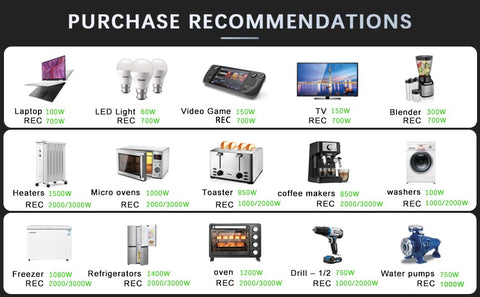
Wattage figures in the table below come from published appliance ranges, including the Allwei guide to what a 1000 watt inverter can run. Individual models vary, so treat these as starting points and confirm against your own appliance label.
| Device | Typical running watts | Startup concern | Suitable for 1000 W? | Room for other loads? |
|---|---|---|---|---|
| Laptop | 45-100 | None | Yes | Plenty |
| LED TV | 60-150 | None | Yes | Plenty |
| LED bulb | 8-15 each | None | Yes | Plenty |
| Box fan | 40-100 | Small motor start | Yes | Plenty |
| Compact refrigerator | 100-300 | Compressor surge, model-dependent | Often, check the surge rating | Some, leave surge headroom |
| Coffee maker | 600-1000 | Heating element at full draw | Smaller models only | Little or none |
| Microwave | 1000-1500 input | Input exceeds cooking output | Most models, no | None |
| Hair dryer | 1200-1800 | Heating element | No | None |
| Space heater | 1500+ | Heating element | No | None |
Microwaves cause the most confusion. A “700-watt” microwave usually refers to cooking output. The electrical input printed on the rear label is often 1000-1500 W, which is more than a 1000 W inverter can carry.
Can a 1000W inverter run a refrigerator, coffee maker, microwave, toaster or hair dryer?
A 1000W inverter can run many compact refrigerators and some smaller coffee makers. It usually cannot run full-size microwaves, hair dryers or space heaters. Toasters and blenders depend on the model, so read the label wattage before relying on one.
- Mini-fridge or compact refrigerator: Running draw of roughly 100-300 W fits easily. Whether the compressor starts depends on the inverter’s surge rating. A pure sine wave unit with a strong surge rating has the best chance. Large household refrigerators have bigger compressors and surges, so check both figures before trying.
- Blender: Small personal blenders often fall within range. High-powered countertop blenders can exceed 1000 W and have a motor surge, so check the label.
- Microwave: Only compact models whose input wattage on the label is comfortably below 1000 W are realistic candidates.
- Toaster: Many toasters draw close to or above 1000 W. Check the label and run nothing else at the same time.
- Coffee maker: At 600-1000 W, smaller drip machines can work alone. Larger brewers sit at or above the limit.
- Hair dryer: At 1200-1800 W, even low settings on many models exceed the rating.
Small tools and equipment follow the same rule:
- Drills – most corded drills fall within range, but the motor has a startup surge.
- Saws – many corded circular and miter saws draw more than 1000 W or surge well past it. Confirm the label rating first.
- Sanders – smaller orbital sanders are usually within range. Check the label on larger belt sanders.
Entertainment and tech gadgets are the easiest loads for this size of inverter:
| Laptops | About 45-100 W, so several can charge at once. |
| TVs | LED sets draw about 60-150 W, leaving room for other devices. |
| Game consoles | Low draw compared with the inverter’s capacity. Check the power supply label. |
| Chargers | Phone and tablet chargers use a small fraction of the rating. |
What can I run with a 1000W inverter at the same time?
You can run several devices at the same time if their running watts add up to less than 1000. Ideally, also keep enough spare capacity to cover any motor starting up.
Here is a worked example:
| Device | Running watts |
|---|---|
| Laptop | 100 |
| LED TV | 100 |
| LED lighting | 30 |
| Wi-Fi router | 50 |
| Total | 280 |
This leaves about 720 W of continuous capacity. That is room for a box fan or a compact fridge’s running load. A 600-1000 W coffee maker added to the same circuit would push the total to or past the limit, so brew coffee with the other loads switched off.
How do I calculate the total load and choose the correct inverter size?
List every device you will run at the same time, add their running watts, then check the single largest startup surge against the inverter’s peak rating. Choose an inverter whose continuous rating sits comfortably above your total, roughly 20% higher.
To find each appliance’s wattage, look for the rating plate or sticker on the back or underside. It usually shows watts (W), or volts and amps. If only amps are listed, multiply by 120 to estimate watts at US household voltage. For a microwave, use the input figure, not the cooking output.
Quick-sizing checklist:
- Label watts: Record the running wattage from each appliance’s label or manual.
- Startup watts: Note which devices have motors or compressors and check the inverter’s surge rating and duration.
- Simultaneous loads: Add only the devices that will actually be on together.
- Battery voltage and capacity: Confirm the battery can deliver the current and the watt-hours you need (see the runtime section below).
- Waveform: Choose pure sine wave for fridges, motors, medical devices and sensitive electronics.
- Cable size: Use the DC cable gauge and maximum length specified in the inverter manual.
- Fuse: Fit an inline fuse or breaker close to the battery, rated as the manufacturer recommends.
- Ventilation: Leave clear airflow around the inverter’s cooling fan and vents.
How can I get the most from a power inverter safely?
Keep the load below the continuous rating, give the inverter airflow, and keep the battery charged with clean, tight connections. These three habits prevent most shutdowns and overheating problems.
Plan device use in watts before plugging in, and run high-draw items such as a coffee maker one at a time. Inspect battery terminals periodically for corrosion or looseness. A poor connection adds resistance, creates heat and can trigger the inverter’s low-voltage alarm.
- Always use the inverter in a well-ventilated area to prevent overheating. Do not cover the fan or vents.
- Do not exceed the inverter’s maximum continuous capacity, even if the surge rating is higher.
- Read the manual for model-specific safety instructions, including cable gauge, fuse size and grounding.
Pure sine wave or modified sine wave?
Pure sine wave inverters produce output close to grid power and work with nearly all devices. Modified sine wave inverters cost less. However, some motors, compressors, audio equipment, chargers and medical devices can run hotter, buzz or malfunction on them. For a fridge, CPAP machine or sensitive electronics, choose pure sine wave.
When is a 1000 watt inverter not enough?
A 1000 watt inverter is not enough when any single appliance draws more than about 1000 W, or when your simultaneous loads add up past that figure. It also falls short when a motor’s startup surge exceeds the inverter’s peak rating. For full-size refrigerators, larger power tools or several kitchen appliances, look beyond 1000 watts to a larger unit.
Running multiple small devices is the most common setup. Keep the combined wattage below 1000 W, and preferably near 800 W for long sessions. A power strip with a surge protector makes multiple devices easier to manage. It does not raise the inverter’s capacity, so the wattage total still applies.
Power inverters are not always the right tool for high-powered appliances such as air conditioners and electric heaters. A generator or shore power can supply those sustained loads without draining a battery in minutes.

Credit: zhcsolar.com

Credit: www.amazon.com
How do 100W, 750W, 1000W and 3000W inverters compare?
Each step up in size adds a new class of appliance. It also increases battery current and shortens runtime from the same battery. The table assumes a 12 V system and about 90% inverter efficiency.
| Inverter size | Typical uses | Not suitable for | Approx. battery current at full load (12 V) |
|---|---|---|---|
| 100 W | Phone and tablet chargers, one laptop, LED lights, small fan | TVs plus laptop together, any kitchen appliance | About 9 A |
| 750 W | Laptop, LED TV, router, lights and fan together; some compact fridges | Most coffee makers, microwaves, hair dryers | About 69 A |
| 1000 W | Mixed electronics, compact fridge, smaller coffee makers | Most microwaves, hair dryers, heaters | About 93 A |
| 3000 W | Microwaves, hair dryers, coffee makers, many refrigerators, larger tools | Air conditioners or several heaters at once | About 278 A |
What will a 100 watt power inverter run?
A 100 watt power inverter will run phone and tablet chargers, one laptop of up to about 100 W, LED lights and a small fan. Most plug into a vehicle’s 12 V accessory socket, which limits them to light loads.
What will a 750 watt power inverter run?
A 750 watt power inverter will run a laptop, LED TV, router, LED lights and a fan together. A compact fridge may also work if the inverter’s surge rating covers the compressor start. Most coffee makers and microwaves exceed it.
What will a 3000 watt inverter run, and how long will it run?
A 3000 watt inverter will run most single kitchen appliances, including microwaves, coffee makers, toasters and hair dryers. It can also handle many refrigerators and larger power tools, provided their surges fit the peak rating. Runtime is short because the draw is high. Using the formula below, a 12 V 200Ah battery at 80% usable capacity and 90% efficiency would run a 3000 W load for about 35 minutes. At this current, a 24 V or 48 V battery system is easier to wire safely.
Is 1000 watts a lot of power?
It depends on what you compare it to. For a phone charger, 1000 watts is far more than you need. For a home kitchen, it is modest. A standard 15-amp, 120-volt household outlet can supply about 1800 watts, so a 1000 watt inverter delivers a little over half of one wall outlet.
| Load | Typical Watts | Share of 1000 W |
|---|---|---|
| Phone charger | 5-20 | Under 2% |
| Laptop | 45-100 | About 5-10% |
| LED TV | 60-150 | 6-15% |
| Coffee maker | 600-1000 | 60-100% |
| Space heater | 1500+ | 150% or more, too much |
The battery side is where 1000 watts becomes a lot. Inverter conversion is not perfectly efficient. A 1000 W AC load needs about 1111 W from the battery at 90% efficiency, according to the Inverter Review battery runtime calculator. On a 12-volt system that works out to about 93 amps, and more as battery voltage sags under load. That current calls for heavy DC cables, often 4 AWG or thicker for short runs depending on the manufacturer’s chart, plus an inline fuse or breaker sized to the manual’s recommendation. The thin leads included with some inverters are not always rated for sustained full load.
How long will a 1000W inverter run on a 12V battery?
A 1000W inverter running a full 1000 W load will run for roughly 30 minutes to just under 2 hours on a single 12 V battery. The figure depends on the battery’s capacity, chemistry and usable depth of discharge.
Runtime formula:
Runtime (hours) = battery watt-hours × usable depth of discharge × inverter efficiency ÷ AC load watts
Worked example with a 12 V 200Ah battery:
- Battery watt-hours: 12 V × 200 Ah = 2400 Wh
- Usable at 80% depth of discharge: 2400 × 0.8 = 1920 Wh
- After 90% inverter efficiency: 1920 × 0.9 = 1728 Wh
- Runtime at 1000 W: 1728 ÷ 1000 ≈ 1.73 hours
That is a theoretical figure. Voltage sag, high-current losses, temperature and the inverter’s low-voltage cutoff often shorten it. The inverter battery calculator at BatteryCalculators.com applies the same approach to other battery sizes. Smaller batteries scale down accordingly:
- 100Ah lithium (LiFePO4) battery: roughly 50-60 minutes at a full 1000 watts.
- 100Ah lead-acid battery: about 30 minutes or less if you stop at 50% discharge to protect the battery. Lead-acid capacity also drops at high discharge rates.
At lighter loads, runtime improves in proportion. The 280 W laptop, TV, lighting and router combination above would run for about six hours on the same 200Ah battery (1728 ÷ 280).
In practice, 1000 watts is plenty for electronics, lights, fans and short bursts from a smaller coffee maker. It is not enough for heating appliances, air conditioners or several high-draw devices running at once.
What do owners say?
Owners like
- Enough capacity for laptops, TVs, lights, routers, fans and other everyday electronics
- A practical size for camping, vehicles, emergency backup and small off-grid setups
- Pure sine wave models work well with sensitive electronics
- Some models handle the brief startup surge of compatible refrigerators or small motors
Common complaints
- Cooling fans can be loud, especially under heavier loads
- Some units cannot sustain their advertised output close to the maximum rating
- Thin or undersized included cables can get hot at high continuous loads
- Runtime is often shorter than expected because of inverter losses, battery limits and high current draw
- Modified sine wave models can cause noise, heat or compatibility problems with some electronics and motors
Summarised from owner reviews and long-term user reports; individual experiences vary.
Frequently asked questions
What can a 1000W inverter run?
It can run laptops, LED TVs, routers, LED lights, fans, chargers and game consoles, often several at once. Compact fridges and smaller coffee makers may also work, provided their running watts and startup surge fit the inverter’s ratings.
What can I run with a 1000W inverter at once?
Any combination whose running watts total less than 1000, ideally under about 800 W for long use. For example, a laptop, TV, LED lighting and router at about 280 W leave roughly 720 W spare.
Will a 1000W inverter run a microwave?
Usually not. Most microwaves draw 1000-1500 W of electrical input even when the advertised cooking power is lower. Check the input rating on the label.
How long will a 3000 watt inverter run?
At a full 3000 W load, a 12 V 200Ah battery at 80% usable capacity and 90% efficiency lasts about 35 minutes. Lighter loads and larger battery banks extend that time proportionally.
What will a 3000 watt inverter run?
Most single kitchen appliances, including microwaves, coffee makers, toasters and hair dryers. It can also run many refrigerators and larger power tools if their startup surges fit the peak rating.
What will a 100 watt power inverter run?
Phone and tablet chargers, a laptop of up to about 100 W, LED lights and a small fan.
What will a 750 watt power inverter run?
A laptop, LED TV, router, lights and a fan together. A compact fridge may also work if the inverter’s surge rating covers the compressor start.
Is a 1000 watt inverter the right size for you?
A 1000 watt power inverter suits electronics, lighting, fans and selected small appliances, either individually or several at once. Size it by adding the running watts of devices used together and checking the largest startup surge against the inverter’s peak rating. Then confirm the battery, cables and fuse can carry roughly 93 amps at full load.
Matched to your devices and battery, a 1000 watt inverter is a practical choice for camping, vans, RVs and short power outages. If you need heating appliances or a full-size microwave, a 3000 W unit is the better fit.
Sources