

Drivers, van owners, campers, and tradespeople who want real AC power from a 12V system should pick an inverter whose continuous rating is 20-25% above the combined running load, then confirm the battery, wiring, and alternator can feed it. Of the five models here, the TOPBULL 3000W is the best overall for trucks, vans, and RVs with a proper high-current install, while 400W plug-in units suit casual charging.
Quick answer
Pick by continuous watts with 20-25% headroom. Above roughly 1,000-1,500W, wire directly to the battery with a fuse and heavy cable. The TOPBULL 3000W suits trucks, vans, and RVs with a strong battery setup.
- Best for heavy tools: TOPBULL 3000W, 3-year warranty
- Best for phones and laptops: Pro Chaser 400W, compact
- Best budget: 400W with USB-C PD
Our Winner: TOPBULL 3000W Power Inverter Car/Home 12V DC to 110V/120V AC
Based on the listing, it pairs a 3000W continuous rating (6000W peak) with thickened copper battery cables, a 200ft wireless remote, a color LED display, ten listed protections, and a 3-year warranty. It needs a direct battery connection and a serious battery bank, but among these five it is the most complete high-watt package.
How We Compared These Models
This comparison is based on listing specifications and patterns in owner feedback, not hands-on testing. We weighed four criteria: continuous versus peak rating, how the unit connects to power (socket or battery clamps), protection and monitoring features, and warranty and port selection. Continuous output and connection method matter most, because they decide what the inverter can actually run in a vehicle.
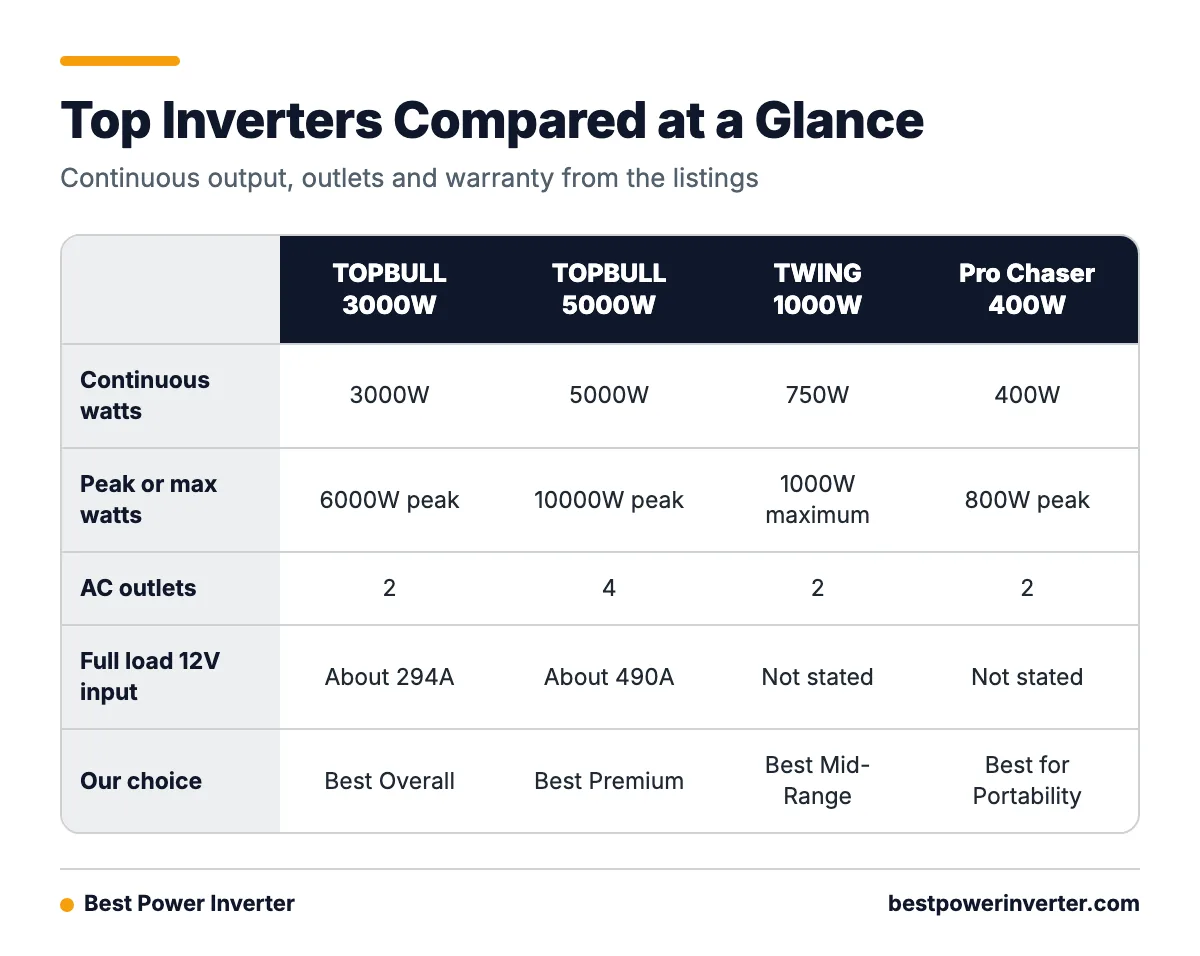
| Product | Key Specs | Our Choice | Action |
|---|---|---|---|
| TOPBULL 3000W | 3000W continuous, 6000W peak, 2 AC outlets, USB-C 30W, remote, 3-year warranty | Best Overall | |
| TOPBULL 5000W | 5000W continuous, 10000W peak, 4 AC outlets, color display, remote | Best Premium | |
| TWING 1000W | 750W continuous, 1000W maximum, modified sine, digital display, clamps and socket plug | Best Mid-Range | |
| Pro Chaser 400W | 400W continuous, 800W peak, 2 AC outlets, 2 USB ports, 12-month warranty | Best for Portability | |
| 400W Inverter with PD | 400W, 2 AC outlets, 30W PD Type-C, dedicated AC switch | Best Budget |
In-Depth Reviews

1. TOPBULL 3000W Power Inverter – Best Overall
Our Verdict: The strongest all-around choice for heavy loads in trucks, vans, and RVs, as long as the battery and wiring are built for it.
The listing states 3000W continuous and 6000W peak. At 12V and 85% efficiency, full load pulls about 294A, so this is a battery-terminal installation, never an accessory-socket device. The included thickened copper cables help, but the fuse, battery bank, and cable length still need to match the manual.
Note the outlet layout: two 20A/120V outlets. One 20A outlet tops out near 2,400W, so a single 3000W appliance cannot run from one receptacle. The listing excerpt also does not state the waveform, so confirm it on the product page before powering sensitive electronics.
Why We Like It
- 200ft wireless remote with one-button shutdown and restart, useful when the unit is mounted out of reach.
- Ten listed protections, including low-voltage, overload, short-circuit, and overheat shutdown.
- Dual fans and a 3-year warranty (1 year replacement plus 2 years extended).
- Listed as compatible with 12V and 12.8V batteries, which covers lithium iron phosphate packs.
Pros & Cons
Pros
- High continuous rating with a 4.5/5 listing score
- Remote, display, and long warranty
- Heavy cables included
Cons
- About 294A at full load demands a large battery bank
- Only two AC outlets
- Waveform not stated in the listing excerpt

2. TOPBULL 5000W Power Inverter – Best Premium
Our Verdict: The highest output here and the best-rated listing (4.6/5), but only sensible for large lithium banks or dedicated RV and work-van power systems.
The listing claims 5000W continuous and 10000W peak, with four 20A sockets, two USB ports, a Type-C port, and a color display showing voltage, power, and status. At 85% efficiency, 5000W corresponds to roughly 490A from a 12V source. No ordinary car alternator or starting battery can support that, and the cabling must be correspondingly massive.
Buy it only if you have a confirmed need for several large loads at once and a battery system sized for them. Otherwise the 3000W model is easier to install.
Why We Like It
- Four 20A AC sockets let several tools run at once.
- Real-time color display and remote control.
- Metal shell and ten listed protections, including reverse-connection and overheating protection.
Pros & Cons
Pros
- Highest output and rating in this group
- Four outlets for multiple loads
- Remote and display included
Cons
- About 490A at full load is beyond typical vehicles
- Overkill for most buyers
- Waveform not stated in the listing excerpt

3. TWING 1000W Inverter – Best Mid-Range
Our Verdict: A practical step up from 400W plug-in units for basic tools and chargers, provided you treat it as a 750W inverter.
The listing is a modified sine wave design and notes 750W continuous, with 1000W as the maximum. That gap is the exact peak-versus-continuous confusion owners often report. It includes battery clamps and a lighter-plug adapter, but the adapter is listed at only 150W surge capacity, so real power requires the clamps.
A digital display, cooling fan, mini slip fuse, and protections against over-voltage, low voltage, overload, short circuit, and overheating are listed. CE and FCC certifications are mentioned. Skip it for motors, audio gear, or chargers that dislike modified sine output.
Why We Like It
- Clamp-on battery connection delivers more than a socket can.
- Two AC outlets plus QC 3.0 and 30W PD USB ports.
- Digital display helps monitor battery drain.
Pros & Cons
Pros
- Moderate output without a heavy installation
- Fast-charging USB options
- Display and fuse protection
Cons
- Modified sine wave
- 750W continuous, not 1000W
- 4.2/5 listing score is the lowest tier here

4. Pro Chaser 400W Inverter – Best for Portability
Our Verdict: The most travel-friendly option for laptops, cameras, and small chargers.
The listing describes a cellphone-sized body, a 30-inch cord, 400W continuous and 800W peak output, dual AC sockets, and two USB ports totaling 4.8A. The cooling fan starts at 113°F (45°C), and a 12-month warranty is included. It holds a 4.5/5 score.
Because it is a plug-in format, the vehicle’s socket fuse is the practical limit. Expect far less than 400W from a typical lighter socket, and keep loads to laptops, camera chargers, and similar low-draw gear.
Why We Like It
- Compact size and flexible cord.
- Overload, voltage, and overheating protection listed.
- Good score for a low-cost unit.
Pros & Cons
Pros
- Small and easy to stow
- Dual AC outlets
- Higher rating than the other 400W unit
Cons
- Socket fuse limits real output
- No USB-C listed
- Only 12 months of warranty

5. 400W Power Inverter with 30W PD – Best Budget
Our Verdict: The lowest-cost way to charge phones and a laptop, with the best USB lineup of the small units.
It lists two AC outlets, a 30W PD Type-C port, a 15W Type-C port, and two 15W USB-A ports. A dedicated AC switch turns the outlets off without unplugging from the socket, which cuts idle draw. An LED shows green for normal operation and red for faults such as over-voltage, under-voltage, overload, overheating, or short circuit.
Like the other plug-in unit, it is limited by the socket circuit. The listing gives a 4.2/5 score and does not state a peak rating or waveform.
Why We Like It
- 30W PD can charge many phones and some laptops.
- Separate AC switch.
- Temperature-controlled fan and clear fault indicator.
Pros & Cons
Pros
- Lowest price in this group
- Five charging ports in total
- Easy status monitoring
Cons
- Socket circuit limits real output
- Waveform and peak rating not listed
- 4.2/5 score
How Do Continuous Watts, Surge Watts, and Load Sizing Work?
Continuous watts are what the inverter can supply indefinitely, while surge or peak watts are brief bursts for motor or compressor startup. Size by continuous rating, then check that the surge rating covers startup.
Add up the running watts of everything you will use at once, then add 20-25% headroom. Typical running figures: laptop 60-90W, TV 50-150W, mini fridge 50-100W (with a startup surge of 2-3 times), cordless tool charger 100-200W, corded drill 500-1,000W, coffee maker 600-1,000W, hair dryer 1,000-1,800W. Check the nameplate on your own appliance, since models vary.
Should I Choose a Pure Sine Wave or Modified Sine Wave Inverter?
Choose pure sine for motors, chargers, audio gear, medical devices, and modern electronics. Modified sine wave is cheaper and works for simple resistive loads like basic heaters and incandescent lights.
Owners of modified-sine units report buzzing, extra heat, or failure to start with chargers, fans, and motors. The TWING is explicitly modified sine. The other listings here do not state a waveform in the supplied data, so verify before buying. The Match 12V Car Inverter to Your Devices guide covers device compatibility in more detail.
How Many Watts Can a Car Outlet Safely Support?
Most accessory sockets are fused at roughly 10-15A, which works out to about 120-180W at 12V. That is why the TWING lists only 150W surge capacity on its lighter adapter.
A 400W plug-in inverter can only deliver what the socket circuit allows. Anything beyond about 150W of sustained AC load should connect to the battery directly.
Do High-Watt Inverters Need to Connect Directly to the Battery?
Yes, above roughly 1,000-1,500W. Loads beyond accessory-socket capacity need direct battery wiring, an appropriate fuse and cable, and an alternator and battery able to supply the current.
What Fuse Size and Cable Gauge Does a High-Watt Car Inverter Need?
Fit an inline fuse close to the battery positive terminal, commonly within about 7 inches, rated just above the inverter’s maximum input current and below the cable’s ampacity. Cable gauge depends on current and run length. Manufacturer charts for short runs commonly call for around 4 AWG at 1,000W, thicker 2 AWG to 1/0 at 2,000W, and 2/0 to 4/0 at 3,000W with a fuse in the 300A range. Always follow your inverter’s manual, keep cables short, and use properly crimped terminals, because voltage drop is a leading cause of nuisance low-voltage shutdowns. The 12V Inverter Guide on sizing, runtime, and battery care offers further sizing context.
How Much 12V Current Does a High-Watt Inverter Draw?
Estimate DC current as load watts divided by 12V, then divided by efficiency. At 85% efficiency, 700W works out to 700 / 12 / 0.85, or about 69A. A 3000W load is 3000 / 12 / 0.85, or about 294A.
| Rating | 12V Input at Full Load (85%) | Connection | Suitable Appliances | Vehicle Capability |
|---|---|---|---|---|
| 700W | About 69A | Battery clamps or hardwired | Laptops, TV, mini fridge, small drill | Healthy battery and alternator, engine running |
| 1000W | About 98A | Hardwired with fuse | Power tools, coffee maker | Strong alternator, preferably auxiliary battery |
| 1500W | About 147A | Hardwired, heavy cable | Small microwave, circular saw | Truck or van with upgraded wiring |
| 2000W | About 196A | Hardwired, large cable | Compressors, larger tools | Dedicated deep-cycle or lithium bank |
| 3000W | About 294A | Professional high-current install | Multiple tools, large appliances | Van or RV with large battery bank |
| 5000W | About 490A | Professional install | Several heavy loads at once | Large lithium system only |
Current figures are calculated from the 85% efficiency assumption, not measured. Real units vary.
Is a 3000 Watt Inverter Realistic for a Standard Car?
No. A 3000W inverter can demand about 294A at full load, far beyond a normal accessory socket and most starting-battery systems. It fits trucks, vans, and RVs with a dedicated deep-cycle or lithium bank, heavy cable, and a high-current fuse.
If your actual load is under 1,000W, a smaller inverter is cheaper, easier to install, and wastes less idle power. High-watt inverters draw current even with no load, so switch them off when idle.
How Long Will a Car Battery Power an Inverter?
Use this formula: Runtime (hours) = battery Ah x 12V x allowed depth of discharge x inverter efficiency / load watts. Starting batteries should not be deeply discharged, so assume a low usable fraction.
- Theoretical full drain, 50Ah at 150W: 600Wh x 0.85 / 150W, about 3.4 hours.
- Starting battery, 50Ah, 30% usable (our assumption): 600 x 0.30 x 0.85 = 153Wh. That is about 1 hour at 150W or 30 minutes at 300W.
- Deep-cycle AGM, 100Ah, 50% usable: 1,200 x 0.50 x 0.85 = 510Wh. About 1.7 hours at 300W.
- Lithium, 100Ah, 90% usable: 1,200 x 0.90 x 0.85 = 918Wh. About 0.9 hours at 1,000W.
For lead-acid, limiting discharge to about 50% is commonly recommended. Battery age, temperature, and Peukert effects at high loads shorten these figures further. Per the Battery Tender inverter sizing guide, runtime depends on usable watt-hours, so size the battery to the load.
Are Power Inverters Safe When the Engine Is Running?
Yes, generally, and running the engine is the safest way to support a sizable load because the alternator replaces battery energy. Engine-off use with a starting battery risks a no-start.
- Use an inline fuse near the battery positive terminal.
- Mount the inverter where air can circulate, away from fuel, and never cover its fan vents.
- Follow the manual for grounding and keep cables short and tight.
- Never idle the engine in an enclosed space, because of exhaust and carbon monoxide.
- Check that the alternator can handle the inverter’s current on top of the vehicle’s own loads, especially at idle.
Are they bad for your car? Properly fused, correctly sized installs generally are not, but undersized wiring, overloaded sockets, and deeply drained batteries cause problems. See this explainer, Are Power Inverters Bad for Your Car?, for more detail.
Pre-Purchase Checklist
- Pure sine output, or a confirmed use with only simple loads.
- Continuous rating at least 20-25% above running load, and surge rating above startup watts.
- Fuse rating and placement within reach of the battery.
- Cable gauge and length matched to the manual’s chart.
- Low-voltage shutdown, thermal, overload, and short-circuit protection.
- Safety certifications and a clear warranty.
- Alternator and battery capacity for the DC current at your intended load.
What Do Owners Say?
Owners like
- Pure-sine models run sensitive electronics, chargers, medical equipment, and modern appliances without buzzing or compatibility problems.
- Built-in displays showing input voltage, output wattage, and fault status make battery drain easy to monitor.
- Low-voltage, overload, short-circuit, and thermal shutdowns make temporary vehicle use easier to supervise.
- Remote on/off controls are handy when the inverter is hardwired under a seat or in a compartment.
- Heavy-duty cables and secure terminals on high-watt installs reduce voltage drop and nuisance shutdowns.
Common complaints
- Advertised peak wattage is much higher than usable continuous output.
- High-power units can run hot, with noisy fans or thermal shutdown near maximum load.
- Lighter-socket plugs, included cables, or terminals are often inadequate for the claimed maximum output.
- Low-voltage alarms and shutdowns occur when a weak battery, long cable run, or thin wiring causes voltage sag.
- Modified-sine units can make chargers, motors, fans, or audio equipment buzz, run hot, or fail to start.
Summarised from owner reviews and long-term user reports; individual experiences vary.
Frequently Asked Questions
What will a 700 watt power inverter run?
It runs laptops, TVs, phone chargers, a mini fridge, and small corded drills, as long as the combined running load stays under about 560W (700W with 20% headroom). It will not run a typical microwave, since a microwave rated for 700W of cooking power usually draws roughly 1,000-1,200W from the outlet. Hair dryers and most coffee makers exceed its limit as well.
How long will a car battery power an inverter?
It depends on battery capacity, usable depth of discharge, and load. A 50Ah starting battery with a conservative 30% usable fraction gives roughly 30 minutes at 300W. Use the formula above, and run the engine for anything larger.
What can a 12 volt inverter power?
Anything whose running and startup watts fit inside the inverter’s continuous and surge ratings, from phone chargers and laptops up to power tools and small appliances. Refer to the sizing table above for what each rating realistically supports.
Are power inverters bad for your car, and are they safe?
Not when sized and fused correctly. Risks come from overloaded sockets, undersized cable, poor ventilation, and draining a starting battery with the engine off.
Is a power inverter for a car with 3000 watts realistic?
Only with direct battery wiring, a large fuse, heavy cable, and a battery bank and alternator that can support roughly 294A. It is a van, truck, or RV solution, not a standard-car one.
Conclusion
For heavy loads in a properly wired truck, van, or RV, the TOPBULL 3000W is the best overall pick thanks to its remote, protections, included cables, and 3-year warranty. The 5000W model is only for large dedicated battery systems. For moderate needs, the TWING 1000W works if you accept modified sine output and a 750W continuous rating. For phones and laptops, choose the Pro Chaser 400W for portability or the 400W PD unit for the lowest price. Whatever you choose, size the inverter by continuous watts, then verify the fuse, cable, battery, and alternator before plugging anything in.
Sources
Affiliate Disclosure: As an Amazon Associate, we may earn commissions from qualifying purchases from Amazon.com. This comes at no extra cost to you and helps support our research.