
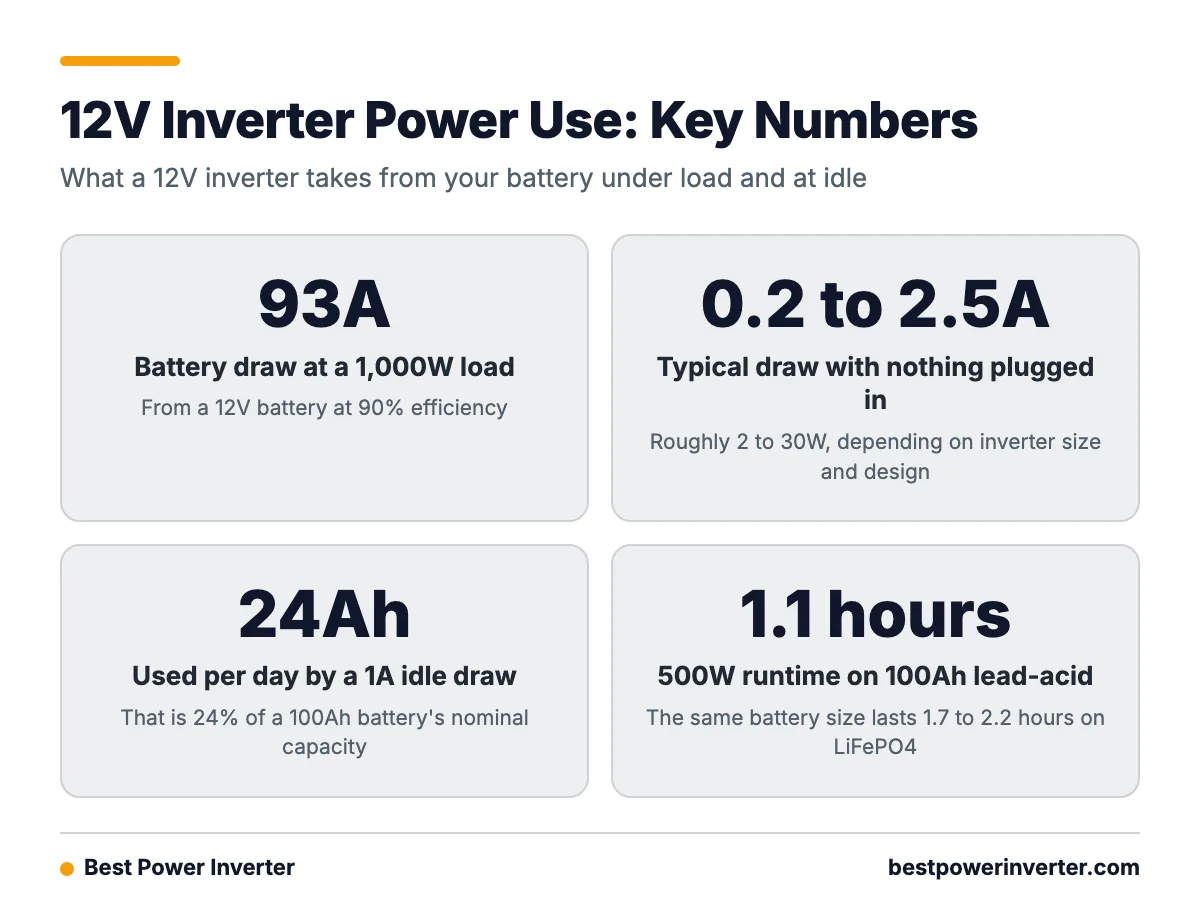
The power a 12V inverter uses equals the load you plug in plus its conversion losses, so DC amps are roughly AC watts ÷ (12 × efficiency), or about 93A for a 1,000W load at 90% efficiency. With nothing plugged in, it still typically draws about 0.2-2.5A (roughly 2-30W), depending on its size and design. The tables below show what that means for your battery, cables and runtime.
Quick answer
Your inverter uses what the load demands plus losses, not its full rating. Work out battery draw with amps = AC watts ÷ (12 × efficiency). Count idle draw too, because 1A left running uses 24Ah a day.
- An inverter’s watt rating is its limit, not its constant use.
- A 1,000W load pulls about 93A from a 12V battery at 90% efficiency.
- A 1A idle draw uses 24% of a 100Ah battery’s nominal capacity every day.
- Equal watts take about the same battery current on 120V and 240V models.
- A 100Ah battery holds about 600Wh usable as lead-acid and 960-1,200Wh as LiFePO4.
- How many amps does a 12V inverter draw?
- Does a 2,000W inverter use 2,000W all the time?
- How much power does it use with nothing plugged in?
- How does a 12V inverter work, and where is energy lost?
- Does a 12V to 240V inverter use more power?
- What can a 12-volt inverter power?
- How long will a 100Ah battery run a 12V inverter?
- Cables, fuses and charging
- What to look for on a spec sheet
- How can you cut inverter power use?
- Frequently Asked Questions
How many amps does a 12V inverter draw at 300W, 500W, 1,000W, 2,000W and 3,000W?
At 90% efficiency, expect about 28A at 300W, 46A at 500W, 93A at 1,000W, 185A at 2,000W and 278A at 3,000W. These figures come from the standard inverter current formula: DC amps ≈ AC watts ÷ (battery volts × efficiency). Efficiency is the share of battery power that reaches your appliance.
| AC load | 85% efficiency | 90% efficiency | 94% efficiency |
|---|---|---|---|
| 100W | 9.8A | 9.3A | 8.9A |
| 300W | 29.4A | 27.8A | 26.6A |
| 500W | 49.0A | 46.3A | 44.3A |
| 1,000W | 98.0A | 92.6A | 88.7A |
| 2,000W | 196.1A | 185.2A | 177.3A |
| 3,000W | 294.1A | 277.8A | 266.0A |
Each amp figure is also the Ah (amp-hours, a measure of battery charge) used per hour. So 46.3A uses 46.3Ah in one hour.
Battery voltage changes the answer. At 11V, the same 1,000W load at 90% efficiency pulls about 101A (1,000 ÷ (11 × 0.9)). Current rises as the battery runs down.
Does a 2,000W inverter use 2,000W all the time?
No. A 2,000W inverter running a 100W TV pulls about 9.3A at 90% efficiency, not the 185A of a full 2,000W load. Large inverters lose efficiency at small loads, so the real figure will be a little higher.
Three numbers get mixed up:
- Continuous rating: the most power the inverter can supply without stopping.
- Surge rating: a higher limit for a brief moment. Fridge compressors and pumps need this when they start.
- Actual use: your load, plus losses, plus the inverter’s own running power.
Only the last number drains your battery. Still, a bigger inverter is not free. It usually has a higher idle draw, which leads to the cost most people miss.

How much power does a 12V inverter use with nothing plugged in?
Typical no-load draw is about 0.2-2.5A at 12V, or roughly 2-30W. This is a general range, and larger inverters tend to sit at the higher end. Your model’s data sheet has the real figure. Cooling fans, displays and heavy transformers can all push it up.
That small number adds up. This table uses 50Ah usable for a 100Ah lead-acid battery (50% depth of discharge, meaning the share of capacity you take out) and 80Ah for LiFePO4, the cautious end of its usual 80-100%.
| Idle draw | Time | Ah used | % of usable lead-acid | % of usable LiFePO4 |
|---|---|---|---|---|
| 0.3A | 8 hours | 2.4Ah | 4.8% | 3% |
| 0.3A | 24 hours | 7.2Ah | 14.4% | 9% |
| 0.3A | 7 days | 50.4Ah | 101% | 63% |
| 1A | 8 hours | 8Ah | 16% | 10% |
| 1A | 24 hours | 24Ah | 48% | 30% |
| 1A | 7 days | 168Ah | 336% | 210% |
| 2.5A | 8 hours | 20Ah | 40% | 25% |
| 2.5A | 24 hours | 60Ah | 120% | 75% |
| 2.5A | 7 days | 420Ah | 840% | 525% |
Anything over 100% means the battery hits its limit before that time is up, unless charging replaces the energy.
Why does efficiency fall at very light loads?
Idle draw stays roughly the same however small the load is. Say a 10W phone charger runs on an inverter with a 1A idle draw (about 12W). The battery supplies about 22W, so only around 45% reaches the charger. With a 2.5A idle draw (30W), that falls to 25%.
The 85-95% peak efficiency often quoted for inverters applies only at the better part of the load range. Check the efficiency curve, or use an inverter efficiency calculator with your own measured watts.
How does a 12V inverter work, and where is energy lost?
The inverter switches 12V DC on and off very fast, steps the voltage up, then shapes it into AC. Each stage turns some energy into heat:
- Switching: transistors, which are electronic switches, warm up as they chop the DC.
- Voltage step-up: the transformer raises the voltage and loses some energy in its windings and core.
- AC output: filters smooth the power into a usable 50Hz or 60Hz wave.
- Support circuits: the control board, display and fan use power even at idle.
High current makes the heat worse, which is why 12V systems lose more in their wiring than higher-voltage ones at the same watts.
Does a 12V to 240V inverter use more power than a 12V to 120V inverter?
No. If efficiency is equal, both pull about the same battery current for the same watts. Output voltage only changes the current on the AC side.
| 1,000W load at 90% efficiency | AC-side current | Battery-side current |
|---|---|---|
| 120V output | 8.3A | About 93A |
| 240V output | 4.2A | About 93A |
Readers in the UK, EU and Australia should buy a 230-240V, 50Hz model. North American readers need 120V, 60Hz. Efficiency varies between models, so compare data sheets rather than output voltages.
What can a 12-volt inverter power at common sizes?
Small inverters suit electronics, while kettles and microwaves need 1,000W or more and a large battery. Check each appliance’s label for its input watts, because a microwave’s cooking power is lower than what it draws.
| Inverter size | Typical uses | Full-load draw at 90% | Connection |
|---|---|---|---|
| 100-150W | Phone, laptop, small fan | 9-14A | 12V socket |
| 300W | Laptop, TV, tool battery charger | 28A | Direct to battery |
| 500W | Several electronics at once, small fridge if surge allows | 46A | Direct to battery |
| 1,000W | Small microwave, coffee maker, some power tools | 93A | Direct to battery |
| 2,000W | Larger microwave, hair dryer, bigger tools | 185A | Direct to battery |
| 3,000W | 3kW kettle, heavy loads | 278A | Direct to battery |
Vehicle 12V accessory sockets are commonly fused at 10-15A. That limits output to about 100-150W in practice, whatever the inverter’s rating says.
If your biggest load is under 150W: use a small socket inverter, or a 12V charger if one exists.
If it is 150W to 2,000W: fit an inverter about 25% above that load, wired directly to the battery. Check that its surge rating covers any motor.
If it is over 2,000W: most readers should move to a 24V or 48V system. Doubling the voltage halves the current.
How long will a 100Ah battery run a 12V inverter?
A 100Ah battery runs a 500W load for about 1.1 hours on lead-acid and 1.7-2.2 hours on LiFePO4. The battery stores a nominal 1,200Wh, but you cannot use it all. Lead-acid is commonly limited to about 50% for longer life (600Wh), while LiFePO4 can commonly use 80-100%.
The math: usable Wh × 0.9 efficiency ÷ load watts.
| Load | Lead-acid (600Wh) | LiFePO4 at 80% (960Wh) | LiFePO4 at 100% (1,200Wh) |
|---|---|---|---|
| 100W | 5.4 hours | 8.6 hours | 10.8 hours |
| 300W | 1.8 hours | 2.9 hours | 3.6 hours |
| 500W | 1.1 hours | 1.7 hours | 2.2 hours |
| 1,000W | 32 minutes | 52 minutes | 65 minutes |
Treat the lead-acid column as a best case. Lead-acid capacity shrinks at high current, a point covered in this introduction to battery capacity and discharge. Many are rated over 20 hours, which means a gentle 5A on a 100Ah battery. Pulling 93A will deliver far less. On LiFePO4, check the battery’s maximum continuous discharge current before running big loads.
Worked example
A van owner runs a 60W laptop for 5 hours and a fridge averaging 100W for 24 hours. The inverter is 90% efficient, draws 1A at idle and stays on all day.
| Energy use | Calculation | Wh | Ah at 12V |
|---|---|---|---|
| Appliances | (60 × 5) + (100 × 24) | 2,700 | 225 |
| Conversion loss | (2,700 ÷ 0.9) − 2,700 | 300 | 25 |
| Standby loss | 1A × 24h × 12V | 288 | 24 |
| Total | 3,288 | 274 |
Losses make up 18% of the total. With no charging, this day needs six 100Ah lead-acid batteries (3,288 ÷ 600 = 5.5) or four LiFePO4 at 80% (3,288 ÷ 960 = 3.4). The estimate is cautious, since an efficiency figure may already include some idle power.
What does high current mean for cables, fuses and charging?
High current needs thick, short cables and a fuse close to the battery. Take a cable run with 0.01 ohms of total resistance, used here as an example. At 93A it drops 0.93V (93 × 0.01) and wastes about 86W as heat (93² × 0.01). That voltage drop can also trigger the inverter’s low-voltage cutoff.
Use the cable and fuse sizes in your inverter’s manual. A fuse protects the cable, so an undersized cable with a large fuse is a fire risk.

Charging has to keep up as well. Replacing the 274Ah from the worked example would take a 30A charger over 9 hours, before charging losses.
What to look for on a spec sheet
Compare these items on any listing, such as this Victron Phoenix 12/1200 product page:
- No-load current: your 24-hour cost. If it is listed in watts, divide by 12.
- Power-save draw: the lower figure when the inverter sleeps between checks for a load.
- Efficiency curve: shows light-load losses that a single peak figure hides.
- Continuous rating: should sit above your largest steady load.
- Surge rating: should cover motor starts.
- Input voltage range: tells you when low battery voltage will shut it down.
- Recommended fuse and cable size: if these are missing, ask the seller before buying.
How can you cut inverter power use?
Switch the inverter off when nothing needs AC power. That is the biggest saving on most small systems.
- Use power-save mode if your loads can wake it. Very small loads may not.
- Avoid oversizing. A smaller inverter usually idles lower.
- Group your AC jobs so the inverter runs for one block of time.
- Run 12V devices directly. In the worked example, a 12V fridge with the same 100W average, plus an inverter on only for the laptop, cuts the day to about 2,793Wh. That saves 495Wh, or 15%.
Frequently Asked Questions
How much power does a 12V to 240V inverter use?
It uses the same battery power as a 120V model for equal watts and efficiency. A 1,000W load takes about 93A from the battery at 90% efficiency, while the 240V side carries only about 4.2A.
Does an inverter use power when it is switched on but not running anything?
Yes. Typical no-load draw is about 0.2-2.5A at 12V. A 1A draw uses 24Ah per day, or about 288Wh.
Does an inverter use power when it is switched off but still connected to the battery?
Usually very little, but it depends on the design. Some models keep a soft switch, remote panel or display circuit alive. The manual may list this figure. A battery disconnect switch stops the draw completely.
Can I leave a 12V inverter connected or on all the time without draining my battery?
Only if charging replaces what it uses. Without solar or another charger, even a 0.3A idle draw will use 50.4Ah in 7 days, which is the full usable capacity of a 100Ah lead-acid battery. Switch it off when you do not need it, especially during storage.
Sources
- https://courses.edraak.org/asset-v1:DelftX+SE-Pt2+2016+type@asset+block@Batteries_I_-_Introduction.pdf
- https://www.offgridtec.com/en/victron-phoenix-inverter-12-1200-230v-ve.direct-1000w-12v-schuko.html
- https://www.zerdly.com/tools/inverter-efficiency-calculator/
- https://calculator.academy/inverter-current-calculator/