
Sizing an inverter by AC watts and sizing it by battery amps are two separate jobs. Skipping the second one is how people melt cables. Pick an inverter whose continuous rating is at least 20% above your running watts, then use DC amps = AC watts ÷ (battery volts × efficiency) to size the battery side. This guide shows the math with real examples.
Quick answer
Add up running watts, add 20%, and check that the surge rating covers motor startup. Then divide AC watts by battery volts times efficiency to get DC amps for cables and fuses.
- Best for TVs and inkjet printers: 150-300W on 12 volts
- Best for pumps and drills: pure sine wave, 1,500-2,000W with surge
- Best for 3,000W and up: 24V or 48V system
- Inverter size is measured in AC watts. Battery draw is measured in DC amps. You must work out both.
- At 90% efficiency, a 4,000-watt load pulls about 370 amps at 12V, 185 amps at 24V, and 93 amps at 48V.
- Motors such as sump pumps and mini fridges need two to three times their running watts for a moment at startup.
- A 5,000-watt-hour battery tells you how long power lasts. It does not tell you what inverter to buy.
- A car outlet usually cannot support more than about 150 watts. Larger inverters must connect straight to the battery.
- Fuse and cable size come from DC amps, not from the AC outlet rating.
- Running Watts vs. Startup Watts
- The Inverter Amperage Formula
- How Big of a Power Drain Is an Inverter?
- What Size Inverter Do You Need for Common Appliances?
- Is a 4,000-Watt Inverter Practical on 12 Volts?
- How Much Power Does a 48-Volt Inverter Draw?
- What Size Inverter Do I Need for a 5,000-Watt-Hour Battery?
- How Big of a Power Inverter Can My Truck Handle?
- Cable, Fuse, and Ventilation Rules
- Should You Choose a Pure Sine Wave Inverter?
- Vehicle and Installation Checklist
- What Do Owners Say?
- Frequently Asked Questions
Running Watts vs. Startup Watts
Running watts are what a device uses while it works. Startup watts, also called surge or peak watts, are the short burst a device needs to get going. Inverter sizing must account for both the continuous output and the brief surge, especially for motor loads.
A TV has almost no surge. It draws about the same power from the moment it turns on. A sump pump or a mini fridge is different. The motor needs a large jolt to start turning. That jolt can be two to three times the running number for a fraction of a second.
Every inverter has two ratings. The continuous rating is what it can hold for hours. The surge rating is what it can deliver for a moment. Do not mix them up. Eaton’s owner’s manual for PowerVerter inverters tells users not to exceed the maximum continuous-watt rating. Treat the continuous number as the real size of the inverter.
The 20% margin rule
A practical starting method is to total the running watts of everything that will run at the same time, then add 20%. The Battery Tender inverter sizing guide uses the same idea. The margin keeps the inverter from running at its limit, which means less heat and fewer shutdowns.
Example: a 400-watt TV setup plus a 100-watt fridge is 500 watts. Add 20% and you get 600 watts. Then check that the surge rating covers the fridge motor starting.
The Inverter Amperage Formula
The formula is simple. Inverter losses mean the battery must supply more power than the inverter delivers. Estimated DC current is DC input power divided by DC voltage.
At 12 volts and 90% efficiency, the bottom of the formula is 12 × 0.9 = 10.8. At 24 volts it is 21.6. At 48 volts it is 43.2. Divide your watts by that number and you have the battery current.
Worked examples at 12 volts
- 32-inch TV, 50 watts: 50 ÷ 10.8 = about 4.6 amps.
- Mini fridge, 100 watts running: 100 ÷ 10.8 = about 9.3 amps. At a 300-watt startup, 300 ÷ 10.8 = about 28 amps for a moment.
- Corded drill, 600 watts: 600 ÷ 10.8 = about 56 amps. At a 1,200-watt startup, about 111 amps.
- 1/3 HP sump pump, 800 watts: 800 ÷ 10.8 = about 74 amps. At a 2,400-watt startup, about 222 amps.
Notice how fast the numbers climb. A drill that looks small on paper pulls more than 50 amps from the battery.
How Big of a Power Drain Is an Inverter?
An inverter drains a battery in two ways: the load it feeds, and its own idle draw. Even with nothing plugged in, an inverter that is switched on uses some power to stay ready.
Idle draw varies by model, so read the no-load current on the spec sheet. As a simple example, an inverter that idles at 1 amp on a 12-volt battery uses 12 watts. Over 24 hours that is 288 watt-hours. That is real energy, and it adds up on a small battery or an RV that sits for days.
The second drain is efficiency loss. At 90% efficiency, about 10% of the battery power turns into heat. A 1,000-watt load takes roughly 1,111 watts from the battery. Turn the inverter off when you are not using it.
What Size Inverter Do You Need for Common Appliances?
The table below uses typical numbers. The startup column is an estimate. The DC amps column assumes 12 volts and 90% efficiency, using running watts.
| Appliance | Running watts (typical) | Estimated startup watts | Suggested continuous inverter size | Approx. 12V DC amps (running) |
|---|---|---|---|---|
| 32-inch TV | 50 | 50 | 150-300W | 4.6 |
| Inkjet printer | 30 | 60 | 150-300W | 2.8 |
| Laser printer (while heating) | 600 | 1,000 | 1,500W | 55.6 |
| Mini fridge | 100 | 300 | 600W | 9.3 |
| Corded drill | 600 | 1,200 | 1,500W | 55.6 |
| 1/3 HP sump pump | 800 | 2,400 | 2,000W with 2,400W+ surge | 74.1 |
| 1/2 HP sump pump | 1,000 | 3,000 | 3,000W | 92.6 |
How big power inverter to run a sump pump?
For a 1/3 HP pump, plan on a 2,000-watt pure sine wave inverter with a surge rating of at least 2,400 watts. For a 1/2 HP pump, move up to 3,000 watts. The running load is only 800 to 1,000 watts, but the startup is what trips smaller units.
Check the pump’s nameplate first. Some pumps list amps instead of watts. Multiply amps by 120 volts to get watts. A pump that is rated at 7 amps is about 840 watts.
At 12 volts, a 1/3 HP pump draws about 74 amps running and over 200 amps at startup. That is why many outage setups for pumps use 24V or 48V batteries.
How big an inverter to power a 32 TV?
A 150 to 300-watt inverter is plenty. Most 32-inch TVs use somewhere around 30 to 60 watts, based on typical manufacturer ratings. Add a streaming box or game console and the total may reach 100 to 200 watts. Check the label on the back.
How big an inverter to power a printer?
An inkjet printer works fine on a 150 to 300-watt inverter. A laser printer is different. Its fuser heats up and can pull several hundred watts for short periods. Size a laser printer setup at 1,500 watts and use pure sine wave output.
How big power inverter to run a drill?
A corded drill pulls most of its power under load. A mid-size corded drill can use around 600 watts, with a higher peak when the motor starts or binds. A 1,500-watt inverter covers most drills. Cordless drill chargers are far smaller, so a 300-watt inverter handles them.
Mini fridge sizing
A mini fridge uses little power on average, but the compressor kicks on and off. Choose a 600-watt pure sine wave inverter. The compressor startup is the part that can shut down a tiny inverter.
From the Shop
A common pattern in owner reports: someone buys a 300-watt inverter for a mini fridge because the label says 100 watts. The fridge runs for a while, then the inverter beeps and shuts off each time the compressor starts. The label showed running watts, and the startup surge was never counted. Moving to a 600-watt pure sine wave unit normally clears it up.

Is a 4,000-Watt Inverter Practical on 12 Volts?
Rarely. A 4,000-watt inverter on a 12-volt system needs about 370 amps at full load. That demands huge cables, a very large fuse, and a battery bank that can deliver that current without sagging.
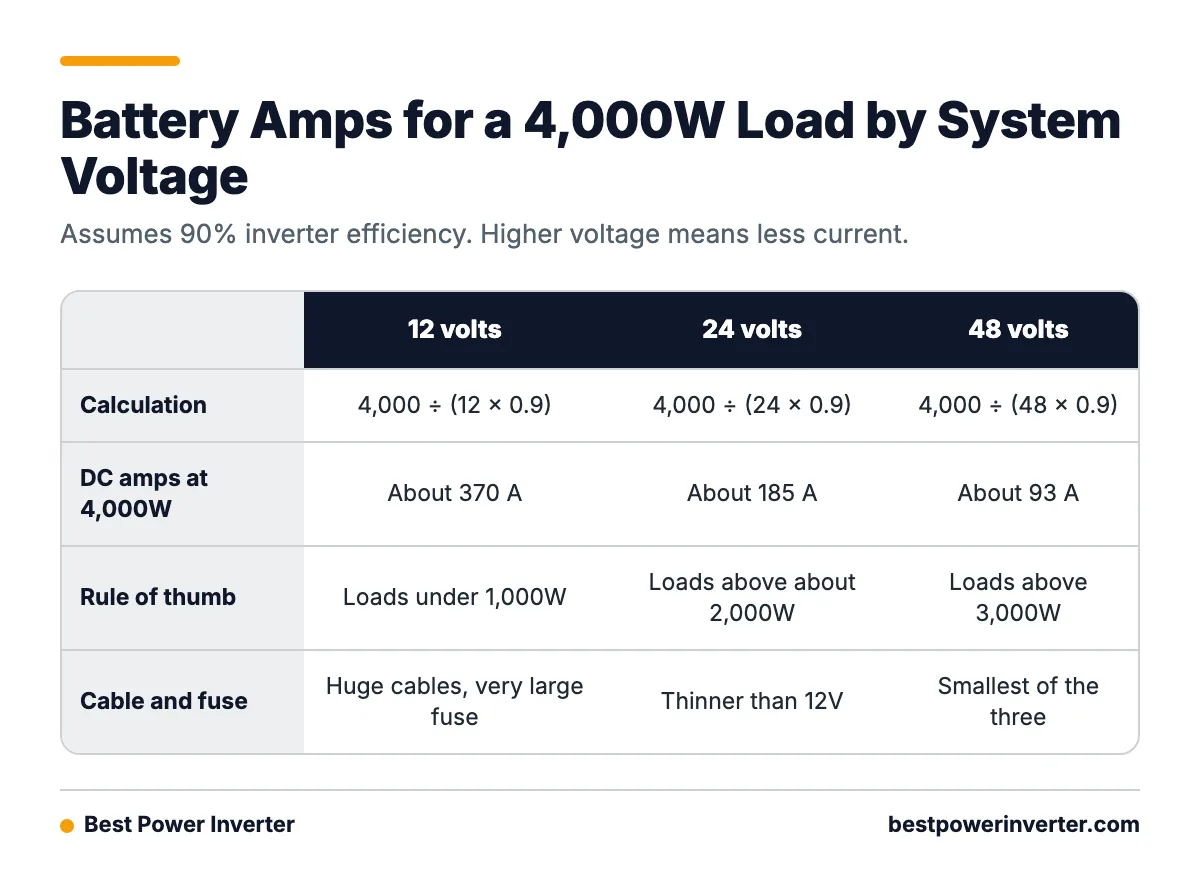
Here is the same 4,000-watt load at three battery voltages, using an assumed 90% efficiency.
| System voltage | Calculation | DC amps at 4,000W |
|---|---|---|
| 12 volts | 4,000 ÷ (12 × 0.9) | about 370 A |
| 24 volts | 4,000 ÷ (24 × 0.9) | about 185 A |
| 48 volts | 4,000 ÷ (48 × 0.9) | about 93 A |
Double the voltage and the current is cut in half. Less current means thinner cable, smaller fuses, less heat, and less voltage drop. Most installers move to 24V once loads pass about 2,000 watts, and to 48V above 3,000 watts. These are common rules of thumb, not strict limits.
Peak versus continuous on big units
When you read a listing for a 2,000-watt Renogy P2 or any 4,000-watt unit, find two numbers: continuous watts and surge watts. A unit sold as 4,000W peak may only deliver 2,000W continuous. Size by the continuous number. Then check the DC input specs for the required cable and fuse sizes.
If your largest load is under 1,000W: a 12V system is fine.
If your loads run 1,000-2,500W: consider 24V, or a very well-wired 12V system.
If your loads run above 3,000W: go with 48V.
If the load is a motor: choose pure sine wave and check the surge rating.
How Much Power Does a 48-Volt Inverter Draw?
A 48-volt inverter draws its AC load in watts divided by 43.2 at 90% efficiency. That is about 23 amps per 1,000 watts. The same load pulls 4 times that current from a 12-volt battery.
| AC load | 48V DC amps | 24V DC amps | 12V DC amps |
|---|---|---|---|
| 1,000W | 23.1 | 46.3 | 92.6 |
| 2,000W | 46.3 | 92.6 | 185.2 |
| 3,000W | 69.4 | 138.9 | 277.8 |
| 5,000W | 115.7 | 231.5 | 462.9 |
Higher voltage does not save energy. The watts are the same. It just moves the same power with less current, which is easier on wire and connections.
What Size Inverter Do I Need for a 5,000-Watt-Hour Battery?
The battery does not decide the inverter size. Your loads do. A 5,000-watt-hour battery stores energy. The inverter must still be sized for the running and startup watts of whatever you plug in.
Think of the battery as a fuel tank and the inverter as the engine size. A big tank does not need a big engine. Most people pair a 5,000Wh battery with a 2,000 to 3,000-watt inverter. A 5,000-watt inverter would empty the same battery in under an hour at full load.
Runtime math
Runtime = battery watt-hours × usable fraction × inverter efficiency ÷ load watts. Say the battery allows 80% usable capacity. That is a common assumption for lithium, so check your battery’s specs. Then:
- 5,000 × 0.80 × 0.90 = 3,600 watt-hours available at the outlet.
- At a 400-watt load, that is 9 hours.
- At a 1,200-watt load, that is 3 hours.
For battery size in amp-hours, divide watt-hours by volts. A 5,000Wh battery is about 417Ah at 12V, 208Ah at 24V, or 104Ah at 48V. The Briggs and Stratton battery sizing article covers how to match storage to your loads.
How Big of a Power Inverter Can My Truck Handle?
Through the cigarette lighter or accessory outlet, expect about 150 watts. Wired directly to the battery, a truck can usually support 1,000 to 2,000 watts with the engine running. The limit depends on your alternator and your wiring.
Vehicle outlets are commonly fused at 10 to 15 amps. At 12 volts, that is only 120 to 180 watts of DC power. A 300-watt inverter would blow that fuse at full load.
How big of power inverter for 12v car?
For a standard 12-volt car, a 150 to 300-watt inverter plugged into the outlet charges laptops and phones. A 400 to 1,000-watt inverter works if you clamp or wire it to the battery. Beyond that, a car alternator and a small starting battery are strained.
Alternator and battery limits
The alternator makes the power while the engine runs. Many vehicles have alternators in the range of about 100 to 200 amps, but the car also needs power for its own systems. Look at the alternator label or your owner’s manual.
Here is a simple rule. Take the inverter’s DC amps at full load. Make sure that number stays well below the alternator’s spare capacity. A 1,500-watt load takes about 139 amps at 12V. That can use most of a smaller alternator.
A starting battery is not built for deep discharge. Running a large inverter with the engine off can leave you unable to start the truck. For long use, add a separate deep-cycle battery.

Cable, Fuse, and Ventilation Rules
Wire is where large inverters fail. High current heats thin cable, drops voltage, and can cause the inverter to shut down on low voltage. Many owners of big inverters report unclear guidance on cable and fuse sizes, so look it up before you buy.
- Fuse: Put a fuse close to the battery. A common practice is to size it about 125% of the inverter’s maximum continuous DC current. At 370 amps, that points to a fuse of roughly 450-500 amps. Follow the manufacturer’s manual if it differs.
- Cable: The cable must carry the full DC current with little voltage drop. For a 4,000-watt load at 12 volts, installers often use 4/0 AWG or larger cable, sometimes in parallel runs. Keep the cable as short as you can.
- Voltage drop: Long, thin cable wastes power as heat. Even a small drop at 12 volts is a large share of the battery’s voltage.
- Ventilation: Inverters make heat, and temperature derating can reduce the usable continuous output. Leave space around the unit and keep it out of hot, closed compartments.
- Connections: Use crimped lugs and tight terminals. Loose joints heat up quickly at high amps.
Should You Choose a Pure Sine Wave Inverter?
For motors, refrigerators, pumps, printers, and sensitive electronics, yes. Pure sine wave output matches household power. Appliances run cooler, quieter, and more reliably.
Modified sine wave inverters cost less. They can run simple loads such as basic heaters or older lights. But motors can hum and run hotter on them, and some electronics will not work at all. Check your appliance manual before you pick one. For a sump pump or a fridge, spend the extra money.
Vehicle and Installation Checklist
- List every device that runs at the same time and total the running watts.
- Add 20% to that total for a continuous-rating target.
- Find the largest startup surge and confirm the inverter’s surge rating covers it.
- Calculate DC amps with AC watts ÷ (battery volts × efficiency).
- Confirm the alternator has spare capacity above that DC current.
- Check the battery’s age and condition. A weak battery causes low-voltage shutdowns.
- Choose a fuse and cable size from the DC amps and the manufacturer’s manual.
- Pick a ventilated mounting spot, away from heat and moisture.
- Choose pure sine wave for motors and electronics.
- Check the idle draw, and switch the unit off when not in use.
What do owners say?
Owner reports on some Renogy 3,000-watt P2 units show the same split seen with many large inverters.
Owners like
- Reliable operation for some RVs, trailers, cabins, and off-grid setups
- High AC output capacity
- Quiet operation
- Compatibility with solar-power systems
- Pass-through operation is described positively by some owners
Common complaints
- Unexpected shutdowns during overload or demanding use
- Premature failures reported by some owners
- Wiring concerns and insufficient installation guidance
- Unclear recommended cable and fuse sizes
- Mixed customer-service experiences
Summarised from owner reviews and long-term user reports; individual experiences vary.
Frequently Asked Questions
How big power inverter to run sump pump?
Use a 2,000-watt pure sine wave inverter for a 1/3 HP pump and 3,000 watts for a 1/2 HP pump. The surge rating must cover the startup, which can be 2,400 to 3,000 watts. Check the pump nameplate for exact numbers.
48 volt power inverter: how much does it draw?
At 90% efficiency, it draws about 23 amps per 1,000 watts of AC load. A 4,000-watt load pulls about 93 amps. That is one quarter of the current a 12-volt system would need.
How big of a power drain is an inverter?
An inverter uses its load plus losses and idle draw. Efficiency losses are around 10% at 90% efficiency. Idle draw is listed on the spec sheet, and a 1-amp idle on 12 volts uses about 288 watt-hours a day. Switch it off when idle.
How big power inverter for 5000w battery?
If you mean a 5,000-watt-hour battery, choose the inverter by your loads, not the battery. A 2,000 to 3,000-watt inverter suits most uses. At 80% usable capacity and 90% efficiency, the battery delivers about 3,600 watt-hours to the outlet.
How big an inverter to power a 32 tv?
A 150 to 300-watt inverter is enough. A 32-inch TV typically uses roughly 30 to 60 watts and draws about 4.6 amps from a 12-volt battery at 50 watts.
How big of a power inverter can my truck handle?
Through the outlet, about 150 watts. Wired to the battery with the engine running, 1,000 to 2,000 watts is typical, depending on alternator spare capacity and cable size. Check your alternator rating first.
4000 watt power inverter: is it practical on 12 volts?
Only with very heavy cable, a large fuse, and a strong battery bank, because it needs about 370 amps. A 24-volt system halves that to about 185 amps, and a 48-volt system cuts it to about 93 amps.
How big inverter to power printer?
Use 150 to 300 watts for an inkjet. Use about 1,500 watts for a laser printer, since the heating element can pull several hundred watts at once.
How big of power inverter for 12v car?
Use 150 to 300 watts in the outlet for phones and laptops. Use 400 to 1,000 watts wired to the battery for larger items, and keep the engine running.
How big power inverter to run drill?
A 1,500-watt inverter handles most corded drills, which can draw around 600 watts with a higher startup peak. Check the tool’s label for its rating.
Sources