
Shoppers who search “AC inverter DC inverter” usually want one of two things: a power inverter for a car, RV or solar battery, or an inverter air conditioner. A power inverter turns DC from a battery or solar panel into AC for household appliances. The reverse job, AC to DC, belongs to a rectifier or charger. In air conditioners, both “AC inverter” and “DC inverter” units change their speed, but the DC inverter type uses a more efficient brushless motor in its compressor.
Quick answer
An inverter changes DC into AC. To go from AC to DC, you need a charger or rectifier, or an inverter-charger that works both ways. For air conditioners, a DC inverter model is the better pick for most homes because its motor wastes less power.
- Best for car, RV or solar batteries: a pure sine wave DC-to-AC inverter, which is safe for motors and electronics.
- Best for backup that recharges from the wall: an inverter-charger or hybrid inverter.
- Best for daily cooling: a DC inverter air conditioner, because it costs less to run.
- Inverters convert DC to AC. Chargers and rectifiers convert AC to DC. Inverter-chargers do both.
- Both kinds of inverter air conditioner turn mains AC into DC inside, then invert it to drive the compressor. The real difference is the motor.
- DC inverter air conditioners use brushless or permanent-magnet motors. These generally use less electricity than the induction motors in AC inverter units, especially at part load.
- Battery current is roughly load watts ÷ battery volts ÷ efficiency. A 1,000 W load on 12 V pulls about 93 A.
- Pick pure sine wave output for motors, compressors and electronics.
- Why does this keyword mean two different things?
- What are AC and DC power?
- Does an inverter convert AC to DC or DC to AC?
- How does a DC to AC inverter work, step by step?
- Pure sine wave vs modified sine wave: which do I need?
- What size power inverter do I need, and how much current will it draw?
- What is the difference between an AC inverter and a DC inverter air conditioner?
- AC inverter vs DC inverter: which is better?
- Can you run an inverter air conditioner from a power inverter?
- Safety and buyer checklist
- Frequently Asked Questions
Why does this keyword mean two different things?
The same words are used for two separate kinds of product. With power gear, an “inverter” is a box that turns battery power into household power. With air conditioners, “inverter” means the compressor speeds up and slows down instead of switching fully on and off.
There is one more twist. In “AC inverter”, the letters “AC” can mean air conditioner, not alternating current. Some listings use “AC inverter” to mean any inverter air conditioner. Read the full product name and the motor details before you compare prices.
What are AC and DC power?
DC (direct current) flows in one direction at a steady voltage. Batteries, solar panels and USB ports all give DC. AC (alternating current) flips direction back and forth many times every second. Your wall sockets give AC.
Grid power is not the same everywhere:
- North America: 120 V at 60 Hz.
- UK, EU and much of Asia and Africa: 230 V at 50 Hz.
Hz (hertz) is how many full back-and-forth cycles happen each second. A power inverter must match your local voltage and frequency. A 120 V, 60 Hz inverter will not run a 230 V, 50 Hz appliance properly, so check this first.
Does an inverter convert AC to DC or DC to AC?
An inverter converts DC to AC. That is what the word means. Changing DC into AC is called inversion. Changing AC into DC is called rectification, and a different device does that job.
Can an inverter convert AC to DC?
A plain inverter cannot. If you need DC from a wall socket, use one of these instead:
- Rectifier: the basic part that turns AC into DC. One sits inside every phone charger and laptop power brick.
- Battery charger: a rectifier plus control circuits that charge a battery safely.
- RV converter: in the RV world, the “converter” is the box that turns campground AC into 12 V DC for lights and the house battery.
- Inverter-charger or hybrid inverter: one unit that works both ways.
| Device | Direction | Typical use | Example |
|---|---|---|---|
| DC-to-AC power inverter | DC → AC | Running household devices from a battery | Laptop or fridge powered from a car or RV battery |
| Rectifier / battery charger | AC → DC | Charging batteries or powering DC devices from the grid | Wall charger topping up a 12 V battery |
| Inverter-charger | Both ways | Backup power that refills itself | Home backup that charges from the grid and inverts when power cuts out |
| Hybrid inverter | Both ways, plus solar input | Solar with battery storage | Solar panels, batteries and grid in one system |
What does “AC/DC inverter” mean compared with a plain inverter?
“AC/DC inverter” usually means an inverter-charger. When grid or shore power is present, it charges the battery and passes AC straight through to your sockets. When the grid drops, it switches to running your loads from the battery. A hybrid inverter adds a solar charge controller, often an MPPT type, which squeezes the most power from your panels.
A plain inverter works in one direction only. If you only want to run a laptop from a car battery, a plain inverter is all you need. If you want backup power that recharges itself from the wall, buy an inverter-charger.
How does a DC to AC inverter work, step by step?
An inverter chops steady DC into fast pulses, raises the voltage, then smooths the pulses into an AC wave. Here is the path:
- DC input: power comes in from a 12 V, 24 V or 48 V battery or solar bank.
- Switching stage: transistors called MOSFETs or IGBTs act as very fast electronic switches. They turn on and off thousands of times a second.
- Boost stage: a transformer or high-frequency boost circuit raises the low battery voltage up to 120 V or 230 V.
- Filter: the switches are timed with pulse-width modulation (changing how long each pulse lasts). A filter then smooths those pulses into a sine wave.
- AC output: the result is 120 V at 60 Hz or 230 V at 50 Hz, ready for your appliances.
Simple flow: Battery DC → switching stage → transformer/boost → filter → 120/230 V AC.

No inverter is perfect. Typical modern DC-to-AC inverters run at roughly 85-95% efficiency at moderate load. Efficiency drops at very light loads. The lost energy turns into heat, which is why inverters have fans and vents. A large inverter running just a phone charger wastes a bigger share of your battery than a small one would.
Pure sine wave vs modified sine wave: which DC-AC inverter do I need?
Most people should buy pure sine wave. It copies grid power closely and safely runs everything from fridges to laptops. Pure sine inverters usually have total harmonic distortion (THD) under about 3%. THD measures how far the wave strays from a smooth curve.
Modified sine wave output is a stepped copy of the real thing. It is cheaper. But it can make motors, compressors and some chargers run hotter or noisier.
| Waveform | Output shape | Good for | Avoid for |
|---|---|---|---|
| Pure sine | Smooth wave, low distortion | Everything, including compressors, pumps, medical gear and sensitive electronics | Nothing, apart from tight budgets |
| Modified sine | Stepped wave | Simple heaters, basic lights, short-term use | Fridges, air conditioners, motors, some battery chargers |
| Square wave | Blocky on/off wave | Very basic resistive loads | Almost all modern appliances |
You will also see inverters sorted by how they connect:
- Off-grid: runs from batteries only. This is common in vans, boats and cabins.
- Grid-tie: sends solar power into the grid. It is designed to shut off during a power cut, so it gives no backup on its own.
- Hybrid: handles solar, batteries and grid together, and can keep your loads running in an outage.
If you run anything with a motor, compressor or charger → choose pure sine.
If you only run a kettle or work light for short periods → modified sine can work, but pure sine is safer if you might add devices later.
If you want power during grid outages from solar → choose a hybrid inverter, not a grid-tie-only unit.
If you need to recharge from the wall → choose an inverter-charger.
What size DC-AC power inverter do I need, and how much current will it draw from my battery?
Size the inverter to the total watts of everything that runs at the same time, plus headroom. Then check the surge rating for motor start-up. Inverters list two numbers:
- Continuous watts: what it can supply all day.
- Surge watts: a short burst for starting motors. Many inverters list a surge of about 2× the continuous rating, for a few seconds or less.
Next, work out battery current. Use this formula: battery amps ≈ load watts ÷ battery volts ÷ efficiency.
Worked example
A camper wants to run a 1,000 W load. The inverter is about 90% efficient (0.9).
- On 12 V: 1,000 ÷ 12 ÷ 0.9 ≈ 93 A
- On 24 V: 1,000 ÷ 24 ÷ 0.9 ≈ 46 A
- On 48 V: 1,000 ÷ 48 ÷ 0.9 ≈ 23 A
Doubling the voltage halves the current. That matters because heat in a cable rises with the square of the current (heat = current² × resistance). Half the current means only a quarter of the heat in the same cable. This is why 24 V and 48 V systems can use much thinner cables, smaller fuses and cheaper connectors.
For runtime: a 100 Ah, 12 V battery feeding 93 A would last about one hour in theory, and less in practice. The inverter’s low-voltage cutoff will stop it earlier to protect the battery.
| Load | 12 V system | 24 V system | 48 V system |
|---|---|---|---|
| 500 W | ≈ 46 A | ≈ 23 A | ≈ 12 A |
| 1,000 W | ≈ 93 A | ≈ 46 A | ≈ 23 A |
| 2,000 W | ≈ 185 A | ≈ 93 A | ≈ 46 A |
All figures assume 90% inverter efficiency.
Here is a simple rule: if your 12 V current works out above about 150 A, move to a 24 V or 48 V battery bank. At that current, cables, fuses and connectors get thick and expensive. Always use the cable sizes in your inverter’s manual. Do not guess.
What is the difference between an AC inverter and a DC inverter air conditioner?
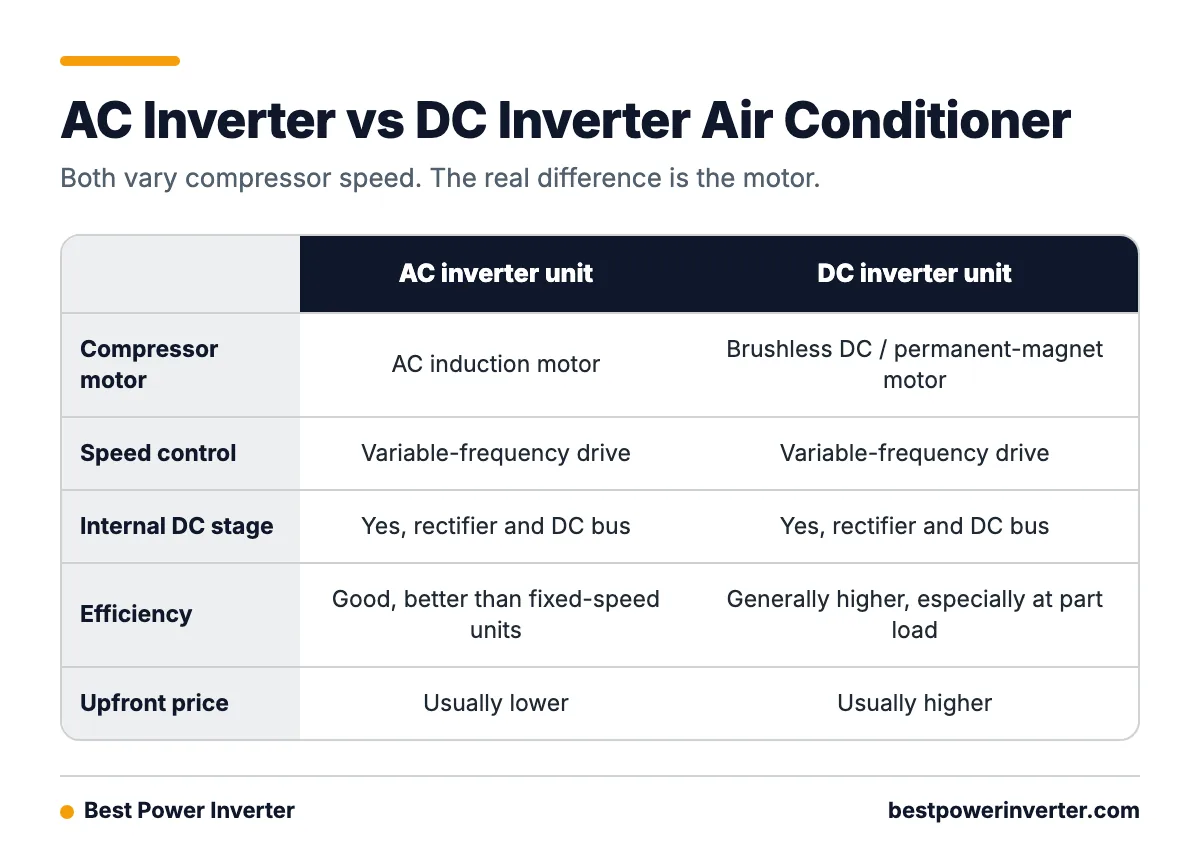
Both types use a variable-frequency drive to change compressor speed. The difference is the compressor motor. An “AC inverter” unit uses an AC induction motor. A “DC inverter” unit uses a brushless DC (BLDC) or permanent-magnet (PMSM) motor.
Many pages get one point wrong. The “AC inverter” type does not run on AC all the way through. Both types follow the same path:
Mains AC → rectifier → DC bus → inverter drive → compressor motor
The rectifier turns wall power into DC. The DC bus is a holding stage of steady DC voltage. The inverter drive then builds a new AC signal at whatever frequency the compressor needs. Higher frequency means a faster compressor and more cooling.
So why does the motor matter? An induction motor has to create a magnetic field in its spinning part (the rotor), and that uses some energy. A permanent-magnet motor has magnets built into the rotor, so it skips that cost. The gap is widest at part load, when the unit is just holding a cool room. That is where an air conditioner spends most of its hours.
| Feature | AC inverter unit | DC inverter unit |
|---|---|---|
| Compressor motor | AC induction motor | Brushless DC / permanent-magnet motor |
| Speed control | Variable-frequency drive | Variable-frequency drive |
| Internal DC stage | Yes (rectifier and DC bus) | Yes (rectifier and DC bus) |
| Efficiency | Good, and better than fixed-speed units | Generally higher, especially at part load |
| Running at low speed | Works, but with more motor losses | Tends to run smoothly and quietly at low speed |
| Upfront price | Usually lower | Usually higher |
| Where the labels are common | Both labels appear often in product listings in South and Southeast Asia, the Middle East and Africa | |
AC inverter vs DC inverter: which is better and which uses less electricity?
A DC inverter air conditioner is the better choice for most buyers, and it generally uses less electricity. If you cool a bedroom or living room for many hours a day, especially in a hot climate, the lower running cost adds up season after season.
Who should skip it: buyers cooling a room only a few weeks a year. In that case, the lower price of an AC inverter or fixed-speed unit may never be paid back by savings.
Real downsides: DC inverter units cost more upfront. They also depend on more electronics, so a failed control board or compressor can be costly to fix. Before you buy, check that local technicians service the brand. Also check how long the warranty covers the compressor and the outdoor control board.

This same “which is better” question has a simple answer for power inverters too. A pure sine wave inverter sized with headroom is the better buy. Cheap modified sine units save money at the till but limit what you can safely run.
Can you run an inverter air conditioner from a power inverter or solar?
It can work if you check five things first. Inverter air conditioners are among the friendlier loads for battery systems, because the compressor ramps up slowly instead of slamming on at full power.
- Pure sine output: the air conditioner’s drive electronics expect clean power. Do not use modified sine.
- Continuous rating: use the maximum input watts on the unit’s label, not the BTU cooling figure. Your inverter’s continuous rating should sit comfortably above that number.
- Surge: the soft start keeps surge modest, but the fans and electronics still add a little. A surge rating of about 2× continuous is plenty.
- Voltage and frequency: match the unit, either 120 V/60 Hz or 230 V/50 Hz.
- Battery current and capacity: run the numbers below.
Worked example
An air conditioner’s label lists 1,200 W maximum input. Adding 25% headroom gives 1,200 × 1.25 = 1,500 W, so the owner picks an inverter rated at 1,500 W continuous or more.
Battery current at full power and 90% efficiency:
- 12 V: 1,200 ÷ 12 ÷ 0.9 ≈ 111 A
- 48 V: 1,200 ÷ 48 ÷ 0.9 ≈ 28 A
For regular air conditioner use, a 48 V system is far easier to wire. Real draw drops once the room cools and the compressor slows, so check actual use with a plug-in energy meter before you size the battery bank.
Safety and installation: what should you check before you buy?
Use this checklist for any DC-to-AC power inverter:
- Direction: confirm you need DC to AC. For AC to DC, buy a charger. For both, buy an inverter-charger.
- Waveform: choose pure sine for motors, compressors and electronics.
- Continuous and surge rating: make sure both cover your loads with headroom.
- Input voltage match: a 12 V inverter goes on a 12 V battery. Never mix them.
- Low-voltage cutoff: a common setting for 12 V lead-acid systems is around 10.5 V, which protects the battery from over-draining. Lithium batteries need the settings from the battery maker.
- Certifications: in the US, look for UL 458 on vehicle and RV inverters, and UL 1741 on inverters that connect to solar or the grid.
- Fusing: fit a fuse or breaker close to the battery’s positive terminal, sized to the inverter manual.
- Cable gauge: follow the manual’s cable chart for your current and cable length. Thin cables overheat.
- Ventilation: give the inverter airflow, and keep lead-acid batteries in a vented space, since they can release hydrogen while charging.
- Home wiring: connecting an inverter to a house circuit needs a transfer switch and a licensed electrician.
Frequently Asked Questions
What is AC inverter and DC inverter?
For power gear, an inverter turns DC battery power into AC household power. For air conditioners, both labels describe variable-speed units. An “AC inverter” unit uses an induction compressor motor, and a “DC inverter” unit uses a brushless or permanent-magnet motor that is generally more efficient.
Does inverter convert AC to DC?
No. An inverter converts DC to AC. Turning AC into DC is called rectification, and it is done by a rectifier, battery charger or RV converter.
Can inverter convert AC to DC?
A plain inverter cannot. An inverter-charger or hybrid inverter can, because it contains both a charger (AC to DC) and an inverter (DC to AC) in one box.
How does a DC to AC inverter work?
Fast electronic switches chop battery DC into pulses. A transformer or boost stage raises the voltage. A filter then smooths the pulses into a 120 V/60 Hz or 230 V/50 Hz sine wave.
Which AC is best, inverter or DC inverter?
For most homes, a DC inverter air conditioner is best because it generally uses less electricity, especially at part load. Choose a cheaper AC inverter or fixed-speed unit only for rooms you rarely cool. Always compare the energy label ratings too.
AC DC inverter vs inverter: what is the difference?
An “AC/DC inverter” is usually an inverter-charger that works both ways. It charges the battery from grid power and inverts battery power when the grid fails. A plain inverter only turns DC into AC.