
Battery voltage is the DC voltage an inverter is built to receive from its battery bank, most often 12V, 24V, or 48V. Match the battery to the inverter’s full input range, not just the number on the label. If voltage drops below the inverter’s low-voltage cutoff, the inverter may reduce output or shut down.
Quick answer
Pick the battery voltage your inverter is rated for. Then confirm the battery’s full charged and empty voltages sit inside the inverter’s DC input window. Higher voltage means lower current for the same power.
- Best for small loads (up to about 1000W): 12V, simple and widely available
- Best for mid-size loads: 24V, half the current of 12V
- Best for home backup: 48V, lowest current and cable loss
- 12V, 24V, and 48V are system classes, not exact measured voltages.
- A 12V-class LiFePO4 battery can swing from about 10.0V to 14.6V.
- The inverter’s low-voltage cutoff and the battery’s safe discharge limit are two different numbers.
- At 1000W, ideal current is about 83A at 12V, 42A at 24V, and 21A at 48V.
- Runtime estimates must include usable capacity and inverter efficiency.
- What Is Battery Voltage in an Inverter?
- What Is a Battery Power Inverter?
- Does an Inverter Need a Battery to Work?
- Why Do Some Inverters Use 12V, 24V, or 48V Batteries?
- Nominal Voltage vs. Actual Battery Voltage
- What Is the Minimum Battery Voltage for an Inverter?
- What Happens When Battery Voltage Is Too Low?
- What Battery Voltage Does a 1000W, 2000W, or 3000W Inverter Need?
- Can You Connect a 12V Battery to a 24V Inverter?
- How to Calculate Inverter Runtime
- Compatibility Checklist
- Series and Parallel Wiring Safety
- Frequently Asked Questions
What Is Battery Voltage in an Inverter?
It is the DC input voltage the inverter needs from its batteries. The inverter converts that DC power into AC power for your appliances. A 24V inverter, for example, is designed for a 24V-class battery bank.
Two numbers matter. Battery voltage is what the battery delivers at that moment. Inverter input voltage is the range the inverter accepts. Voltage must stay inside that range at all times, including when the battery is full and when it is nearly empty.
What Is a Battery Power Inverter?
A battery power inverter is a device that draws DC power from a battery and turns it into household-style AC power. It lets you run TVs, fans, routers, and tools from stored energy. Many hybrid solar inverters also charge the battery from solar panels or the grid.
Does an Inverter Need a Battery to Work?
Not always. A plain battery-based inverter needs a battery or another DC source. A grid-tied solar inverter takes DC from panels and feeds the grid. It usually shuts off during an outage, and it provides no backup power.
For backup power, you need a battery. A hybrid or off-grid inverter is designed to work with one. Always check the manual of your specific model before running it without a battery.
Why Do Some Inverters Use 12V, 24V, or 48V Batteries?
The reason is current. Power equals voltage times current, so a higher voltage moves the same power with fewer amps. Fewer amps mean thinner cables, less heat, and smaller voltage drop.
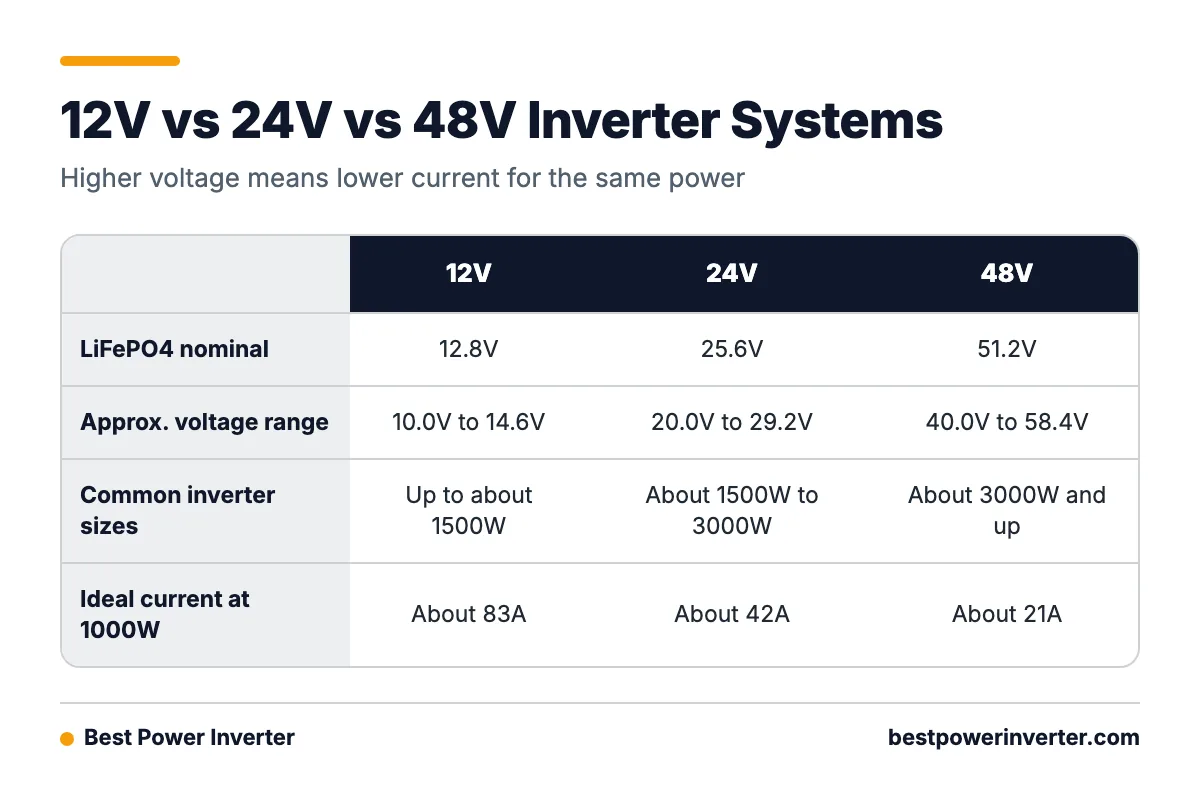
Take a 1000W load. The ideal DC current is about 83A at 12V, 42A at 24V, and 21A at 48V. Real current is higher once inverter losses are added. At 83A or more, a 12V system needs thick cable, short runs, and well-rated fuses.

| System class | Typical LiFePO4 nominal | Approx. LiFePO4 voltage range | Common inverter sizes | Ideal current at 1000W |
|---|---|---|---|---|
| 12V | 12.8V | 10.0V to 14.6V | Up to about 1500W | About 83A |
| 24V | 25.6V | 20.0V to 29.2V | About 1500W to 3000W | About 42A |
| 48V | 51.2V | 40.0V to 58.4V | About 3000W and up | About 21A |
Nominal voltages and ranges follow typical figures from QES Energy’s battery voltage comparison. The sizes are common pairings, not rules. Your inverter’s datasheet decides.
What Is the Difference Between Nominal Voltage and Actual Battery Voltage?
Nominal voltage is a label. Actual voltage changes with charge level, load, temperature, and charging. A “12V” battery is rarely sitting at exactly 12V.
A 4-series LiFePO4 battery is called 12.8V nominal. Its real range runs from roughly 10.0V to 14.6V. A 16-cell battery sold for a “48V” system is commonly 51.2V nominal, as the OEM Battery Pack compatibility guide explains. So “48V” names a system class, not a measurement.
This is where many buyers go wrong. They match the label and ignore the swing. The inverter must accept the battery’s complete range, including the high voltage reached during charging.
What Is the Minimum Battery Voltage for an Inverter?
It depends on the model. The minimum is the low-voltage cutoff listed in the inverter’s specifications. Many 12V-class inverters list a cutoff around 10V to 11V, but you must read your own datasheet.
Do not mix up two limits:
- Inverter cutoff: the voltage where the inverter derates or shuts down.
- Battery safe discharge limit: the lowest voltage the battery maker allows.
They are not always the same. One inverter programming reference from Selectronic uses 1.85V per cell as a minimum for its specified battery system. Across 6 cells, that works out to about 11.1V. If the inverter’s cutoff sits below the battery’s safe limit, the inverter can drain the battery too far. Set the cutoff to the higher of the two.
What Happens When Battery Voltage Is Too Low?
The inverter protects itself, and sometimes the battery. First you may see a low-voltage alarm. Some inverters then derate their output, as noted in the Itel hybrid inverter manual. If voltage keeps falling, the unit shuts off.
Heavy loads make this worse. Large current pulls battery voltage down for a moment, called voltage sag. A battery that looks fine at rest can trip the cutoff when a microwave or pump starts. Thin cables add to the sag.
What Battery Voltage Does a 1000W, 2000W, or 3000W Inverter Need?
Check the model’s rating first. As a general pattern, 1000W units are often 12V. 2000W units come in 12V or 24V. 3000W units are commonly 24V or 48V.
| Inverter size | Ideal current at 12V | At 24V | At 48V |
|---|---|---|---|
| 1000W | About 83A | About 42A | About 21A |
| 2000W | About 167A | About 83A | About 42A |
| 3000W | About 250A | About 125A | About 63A |
These figures are watts divided by volts, before efficiency losses. Real current is higher. A 3000W load at 12V would need extreme cable and fuse sizes, which is why larger inverters move to 24V or 48V.
- If your loads stay under about 1000W and cable runs are short, choose 12V.
- If you run 1500W to 3000W regularly, choose 24V.
- If you want whole-home backup or plan to expand later, choose 48V.
Can You Connect a 12V Battery to a 24V Inverter?
No. A single 12V battery is below a 24V inverter’s minimum input, so the unit will not start or will fault right away. To reach 24V, wire two matching 12V batteries in series. The reverse is also a problem: putting 24V into a 12V inverter can damage it. Always check both the minimum and the maximum DC input voltage.

How Do I Calculate Inverter Runtime From Battery Voltage and Capacity?
Multiply voltage by amp-hours to get watt-hours. Then reduce it for usable capacity and inverter efficiency. Divide the result by your load in watts.
Worked example. Take a 12.8V, 100Ah LiFePO4 battery.
- Nominal energy: 12.8V × 100Ah = 1,280Wh (1.28kWh).
- Usable share: assume 80%, or 1,024Wh. This is an assumption, so use your battery maker’s recommended depth of discharge.
- Inverter efficiency: assume 90%, giving about 922Wh of AC energy.
- Runtime at a 500W load: 922 ÷ 500 = about 1.8 hours.
A naive calculation (1,280 ÷ 500) says 2.6 hours. That is about 40% too optimistic. Cold weather, high surge loads, and aging batteries shrink the result further.
Battery-to-Inverter Compatibility Checklist
- Full charge voltage: must be below the inverter’s maximum DC input.
- Discharge cutoff: set it at or above the battery maker’s safe limit.
- Inverter DC input range: the battery’s whole swing must fit inside it.
- Battery chemistry setting: lead-acid, LiFePO4, or custom, matching the battery.
- Polarity: positive to positive, negative to negative. Reverse polarity can destroy equipment.
- Cable rating: sized for the full current, with a fuse or breaker near the battery.
Series and Parallel Wiring Safety
Series wiring adds voltage. Parallel wiring adds capacity. Two 12V 100Ah batteries in series make 24V at 100Ah. In parallel they make 12V at 200Ah.
Use identical batteries: same chemistry, capacity, age, and brand. Charge them to the same level before joining them. Mismatched batteries drift apart and wear out unevenly. In parallel banks, use equal-length cables so current shares evenly. Fit overcurrent protection, and follow the battery and inverter manuals.
Frequently Asked Questions
What is battery voltage in inverter?
It is the DC voltage the inverter is designed to take from its battery bank, usually 12V, 24V, or 48V. The real voltage moves up and down with charge level and load. It must stay inside the inverter’s stated input range.
What is a battery power inverter?
It is a device that converts battery DC power into AC power for household appliances. Some models also charge the battery from solar panels or the grid. It is the core part of most backup power systems.
What is the minimum battery voltage for inverter?
The minimum is the inverter’s low-voltage cutoff, listed in its datasheet. It differs by model and battery type. Also respect the battery maker’s own discharge limit, and use whichever is higher.
Does inverter need battery?
A battery-based or hybrid inverter does. A grid-tied solar inverter can run from panels and the grid without one, but it will not give backup power during an outage. If you want power when the grid is down, add a battery and a compatible inverter.
Sources