
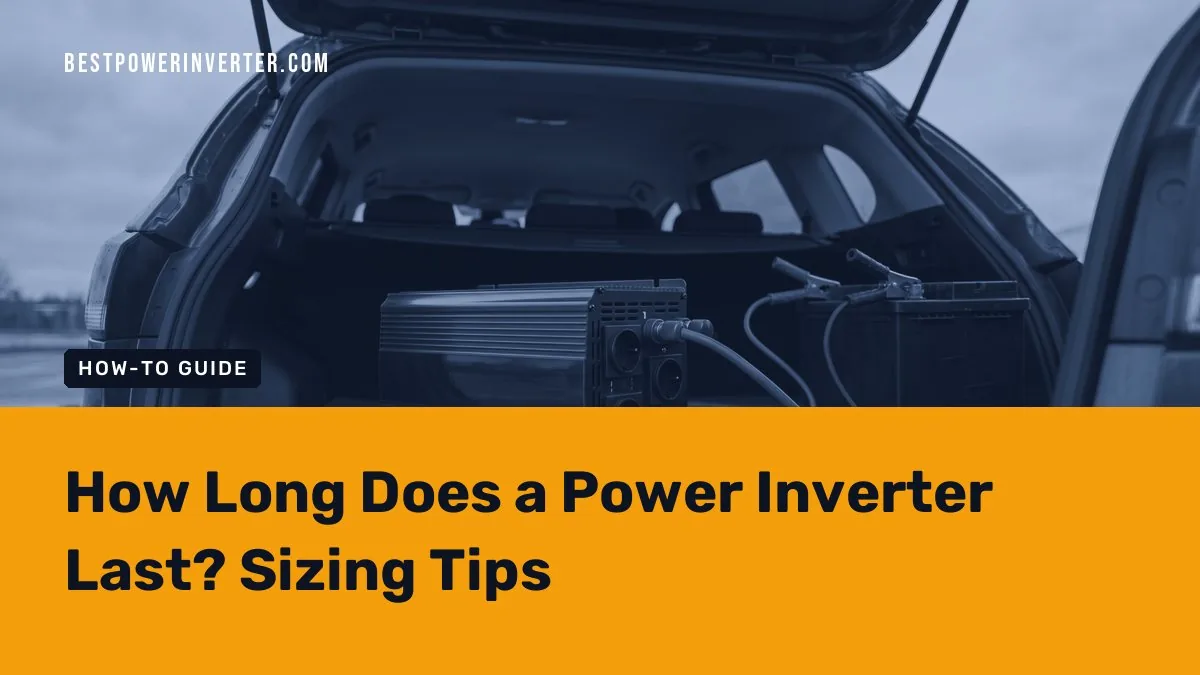
Most quality power inverters give several years of service, but heat, dust, moisture, overloading, and poor wiring can cut that short. To get the longest life, pick an inverter whose continuous rating is about 20-25% above your running load, whose surge rating covers motor startup, and whose battery-side current stays inside your battery, fuse, and cable limits.
Quick answer
A good inverter runs for several years if it stays cool, clean, dry, and below its maximum rating. Size it 20-25% above your running watts, check the surge rating for motors, and confirm the battery can deliver the current.
- Best for small electronics: 300-500W pure sine wave
- Best for pumps and tools: 2,000W+ with high surge
- Best for 4,000W loads: 48V system
- Running an inverter at its maximum rating all day adds heat and shortens its life.
- Add 20-25% headroom above the total running watts of everything on at once.
- Motors need extra startup power. Use about 3× running watts if no spec exists, and up to 10× for cautious sizing.
- DC current equals AC watts divided by battery voltage and inverter efficiency.
- A 5,000Wh battery stores energy. It does not set the inverter size.
- Above roughly 3,000W, 48V is usually the practical choice.
- How long does a power inverter last?
- What causes a power inverter to fail early?
- Continuous watts vs. surge watts
- Inverter sizing chart for common loads
- 12V, 24V, or 48V?
- How much power does an inverter drain from a battery?
- What size inverter for a 5,000Wh battery?
- How big an inverter can a truck or 12V car handle?
- Is a 4,000-watt inverter practical?
- Comparing a 2,000W pure sine wave inverter
- Maintenance checklist to extend inverter life
- Power inverter buying checklist
- What do owners say?
- Frequently Asked Questions
How long does a power inverter last?
A quality power inverter typically lasts several years. No single number fits every unit, because the real figure depends on heat, dust, moisture, overloading, battery voltage, installation, and how many hours a day it runs.
The warranty is a useful floor. It shows how long the maker expects the unit to work under normal use. A unit that runs a TV for two hours a night lives an easy life. A unit that runs a freezer and a pump around the clock near its limit does not.
Duty cycle matters most. An inverter used now and then as a backup sits cool for most of its life. One used daily in an RV or off-grid cabin sees constant heat cycles. Heat is what wears out the capacitors and power switches inside.
What causes a power inverter to fail early?
Heat is the main cause. Sustained operation at the maximum rating raises thermal stress and can trigger thermal shutdown or shorten service life, according to sizing guidance from inverter.com.au.
Common failure points include:
- Running near the limit. A 2,000W unit holding a 1,900W load for hours is under constant stress.
- Blocked airflow. Fans and heat sinks need open space. Stuffing an inverter in a closed box or under a pile of gear traps heat.
- Dust and moisture. Dust coats the heat sink. Damp air corrodes terminals and circuit boards.
- Loose or dirty DC terminals. A poor connection makes heat right at the lug and wastes power.
- Undersized cable. Thin cable causes voltage drop. The inverter then pulls more current to compensate and may shut down on low voltage.
- Wrong battery voltage. A 12V inverter on a 24V bank is a quick way to destroy it.
- Repeated surge overload. Starting a motor that is too big for the inverter again and again strains the output stage.

Continuous watts vs. surge watts
Continuous watts are what the inverter can supply all day. Surge watts are a short burst, often lasting a second or less, for startup. Motors in pumps, drills, and refrigerators need that burst to get moving.
Two rules from the sizing guides help:
- Make the continuous rating about 20-25% higher than all loads running at the same time. Battle Born Batteries and others give this same advice.
- If the label does not list startup watts, estimate about 3× running watts for a motor. Cautious guidance uses up to 10×, as covered in this motor surge guide from Eneronix.
Always check the nameplate first. It beats any estimate.
Inverter sizing chart for common loads
The figures below are typical estimates, not measurements of a specific product. Your appliance label is the final word.
| Load | Est. running watts | Likely startup surge | Suggested inverter | Waveform |
|---|---|---|---|---|
| 32-inch TV | 30-60W | Little to none | 300W | Pure sine preferred |
| Inkjet printer | 20-50W | Small | 300W | Pure sine preferred |
| Laser printer | 400-1,000W while warming up | Heater spike | 1,500W | Pure sine |
| Mini fridge | 60-100W | About 3× (180-300W) | 500W | Pure sine |
| Corded drill | 500-800W | About 2-3× | 1,500W | Pure sine |
| Sump pump (about 1/3 hp) | About 800W | About 2,400W at 3×; more if cautious | 2,000W with strong surge | Pure sine |
| TV + inkjet printer + mini fridge together | About 170W | About 300W peak | 500W | Pure sine |
How big power inverter to run sump pump?
Plan on about 2,000W continuous with a surge rating of at least 3× the pump’s running watts. A pump that draws 800W running may want 2,400W for a moment at startup. If the nameplate shows a higher number, or you want a cautious margin, size up. Pure sine wave is the safer choice for motors, and the battery must be able to supply the surge current.
How big inverter to power a 32-inch TV?
A 300W inverter is plenty. A 32-inch TV commonly draws well under 100W. Add up everything else plugged in, such as a streaming box or soundbar, and keep 20-25% headroom.
How big inverter to power a printer?
An inkjet needs only about 300W. A laser printer is different. Its fuser heats up with a big spike, so give it 1,500W or more.
How big power inverter to run a drill?
A corded drill commonly needs a 1,500W pure sine wave inverter. Running watts may be 500-800W, with a startup burst on top. Cordless drills only charge through a small charger, so they need far less.
12V, 24V, or 48V? When to use a 48V power inverter
Use 48V when your load climbs above roughly 3,000W. Common sizing guidance puts 12V systems up to about 1,500W, 24V up to about 3,000W, and 48V above that. Higher voltage means lower current for the same power, so you can use thinner cable, smaller fuses, and lose less to voltage drop.
Here is the math. Divide AC watts by battery voltage and by inverter efficiency to find approximate DC current. The 90% efficiency below is an assumption for illustration. Check your inverter’s spec sheet for its real figure.
| Example | Before losses | With 90% efficiency (assumed) |
|---|---|---|
| 2,000W at 12V | About 167A | About 185A |
| 2,000W at 48V | About 42A | About 46A |
| 4,000W at 12V | About 333A | About 370A |
| 4,000W at 48V | About 83A | About 93A |
- Load under about 1,500W: 12V works.
- Load up to about 3,000W: choose 24V.
- Load above about 3,000W: choose 48V.
- Long cable run: go up one voltage step to cut voltage drop.
How much power does an inverter drain from a battery?
An inverter drains power in two ways: the load you run, and its own idle draw. Idle draw is what it uses with nothing plugged in, and it varies by model. Check the no-load figure on the spec sheet.
A simple example shows why it matters. Say an inverter idles at 25W. Over 24 hours that is 600Wh. On a 12V battery, 600Wh is about 50Ah, gone with nothing running. That is why owners complain about mystery battery drain when they leave an inverter switched on.
For loaded draw, use this formula:
DC amps = AC watts ÷ (battery volts × efficiency)
A 500W load on a 12V system at 90% efficiency pulls about 46A from the battery. If you leave the inverter on a small battery, switch it off when not in use.
What size inverter for a 5,000Wh battery?
The battery’s watt-hours do not set the inverter size. Wh measures stored energy, like the size of a fuel tank. Inverter watts measure how fast you can use it, like how hard you press the gas. A 5,000Wh battery can feed a 500W inverter for a long time or a 3,000W inverter for a short time.
Pick the inverter from your loads first. Then check the battery:
- Runtime: a 2,000W load at 90% efficiency draws about 2,222W from the battery. A full 5,000Wh gives about 2.25 hours in theory. Real runtime is shorter, since you should not drain a battery to zero.
- BMS limit: the battery’s battery management system caps current. For example, a 48V battery with a 100A BMS tops out near 4,800W. The BMS must also handle the inverter’s surge, not just the continuous load.
Inverter wattage alone does not mean the battery can deliver it. Read the battery’s continuous and peak current ratings.
How big of a power inverter can my truck handle?
It depends on the alternator, the battery, the wiring, and whether the engine is running. A plug-in inverter limited by the cigarette lighter or factory socket is small, often around 150-180W if the socket is fused at 12-15A. Check your owner’s manual for the real rating. A larger inverter must connect straight to the battery with proper cable and a fuse.
For direct connection, 12V inverters up to about 1,500W are the usual limit. Even then, 1,000W at 12V and 90% efficiency draws about 93A. Many alternators cannot supply that and run the truck too.

How big of power inverter for a 12V car?
Plug into the socket only for small loads such as a phone charger or laptop. For anything over the socket’s rating, wire to the battery and keep the engine running. Cars have smaller alternators than trucks, so stay conservative.
Vehicle checklist
| Check | Why it matters |
|---|---|
| Alternator output | Must cover the inverter’s DC draw plus the vehicle’s own needs |
| Factory socket rating | Exceeding it blows a fuse or overheats wiring |
| Fuse | Install close to the battery, sized to the cable and inverter manual |
| Cable gauge and length | Short, thick cable cuts voltage drop |
| Battery condition | A weak battery sags under load and trips low-voltage shutdown |
| Engine running | Large loads can drain a starting battery fast with the engine off |
Is a 4,000-watt inverter practical?
Yes, but only with the right battery bank and wiring. At 12V, a 4,000W load pulls about 333A before losses, roughly 370A at 90% efficiency. That needs very heavy cable, a large fuse, and a battery that can supply it. Few 12V setups handle that well.
A 48V design is far more practical. The same 4,000W needs about 93A at 90% efficiency. Requirements for a 4,000W unit:
- A 48V battery bank with a BMS rated well above the draw, including surge.
- Pure sine wave output for motors and sensitive electronics.
- A surge rating that covers your biggest motor startup.
- Open space for cooling, plus a clean, dry mounting spot.
- Cable and fusing sized to the manufacturer’s instructions.
What should buyers check when comparing a Renogy 2,000W inverter with other pure sine wave models?
Compare the spec sheets line by line instead of trusting the headline wattage. For any 2,000W pure sine wave model, including Renogy’s, look at:
- Surge rating and its duration. A higher peak for longer handles pumps better.
- Efficiency. Lower efficiency means more heat and more battery draw.
- Idle draw. It affects battery life when the unit stays on.
- Protections. Look for over-temperature, overload, low-voltage, and short-circuit protection.
- Cooling. Check fan behavior and clearance requirements.
- Warranty terms. Note the length and when it starts.
Then check that your battery and BMS can feed it, since a 2,000W inverter at 12V needs roughly 185A.
Maintenance checklist to extend inverter life
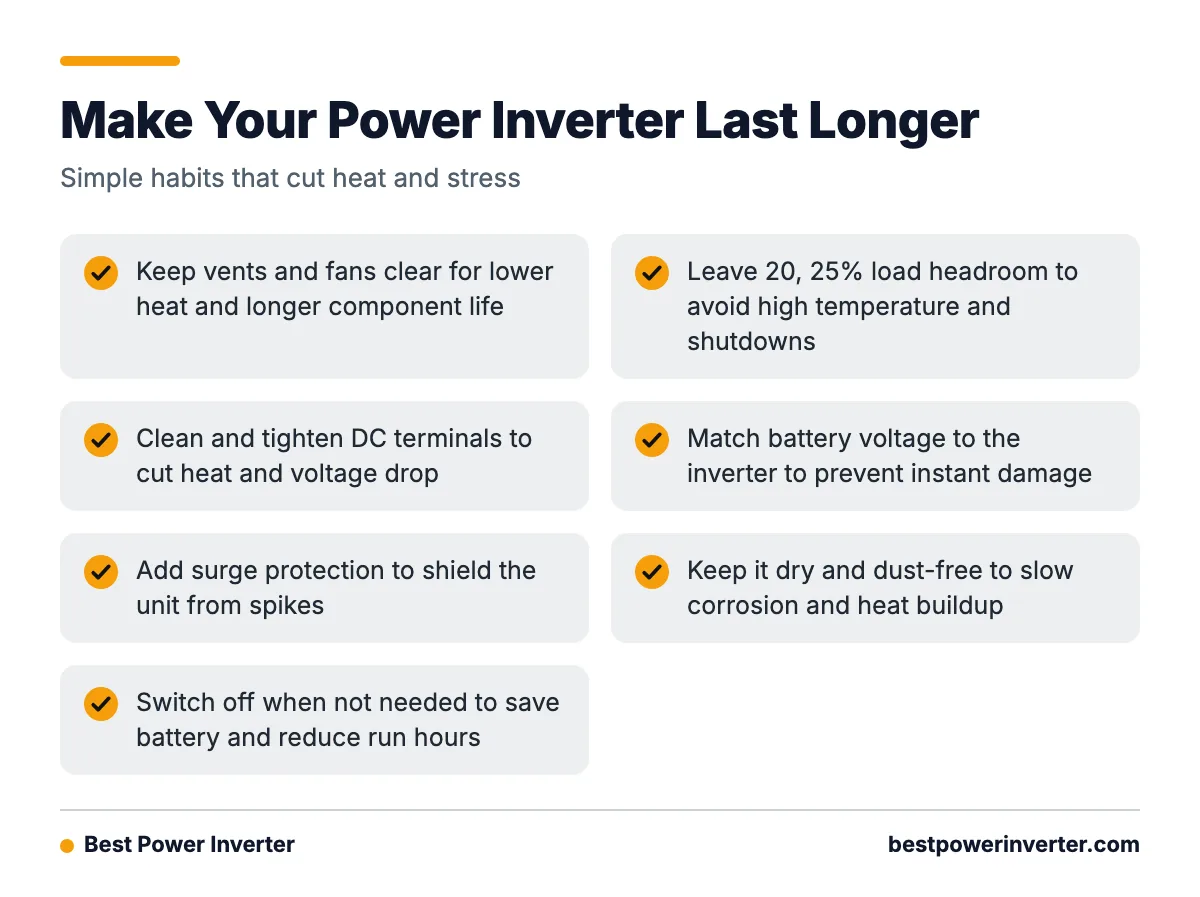
| Habit | Effect on reliability |
|---|---|
| Keep vents and fans clear | Lower heat, longer component life |
| Leave 20-25% load headroom | Avoids sustained high temperature and shutdowns |
| Clean and tighten DC terminals | Cuts heat at connections and voltage drop |
| Match battery voltage to the inverter | Prevents instant damage |
| Add surge protection | Shields the unit from spikes |
| Keep it dry and dust-free | Slows corrosion and heat buildup |
| Switch off when not needed | Saves battery and reduces run hours |
If the inverter trips often, do not just reset it. Add up the load, check the battery voltage under load, and feel the cables for heat.
Power inverter buying checklist
- Waveform: pure sine wave for motors, laser printers, and electronics.
- Continuous watts: total running load plus 20-25%.
- Surge watts: enough for your biggest motor.
- Efficiency and idle draw: both come from the spec sheet.
- Protections: overload, over-temperature, low voltage, short circuit.
- Battery compatibility: voltage, BMS limits, and cable size.
- Warranty: length, start date, and support reputation. Trustpilot pages such as Ginlong (Solis) reviews show how real customers describe support, though they cover solar brands.
- Verified ratings: look for safety listings and check them on the label.
What do owners say?
Owners like
- Quiet operation under moderate loads.
- Reliable startup of refrigerators, pumps, and power tools when surge capacity is adequate.
- Stable performance for several years without nuisance shutdowns.
- Clear displays, straightforward installation, and responsive warranty support.
Common complaints
- Failure after a short operating period or after a few years.
- Nuisance shutdowns when loads approach the rated limit or ventilation is poor.
- Difficult warranty processes, slow support, or disputes over warranty start dates.
- Battery drain and unexpected cycling when idle draw, charging behavior, or settings are not understood.
Summarised from owner reviews and long-term user reports; individual experiences vary.
Frequently Asked Questions
How big power inverter to run sump pump?
Plan on about 2,000W continuous for a typical 1/3 hp pump, with a surge rating of at least 3× its running watts. Use pure sine wave, and confirm the battery can deliver the startup current.
What is a 48 volt power inverter used for?
A 48 volt power inverter suits loads above roughly 3,000W. The higher voltage cuts battery current, so you can use smaller cable and lose less power. A 4,000W load draws about 93A at 48V, compared with about 370A at 12V (assuming 90% efficiency).
How big of a power drain is an inverter?
It drains power for the load plus its own idle draw. Divide AC watts by battery voltage and efficiency to find the current. Check the spec sheet for no-load draw, since even 25W adds up to 600Wh a day.
How big power inverter for 5000w battery?
A 5,000Wh battery stores energy and does not set inverter size. Choose the inverter from your loads plus 20-25% headroom. Then confirm the battery’s BMS can supply the continuous and surge current.
How big an inverter to power a 32 tv?
A 300W inverter is enough for most 32-inch TVs, which commonly draw well under 100W. Add any other devices and keep 20-25% headroom.
How big of a power inverter can my truck handle?
Plug-in socket inverters are limited to roughly 150-180W by the socket fuse. A battery-wired 12V inverter generally tops out around 1,500W, and the alternator, fuse, and cable must support it. Keep the engine running for larger loads.
Is a 4000 watt power inverter practical?
It is practical on a 48V system with a strong battery bank, heavy fusing, and pure sine wave output. At 12V it would draw about 333A before losses, which is hard to wire and supply safely.
How big inverter to power printer?
A 300W pure sine wave inverter handles most inkjet printers. A laser printer needs 1,500W or more because of its heater spike.
Sources