

Affiliate disclosure: As an Amazon Associate, we earn from qualifying purchases. This comes at no extra cost to you.
Most people who regret a Black Friday inverter bought the model with the biggest peak-watt number and the biggest percent-off badge. Do this instead: buy a pure sine wave inverter sized to your continuous load plus 20 to 25 percent headroom, and only check out when the price is at or below its 90-day low on a price tracker.
Power inverters turn 12V DC battery power into 120V AC household power, so you can run a laptop, TV, fridge or power tool from a car, van, RV or solar battery bank. Portable power stations put the battery, inverter and charger in one box. This page is for car campers, van and RV owners, DIY solar builders and homeowners who want outage backup.
The models most worth watching are Renogy, Victron and BESTEK inverters. If you would rather not wire anything, watch the Jackery Explorer 1000 v2 and EcoFlow DELTA 3 power stations. Our judgements come from manufacturer specifications and patterns in buyer feedback. This page lists no prices because Amazon prices change by the hour. It shows you how to judge the price you see.
Last checked: November 2026
Quick answer
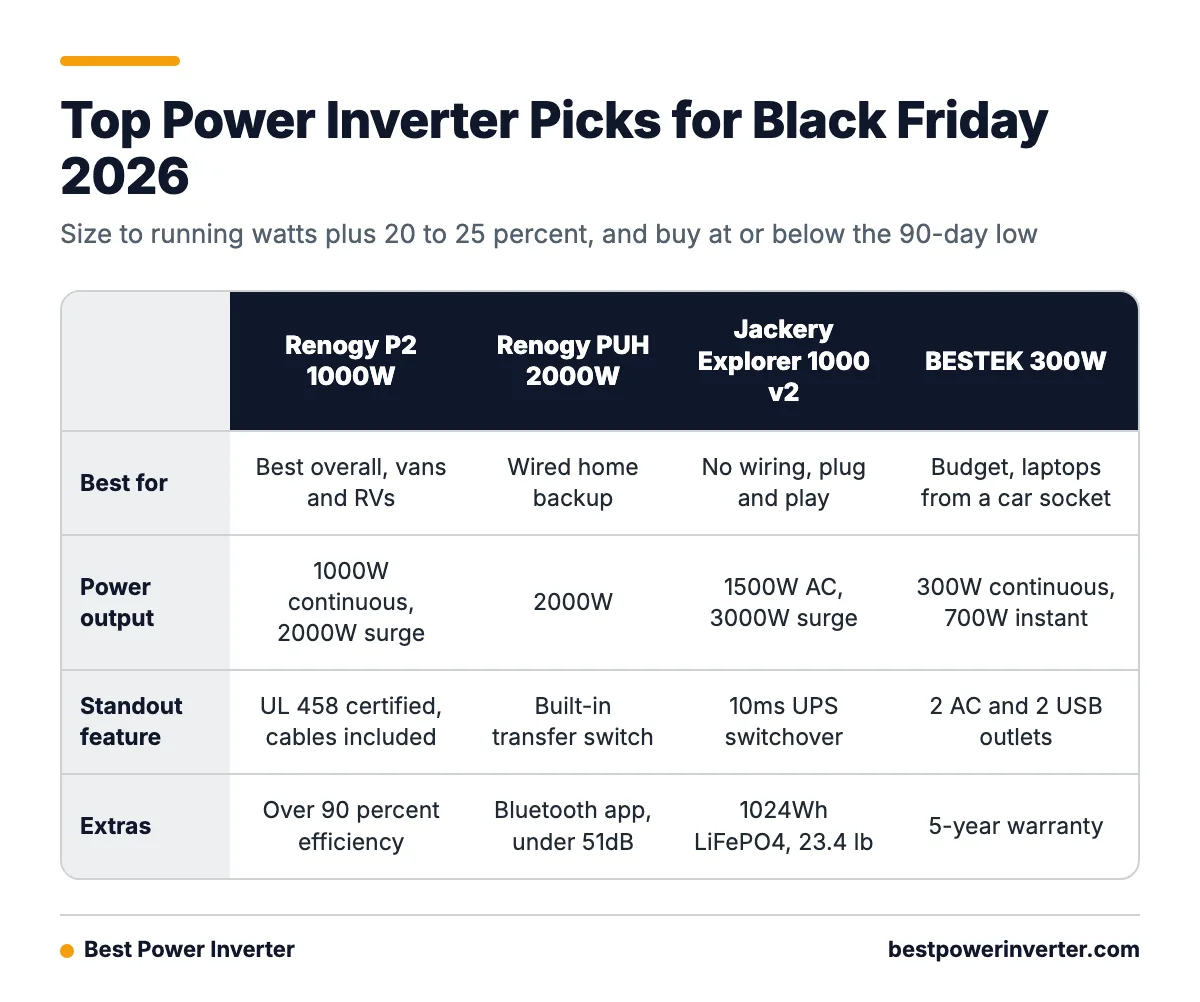
Most readers should buy the Renogy P2 1000W pure sine wave inverter. Size any inverter to your running watts plus 20 to 25 percent, and buy only at or below its 90-day low on a price tracker.
- Best for vans and RVs: Renogy P2 1000W, cables included.
- Best for wired home backup: Renogy PUH 2000W, built-in transfer switch.
- Best for no wiring: Jackery Explorer 1000 v2, plug and play.
- Best budget: BESTEK 300W, laptops from a car socket.
Our Winner: Renogy P2 1000W Pure Sine Wave Inverter
Renogy rates the P2 1000W at 1000W continuous, 2000W surge, and more than 90 percent conversion efficiency. It is UL 458 and CSA C22.2 No. 107.1 certified, which are the North American safety standards for vehicle and RV inverters. It ships with two 3 ft 4 AWG battery cables, a 16.4 ft wired remote, GFCI protection, two AC outlets, a hardwire terminal block and a USB port.
Most car campers and van owners run laptops, a TV, lights, phone chargers and small tools. A 1000W unit covers those loads with headroom. It also stays within what a single deep cycle battery and short, thick cables can reasonably supply. Renogy’s own 2025 Black Friday guide put its 12V 1000W pure sine wave inverter at up to 22 percent off, so this model has a track record of real seasonal discounts.
Black Friday 2026 Dates at a Glance
Black Friday 2026 falls on Friday, November 27, and Cyber Monday falls on Monday, November 30, according to Amazon’s official Black Friday FAQ. Amazon has not announced when its 2026 deal week starts. Early deals usually begin the week before Thanksgiving.
| Event | Date | What to expect |
|---|---|---|
| Early Black Friday deals | Usually the week before Thanksgiving (2025’s Black Friday Week began November 20) | First markdowns appear. Set price alerts now so you know the 90-day low before the rush. |
| Thanksgiving | Thursday, November 26, 2026 | Some deals refresh overnight. Check your alerts that evening. |
| Black Friday | Friday, November 27, 2026 | Peak deal day. Popular power stations can sell through at the lowest prices. |
| Cyber Monday | Monday, November 30, 2026 | Second wave of deals. Prices may match or come close to Black Friday. |
| Possible extension | Not confirmed (2025’s event ran through December 1) | A last chance at leftover deals, if Amazon repeats the pattern. |
When does Amazon Black Friday 2026 start and end?
The fixed dates are Black Friday on November 27 and Cyber Monday on November 30. Amazon’s 2025 Black Friday Week ran from November 20 to December 1, so expect a similar window of roughly 12 days. Treat the start date as unconfirmed until Amazon announces it.
How to Tell a Real Inverter Deal From a Fake One
How can I tell if a Black Friday inverter deal is real?
A deal is real when today’s price is at or below the lowest price the product has sold for in the last 90 days. The percent-off badge on the listing does not tell you that. Use this checklist before you add anything to your cart:
- Check 90-day price history. Paste the product link into Keepa or camelcamelcamel. Both chart Amazon price history and can email you when a price drops. Trusted Reviews explains how to find Amazon price history step by step.
- Compare against the all-time low, not the list price. If an inverter hit a lower price during Prime Day or a spring sale, a Black Friday price above that is not the best deal. It is just a discount.
- Ignore the percent-off badge. The badge compares today’s price with a reference price. It does not compare with what the item usually sells for.
- Watch for pre-sale price bumps. If the chart shows the price climbing in October and then dropping in late November, the real saving is smaller than the badge suggests.
- Understand Amazon’s List Price. For non-seasonal items, Amazon only shows a List Price when the product has sold at or above that price in the past 90 days. A strikethrough List Price means the item recently sold at that level. It does not mean the item usually sells there.
- Check the seller. Buy from the brand’s own storefront or from Amazon itself. Third-party sellers can ship older versions, open-box stock, or units with no clear warranty path.
- Check continuous watts, not peak. A 2000W peak inverter may only run 1000W continuously. Continuous rating covers loads that run for minutes or hours. Peak (surge) rating only covers the brief spike when a motor or compressor starts.
Here is a decision rule you can apply in 30 seconds. If today’s price is at or below the 90-day low and the seller is the brand or Amazon, buy. If it is within about 5 percent of the 90-day low, it is a fair price, not a standout. If it is above the 90-day average, wait.
What Size Inverter Do You Actually Need?
Add up the running watts of everything you will use at the same time, then add 20 to 25 percent headroom. Next, check that any motor or compressor load fits within the surge rating. The headroom keeps the inverter out of its overload and overheat zone, and inverters run cooler and quieter below their maximum.
Find running watts on each device’s label or power brick. If the label lists only amps, multiply by 120 to get approximate watts. Here are typical ranges to start from. Your own devices may differ, so check their labels.
| Load | Typical running watts | Startup surge? | Sensible inverter size |
|---|---|---|---|
| Phone or laptop charger | 10 to 100W | No | 150 to 300W |
| TV (LED, 32 to 55 inch) | 50 to 200W | No | 300 to 600W |
| Fridge or chest freezer | 100 to 250W running | Yes, several times running watts at compressor start | 1000W pure sine minimum |
| Coffee maker | 800 to 1200W | No | 1500 to 2000W |
| Microwave (700 to 1000W cooking power) | About 1000 to 1500W drawn from the outlet | Small | 2000W |
| Power tools (drill, circular saw) | 300 to 1800W | Yes, motor start | 2000W or more for saws |
Worked example: a van with a 60W laptop, a 100W TV and a 150W running fridge adds up to 310W. Add 25 percent headroom and you get about 388W. The fridge compressor may spike to several times its running watts at start, so a 1000W inverter with 2000W surge, like the Renogy P2 1000W, covers this setup comfortably. A 300W socket inverter does not.
How much current does an inverter pull from the battery?
Far more than most buyers expect. DC current is roughly AC watts divided by (battery volts times inverter efficiency). Efficiency is the share of battery power that comes out as AC; the rest becomes heat.
- 1000W at 12V and 90 percent efficiency: 1000 / (12 x 0.90) = 1000 / 10.8 = about 93A.
- 2000W at 12V and 90 percent efficiency: 2000 / 10.8 = about 185A.
- 300W at 12V and 90 percent efficiency: 300 / 10.8 = about 28A.
That last line explains why a 300W inverter plugged into a cigarette lighter socket cannot deliver 300W. Those sockets are usually fused at 10 to 15A. At 12V that is roughly 120 to 180W in practice, before the fuse blows.
What wire and fuse does an inverter need?
Use the cable size and fuse rating listed in your inverter’s manual first. The fuse protects the wire, not the inverter, so it belongs on the positive cable within about 7 to 12 inches of the battery positive terminal.
A common rule of thumb sizes the fuse near 125 percent of continuous DC draw. For the 1000W example, 93A x 1.25 = about 116A, so you would look at the nearest standard fuse size the manual allows. For 2000W, 185A x 1.25 = about 231A. A long-running Victron Energy community discussion on fusing for continuous or peak power covers why the fuse is sized to continuous draw and the cable rating, not to brief surges.
Renogy sends 3 ft 4 AWG cables with the 1000W model and 3 ft 1/0 AWG cables with the 2000W model. AWG is American Wire Gauge, where a smaller number means thicker wire. If you need longer runs, you need thicker cable, because voltage drop grows with length. Thin or long cables are a common cause of low-voltage shutdowns, where the inverter sees the voltage sag under load and switches off even though the battery is fine.
Inverter or Portable Power Station?
Choose a wired inverter if you already have, or plan to build, a battery bank. Choose a power station if you want AC power without touching a cable lug. That is why this list includes two power stations alongside five inverters.
A wired inverter plus battery wins when:
- You are building a van, RV or solar system and want to choose your own battery size and chemistry.
- You use power heavily every day, so you need capacity you can expand cheaply with more batteries.
- You want the inverter mounted permanently with a remote switch, as the Renogy P2 models allow.
A portable power station wins when:
- You want home backup with no wiring. The Jackery Explorer 1000 v2 lists a 10ms UPS switchover, which means connected devices switch to battery fast enough for most electronics to keep running during an outage.
- You camp in different places and want to carry power from car to tent.
- You rent your home or vehicle and cannot install anything permanent.
The trade-off is cost per watt-hour and flexibility. A power station’s battery is sealed in; when you outgrow it, you buy an expansion battery from the same brand, or a second unit.
How We Compared These Models
We ranked these models on four things: continuous output (what they run for hours, not seconds), waveform (all seven list pure sine wave AC output), what the DC side needs (cable gauge, fuse and current draw), and protections and certifications such as UL 458, ETL or GFCI. For power stations, we also weighed battery capacity, cycle life and recharge speed. The picks rely on manufacturer specifications and the product listings, not hands-on testing.
| Product | Key Specs | Our Choice | Action |
|---|---|---|---|
| Renogy P2 1000W Inverter | 1000W continuous, 2000W surge, >90% efficiency, UL 458, 4 AWG cables | Best Overall | |
| Renogy P2 2000W Inverter | 2000W continuous, 4000W surge, >90% efficiency, 1/0 AWG cables | Best for RV and Solar Builds | |
| Renogy PUH 2000W Inverter | 2000W, transfer switch, Bluetooth app, >92% efficiency, under 51dB | Best for Wired Home Backup | |
| Victron Energy 1200VA 12V Inverter | About 1000W continuous at 25°C, 1W ECO mode draw, VE.Direct port | Best Premium | |
| BESTEK 300W Car Inverter | 300W continuous, 700W instant, 2 AC + 2 USB, 5-year warranty | Best Budget | |
| Jackery Explorer 1000 v2 | 1024Wh LiFePO4, 1500W AC, 3000W surge, 10ms UPS, 23.4 lb | Best No-Wiring Option | |
| EcoFlow DELTA 3 | 1024Wh LiFePO4, 1800W AC, expandable to 5kWh, 56-min recharge | Best Expandable Power Station |
In-Depth Reviews

1. Renogy P2 1000W Pure Sine Wave Inverter – Best Overall
Our Verdict: Buy this if you run a van, truck camper or small RV from one deep cycle battery and your loads stay under about 800W at once. Skip it if you want to run a microwave, coffee maker or circular saw; those need the 2000W models below. It earns Best Overall because it pairs a useful 1000W continuous rating with safety certifications and the cables most buyers forget to budget for.
Renogy rates it at 1000W continuous and 2000W surge, with conversion efficiency above 90 percent. At full load it pulls about 93A from a 12V battery, as the worked example above shows. The included 3 ft 4 AWG cables are sized for that short run. If you mount the inverter farther from the battery, plan to buy thicker cable. The listing notes that power input should come from a deep cycle battery, not a starting battery.
Why It Made the List
- UL 458 and CSA C22.2 No. 107.1 certified, the safety standards that apply to mobile and RV inverters.
- GFCI protection, plus under-voltage, over-voltage, over-temperature, overload and short-circuit protection with LED indicators.
- Two AC outlets, an AC terminal block for hardwiring, a 5V/2.1A USB port and a 16.4 ft wired remote.
Pros & Cons
Pros
- Battery cables and remote included
- Certified to North American mobile inverter standards
- Metal housing, per Renogy’s listing
Cons
- Uses cooling fans, so it is not silent under load
- Single USB port at 2.1A is slow for modern phones and tablets
- Included cables are only 3 ft long
Black Friday buying tip: Renogy’s own 2025 Black Friday guide listed its 12V 1000W, 2000W and 3000W pure sine wave inverters at up to 22 percent off. A price around 20 percent below its normal 90-day level, or at a new 90-day low, is a deal worth taking. Do not buy it at any price if your plan includes a microwave or space heater; you would be buying the wrong size.

2. Renogy P2 2000W Pure Sine Wave Inverter – Best for RV and Solar Builds
Our Verdict: Buy this if you want to run kitchen appliances or power tools from a properly built battery bank in an RV or off-grid solar setup. Skip it if your battery is a single small 12V unit or your wiring is not rated for about 185A; you will get low-voltage shutdowns and hot cables. It is the step up most RV owners end up needing.
Renogy rates it at 2000W continuous and 4000W surge, with efficiency above 90 percent. That surge figure matters for fridge compressors and saw motors, which draw a brief spike at startup. It ships with 3 ft 1/0 AWG cables, which are much thicker than the 1000W model’s 4 AWG, because full output pulls roughly twice the current. The listing notes the input should be a deep cycle battery.
Why It Made the List
- 2000W continuous covers a typical microwave or coffee maker, one at a time.
- Three AC outlets plus an AC terminal block for hardwiring into an RV panel.
- Heavy 1/0 AWG cables and a 16.4 ft wired remote included.
Pros & Cons
Pros
- 4000W surge handles motor startup
- Proper gauge cables in the box
- Same protection set as the 1000W model
Cons
- Needs a large battery bank to sustain full output
- Requires a high-amp fuse and holder, bought separately (check the manual for the rating)
- No transfer switch for automatic grid backup
Black Friday buying tip: This model falls under the same Renogy 2025 Black Friday guide that listed 12V 1000W, 2000W and 3000W pure sine wave inverters at up to 22 percent off. Wait for something close to that, or a price at or below its 90-day low. Do not buy it if your battery bank stores less than about 200Ah at 12V; size the battery first, then the inverter.

3. Renogy PUH 2000W Pure Sine Wave Inverter with Transfer Switch – Best for Wired Home Backup
Our Verdict: Buy this if you have a 12V battery bank and want loads to switch between grid power and battery automatically, like a homemade UPS (uninterruptible power supply). Skip it if you only use power off-grid in a van; the transfer switch adds cost you will never use there.
The built-in transfer switch lets the inverter pass grid AC through when it is available and switch to battery when it is not. Renogy lists efficiency above 92 percent and a noise level under 51dB. That noise figure is a manufacturer claim worth having, since fan noise is a common complaint on budget inverters. Bluetooth and the Renogy app let you monitor it from your phone, and a wired remote switch is included.
Check before you buy: the listing data does not state a surge rating or say whether battery cables are included. Confirm both on the product page or in the manual, and budget for 1/0 AWG cables and a fuse if they are not in the box.
Why It Made the List
- Automatic switching between grid AC and battery power.
- Bluetooth app monitoring plus a wired remote switch.
- Rated quiet by the manufacturer, under 51dB.
Pros & Cons
Pros
- Transfer switch built in
- Highest listed efficiency of the three Renogy models
- App monitoring of the inverter
Cons
- Surge rating not stated in the listing data
- Costs more than the P2 2000W for a feature off-grid users do not need
- Still requires a battery bank, charger and fused wiring
Black Friday buying tip: There is no verified record of past Black Friday pricing for this specific model, so judge it purely by price history. Buy at or below its 90-day low, and compare the gap to the P2 2000W that day. Do not buy it if you need backup with zero wiring; a power station does that job for less effort.

4. Victron Energy 1200VA 12V Pure Sine Wave Inverter – Best Premium
Our Verdict: Buy this if your inverter stays on all day in a van or solar build and you care about every watt-hour your battery stores. Skip it if you need more than about 1000W continuous, or if you mostly care about the lowest price per watt; the Renogy P2 1000W costs less for similar output.
It is rated 1200VA. VA (volt-amps) is a different rating from watts: retailers that sell this model list about 1000W continuous at 25°C, falling to about 850W at 40°C, because inverters derate as they get hot. Peak figures vary by listing, so check the product page if motor starts matter to you. The standout figure is the 1W draw in ECO mode. In ECO mode the inverter drops to standby when nothing is drawing power. Over 24 hours, 1W of idle draw costs about 24Wh, roughly 2Ah from a 12V battery. That matters when a small solar panel has to refill the battery every day.
At full output, using a 90 percent efficiency assumption, it pulls about 1000 / 10.8 = 93A from a 12V battery. The VE.Direct port connects to computers, tablets and phones for monitoring, but the cables and dongles are sold separately.
Why It Made the List
- 1W zero-load draw in ECO mode, the lowest idle figure in this list.
- Hybrid HF design, which Victron says keeps it compact and light.
- Monitoring through the VE.Direct port.
Pros & Cons
Pros
- Very low idle draw in ECO mode
- UL 458 listed for vehicle and RV use, per retailers
- NEMA 5-15R outlet, the standard US household socket
Cons
- Continuous output drops to about 850W in hot spaces
- Monitoring cables and dongles cost extra
- Battery cables are not listed as included
Black Friday buying tip: There is no verified Black Friday discount history for this model, so do not wait for a dramatic percent-off badge. Any price at or below its 90-day low is a good time to buy. Do not buy it if you plan to run a coffee maker, hair dryer or microwave; it is built for efficiency, not big loads.

5. BESTEK 300W Car Power Inverter – Best Budget
Our Verdict: Buy this to charge a laptop, camera batteries or a tablet from your car’s 12V socket. Skip it if you expect to run a kettle, hair dryer, coffee maker or anything with a heating element; no cigarette lighter inverter can do that.
BESTEK rates it at 300W continuous and 700W instantaneous, with two AC outlets and two USB ports rated at 4.8A. The listing says it accepts 11 to 17V input and works with Tesla 12V sockets. In practice, your car’s socket fuse sets the real limit. At 10 to 15A, that works out to roughly 120 to 180W before the fuse blows. A 65W laptop charger plus phones fits easily. Two laptops plus a small fan is about the ceiling.
The fan speeds up once output passes 70W or the unit warms up, according to BESTEK. It has a built-in 40A fuse, ETL certification and protection against overheating, under- and over-voltage, and short circuits.
Why It Made the List
- Plugs straight into almost any vehicle’s 12V socket, with no wiring.
- Five-year (60-month) replacement warranty from BESTEK.
- Aluminum housing in a phone-sized body.
Pros & Cons
Pros
- Simplest setup in this list
- Long warranty for the price class
- Two USB ports alongside the AC outlets
Cons
- Real output limited to about 120 to 180W by the car socket
- Fan runs faster above 70W
- Draining the car battery with the engine off is a risk on long sessions
Black Friday buying tip: On a product this cheap, even a large percent-off saves only a few dollars. Buy when it is at or below its 90-day low and do not hold out for a bigger cut. Do not buy it at any price if you need more than about 150W; buy the Renogy P2 1000W and wire it to a battery instead.

6. Jackery Explorer 1000 v2 Portable Power Station – Best No-Wiring Option
Our Verdict: Buy this if you want outage backup for a modem, CPAP machine, lights or a fridge, or camping power, without buying a battery, charger and cables separately. Skip it if you already own Renogy or other third-party solar panels; Jackery says the 1000 v2 only works with Jackery solar panels for solar charging.
- Brand: Jackery
- Output Wattage: 1500 watts
- Voltage: 120 volts
- Weight: 23.4 pounds
- Power Source: Battery Powered, Solar Powered
- Included Components: Explorer 1000 v2, User Manual
Jackery lists 1024Wh of LiFePO4 capacity, 1500W AC output and 3000W surge. LiFePO4 (lithium iron phosphate) is a battery chemistry known for long cycle life; Jackery rates it at over 70 percent capacity after 4,000 cycles. To estimate runtime, multiply capacity by about 0.85 to allow for inverter losses (an assumption, not a Jackery figure), then divide by your load. For a 100W load: 1024 x 0.85 / 100 = about 8.7 hours.
The 10ms UPS switchover keeps connected devices running when the grid drops. Recharge takes 1.25 hours by default, or 50 minutes with emergency charging turned on in the app before each charge.
Why It Made the List
- True plug and play: two pure sine wave AC outlets, two USB-C, one USB-A and a car port.
- 10ms UPS for home backup.
- Fast recharge, with an app-controlled 30dB quiet charging mode.
Pros & Cons
Pros
- No wiring, fuses or cable sizing to worry about
- Lightest 1kWh unit in this list at 23.4 lb
- Long-life LiFePO4 battery
Cons
- Solar charging limited to Jackery panels
- Solar panel not included
- 50-minute charging must be enabled in the app each time
Black Friday buying tip: Black Friday 2025 roundups from 9to5Toys and Bob Vila reported this model at well under half its list price. That sets the bar. A price near list, or a 20 percent badge, is not a Black Friday deal on this unit. Do not buy it at any price if you need to pair it with solar panels you already own.

7. EcoFlow DELTA 3 Portable Power Station – Best Expandable Power Station
Our Verdict: Buy this if you want a no-wiring power station today that can grow into a 5kWh home backup system later. Skip it if you carry your power station often; at 12.5 kg (about 27.6 lb), it is roughly 4 lb heavier than the Jackery with the same capacity.
- Brand: EF ECOFLOW
- Capacity: 1024 watt-hours
- Output Wattage: 1800W
- Voltage: 120V AC
- Weight: 12.5 kg
- Included Components: AC charging cable, EcoFlow DELTA 3 portable power station, manuals and warranty card
EcoFlow lists 1800W AC output, a step above the Jackery’s 1500W. X-Boost is a mode that lowers voltage so heating appliances such as kettles can run beyond the rated output, at reduced heat. The listing figures differ: the spec sheet says 2200W with X-Boost and 3600W surge, while the feature text mentions resistive loads over 2600W. Confirm the figure on the product page before you count on it for a specific appliance.
Recharge is fast: EcoFlow claims 80 percent in 30 minutes and 100 percent in 56 minutes from AC, with up to 500W solar input. The LiFePO4 battery is rated for 4,000 cycles to 80 percent, and the battery pack carries an IP65 rating, meaning it is protected against dust and water splashes.
Why It Made the List
- Expands to 5kWh with DELTA 3, DELTA Pro 3 and DELTA 2 Max extra batteries.
- Powers up to 13 devices at once, according to EcoFlow.
- 1800W output covers more single appliances than the Jackery.
Pros & Cons
Pros
- Clear upgrade path for whole-home backup
- Higher AC output than other 1kWh units here
- 5-year customer service coverage in the box
Cons
- Heavier than the Jackery Explorer 1000 v2
- Listing gives conflicting X-Boost figures
- Expansion batteries are an added cost
Black Friday buying tip: There is no verified past Black Friday price for this model, so use its 90-day low as your floor. On the same day, compare it with the Jackery Explorer 1000 v2. If the Jackery is at its usual Black Friday low and you do not need expansion, the Jackery is the better buy. Do not buy the DELTA 3 if all you run is laptops and phones; a 300W inverter or smaller station does that for far less.
Pure Sine Wave or Modified Sine Wave?
Buy pure sine wave. It produces AC power shaped like grid power, while modified sine wave produces a stepped approximation that some devices tolerate and others do not. Every product on this page lists pure sine wave output.
Pure sine wave matters most for:
- CPAP machines and other medical devices, which may run hot, noisy or not at all on modified sine.
- Laptop chargers and other switching power supplies, which can buzz or run warm.
- Motors and compressors in fridges, fans and power tools, which run less efficiently and hotter on modified sine.
- Audio gear and TVs, where modified sine can cause hum or interference.
Modified sine inverters cost less. That saving disappears the first time a device you rely on misbehaves. On Black Friday, the price gap between the two types shrinks further, which makes pure sine the clear choice.
After Cyber Monday
If you miss the sale, do not panic-buy at full price. Keep your Keepa or camelcamelcamel alerts running and set them to the Black Friday low you saw.
- Holiday and January sales: some leftover deals continue through December, and stock clear-outs can follow.
- Spring: camping and RV season brings brand promotions on power stations and inverters.
- Prime Day in July: Amazon’s summer event, a second strong window for power stations.
- Prime Big Deal Days in October: a useful preview of where Black Friday prices may land.
If your old inverter has failed and you need power now, buy at the best 90-day price you can find and stop watching. An outage is not the time to save 10 percent.
Frequently Asked Questions
When does Amazon Black Friday 2026 start?
Amazon has not announced a 2026 start date. Black Friday is November 27 and Cyber Monday is November 30. Early deals usually begin the week before Thanksgiving; in 2025, Black Friday Week started November 20 and ran to December 1.
Are inverters cheaper on Black Friday or Prime Day?
Both events bring real discounts, and neither is cheaper every year. Black Friday has the best verified record for these specific models: Renogy listed up to 22 percent off its 12V pure sine inverters in its 2025 Black Friday guide, and the Jackery Explorer 1000 v2 fell well under half its list price in Black Friday 2025 roundups. Compare any sale price with the 90-day and all-time lows rather than the event name.
Is a pure sine wave inverter worth the extra money?
Yes, for nearly every buyer. Pure sine output protects CPAP machines, laptop chargers, fridges and power tools from the heat, noise and erratic behavior that modified sine can cause. The only case for modified sine is basic resistive loads like an incandescent work light, and even there the saving is small.
Can I run a microwave on a 1000W inverter?
Usually not. Microwave labels show cooking power, but a 700 to 1000W microwave typically draws about 1000 to 1500W from the outlet. Check the input watts on the label. For most microwaves, buy a 2000W inverter like the Renogy P2 2000W, with a battery bank and cables that can supply around 185A.
Should I buy an inverter or a power station?
Buy a wired inverter if you are building a van, RV or solar system and want to choose and expand your own battery bank. Buy a power station like the Jackery Explorer 1000 v2 or EcoFlow DELTA 3 if you want home backup or camping power with no wiring, fuses or cable sizing.
Conclusion
For most readers, the Renogy P2 1000W is the inverter to watch this Black Friday: pure sine wave, certified, and shipped with the cables it needs. Step up to the Renogy P2 2000W for kitchen appliances in an RV, the Renogy PUH 2000W for wired home backup with a transfer switch, or the Victron for the lowest idle draw. The BESTEK 300W covers laptops from a car socket. If you would rather skip wiring altogether, the Jackery Explorer 1000 v2 is the best value when it returns to its Black Friday low, and the EcoFlow DELTA 3 makes sense if you plan to expand.
Whatever you choose, size it to your continuous load plus 20 to 25 percent, wire and fuse it to the manual, and only buy at or below its 90-day low. That rule protects you better than any percent-off badge.
Sources
- Amazon: When is Black Friday? (FAQ)
- Trusted Reviews: How to find Amazon price history
- Victron Energy community: inverter fusing for continuous or peak power
- Renogy: Black Friday Sale 2025
- 9to5Toys: Jackery Explorer v2 Black Friday lows (2025)
- Northern Arizona Wind & Sun: Victron Phoenix 12/1200 120V specifications