
To test a power inverter, check three things in order: the DC voltage going in, the AC voltage coming out, and how the inverter acts under a real load. A healthy 12V setup reads about 12.4-12.7V at the inverter terminals at rest (13.5-14.7V with the engine running), and a healthy 120V inverter reads roughly 110-125V AC at the outlet. Then you plug in a known load and confirm the voltage holds steady with no beeping or shutdown. This guide covers each step, the readings to expect, and how to tell a bad inverter from a weak battery, thin cable, or blown fuse.
Quick answer
Test in three steps: DC input at the inverter terminals, AC output with nothing plugged in, then a known load. The DC input should stay above about 11.5V under load, and the AC output should read about 110-125V on a true-RMS meter. If the DC input sags under load while the battery looked fine at rest, the problem is the battery or cables, not the inverter.
- Always measure DC voltage at the inverter terminals, not just at the battery. Thin cables can drop the voltage below the 10-10.5V cutoff while the battery still looks healthy.
- Cheap multimeters can read modified sine wave output anywhere from about 90V to 130V even when the inverter is fine. Use a true-RMS meter or trust a load test instead.
- Every 100W of AC load pulls about 9-10A from a 12V battery. A 1000W load pulls about 95A.
- Idle draw adds up. Just 1A of no-load draw removes about 24Ah from your battery in a day.
- Motors and compressors can surge to 2-3× their running watts. Passing a light-load test does not mean the inverter can start a fridge or sump pump.
- A 12V accessory socket only supports about 120-200W. Anything bigger must be wired straight to the battery with a fuse close to the battery.
- What do you need before you start testing?
- How do I test a power inverter with a multimeter?
- What AC voltage should a working inverter read?
- How big of a power drain is an inverter?
- What do beeps, flashing lights, and shutdowns mean?
- Is the problem the inverter or the battery, cables, or fuse?
- How to test a power inverter on an RV
- What size inverter do you need?
- How big of a power inverter can my truck handle?
- Frequently Asked Questions
What do you need before you start testing?
You need a multimeter, a known test load, and about 30 minutes. A DC clamp meter is a big help too. Before any of that, respect the two kinds of danger here.
The AC side can kill you. An inverter’s outlet puts out the same 120V as a wall socket. Treat it that way. Keep your fingers behind the guards on your meter probes, and never touch the metal tips while the inverter is on.
The DC side can burn you. A 12V battery won’t shock you, but it can push hundreds of amps through a dropped wrench. That melts metal fast. Take off rings and watches. Wear eye protection near the battery, and keep lead-acid batteries in a space with fresh air.
Here is your tool list:
- Multimeter, ideally true-RMS. “True-RMS” means the meter measures the real power value of any wave shape, not just a smooth one. This matters for modified sine wave inverters (more on that below).
- DC clamp meter. This clamps around a cable and reads the current (amps) flowing through it. Many cheap clamp meters only read AC amps, so check that yours says DC.
- A known test load. An old 100W incandescent bulb is perfect. A space heater or kettle on a low setting (500-1000W) works for a bigger test, as long as it stays under your inverter’s rating.
- The appliance you actually want to run. You’ll use it last, for the startup surge test.
- Your inverter’s manual. Beep patterns and light codes differ by brand.

How do I test a power inverter with a multimeter?
Set your meter to DC volts to check the input, then switch to AC volts to check the output. Do the input first. If the inverter isn’t getting good power, every other reading is useless.
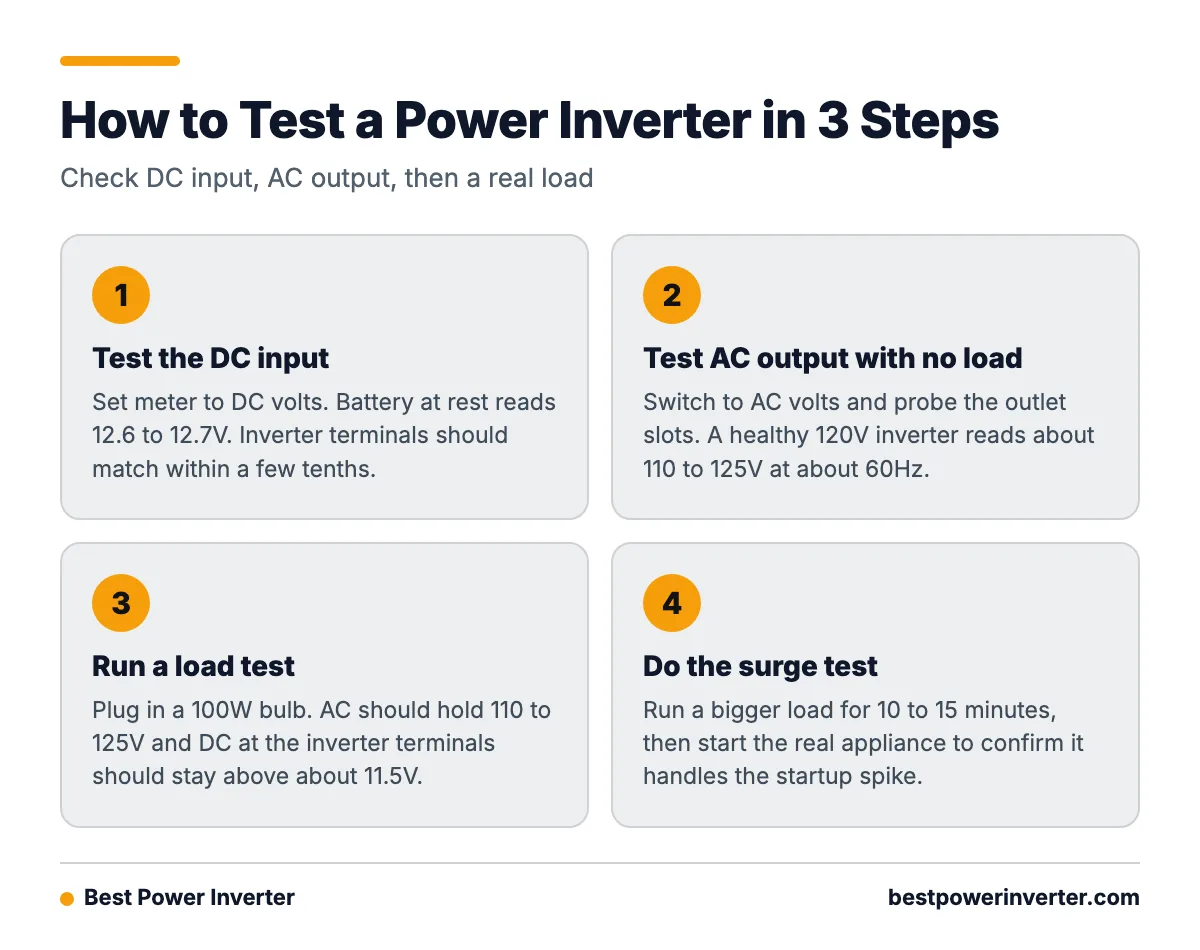
Step 1: Test the DC input
Turn the dial to DC volts. That’s the V with a straight line above it. If your meter isn’t auto-ranging, pick the 20V range.
- With the engine off and the inverter off, touch the red probe to the battery’s positive post and the black probe to the negative post. A fully charged 12V lead-acid battery rests at about 12.6-12.7V. About 12.2V means it’s only around half charged.
- Now probe the inverter’s own input terminals. The reading should match the battery within a few tenths of a volt. If it’s lower, look for a loose lug, corrosion, or a bad fuse between them.
- Start the engine and check again. With the alternator running, most systems read about 13.7-14.7V.
You’ll come back to these terminals in Step 3. That under-load reading tells you the most. For background on how the DC side feeds an inverter, see this explainer on how inverters use DC battery power.
Step 2: Test the AC output with no load
Switch the dial to AC volts (V with a wavy line). Use the 200V range or higher if you have to pick one. Turn the inverter on with nothing plugged in.
Put one probe in each of the two flat slots of the outlet. A healthy 120V inverter reads about 110-125V. If your meter has a Hz setting, check the frequency too. It should read about 60Hz for US-style inverters.
A reading of 0V doesn’t always mean it’s dead. Many inverters have a “search” or power-saving mode. It turns the output off until it senses a load. Plug in the bulb and test again before you blame the inverter.
Step 3: Run a load test
This is the real test. Plug in your 100W bulb, then measure again. Watch four things:
- AC output should stay in the 110-125V range.
- DC voltage at the inverter terminals should stay above about 11.5V.
- The fan should spin up on most models once the load grows.
- The case can get warm, but it shouldn’t get too hot to touch.
If all four look good, step up to the heater or kettle on low. Let it run for 10-15 minutes. Then do the surge test: plug in the real appliance you care about and switch it on. A fridge, pump, or laser printer pulls a big spike at startup. An inverter can pass the bulb test and still trip here.
Test checklist
| Check | Meter setting | Where to probe | Healthy reading | If it’s out of range |
|---|---|---|---|---|
| Battery at rest | DC volts | Battery posts, engine off | 12.4-12.7V | Under 12.2V: battery is half charged or weaker. Charge it first. |
| Engine running | DC volts | Battery posts | About 13.7-14.7V | Low: charging system issue, not the inverter. |
| Inverter input, no load | DC volts | Inverter + and − terminals | Matches battery within a few tenths | Lower: loose lug, corrosion, or bad fuse. |
| Inverter input, under load | DC volts | Inverter + and − terminals | Above about 11.5V | Under 11.5V: cable or battery problem, not the inverter. |
| AC output, no load | AC volts | Outlet slots | 110-125V (true-RMS meter) | 0V: off, tripped, or in search mode. Odd number: may be your meter. |
| AC output, under load | AC volts | Outlet slots or power strip | Stays 110-125V | Big drop: overloaded inverter or weak DC supply. |
| Input current | DC amps (clamp) | Around the positive cable | About 9-10A per 100W of load | Much higher: the load is bigger than you think. |
What AC voltage should a working inverter read?
A working 120V inverter should read about 110-125V AC on a true-RMS meter. If your inverter is a modified sine wave model and your meter is a basic one, the number can be way off. That doesn’t mean the inverter is broken.
Here’s why. A pure sine wave inverter makes a smooth wave, just like the power from your wall. A modified sine wave inverter makes a choppy, stair-step wave. Cheap meters are “average-responding.” They assume the wave is smooth and do a quick math shortcut. On a choppy wave, that shortcut fails. The meter may show anywhere from about 90V to 130V even when the inverter is perfectly fine.
How big of a power drain is an inverter?
An inverter drains about 9-10A from a 12V battery for every 100W you run, plus a small “idle draw” even when nothing is plugged in. Idle draw (also called no-load draw) is the power the inverter uses just to stay switched on.
For typical consumer inverters at 12V, idle draw runs about 0.2-1A for small units and about 1-3A or more for 2000W and larger units. That sounds tiny. It isn’t. Over 24 hours, 1A of idle draw removes about 24Ah from your battery. A big inverter left on overnight can flatten a starter battery. Many owners blame the inverter for “killing” the battery when it was only left on.
How to measure it: Set your clamp meter to DC amps and zero it with the jaws closed on nothing. Turn the inverter on with nothing plugged in. Clamp around the positive cable only (clamping both cables cancels the reading). That number is your idle draw. Plug in a load and read it again to see your current under load.
The formula for current under load is simple: DC amps ≈ AC watts ÷ battery voltage ÷ efficiency. Efficiency is how much of the battery’s power actually reaches your outlet. For most inverters, it’s around 85-90%.
Worked example
Someone wants to run a 1000W load from a 12V inverter that’s about 88% efficient.
Current: 1000 ÷ 12 ÷ 0.88 ≈ 95A from the battery.
Cable: 95A is a lot. That calls for heavy cable, about 4 AWG copper for a short run of a few feet, and 2 AWG if the run is longer. Thin cable will heat up and drop voltage.
Fuse: A fuse is normally sized a bit above the steady current and must not be larger than the cable can carry. Here, that points to about a 125A fuse, mounted close to the battery.
Runtime: A 100Ah lead-acid battery should only go down to about 50% to avoid damage. That leaves about 50Ah. 50Ah ÷ 95A ≈ 0.53 hours, or about 30 minutes. In practice it’s often less, because lead-acid batteries give up less of their capacity at high currents.
Plug in your own numbers: your load in watts, your battery voltage, and 0.88 for efficiency.
What do beeps, flashing lights, and shutdowns mean?
Most beeps and shutdowns during a test come from one of five built-in protections. Each one points to a different cause. Exact light colors and beep patterns differ by brand, so check your manual for the codes.
| Warning | What triggers it | What to check |
|---|---|---|
| Low-voltage alarm (beeping) | Input drops to about 10.5-11V on most 12V inverters | DC voltage at the inverter terminals under load |
| Low-voltage shutdown | Input drops to about 10-10.5V | Battery charge, cable size, loose connections |
| Overload | Load is bigger than the inverter’s rating | Running watts and startup surge of the appliance |
| Over-temperature | Inverter gets too hot | Blocked vents, dead fan, heat from the engine bay |
| Short circuit | Output wiring or the appliance is shorted | Unplug everything and test with the bulb alone |
The low-voltage alarm is the one that fools people most. It’s measured at the inverter’s input, not at the battery. Thin or long cables can drop the voltage enough to set it off while the battery itself is healthy.
Is the problem the inverter or the battery, cables, or fuse?
Measure DC voltage at the inverter terminals while a load is running. If that number sinks below about 11.5V, the supply is the problem. If it stays solid and the inverter still won’t produce good AC power, the inverter is the problem.
Here’s why this one test matters so much. A battery can read 12.6V at rest and still be weak. It only shows its weakness when current flows. The same goes for undersized cables and corroded fuse holders. They look fine at rest and fall apart under load.
Try this extra check: with the load running, measure at the battery posts and then at the inverter terminals. If the inverter reads more than about half a volt lower than the battery, you’re losing power in the cables, lugs, or fuse.
| Symptom | Most likely cause | What to do |
|---|---|---|
| No lights at all | No DC reaching the inverter: blown fuse, loose cable, dead battery | Check DC at the inverter terminals. Then check the fuse with the meter. |
| Beeps, then shuts off | Input voltage sagging to the alarm or cutoff level | Measure DC at the terminals under load. Charge the battery or upsize the cables. |
| Works with engine running, not with engine off | Weak or discharged battery. The alternator was covering for it. | Charge and load-test the battery. |
| Meter reads about 100V at the outlet | Average-responding meter on a modified sine wave | Use a true-RMS meter or run the bulb test. |
| Shuts off the moment an appliance starts | Startup surge is bigger than the inverter’s surge rating | Compare the appliance’s surge to the inverter’s spec. Size up. |
| Output drops under load | Inverter near its limit, or DC input sagging | Check DC at the terminals. Reduce the load. |
| Appliance hums, buzzes, or runs hot | Modified sine wave output on a motor or sensitive device | Use a pure sine wave inverter for that appliance. |
If DC at the terminals is low at rest → fix the fuse, lugs, or battery first.
If DC is fine at rest but drops below about 11.5V under load → the battery is weak or the cables are too thin.
If DC stays above 11.5V under load but AC output is missing or unstable → the inverter is likely faulty.
If everything passes with the bulb but the real appliance trips it → the inverter is too small for that startup surge.
How to test a power inverter on an RV
To test an RV inverter, unplug shore power, turn off the generator, and then check the inverter-fed outlets with your meter. If shore power or the generator is still on, you’re testing those instead of the inverter. That’s the most common mistake.
- Cut outside power. Unplug the shore power cord and shut off the generator. Some RVs have an auto-start generator. Disable it for the test.
- Turn on the battery disconnect. This switch links your house batteries to the rest of the coach. If it’s off, the inverter gets nothing.
- Switch the inverter on. Use the wall remote or the switch on the unit.
- Find the inverter-fed outlets. Most RVs don’t power every outlet from the inverter. Look for labels, or check your owner’s manual for which circuits run through the inverter. Test those outlets with your meter on AC volts.
- Run the load test. Use the same bulb, then the bigger load, and check DC voltage at the inverter’s battery terminals under load.
- Test the transfer switch. A transfer switch automatically swaps your outlets between shore power and the inverter. With a load running on the inverter, plug shore power back in. Within a few seconds, the outlets should switch over and the inverter should stop pulling from the battery. Your clamp meter will show the DC current fall.
- Check charger mode. Many RVs use an inverter/charger. It inverts when you’re off-grid and charges the batteries when shore power is connected. With shore power on, the battery voltage should rise into the charging range, about 13.7-14.7V for lead-acid.

Also check the inverter/charger’s settings. Search mode, low-voltage cutoff, and “charger only” modes can all make a working unit look dead.
What size inverter do you need?
Pick an inverter whose continuous rating covers your running watts with some headroom, and whose surge rating covers the startup spike. Continuous watts is what the inverter can supply nonstop. Surge watts is the short burst it can give for a second or two when a motor starts.
Motor and compressor loads like sump pumps and fridges commonly surge to about 2-3× their running watts. For tools with only an amp rating on the label, multiply amps by 120 to get watts. A 6-amp drill is about 720W.
| Load | Running watts | Startup surge | Suggested inverter |
|---|---|---|---|
| 32-inch LED TV | About 30-60W | Low | 150-300W. A 12V socket unit works. |
| Laptop | Watts on the charger label | Low | 150-300W |
| Inkjet printer | About 20-50W while printing | Low | 300W |
| Laser printer | Several hundred to over 1,000W while the fuser heats | High | 1500W or larger, pure sine wave |
| Mini fridge | About 50-100W | Several hundred watts | 600W or larger, pure sine wave |
| Corded drill | Amps × 120 (e.g. 6A ≈ 720W) | About 2-3× running | 1500W or larger for most drills |
| 1/3 hp sump pump | About 800W | About 1,500-2,500W | 1500W+ continuous with 2,500W+ surge, pure sine wave |
| 12V accessory socket limit | Usually fused at 10-20A, so about 120-200W continuous. Stick to small loads. | ||
| Battery-direct install | Limited by cable, fuse, and battery. About 1000W needs about 95A and heavy cable. | ||
For most readers, the safe rule is this: if anything on your list has a motor or a heater, size for its surge, not its running watts. To add up a full list of loads, an inverter size calculator can help you check your math.
How big of a power inverter can my truck handle?
A plug-in inverter in a truck’s 12V socket can handle only about 120-200W, because those sockets are usually fused at 10-20A. Anything bigger has to be wired straight to the battery. Beyond that, your limit is your cables, your fuse, and how much current the battery and alternator can supply.
A poor install gives bad test results. Thin cables cause voltage drop, and voltage drop triggers false low-voltage alarms. Get these points right and your readings will mean something:
- Connect to the battery directly. Don’t tap into existing wiring for anything above the socket limit.
- Use the right cable gauge. Match the cable to the current. Using the worked example above, a 1000W load at about 95A needs about 4 AWG for a short run. Keep the cables as short as you can, since every extra foot adds voltage drop.
- Fuse near the battery. Put an inline fuse on the positive cable as close to the battery as you can. The fuse protects the cable from catching fire if it gets pinched or shorted along the way.
- Ground the case. Many inverters have a separate chassis ground lug. Connect it to the truck frame as the manual directs. Run the main negative cable to the battery negative, using the same gauge as the positive.
- Give it air. Mount the inverter where air can flow around it, away from engine heat and out of the weather. Over-temperature shutdowns often trace back to a cramped spot under a seat.
- Respect the alternator. Even with the engine running, a load close to the alternator’s rated output will slowly drain the battery. Check the alternator rating before planning big loads.
For a look at what a complete wiring setup includes, see this overview of a truck inverter kit. Once the install is done, run the full three-step test again to confirm the cables hold voltage under load.
Frequently Asked Questions
How to test power inverter with multimeter?
Set the meter to DC volts and check the inverter’s input terminals. You want about 12.4-12.7V at rest and above about 11.5V under load. Then switch to AC volts and probe the outlet slots with the inverter on. A healthy 120V inverter reads about 110-125V on a true-RMS meter. Finish with a load test using a 100W bulb.
How to test power inverter on RV?
Unplug shore power and turn off the generator so only the batteries feed the system. Turn on the battery disconnect and the inverter, then check the inverter-fed outlets with your meter on AC volts. Plug shore power back in during a load to confirm the transfer switch hands the load over.
How big power inverter to run sump pump?
A 1/3 hp sump pump running about 800W can need roughly 1,500-2,500W of surge at startup. Choose an inverter with at least 1500W continuous and a surge rating of 2,500W or more. Pure sine wave is the better choice for motors, since they can hum and run hot on modified sine wave power.
How big of a power drain is an inverter?
Under load, a 12V inverter draws about 9-10A for every 100W you run. With nothing plugged in, it still uses about 0.2-1A for small units and 1-3A or more for 2000W+ units. Over 24 hours, 1A of idle draw removes about 24Ah, so switch the inverter off when you’re not using it.
How big power inverter for 5000w battery?
Battery size doesn’t set the inverter size. Your loads do, along with how much current the battery can safely deliver. If you mean a 5000Wh battery, check its maximum discharge current on the spec sheet. Multiply that current by the battery voltage and by about 0.88 to get the most AC watts it can support. Then pick an inverter that covers your loads without going over that limit.
How big an inverter to power a 32 TV?
A 32-inch LED TV typically uses about 30-60W, so a 150-300W inverter is plenty. That size can run from a 12V accessory socket. Check the watts on your TV’s label to confirm.
How big inverter to power printer?
An inkjet printer uses about 20-50W while printing, so a 300W inverter works. A laser printer is very different. Its fuser can briefly draw several hundred to over 1,000W, so plan on a 1500W or larger pure sine wave inverter.
Sources