
To hardwire a power inverter, run correctly sized copper cable from the battery positive through a fuse and a disconnect to the inverter’s positive terminal. Then connect the negative cable straight to the battery negative or a bus bar, and ground the inverter chassis. Size the inverter to your running load plus 20-25% headroom, and size the cable so voltage drop stays under 2-3% at the inverter’s maximum DC current.
Quick answer
Put a Class T or ANL fuse on the positive cable within about 7 inches of the battery. Add a DC disconnect, use short, thick, crimped copper cable, and ground the chassis. Use 24V or 48V once the inverter passes about 3000W.
- Best for 1000-2000W: 12V with 2 AWG to 2/0 cable
- Best for 3000W and up: 24V or 48V to keep amps low
- Hardwire anything above roughly 300-400W continuous. Lighter plugs and clamps overheat.
- Amps equal watts divided by volts, plus losses. A 2000W inverter at 12V pulls about 190A at full load.
- The fuse protects the cable, so rate it for the cable’s ampacity and place it close to the battery.
- Motors like sump pumps and drills can need 2-3x their running watts for a moment at startup.
- Idle draw is real. A 2000W unit can burn 20-60W doing nothing.
- Panel or transfer switch connections need a qualified electrician.
- What does hardwiring an inverter mean?
- How big a power inverter do you need?
- How big of a power inverter can my truck handle?
- What wire gauge and fuse size do you need?
- Why do 3000W+ inverters need 24V or 48V?
- Where do the fuse, disconnect and ground go?
- How to hardwire a power inverter to a car battery
- Worked example: 2000W on 12V
- Can you hardwire an inverter to household wiring?
- Modified or pure sine wave?
- Common mistakes and troubleshooting
- What do owners say?
- Frequently Asked Questions
What does hardwiring an inverter mean?
Hardwiring means the inverter connects to the battery with fixed cable, lugs and bolted terminals. It does not use a cigarette lighter plug or alligator clamps. The connection is permanent, fused and sized for the load.
You need it once the load passes roughly 300-400W continuous. Lighter sockets are usually rated for about 10-15A. Clamps work loose, heat up and drop voltage. Both cause low-voltage shutdowns and, at worst, melted plastic.
How big a power inverter do you need?
Add up the running watts of everything you will use at the same time. Then add 20-25% headroom. Check the largest startup surge against the inverter’s surge rating.
Running watts are what a device uses once it is going. Surge watts are the short spike at startup. Motors, compressors and pumps spike the most. Resistive loads like heaters barely spike at all.
How do I calculate inverter size for a sump pump, mini fridge, 32-inch TV, printer or power drill?
Use the running watts, then check the surge. The table below uses typical ranges. Read the nameplate on your own device, since models vary. For more on sizing charts, see this inverter size chart.
| Appliance | Running watts | Surge | Suggested inverter |
|---|---|---|---|
| Sump pump (1/3-1/2 HP) | About 800-1050W | 2-3x running | 3000W pure sine |
| Mini fridge | About 50-100W | 300-600W | 1000W |
| 32-inch TV | About 30-60W | Low | 300-500W |
| Inkjet printer | About 20-50W | Low | 300-500W |
| Laser printer | Idle low, peaks 300-600W | Heating peak | 1000W |
| Corded drill | About 500-800W | Higher at startup | 1500-2000W |
Notice the sump pump. Its running watts look modest, but a 2-3x surge pushes the start load to roughly 2400-3150W. Pick the inverter by the surge, not the running number.

How big of a power inverter can my truck handle?
Most trucks and cars can handle a 1000-2000W inverter if the battery is healthy and the engine is running. Beyond that, add a second or house battery. The alternator does not feed the inverter directly in a way that avoids battery strain, and the battery takes the surge.
Do the math. Divide watts by volts, then add 10-15% for losses. A 1000W load is about 93A at 12V. Many alternators put out 100-200A, and the truck itself needs some of that. As a rule of thumb, keep the inverter’s continuous draw well below the alternator’s rating. For larger loads, use a dedicated battery bank. A good truck inverter installation overview covers vehicle-specific routing.
What wire gauge and fuse size do you need?
The table shows max DC amps at about 90% efficiency, suggested minimum copper cable, and fuse size. These are typical starting points aimed at 3% voltage drop or less. Always check your inverter’s manual and an ampacity chart. Run lengths are one-way distances from battery to inverter.
| Inverter | System | Max DC amps | Cable, 5 ft | Cable, 10 ft | Fuse |
|---|---|---|---|---|---|
| 1000W | 12V | ~93A | 2 AWG | 1/0 AWG | 125A |
| 1000W | 24V | ~46A | 8 AWG | 6 AWG | 60A |
| 1000W | 48V | ~23A | 10 AWG | 8 AWG | 30A |
| 2000W | 12V | ~185A | 2/0 AWG | 3/0 AWG | 250A |
| 2000W | 24V | ~93A | 2 AWG | 1/0 AWG | 125A |
| 2000W | 48V | ~46A | 6 AWG | 6 AWG | 60A |
| 3000W | 12V | ~278A | 4/0 AWG | 4/0 AWG | 300A+ |
| 3000W | 24V | ~139A | 1/0 AWG | 2/0 AWG | 175A |
| 3000W | 48V | ~69A | 4 AWG | 4 AWG | 100A |
| 4000W | 12V | ~370A | Not practical | Not practical | – |
| 4000W | 24V | ~185A | 2/0 AWG | 3/0 AWG | 250A |
| 4000W | 48V | ~93A | 4 AWG | 2 AWG | 125A |
| 5000W | 12V | ~463A | Not practical | Not practical | – |
| 5000W | 24V | ~231A | 4/0 AWG | 4/0 AWG | 300A |
| 5000W | 48V | ~116A | 2 AWG | 2 AWG | 150A |
The fuse protects the cable. Rate it for the cable’s ampacity, not above it, and make sure it still sits above the inverter’s maximum draw so it does not blow in normal use. Class T fuses are common with lithium banks because they handle very high fault current. ANL fuses are common in vehicles and boats.
Why do 3000W+ inverters need 24V or 48V?
Because current climbs too high at 12V. Above about 3000W, a 12V inverter pulls more than 250A. That means huge cable, huge fuses and big losses.
Double the voltage and the amps drop by half. A 4000W inverter at 12V pulls roughly 370A. At 48V it pulls about 93A, which is the same cable you might use for a 1000W inverter at 12V. That is why a 48 volt power inverter is the usual choice for 4000W and 5000W battery-based setups. Cable stays cheaper, heat stays lower, and voltage drop matters less.
- Up to about 2000W, short cable runs: 12V is fine.
- 2000-3000W: 24V is easier on the wiring.
- 4000W or more: 48V, as it keeps amps and cable size manageable.
Where do the fuse, disconnect and ground go?
Put the fuse on the positive cable as close to the battery as practical. ABYC guidance for boats commonly cites within about 7 inches. Put the disconnect after the fuse, on the positive side, where you can reach it. Ground the inverter chassis to the vehicle frame or boat bonding system as the manual directs.
The negative cable goes straight to the battery negative or a bus bar, not to a random chassis bolt. If you use a shunt for monitoring, the inverter negative goes on the load side of the shunt.
How to hardwire a power inverter to a car battery
Here is how to hardwire a power inverter to a car battery, step by step. Make sure the inverter switch is off first.
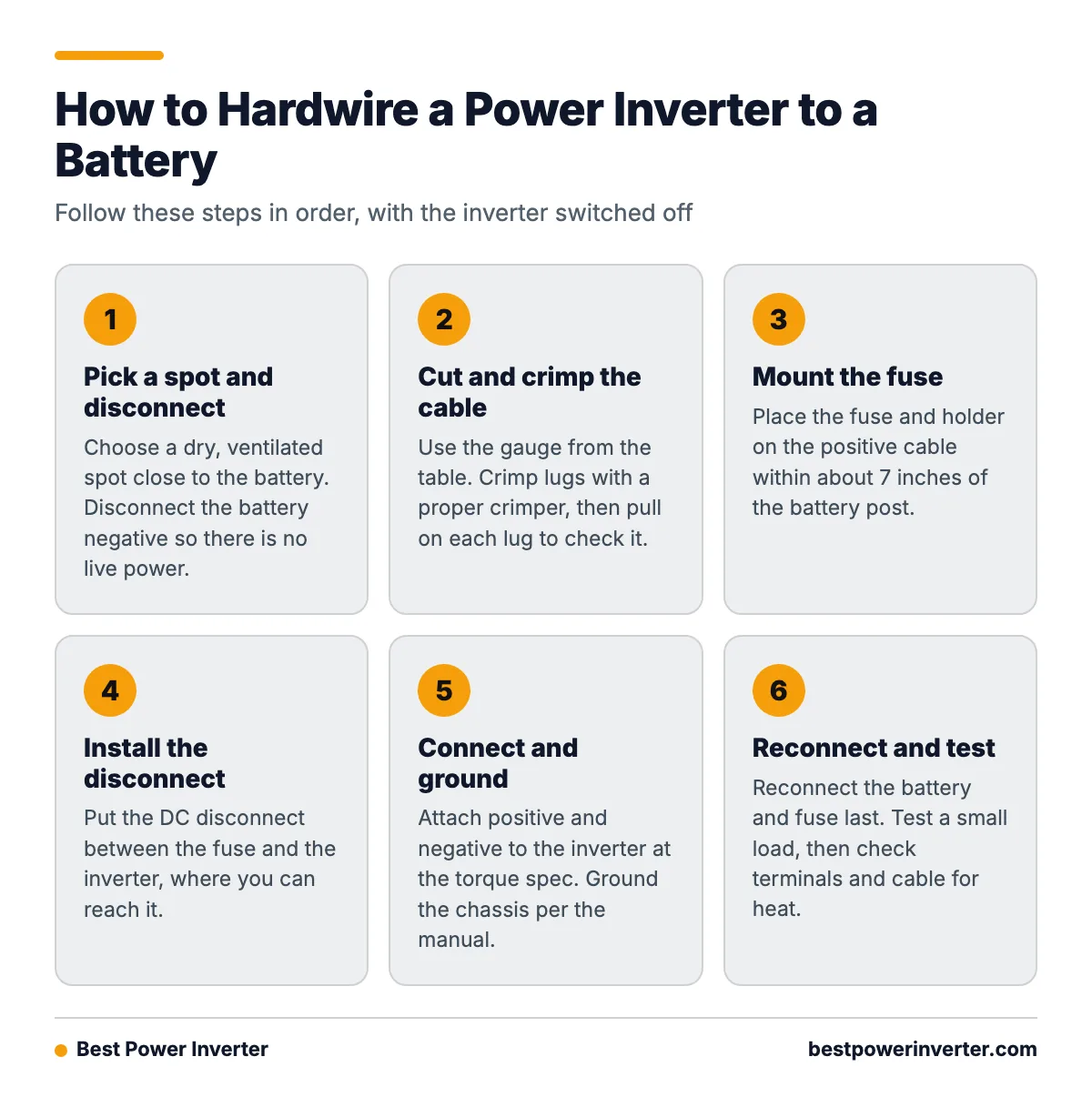
- Pick a spot. Dry, ventilated, and as close to the battery as you can. Keep the cable short.
- Disconnect the battery negative. Work with no live power.
- Cut the cable. Use the gauge from the table. Red for positive, black for negative. Cut clean with a proper cable cutter.
- Crimp the lugs. Strip the cable, slide on heat shrink, and use a hydraulic or heavy-duty hammer crimper. Tinned copper lugs resist corrosion. Pull on each lug to check it.
- Mount the fuse and holder within about 7 inches of the positive post.
- Install the disconnect between the fuse and the inverter.
- Run the cables. Use grommets where they pass through metal. Do not pinch or kink them.
- Connect to the inverter positive and negative. Follow the manufacturer’s torque spec on the terminals.
- Attach the chassis ground per the manual.
- Reconnect the battery and fuse last. You may see a small spark when you first connect, as the inverter’s capacitors charge. That is normal on many units.
- Test with a small load. Then check terminals and cable for heat after a few minutes under real load.

From the Shop
Based on patterns in owner reviews: many shutdown complaints trace back to the installation. Included cables are often short or thin, and a loose lug can cause heat and voltage sag. Owners report that replacing the kit cables with correctly sized ones often fixes what looked like a bad inverter.
Worked example: 2000W on 12V
Take a 2000W pure sine wave inverter on a 12V system, like the Renogy 2000W models sold for RV and truck use. Check your own model’s manual for its exact specs.
- Full-load current: 2000W / 12V = about 167A at 100% efficiency. At about 90% efficiency, roughly 185-190A.
- Cable: 2/0 AWG for a short run, 3/0 for 10 feet.
- Fuse: about 250A Class T or ANL.
- Battery: a 200Ah LiFePO4 battery holds about 2,560Wh. At full load, it lasts roughly one hour.
- Realistic load: 500W means about 43A from the battery. Using 160Ah (80%), that is about 3.7 hours.
How much power does an inverter draw when idle and with no load?
Typical idle draw is roughly 0.5-2% of the inverter’s rating. On a 2000W unit that is about 20-60W, or about 2-5A at 12V. Take 40W as an example. That is about 3.3A, or roughly 80Ah in 24 hours. A 100Ah lead-acid battery with 50Ah usable would be flat in about 15 hours. Switch the inverter off when you are not using it, or add a remote switch.
That answers how big of a power drain is an inverter when doing nothing: small per hour, large per day.
Can you hardwire an inverter to household wiring?
Yes, but only through a proper transfer switch or an inverter/charger with a built-in transfer function, and with a qualified electrician. Never plug an inverter into a wall outlet to backfeed a house. That can energize utility lines and injure line workers.
- Use a transfer switch so the house cannot connect to the grid and inverter at once.
- Feed only a dedicated, protected sub-panel for the circuits you want to back up.
- Use GFCI protection where the code requires it, such as outdoor, bath and kitchen outlets.
- Check how the inverter handles the neutral-to-ground bond. Wrong bonding can trip GFCIs or cause shock risk.
Panel work and code rules vary by location. For vehicles and RVs, a simple outlet box with a GFCI outlet is common. The Eaton power inverter buying guide is a helpful read on feature choices.
What is the difference between modified sine wave and pure sine wave for hardwired use?
Pure sine wave output matches household power. Modified sine wave is a blocky approximation that costs less. For a permanent install, pure sine is usually the better pick.
Motors run cooler and quieter on pure sine. Sensitive electronics, medical gear, laser printers and some chargers can misbehave or buzz on modified sine. Modified sine can work for simple tools and basic lights. If the install is permanent, the extra cost of pure sine is usually worth it.
Common mistakes and troubleshooting
Pre-install safety checklist
- Cable gauge matches the table and the manual.
- Fuse is within about 7 inches of the battery, on the positive.
- A DC disconnect is installed and reachable.
- Lugs are crimped, not just squeezed with pliers.
- Terminals are torqued to spec.
- The chassis is grounded.
- The area has airflow, with no fabric or boxes blocking vents.
- Battery bank is big enough for the surge and runtime.
Troubleshooting list
- Low-voltage alarm: check for undersized cable, a weak or discharged battery, or a loose terminal. Measure voltage at the inverter under load.
- Overheating: clear the vents, lower the load, check ambient heat and fan operation.
- Voltage drop: shorten the run, use thicker cable, or move up to 24V or 48V.
- Loose terminals: warm lugs mean a poor connection. Turn it off, retighten and recheck crimps.
- Shutdown on motor start: the surge is above the inverter’s rating. Size up or add a soft starter.
What do owners say?
Owners like
- Pure sine wave inverters run sensitive electronics and motors quietly and cleanly.
- Hardwired installs are stable and avoid the overheating or voltage drop of clamps and lighter-socket plugs.
- Remote switch or display and built-in low-voltage and overload protection are valued.
- Compact, rugged units suit RV, van and truck installs.
Common complaints
- Cooling fans can be noisy under load.
- Stated surge or continuous ratings are sometimes not met in practice, with units shutting down on motor starts.
- Idle draw drains batteries when left on.
- Included cables, lugs or fuses are often too short or too thin, so owners buy their own.
- Low-voltage shutdowns caused by undersized cable or weak batteries are commonly misdiagnosed as a faulty inverter.
Summarised from owner reviews and long-term user reports; individual experiences vary.
Frequently Asked Questions
How to hardwire power inverter to car battery?
Fit a fuse on the positive cable within about 7 inches of the battery, add a disconnect, and run correctly sized cable to the inverter. Connect the negative to the battery negative or bus bar, and ground the chassis. See the step-by-step section above.
How to hardwire a power inverter?
The method is the same for any battery: fused positive, disconnect, short thick cable, solid crimped lugs, direct negative and a chassis ground. Match cable and fuse to the inverter’s maximum DC amps and the system voltage.
How big power inverter to run sump pump?
A 1/3-1/2 HP sump pump runs at about 800-1050W and can surge 2-3x. A 3000W pure sine wave inverter is the usual choice, ideally on 24V or 48V. Check the pump’s nameplate first.
48 volt power inverter: when does it make sense?
It makes sense for 3000W and above. At 48V a 4000W inverter pulls about 93A at ~90% efficiency instead of roughly 370A at 12V, so cable and fuses are smaller and cheaper.
How big of a power drain is an inverter?
Idle draw is roughly 0.5-2% of the rating. On a 2000W unit that is about 20-60W, or 2-5A at 12V. Left on, it can drain a battery in a day or two.
How big power inverter for 5000W battery?
If you mean a 5000W load, choose a 5000W inverter at 24V or 48V, with 48V preferred. At 48V it draws about 116A at full load, so 2 AWG cable and a 150A fuse is a typical starting point. Add headroom if your loads include motors.
How big an inverter to power a 32 tv?
A 32-inch TV uses about 30-60W. A 300-500W inverter handles it easily, with room for a streaming box or console.
How big of a power inverter can my truck handle?
Most trucks handle 1000-2000W with the engine running and a healthy battery. For more, add a house battery bank and a higher system voltage. Keep the continuous draw well under what the alternator can supply.
4000 watt power inverter: what cable and voltage?
Use 24V or 48V. At 24V it draws about 185A, needing 2/0-3/0 cable and a 250A fuse. At 48V it draws about 93A, needing 2-4 AWG and a 125A fuse. At 12V it is impractical.
How big inverter to power printer?
An inkjet needs about 20-50W, so a 300-500W inverter is plenty. A laser printer can peak at 300-600W while heating, so choose a 1000W pure sine wave unit.
Sources