
Most DIY solar, RV, off-grid, and backup-power buyers with larger systems should choose 48V, because it moves the same watts with far less current than 12V or 24V. The inverter turns 48V battery power into 120V AC household power.
- Lower current at 48V means thinner cable, less heat, and smaller losses.
- Listed 48V inverter prices run from about $100 to over $1,500, and cost climbs fast with wattage.
- A 24V inverter does not work on a 48V battery unless the maker lists that input range.
- Pure sine wave is the safer default for electronics and motors.
- Size the inverter by running watts and surge. Size the battery by watt-hours, efficiency, and depth of discharge.
- What Is a 48 Volt Power Inverter?
- When a 48V System Makes Sense
- 12V vs 24V vs 48V Inverters
- What a 12 Volt Inverter Can Power
- How to Choose the Right Wattage
- How Much a 48 Volt Inverter Costs
- Battery Cost and Bank Size
- Runtime and Efficiency
- Compatibility and Wiring Safety
- Pure Sine Wave or Modified Sine Wave
- Buying Checklist and Common Mistakes
- Frequently Asked Questions
What Is a 48 Volt Power Inverter and How Does It Work?
A battery stores DC power. Your outlets, fridge, and TV need AC. The inverter bridges that gap. It takes DC from a 48V battery bank, switches it rapidly, and shapes it into AC at 120V (or 240V on some models).
The input voltage is fixed by design. A 48V inverter expects a 48V nominal bank. For lithium iron phosphate (LiFePO4), that is usually 16 cells in series. For lead-acid, it is 24 cells, or four 12V batteries in series.
When a 48V System Makes Sense
Power is volts times amps. Raise the volts and the amps drop. A 48V system is common in higher-power off-grid and solar builds for this reason.

Lower current helps in three ways:
- Thinner cable. Less copper is needed for the same power.
- Less heat. Heat loss in a wire rises with the square of the current.
- Less voltage drop. Long runs between the battery and inverter waste less power.
Most 48V gear targets about 2,000W and up. Below roughly 1,000W, a 12V unit is usually simpler and cheaper.
- Under about 1,000W, such as a van or small cabin: choose 12V.
- About 1,000W to 3,000W: choose 24V, or 48V if you plan to grow.
- 3,000W and up, a whole-home backup, or long cable runs: choose 48V.
What Is the Difference Between 12V and 48V Inverters?
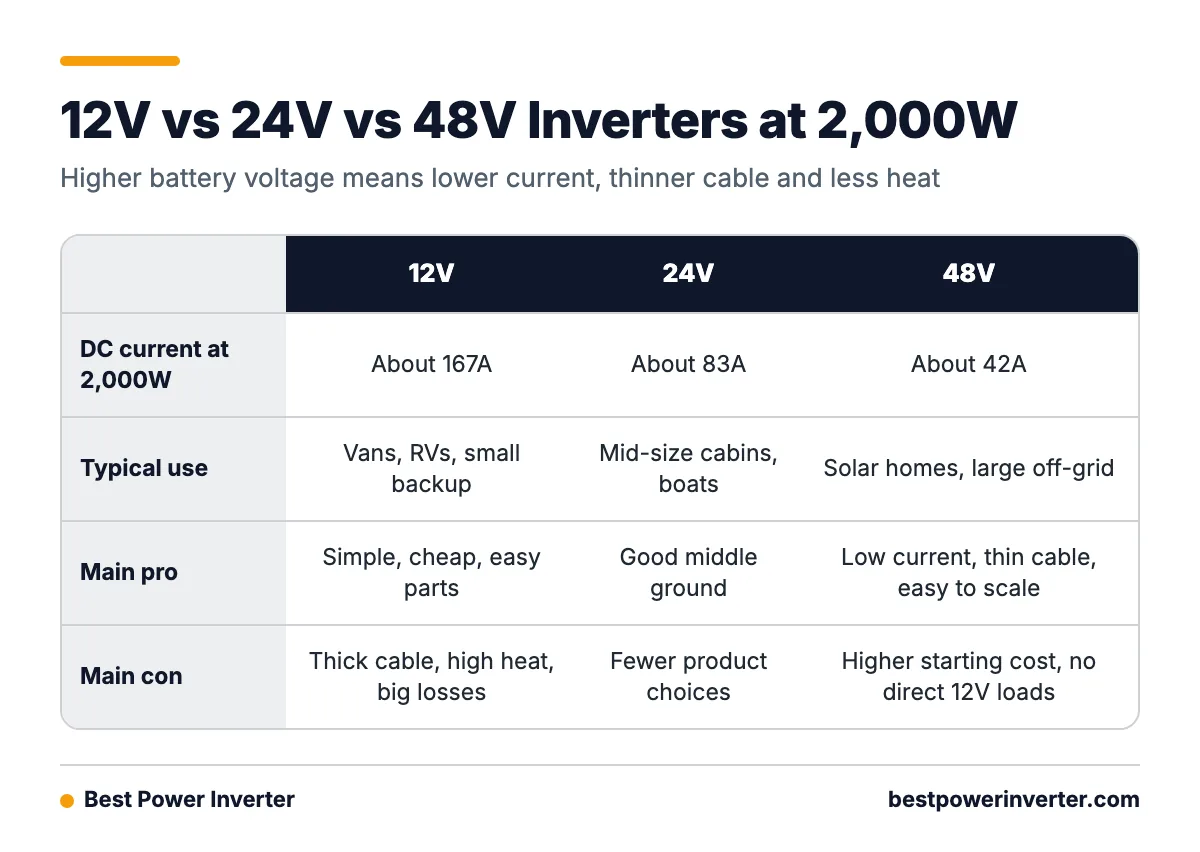
Mainly current. The table shows the DC current for a 2,000W load. These are ideal figures before inverter losses, so real current runs about 10% higher.
| System | DC Current at 2,000W | Typical Use | Pros | Cons |
|---|---|---|---|---|
| 12V | About 167A | Vans, RVs, small backup | Simple, cheap, easy parts | Thick cable, high heat, big losses |
| 24V | About 83A | Mid-size cabins, boats | Good middle ground | Fewer product choices |
| 48V | About 42A | Solar homes, large off-grid | Low current, thin cable, easy to scale | Higher starting cost, no direct 12V loads |
What Can a 12 Volt Inverter Power?
It depends on the wattage rating. Small 12V units run phone chargers, laptops, LED lights, and a TV. Mid-size units of 1,000W to 2,000W can run a fridge, a coffee maker, or a power tool. Heavy heating loads like a space heater or a large microwave push 12V systems hard because the battery current gets very high.
How Do I Choose the Right Wattage for My Appliances?
Add up the running watts of everything that will run at the same time. Then check the surge, which is the short burst a motor pulls when it starts. Compressors in fridges and air conditioners often pull two to three times their running watts for a moment. Check the label on each appliance for the real numbers.
Worked example (typical values, so check your own labels):
| Load | Running Watts |
|---|---|
| Fridge | 150W (surge may reach 450W or more) |
| TV | 100W |
| Microwave | 1,000W |
| Lights | 50W |
| Total | 1,300W |
Add 20% to 25% headroom: 1,300W × 1.25 is about 1,625W. A 2,000W inverter fits. A small window air conditioner at about 1,000W would not run alongside the microwave on this unit, so plan to run one at a time, or step up to 3,000W.
How Much Does a 48 Volt Inverter Cost?
Current listings range from about $100 to over $1,500. Price depends on wattage, wave type, brand, and extras like a built-in charger or transfer switch. Retailers such as Inverters R Us, Don Rowe, and A1 SolarStore list 48V models you can compare.
| Size | Listed Price Pattern |
|---|---|
| Small, about 375VA to 1,600VA | Roughly $100 to about $1,000, depending on brand |
| 600W pure sine example | Around $314 |
| 1,500W pure sine example | Around $953 |
| 5,000W and above | Often over $1,500 |
Cost rises quickly with output. Cheap units may lack low-voltage cutoff, strong surge ratings, or solid warranty support. Prices change often, so confirm before buying.
How Much Does a 48 Volt Inverter Battery Cost, and What Bank Size Do I Need?
No single price fits. Cost depends on chemistry, capacity, and whether you mean one battery or a full bank. Lithium costs more upfront and gives more usable capacity. Lead-acid costs less per battery but should only be drained about 50%.
To size the bank, use this formula:
Bank watt-hours = (load watts × hours) ÷ inverter efficiency ÷ usable depth of discharge
Divide watt-hours by 48 to get amp-hours.
Simple cost estimate: inverter price + (bank kWh × battery price per kWh). As an illustration only, assume a $953 inverter and a 4.8 kWh lithium bank at an assumed $400 per kWh. That is $953 + $1,920, about $2,873. Swap in real quotes for your own numbers.
How Long Will a 12V Battery Last With an Inverter?
Many buyers skip efficiency and depth of discharge. Do not. Take a 12V 100Ah battery: 12 × 100 = 1,200Wh on paper.
- Lithium at 80% usable: 960Wh. At 90% inverter efficiency, that is 864Wh. A 100W load runs about 8.6 hours. A 500W load runs about 1.7 hours.
- Lead-acid at 50% usable: 600Wh. At 90% efficiency, 540Wh. A 100W load runs about 5.4 hours.
48V example: a 300W average load for 10 hours needs 3,000Wh. Divide by 0.9 efficiency to get about 3,333Wh. With lithium at 80% usable, that is about 4,167Wh, or roughly 87Ah at 48V. A 100Ah 48V lithium battery covers it. Lead-acid at 50% would need about 139Ah.

Can I Use a 24V Inverter on a 48V Battery?
No, not directly. Input voltage must match the inverter spec. Feeding 48V into a 24V unit can destroy it at once. Use one only if the manufacturer lists an input range that includes 48V. Also remember that a “48V” battery charges higher than its nominal rating, so check the maximum input voltage too.
Pure Sine Wave or Modified Sine Wave: Which Should I Buy?
Both come in 48V versions. Pure sine wave is the safer default. It runs sensitive electronics, motors, and medical or audio gear cleanly. Modified sine wave costs less but can cause buzzing, extra heat, and trouble with some chargers and compressors. Buy modified only for simple resistive loads, and only if the budget forces it.
Buying Checklist and Common Mistakes
- Pure sine wave output.
- Continuous watts that cover your total load plus 20% to 25%.
- Surge rating that covers your biggest motor start.
- Input range that matches your battery chemistry and charge voltage.
- Low-voltage cutoff and overload protection.
- DC disconnect, fuse, and correct cable gauge.
- Clear warranty and support.
Common mistakes: sizing by running watts only, ignoring efficiency, mixing voltages, using undersized cable, and picking a battery by price per battery instead of price per usable kWh.
Frequently Asked Questions
What is a 48 volt power inverter?
It is a device that converts 48V DC battery power into AC power for household appliances. It is used mostly in larger solar, off-grid, and backup systems.
What is the 48 volt inverter price?
Listings run from about $100 to over $1,500. A 600W model is around $314 and a 1,500W model around $953 in current examples. Price rises with wattage and features.
What is the 48 volt inverter battery price?
It varies by chemistry, capacity, and whether you buy one battery or a full bank. Price by usable kWh, not by the single unit.
Can I use a 24V inverter on a 48V battery?
No, unless the manufacturer states that the inverter accepts 48V input. Otherwise it can be damaged. Match the inverter’s input voltage to the battery bank.
What is the difference between 12V and 48V inverters?
The battery voltage. At the same wattage, 48V draws about one quarter of the current of 12V. That means thinner cable, less heat, and lower losses.
What can a 12 volt inverter power?
Chargers, laptops, lights, and a TV on small units. Larger 12V units can run a fridge or power tools. Heavy loads like heaters strain a 12V system.
How long will a 12V battery last with an inverter?
A 12V 100Ah lithium battery runs a 100W load about 8.6 hours and a 500W load about 1.7 hours, after efficiency and 80% usable capacity. Lead-acid lasts about 40% less.