

Plug-in car inverters like the five reviewed here are rated between 200W and 400W continuous. That covers phone chargers, laptops, and camera batteries, but not hair dryers or heaters. For most drivers, the best quiet option is the BESTEK 300W, because its listing says the fan runs faster only as the unit warms or output passes 70W, and it carries a 5-year warranty. This guide ranks all five based on listing specifications and buyer ratings. It also explains sizing math, cigarette-lighter limits, and why a 3000W inverter is a different class of equipment.
Quick answer
For phones, laptops, and cameras, a 300W to 400W inverter with a temperature-controlled fan is the best quiet choice. The BESTEK 300W is our pick. Anything near 3000W draws about 250A at 12V and needs direct battery wiring.
- Best for quiet daily use: BESTEK 300W, fan speeds up only when warm or above 70W
- Best for fast charging: 400W model with 30W USB-C PD
- Best for tight budgets: PiSFAU 200W
Our Winner: BESTEK Power Inverter DC 12-17V to AC 110V – 300W Car Plug Adapter Outlet
The BESTEK combines 300W continuous output, 700W instantaneous power, a built-in 40A fuse, an aluminum housing, and a smart fan that the listing describes as very silent at light load. It has the highest rating of the group (4.5/5) and the longest warranty (60 months). For laptops, tablets, and phones, it is the most complete quiet package here.
How We Compared These Models
Based on the specifications and buyer feedback, four criteria matter most for a quiet car inverter: fan behavior (temperature-controlled or load-triggered), the gap between continuous and surge watts, the mix of AC outlets and USB ports, and built-in protection plus warranty. None of the listings publishes a decibel figure or states the waveform, so noise comparisons rely on manufacturer descriptions, not measurements. Ratings reflect Amazon buyer scores at the time of the data pull.
| Product | Key Specs | Our Choice | Action |
|---|---|---|---|
| BESTEK 300W | 300W continuous, 700W surge, 2 AC, 2 USB (4.8A each), 40A fuse, 5-year warranty | Best Overall | |
| 400W Power Inverter for Vehicles | 400W, 2 AC, 30W PD USB-C, 15W USB-C, 2x 15W USB-A, AC on/off switch | Best for Fast Charging | |
| Pro Chaser 400W | 400W continuous, 800W peak, 2 AC, 2 USB (3.1A), fan starts at 113°F | Best for Higher Output | |
| 300W Portable Charger Car Inverter | 300W, 2 AC, 4 USB-C/A ports (24W), 9.17 oz | Best for USB Ports | |
| PiSFAU 200W | 200W, 2 AC, 4 USB, insulated ABS shell, 8.5 oz | Best Budget |
Quiet-inverter shortlist: fan, noise, waveform, and connection
This table uses only what each listing states. Where a value is missing, it says so, because an unstated figure should not be read as a good one.
| Model | Continuous | Surge | Waveform | Fan behavior (per listing) | Reported noise | Connection | Suitable loads |
|---|---|---|---|---|---|---|---|
| BESTEK 300W | 300W | 700W | Not stated | Smart fan, faster when warm or above 70W | Described as very silent; no dB figure | Cigarette lighter plug, 32-inch cord | Laptops, tablets, phones |
| 400W Power Inverter | 400W | Not listed | Not stated | Temperature-controlled fan | No dB figure | Cigarette lighter adapter | Laptops, drones, phone charging |
| Pro Chaser 400W | 400W | 800W | Not stated | Fan starts at 113°F (45°C) | No dB figure | Cigarette lighter plug, 30-inch cord | Laptops, DVD players, bottle warmers |
| 300W Portable Charger | 300W | Not listed | Not stated | Upgraded intelligent fan | Described as quieter; no dB figure | Cigarette lighter adapter | Phones, cameras, game consoles, small TVs |
| PiSFAU 200W | 200W | Not listed | Not stated | Heat dissipation design, fan behavior not detailed | Described as quiet; no dB figure | Cigarette lighter adapter | Phones, tablets, light strings |
In-Depth Reviews

1. BESTEK Power Inverter 300W – Best Overall
Our Verdict: The best fit for drivers who want quiet, low-load operation and strong protection in a compact plug-in unit.
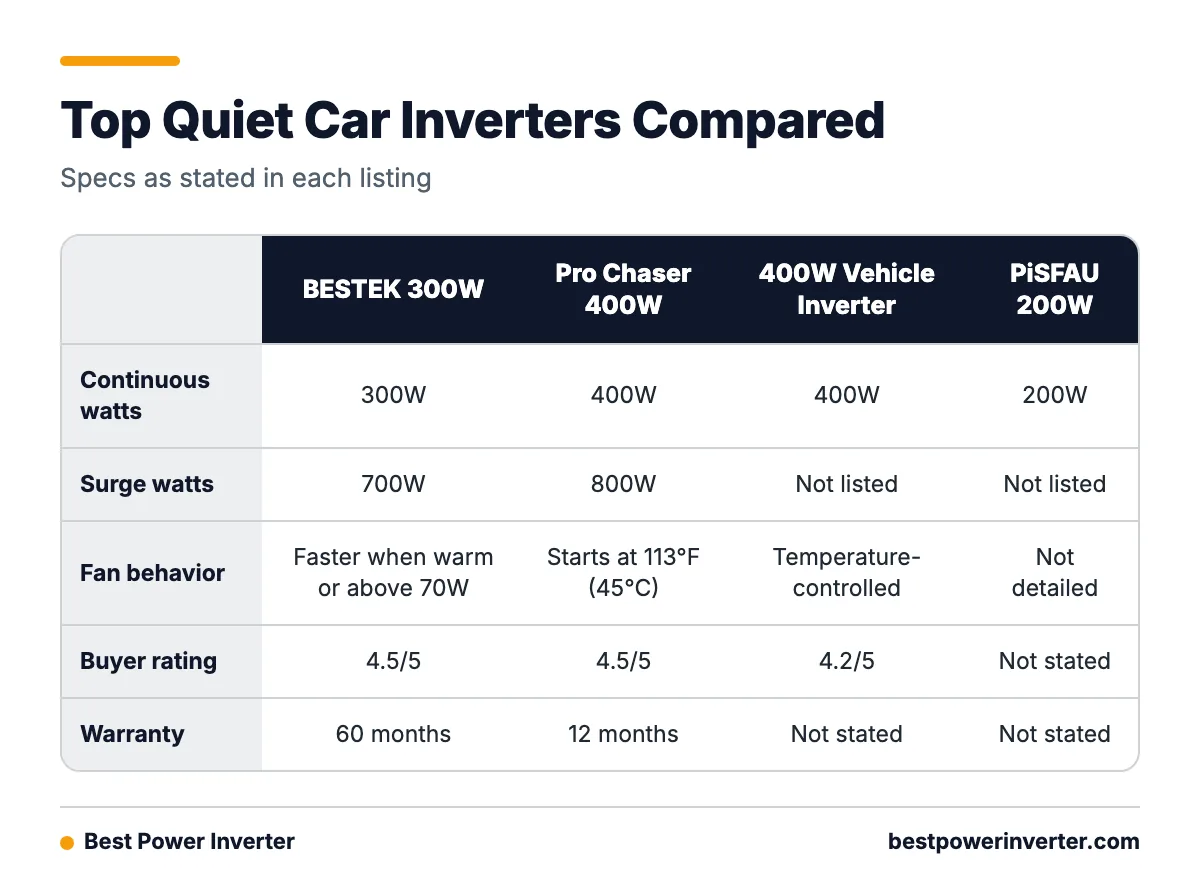
The BESTEK lists 300W continuous and 700W instantaneous power, two AC outlets, and two 4.8A USB ports. Its input range of 11V to 17V is described as compatible with Tesla vehicles. The listing says the smart fan makes the unit very silent in normal operation, then speeds up when the device warms or output exceeds 70W. That is the most specific fan description among the five.
Protection is a strength: a built-in 40A fuse, plus guards against overheating, over-voltage, under-voltage, and short circuits. The housing is aluminum, and the listing cites ETL certification. The 32-inch cord helps with placement. The warranty is 60 months.
At full 300W, the unit would pull roughly 25A from the socket before losses, so heavy sustained loads depend on your vehicle’s accessory fuse. Keep it to laptops and chargers for the best results.
Why We Like It
- Fan behavior is described in concrete terms (faster above 70W or when warm)
- Highest rating of the group (4.5/5) and a 5-year warranty
- Aluminum housing and a 40A internal fuse
Pros & Cons
Pros
- 700W instantaneous rating gives room for brief startup spikes
- Two AC outlets and two high-current USB ports
- Broad protection suite and ETL certification per the listing
Cons
- Waveform is not stated
- No published decibel rating
- 300W ceiling rules out most kitchen and heating appliances

2. 400W Power Inverter for Vehicles 12V to 110V – Best for Fast Charging
Our Verdict: The strongest USB-C setup of the group, with a handy AC switch, at a price of $29.97.
This 400W unit has two US AC outlets, a 30W PD USB-C port, a 15W USB-C port, and two 15W USB-A ports. The 30W PD port can charge recent iPhones, Android phones, and some laptops directly, so you may not need the AC outlets at all. The dedicated AC switch lets you turn the inverter section off without unplugging from the socket, which cuts idle draw and fan activity when only USB charging is needed.
The temperature-controlled fan and an LED status light (green for normal, red for faults such as overload, overheating, or under-voltage) round out the safety design. Its 4.2/5 rating is the lowest of the five, so check recent buyer comments before purchase. The listing mentions travel kettles, but most heating elements draw more than a plug-in unit should handle, so verify wattage first.
Why We Like It
- 30W PD USB-C port for modern phones and some laptops
- Separate AC switch reduces idle noise and power draw
- Clear LED fault indication
Pros & Cons
Pros
- Five output ports in total
- 400W rating for slightly larger loads
- Low price for the feature set
Cons
- Lowest buyer rating of the group (4.2/5)
- Surge rating and waveform not listed
- No published noise figure

3. Pro Chaser 400W Power Inverter – Best for Higher Output
Our Verdict: A solid choice for 300W to 400W devices, with an 800W peak rating for brief spikes.
The Pro Chaser lists 400W continuous and 800W peak output, dual 110V outlets, and two 3.1A USB ports (4.8A combined per the listing). The cooling fan starts at 113°F (45°C), which suggests it may stay idle in cool conditions and under light loads. That is a useful quiet-use detail, though no decibel figure backs it up.
The listing names laptops, breast pumps, DVD players, and bottle warmers as suitable 300W to 400W devices. It includes overload, voltage, and overheating protection and a 30-inch cord. The warranty is 12 months, shorter than the BESTEK. The maker advises using it in a cool, dry place.
Why We Like It
- Highest continuous and peak figures among the models that list a surge rating
- Defined fan activation temperature
- 4.5/5 buyer rating
Pros & Cons
Pros
- 400W continuous with 800W peak
- Fan threshold is stated in the listing
- Compact, cellphone-sized body
Cons
- 12-month warranty only
- Waveform not stated
- 400W would draw about 33A at 12V, which may exceed the socket fuse

4. 300W Portable Charger Car Power Inverter – Best for USB Ports
Our Verdict: The best option if you charge several devices at once and want a lightweight body.
This 300W model offers two 110V AC outlets and four USB-C/A ports rated at 24W, six outputs in total. It measures 5.4 x 2.75 x 1.4 inches and weighs 9.17 oz. The listing says the upgraded intelligent fan runs more stably and quietly during prolonged use, though it gives no activation temperature or decibel figure.
The listing warns against hair dryers and electric heaters, which may blow the fuse. It also mentions breast pumps and nebulizers. For any medical device, confirm the waveform requirement with the device maker, since this listing does not state the waveform.
Why We Like It
- Four 24W USB ports for family or passenger charging
- Light and compact for glove-box storage
- Clear warning about unsuitable high-wattage loads
Pros & Cons
Pros
- Six output ports
- Upgraded cooling fan described as quieter
- 4.4/5 buyer rating
Cons
- Surge rating and waveform not listed
- No warranty details in the data provided
- Not for heating or hair-care appliances

5. PiSFAU 200W Car Power Inverter – Best Budget
Our Verdict: The right pick for phones, tablets, and a single small laptop on a tight budget.
The PiSFAU is the lowest-powered unit here at 200W, with two US AC outlets and four USB ports. The listing says an efficient circuit and heat dissipation design reduce energy use and fan noise. At 2.7 x 1.4 x 5 inches and 8.5 oz, it is the lightest of the five. The shell is fully insulated ABS, and protections cover overheating, over-voltage, under-voltage, overload, and short circuit. The seller advertises returns, exchanges, and 24-hour consultation.
The 200W cap is the main limit. A 65W laptop charger and a couple of phone chargers fit easily, but anything with a motor or heating element does not.
Why We Like It
- Lowest-priced model in the group
- Lightest and smallest body
- Four USB ports plus two AC outlets
Pros & Cons
Pros
- Light load keeps heat and fan activity low
- Insulated shell and full protection set
- Returns and exchanges accepted per the listing
Cons
- Only 200W, with no surge rating listed
- Waveform not stated
- Fan behavior not described in detail
How big of a power inverter do I need for a 12V car?
For phones, tablets, cameras, and laptops, a 300W to 500W inverter is usually enough. Most charging needs fit within roughly 200W to 300W, and the extra capacity provides headroom. Power tools, heating elements, kitchen appliances, and medical equipment often need 750W to 1500W or more.
Wattage-sizing calculator
- List every device you will run at the same time and note its running watts from the label.
- Add them together to get total simultaneous running watts.
- Multiply by 1.25 to 1.5 to add 25% to 50% headroom.
- Separately check motor or compressor startup surge against the inverter’s surge rating.
Illustrative example: a 65W laptop charger, a 20W phone charger, and a 15W camera charger total 100W. With 50% headroom, you need at least 150W. Any of the five models above covers that comfortably.
Surge example: suppose a small compressor cooler is labeled 150W running and 450W at startup. Running watts with 25% headroom is about 188W, but the startup spike needs an inverter whose surge rating clears 450W. Among these models, only the BESTEK (700W) and Pro Chaser (800W) list a surge figure that high, and a motor load may still stress a plug-in unit.
What is the difference between continuous watts and peak or surge watts?
Continuous watts is what the inverter can supply indefinitely. Peak or surge watts is what it can supply for a fraction of a second, usually to start a motor or charger. Size by continuous watts first. Buyers sometimes mistake an advertised peak figure for continuous output, which is a common complaint in owner feedback.
Why is pure sine wave important for laptops, CPAP machines, chargers, and other sensitive electronics?
Pure sine wave output matches household AC and is the safer choice for sensitive electronics, chargers, medical devices, and motors. Equipment on modified sine wave power may run hot, buzz, or malfunction. None of the five listings states the waveform, so confirm it with the seller before connecting a CPAP machine or other medical equipment. When in doubt, check the device maker’s guidance.
Is a 3000W car power inverter realistic or safe in a normal car?
A 3000W inverter is realistic only with a proper installation: direct battery connection, short heavy-gauge cable, correct fusing, and an electrical system built to support it. In a typical commuter car, it is rarely practical. Owner reports describe 3000W-class units as bulky, with difficult and expensive cabling and a need for suitable battery and alternator capacity.
Worked calculation: why 3000W needs about 250A
Current equals watts divided by volts. For 3000W at 12V, that is 3000 / 12 = 250A under ideal conditions. Real inverters lose energy as heat, so demand is higher.
- 100% efficiency: 3000 / 12 = 250A
- 90% efficiency: 3000 / 0.9 / 12 = about 278A
- 80% efficiency: 3000 / 0.8 / 12 = about 313A
Those are hundreds of amps, which is why direct battery wiring is mandatory.
Can I run a 3000W power inverter from the cigarette-lighter socket?
No. Accessory sockets are not designed for hundreds of amps, and a 3000W unit would overload the wiring and fuse immediately. The same logic applies at smaller scale: a 200W load draws about 17A, 300W about 25A, and 400W about 33A at 12V before losses. Check your owner’s manual for the accessory circuit fuse, which is commonly in the 10A to 20A range. That means sustained loads near the rated maximum of a plug-in inverter can trip the vehicle fuse.
For higher wattage, look at direct-wire models, such as those in the VEVOR power inverter range, which use battery clamps or terminals rather than a socket plug.
Should I connect a 1000W or 3000W inverter directly to the battery?
Yes. Anything beyond the socket’s capacity should connect directly to the battery, with a fuse close to the positive terminal. Follow the manufacturer’s cable gauge for your run length, keep cables as short as practical, and ground the unit as instructed. Undersized or long cables are a leading cause of low-voltage shutdowns, according to owner feedback.
How much battery and alternator capacity does a high-wattage inverter require?
A 3000W load at about 278A would drain a typical starting battery in minutes, and few alternators can sustain that current. For heavy loads, run the engine so the alternator supplies current, and consider a dedicated deep-cycle battery. Check your alternator’s rated output and add up all other loads before attempting it.
How long can I use a power inverter in my car before draining the battery?
It depends on load and usable battery capacity. Illustrative example: a 100W load at 12V and 90% efficiency draws about 9.3A (100 / 0.9 / 12). If a battery has 25Ah of usable capacity, that gives roughly 2.7 hours (25 / 9.3). Avoid draining a starting battery deeply, and use a model with low-voltage shutdown. With the engine off, keep the load small and the time short. With the engine running, the alternator carries the load.
Which car inverter is quietest at low and medium loads?
Based on the listings, the BESTEK has the clearest quiet-operation description: very silent in normal use, with the fan speeding up above 70W or when warm. The Pro Chaser’s 113°F fan threshold also suggests quiet operation in cool cabins. No listing provides measured noise, so treat all quiet claims as manufacturer statements. High-wattage fans normally become more audible as internal temperature and load rise, and quiet at light load does not mean silent near full output.
Noise testing methodology you can use
- Measure with a phone decibel app at a fixed distance, such as three feet.
- Record at idle with no load, at 100W, at 300W, and near rated load.
- Note whether the fan runs at idle and when it kicks in.
- Test with the engine off, since engine noise masks fan sound.
What safety features should a quiet car power inverter have?
Look for overload, over-voltage, under-voltage, overheating, and short-circuit protection, plus a fuse. A visible status indicator helps you spot faults quickly.
Quiet-use checklist
- Fan activation temperature or load threshold stated
- Low fan noise at light load, ideally with an AC on/off switch
- Pure sine wave output for sensitive electronics
- Ventilation space around the unit, away from seats and cargo
- Cable gauge and length matched to the inverter’s rating
- Fuse rating matched to the circuit
- Low-voltage battery protection
Recommended use cases and alternatives to a 3000W inverter
If you only need phones, laptops, and cameras, a plug-in 300W model covers it. For tools or appliances in the 750W to 1500W range, a direct-wired 1000W to 2000W inverter is more appropriate. For high-draw use, a portable power station may be simpler than modifying a vehicle. Other roundups, such as this car inverter comparison, can help you shop larger sizes.
What do owners say?
Owners like
- Temperature-controlled or variable-speed fans that stay unobtrusive at light and medium loads
- Pure sine wave output that keeps laptops, chargers, and other sensitive electronics working normally
- Models offering both a cigarette-lighter option for small loads and direct battery clamps for larger ones
- LCD displays, USB ports, remotes, and clear overload or low-voltage warnings
- Compact aluminum housings and quiet operation for road trips, vans, and cabin use
Common complaints
- Fans get clearly loud at 1000W-plus or sustained near-maximum loads
- Some fans run continuously even with little or no load, adding noise and idle draw
- Confusion between advertised peak wattage and continuous output
- Low-voltage shutdowns with undersized cables, long runs, or an aging battery
- 3000W-class units are bulky and need difficult, expensive cabling and sufficient battery or alternator capacity
Summarised from owner reviews and long-term user reports; individual experiences vary.
Frequently Asked Questions
How big of power inverter for 12v car?
For phones, tablets, cameras, and laptops, 300W to 500W is usually enough. Add 25% to 50% headroom over your combined running watts, and check motor startup surges separately.
Is a car power inverter 3000w practical?
Only with direct battery wiring, heavy-gauge cable, proper fusing, and a capable battery and alternator. At 12V it draws roughly 250A to 313A depending on efficiency.
Can a 3000w car power inverter plug into the lighter socket?
No. The socket and its fuse are not built for hundreds of amps. Plug-in units are best kept to the wattage the listing states and your vehicle’s accessory fuse allows.
Is a power inverter for car 3000 watt worth it for most drivers?
Rarely. Most drivers are better served by a 300W to 500W plug-in model, or by a direct-wired 1000W to 2000W unit if they need tools or appliances.
What should I know about using a power inverter in your car?
Keep ventilation clear, run the engine for larger loads, avoid draining the battery deeply, and never exceed continuous rating. Confirm waveform before connecting medical or sensitive equipment.
Conclusion
For quiet, everyday use, the BESTEK 300W is the best overall choice thanks to its described fan behavior, 40A fuse, and 5-year warranty. The 400W model suits drivers who want fast USB-C charging, the Pro Chaser fits slightly larger loads, the 300W Portable Charger offers the most ports, and the PiSFAU 200W is the budget pick. Match the inverter to your real watts, leave headroom, and treat 3000W as a direct-wired project, not a plug-in accessory.
Affiliate Disclosure: As an Amazon Associate, we may earn commissions from qualifying purchases from Amazon.com. This comes at no extra cost to you and helps support our research.