

Most trucks can run a 300- to 1,000-watt inverter for light loads, but the real limit is set by the alternator’s unused output, the battery, the wiring, the fuse, and whether the engine is running. Among the five plug-in models reviewed here, the 400W inverter with USB-C Power Delivery is the best all-around pick for chargers, laptops, and camera gear.
Quick answer
For phones, laptops, and small chargers, a 300W to 400W plug-in inverter is enough. Anything above roughly 150W to 180W should connect directly to the battery, not a cigarette lighter outlet.
- Best for most drivers: 400W inverter with 30W USB-C (B0F7HHMR8B)
- Best for higher loads: 500W MOVFFGGRM with battery clips (B09YNBNP1J)
- Best budget: PiSFAU 200W (B0CFB6T2QN)
This guide is based on product listings, published specifications, and patterns in verified buyer reviews. It also explains how to size an inverter for a truck’s electrical system, because the wattage on the box is only part of the answer.
Our Winner: 400W Power Inverter for Vehicles 12V to 110V Inverter [Black]
It pairs two AC outlets with a 30W PD USB-C port, a 15W USB-C port, and two 15W USB-A ports. A dedicated AC switch lets you turn the outlets off without unplugging the unit, and an LED shows overload, over-voltage, under-voltage, and overheating faults. It is a practical fit for a driver who mostly charges devices.
How We Compared These Models
We compared continuous and peak wattage, the input method (cigarette lighter plug or battery clips), protection features, and port selection. We also weighed safety certification and buyer feedback on heat, fan noise, and low-voltage shutdowns. The Amazon data supplied for these listings has no detailed specification fields, so the comparison relies on each listing’s feature description.
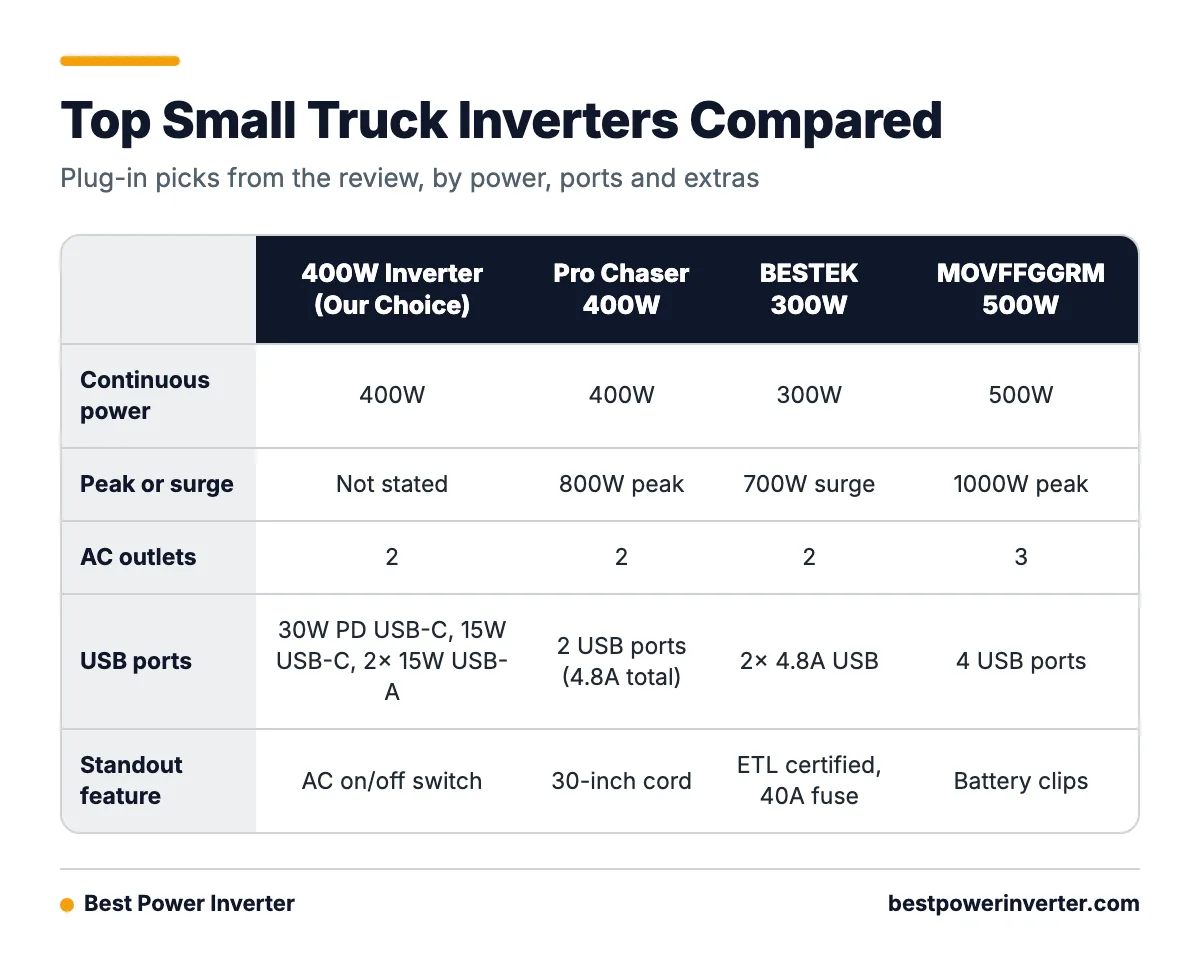
| Product | Key Specs | Our Choice | Action |
|---|---|---|---|
| 400W Power Inverter (B0F7HHMR8B) | 400W, 2 AC outlets, 30W PD USB-C, 15W USB-C, 2x 15W USB-A, AC switch | Editor’s Choice | |
| Pro Chaser 400W (B0CPDGXT5H) | 400W continuous, 800W peak, 2 AC outlets, 2 USB ports (4.8A total), 30-inch cord | Best Value | |
| BESTEK 300W (B004MDXS0U) | 300W continuous, 700W surge, 2 AC outlets, 2x 4.8A USB, 40A fuse, ETL certified | Best for Safety Certification | |
| MOVFFGGRM 500W (B09YNBNP1J) | 500W continuous, 1000W peak, modified sine wave, 3 AC outlets, 4 USB ports, battery clips | Best for Higher Loads | |
| PiSFAU 200W (B0CFB6T2QN) | 200W, 2 AC outlets, 4 USB ports, 2.7 x 1.4 x 5 in, 8.5 oz | Best Budget |
How big of a power inverter can my truck handle?
A typical truck can handle a 300W to 1,000W inverter if the alternator has spare capacity and the wiring is correct. Beyond that, you generally need an auxiliary battery, heavy cable, proper fusing, and sometimes a higher-output alternator.
Many guides quote inverter wattage without subtracting what the truck already uses. Headlights, the blower motor, the ignition system, and the engine computer all draw from the alternator first. Only the remaining output is available for an inverter.
As one reference point, a 1,100W inverter installation in a light truck may call for at least an 85-amp alternator, a Group 27 or larger deep-cycle battery, and 2-gauge cable for runs up to 15 feet one way, according to installation guidance summarized by Fleet Maintenance.
How many amps does a 1,000-watt inverter draw from a 12-volt battery?
A 1,000W load draws about 91 amps from a 12-volt system once conversion losses are included. That is far above what a cigarette lighter circuit can carry.
The worked example:
- 1,000 watts divided by 12 volts equals about 83 amps.
- Inverters lose some energy as heat. At roughly 92% efficiency, the DC demand rises to about 91 amps.
- A rule of thumb: divide AC watts by 11 to estimate DC amps.
Alternator and battery sizing must account for this continuous current, not the brief rating printed on the package.
What can I run from a 300-, 500-, or 1,000-watt truck inverter?
A 300W inverter handles laptops, phone and tablet chargers, and camera chargers. A 500W unit adds battery chargers for cordless tools and small fans. A 1,000W unit can run a small kitchen appliance or a modest corded tool, but only with a direct battery connection.
| Common Truck Load | Typical Draw | Suggested Inverter | Est. 12V Current | Pure Sine Advisable? |
|---|---|---|---|---|
| Phone and tablet charging | 10 to 40W | 150 to 300W | 1 to 4A | Optional |
| Laptop | 65 to 100W | 300W | 6 to 9A | Yes |
| Camera or drone battery charger | 50 to 100W | 300W | 5 to 9A | Yes |
| Mini cooler or small fridge | 50 to 60W running, higher at startup | 300 to 500W | 5A running | Yes |
| Cordless tool charger | 150 to 300W | 500W | 14 to 27A | Yes |
| Small appliance (coffee maker, travel kettle) | 600 to 1,000W | 1,000W, direct to battery | 55 to 91A | Yes |
| Corded tool or compressor | 1,000W+ with surge | 2,000W, auxiliary battery | 180A+ | Yes |
These figures are estimates based on the divide-by-11 rule. Check the nameplate wattage of your own equipment.
How much surge power is needed for tools, refrigerators, compressors, or pumps?
Motor-driven equipment can briefly draw several times its running wattage at startup. Size the inverter to cover the combined continuous wattage of everything used at once, plus the highest single startup surge.
A practical approach is to add about 20% headroom to the combined continuous load. Quality inverters often offer surge capacity of roughly twice the continuous rating. Peak numbers on budget listings, such as 800W or 1,000W, are brief ratings, not what the unit sustains.
Plug-in vs. direct-to-battery: what is the practical limit?
A cigarette lighter outlet is typically fused at 10 to 15 amps. At 12 volts, 15 amps works out to about 180W before any losses, so continuous loads should stay well under that.
- Plug-in (cigarette lighter): Best for loads of roughly 150W or less. Easy to install, but limited by the outlet’s fuse and thin wiring.
- Direct to battery: Required above that range. It needs correctly sized cable, an inline fuse or breaker near the battery, and a secure mounting location.
The MOVFFGGRM listing states the same limit: use the clips connected to the battery when the load exceeds 150W, because cigarette lighter fuses are usually rated below 15 amps. A 400W label on a plug-in unit does not mean the outlet can supply 400W continuously.
Should I choose a pure sine wave or modified sine wave inverter?
Choose pure sine wave for laptops, camera chargers, medical devices, compressors, and anything with a motor or sensitive electronics. Modified sine wave works for simple resistive loads such as string lights, though it can cause buzzing, extra heat, or failure to charge in some devices.
Verified buyers report that pure sine wave output works reliably with modern chargers and sensitive electronics. Of the five listings here, only the MOVFFGGRM states its waveform (modified sine wave). The others do not specify, so confirm compatibility before connecting expensive gear.
Can I run a power inverter with the truck engine off?
You can, but only briefly with a starting battery. Starting batteries are designed to deliver a large burst of current, not to be drained repeatedly.
Will an inverter drain my truck’s starting battery?
Yes, it can. Even a 100W load pulls roughly 9 amps, and a weak or aging battery can drop to a point where the truck will not start. Low-voltage shutoff protection in the inverter helps, but it may trigger at a level that still leaves little reserve.
For engine-off use beyond short charging sessions, keep the engine running or use a separate battery.
Do I need an auxiliary battery or battery isolator?
For sustained engine-off use or loads above a few hundred watts, yes. An auxiliary deep-cycle battery should be isolated from the starter battery so that running the inverter does not prevent the truck from starting. Victron Energy’s truck guidance describes this type of dual-battery setup for professional vehicles.
What fuse and cable size does a truck inverter need?
Fuse and cable must match the inverter’s maximum DC current and the cable run length. An undersized cable overheats and causes voltage drop, which is a common reason for low-voltage shutdowns.
- Place the fuse or circuit breaker near the battery, on the positive cable.
- Do not oversize the fuse. An oversized fuse can allow cables to overheat dangerously.
- Keep cable runs as short as practical. Guidance for a 1,100W installation cites 2-gauge cable for runs up to 15 feet one way.
Follow the inverter manufacturer’s table for your wattage. DMX Power’s installation guide covers cable, fuse, and connection practices in more detail.
Where should a power inverter be mounted in a truck?
Mount it in a dry, ventilated spot away from engine-compartment heat, fluids, and possible fuel vapors. Inside the cab or in a protected storage area works well for most trucks.
- Leave clearance around the fan and vents so heat can escape.
- Keep it away from moisture, splashing, and loose cargo.
- Use a solid ground connection to the chassis or battery negative.
- Keep DC cables short, secured, and protected from abrasion.
Does safety certification matter?
Yes. UL or ETL listing, including UL 458 for applicable vehicle power-conversion equipment, provides independent safety evaluation. Of the products below, the BESTEK listing states ETL certification. The other listings describe built-in protections but do not name a certification.
Truck inverter sizing checklist
- Alternator reserve: Subtract the truck’s existing electrical load from alternator output.
- Battery type: Starting battery for brief charging only; isolated deep-cycle for engine-off use.
- Combined load: Add the wattage of everything running at once, then add about 20%.
- Surge wattage: Confirm the inverter can cover the largest startup surge.
- Cable length and gauge: Shorter and thicker is better.
- Fuse rating: Sized to the cable and inverter, placed near the battery.
- Waveform: Pure sine wave for sensitive electronics and motors.
- Mounting location: Dry, ventilated, away from engine heat and fuel vapors.
In-Depth Reviews

1. 400W Power Inverter for Vehicles 12V to 110V Inverter [Black] – Editor’s Choice
Our Verdict: The most complete set of ports and controls in this group, which suits drivers who charge many devices at once.
Based on the listing, this model offers two standard US AC outlets, a 30W PD USB-C port, a 15W USB-C port, and two 15W USB-A ports. The 30W PD port can fast charge recent phones and some laptops. A dedicated AC switch turns the outlets off independently, which avoids unplugging the unit from the vehicle outlet.
An intelligent temperature-controlled fan manages heat, and a LED indicator shows a normal green state or a red fault for over-voltage, under-voltage, overload, overheating, or short circuit. It is rated 4.4 out of 5 on Amazon at $29.97.
The listing describes a cigarette lighter adapter. As with any plug-in model, the vehicle outlet’s fuse limits what it can deliver continuously, so treat 400W as a ceiling, not an everyday load.
Why We Like It
- 30W PD USB-C port for modern phones and some laptops
- Separate AC on/off switch
- Clear LED fault indication
- Four USB ports plus two AC outlets
Pros & Cons
Pros
- Strong USB-C and PD charging options
- Convenient AC switch saves standby draw
- Fault indicator makes problems easy to spot
Cons
- Waveform type is not stated in the listing
- Plug-in use limits sustained output well below 400W

2. Pro Chaser 400W Power Inverters for Vehicles – Best Value
Our Verdict: A well-rated 400W option with a stated 800W peak and a 12-month warranty, priced under $30.
This unit is rated 4.5 out of 5 at $29.38. The listing states 400W continuous output with an 800W peak, two 110V AC sockets, and two 3.1A USB ports (4.8A total across the USB pair). It includes a 30-inch cord, which gives flexibility in placing the unit on a console or seat.
Built-in protection covers overloads, voltage issues, and overheating. The cooling fan activates at 113°F (45°C). The seller also advises using it in a cool, dry environment, which matters in a hot cab.
Why We Like It
- Highest buyer rating of the plug-in 400W models
- Stated 800W peak for brief startup surges
- 30-inch cord adds placement flexibility
- 12-month warranty
Pros & Cons
Pros
- Good price for a 400W rating
- Overload, voltage, and thermal protection
- Compact, phone-sized body
Cons
- No USB-C port listed
- Waveform and safety certification are not specified

3. BESTEK Power Inverter 300W – Best for Safety Certification
Our Verdict: The only model in this group that states ETL certification, with a built-in 40-amp fuse and a five-year warranty.
The listing states 300W continuous and 700W instantaneous power, two AC outlets, and two 4.8A USB ports. It accepts 11 to 17 volts input and is described as compatible with Tesla vehicles. A 32-inch cord and an aluminum housing support portability and durability.
Protection covers overheating, under-voltage, over-voltage, and short circuit. The listing says the fan runs faster when output exceeds 70W. For a 300W unit, that matches the real-world loads (laptops, camera chargers) it suits best. The Amazon price shown in the data was listed in pounds, so confirm the current US price on the product page.
Why We Like It
- ETL certified per the listing
- Built-in 40-amp fuse
- Five-year replacement warranty
- Rated 4.5 out of 5 on Amazon
Pros & Cons
Pros
- Independent safety listing
- Realistic 300W rating for a plug-in unit
- Long warranty
Cons
- Lowest wattage of the 300W+ models
- No USB-C port listed

4. MOVFFGGRM 500W Power Inverter – Best for Higher Loads
Our Verdict: The only model here with a clip-to-battery input, which makes it the right choice if you need to go beyond about 150W.
This modified sine wave inverter lists 500W continuous and 1,000W peak, three AC outlets, four 2.4A USB ports, and a cigarette lighter port. Its listing says it can draw power from the lighter socket or directly from the 12V battery through the included clip. For loads above 150W, the seller recommends the battery clips because lighter circuits are usually fused below 15 amps.
Rated 4.3 out of 5 at $34.99, it has the lowest buyer rating of the group. The modified sine wave output is better suited to simple loads than laptops or compressor-driven equipment. Run it from the battery with a fused connection and keep cables short.
Why We Like It
- Battery clip input for higher loads
- Three AC outlets and four USB ports
- Protection against overheating, voltage faults, short circuit, and overload
Pros & Cons
Pros
- Higher continuous rating than the plug-in-only models
- Clear guidance on lighter versus battery input
- Many outlets for shared use
Cons
- Modified sine wave output
- Lowest rating among the five
- Fused clips and proper cable gauge are your responsibility

5. PiSFAU 200W Car Power Inverter – Best Budget
Our Verdict: The lowest-priced and lightest option, and a sensible match for a cigarette lighter outlet since 200W stays close to that circuit’s limit.
Priced at $22.95 and rated 4.4 out of 5, it provides two US AC outlets and four USB ports. The listing gives its dimensions as 2.7 x 1.4 x 5 inches and its weight as 8.5 oz. The ABS shell is described as fully insulated, with protection against overheating, under-voltage, over-voltage, overload, and short circuit.
It suits phone, tablet, and laptop charging. It is not the right tool for anything with a motor or heating element.
Why We Like It
- Lowest price of the five
- Very compact and light
- 200W rating fits within lighter-outlet limits
Pros & Cons
Pros
- Affordable
- Easy to store in a glove box
- Insulated housing with standard protections
Cons
- Lowest power capacity
- No fast-charging USB-C port listed
- Waveform and certification not specified
What do owners say?
Owners like
- Convenient AC power for laptops, chargers, camera equipment, and small appliances while traveling or working.
- Pure sine wave output works reliably with sensitive electronics and modern chargers.
- Direct-to-battery models support substantially higher loads than cigarette-lighter plug-in units.
- Built-in displays, USB ports, cooling fans, and low-voltage shutdowns improve everyday usability.
Common complaints
- Cooling fans can be noisy and may run frequently under sustained loads.
- Advertised peak wattage can create unrealistic expectations when continuous wattage is much lower.
- Low-voltage shutdowns occur when starter batteries are weak, cables are too long, or connections are undersized.
- Plug-in models are often limited by the vehicle outlet and cannot safely deliver their advertised maximum continuously.
- Some units generate heat, especially when operated near their continuous rating or installed without sufficient ventilation.
Summarised from owner reviews and long-term user reports; individual experiences vary.
Frequently Asked Questions
How big of a power inverter can my truck handle?
Most trucks can support 300W to 1,000W for light loads, depending on spare alternator output, battery capacity, cable gauge, and fusing. A 1,000W continuous load draws about 91 amps from a 12-volt system, so larger loads need an auxiliary battery and heavy cabling. The Don Rowe power inverter FAQ covers additional sizing basics.
Can I plug a 400W inverter into the cigarette lighter?
You can plug it in, but you should not expect 400W continuous. A typical 15-amp lighter circuit supports about 180W at 12 volts, and many are fused lower. Keep sustained loads under roughly 150W, or use a battery-clip inverter.
Is a modified sine wave inverter safe for a laptop?
It may work, but pure sine wave is the safer choice. Modified sine wave can cause heat, noise, or charging problems in electronics with switching power supplies.
Do I need a fuse on a truck inverter?
Yes, for any direct-to-battery connection. Install a correctly sized fuse or breaker near the battery to protect the cable.
Conclusion
For most truck owners who charge phones, laptops, and camera gear, the 400W inverter with PD USB-C (B0F7HHMR8B) is the best overall pick. Choose the Pro Chaser 400W for value, the BESTEK 300W for a stated ETL certification, the MOVFFGGRM 500W if you need battery-clip input, or the PiSFAU 200W for the lowest cost.
Treat every plug-in rating as a ceiling. Size your inverter for the actual load, keep cables short and properly fused, and add an isolated auxiliary battery if you plan to run equipment with the engine off.
Sources
Affiliate Disclosure: As an Amazon Associate, we may earn commissions from qualifying purchases from Amazon.com. This comes at no extra cost to you and helps support our research.