

Drivers, campers, and anyone planning for outages who want AC power from a 12V battery should buy a clamp-style inverter that matches the battery voltage, covers both the running and surge watts of their devices, and includes overload, thermal, and reverse-polarity protection. Based on the listing details provided, the 500W model below is the most clearly documented choice for most people.
Quick answer
Match the inverter to your battery voltage, then size it to your loads. For phones, laptops, and camping lights, a 500W clamp inverter with reverse-polarity protection is enough. Use a larger battery for longer runtime.
- Best for most buyers: 500W inverter, B0HJ2K7THP
- Best for higher power: TWING 1000W, B082V5TC11
Our Winner: 500W Power Inverter 12V to 110V with Alligator Battery Clamps
Its listing states 500W continuous and 1000W peak output, two AC outlets, a USB port, and protection against overload, short circuit, voltage and temperature swings, and reverse connection. It is also compact at 6.7 x 3.5 x 2 inches, and its 5.0/5 rating is the highest of the group.
What is a power inverter with battery clamps?
It is a DC-to-AC converter with cables that end in alligator-style clamps. You clip the clamps to a battery’s terminals, and the inverter turns 12V DC into 110V AC for household plugs.
These units suit temporary use: camping, roadside work, and short outages. Alligator clamps are intended for battery connection, not as a permanent solution. For a fixed install, use ring terminals, proper fusing, and heavier cable.
How We Compared These Models
We compared the listings on four criteria: continuous versus surge wattage, protection features, output ports, and size. We also weighed star ratings. Three listings (B07GNGTBDM, B0FDDRN7LL, B09YNBNP1J) provided no specifications or feature text, so we cannot confirm their wattage or protections and rate them on star ratings only. Check each product page before buying.
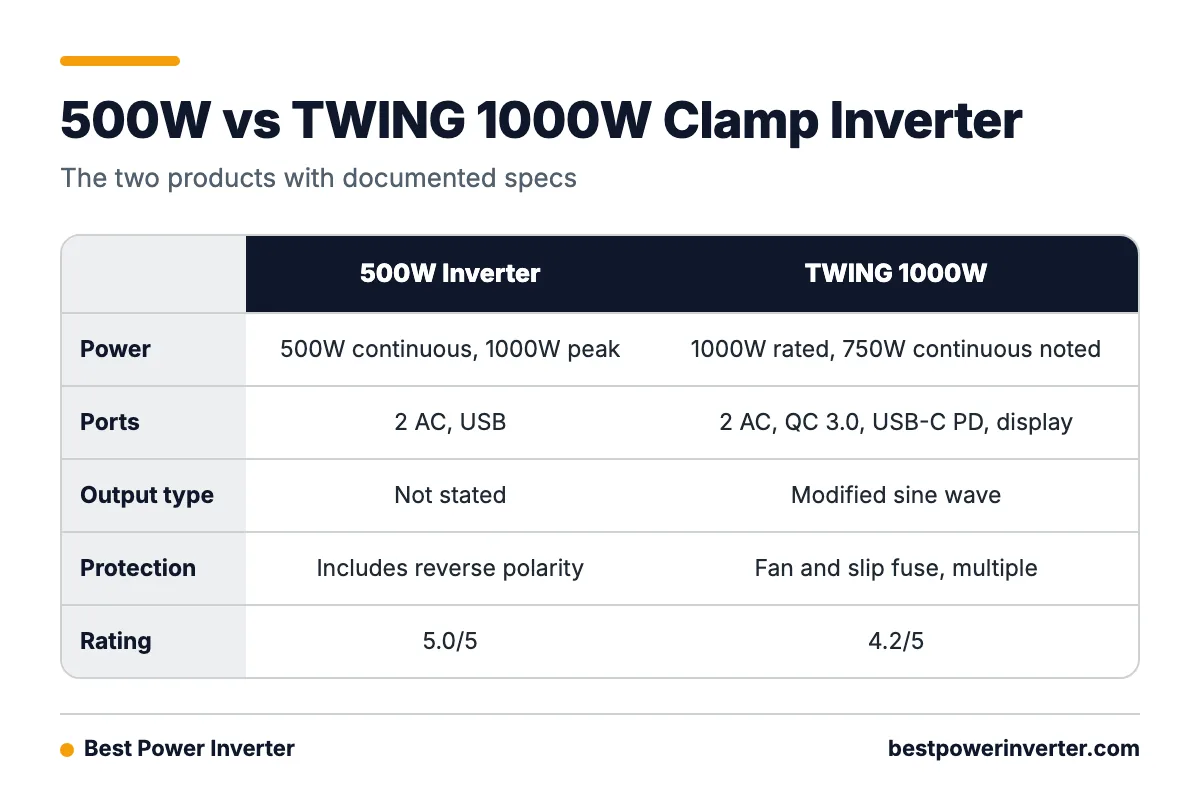
| Product | Key Specs | Our Choice | Action |
|---|---|---|---|
| 500W Power Inverter with Alligator Clamps | 500W continuous, 1000W peak, 2 AC, USB, reverse-polarity protection | Editor’s Choice | |
| TWING 1000W Car Inverter | 1000W rated, 750W continuous noted, 2 AC, USB, USB-C PD, digital display | Best Premium | |
| Battery Clamp Inverter (B07GNGTBDM) | 4.5/5 rating, specs not listed | Highly Rated Option | |
| Battery Clamp Inverter (B0FDDRN7LL) | 4.5/5 rating, specs not listed | Highly Rated Alternative | |
| Battery Clamp Inverter (B09YNBNP1J) | 4.5/5 rating, specs not listed | Highly Rated Alternative |
How does an inverter work with a battery?
The battery supplies DC power, and the inverter converts it to AC. The battery drains as the load draws power, so runtime depends on battery capacity and load size. This beginner guide to inverter batteries covers the basics.
Can you use a 24 volt inverter with a 12 volt battery?
No. System voltage must match the inverter’s input voltage, so a 24V inverter should not be paired with a 12V battery. Mismatched voltage can trigger low-voltage shutdown or damage the unit.
| System | Typical Use | Current at 1000W (approx.) |
|---|---|---|
| 12V | Cars, camping, small loads | About 83A before losses |
| 24V | Larger RVs, trucks, mid-size backup | About 42A before losses |
| 48V | Home backup, off-grid, heavy loads | About 21A before losses |
Higher voltage means lower current for the same watts. That allows thinner cable and less heat, which is why large systems move to 24V or 48V.
Continuous watts vs. surge watts: how big of a power inverter do I need?
Continuous watts are what the inverter can supply steadily. Surge (peak) watts are a brief burst for motor or compressor startup. Total your running watts, then add the largest surge load.
| Appliance | Typical Running Watts | Suggested Inverter | Suggested Battery |
|---|---|---|---|
| Phone or tablet charger | 10 to 30W | 150W or more | Any healthy 12V battery |
| Laptop | 60 to 90W | 300W | Car or deep-cycle |
| LED camp lights, router | 10 to 50W | 300W | Deep-cycle |
| Small TV or mini fridge | 100 to 200W | 500 to 1000W | Deep-cycle or lithium |
| Power tool, microwave | 800 to 1500W | 2000W or more | Large deep-cycle or lithium |
These are typical figures. Check your appliance’s label. One sizing guide suggests dividing peak watts by 0.8 to get the inverter VA rating, as explained in this inverter and battery sizing guide.
For a 5000W load, that math gives about 6250VA. A 12V clamp inverter is the wrong tool: 5000W at 12V means over 400A of DC current. Use a 24V or 48V hardwired system.
How long will a 12V battery last with an inverter?
Runtime (hours) = battery Ah x 12V x usable depth of discharge x inverter efficiency, divided by load watts.
Worked example with assumed figures: a 100Ah lead-acid battery, 50% usable capacity, 85% inverter efficiency, and a 300W load.
- 100 x 12 x 0.5 x 0.85 = 510 usable watt-hours
- 510 / 300 = about 1.7 hours
A lithium battery allowing roughly 90% usable capacity would run the same load about 3 hours. An undersized battery is the most common runtime complaint in buyer feedback.
Can I use a car battery for an inverter?
Yes, for short, light loads. Car batteries are built to deliver a burst of starting current, not to be discharged deeply. Repeated deep drains shorten their life.
Keep the engine running for heavier loads, or you may not be able to start the car. Never drain a car battery low enough to prevent starting.
How do I use a power inverter with a car battery?
Connect the clamps to the battery with the inverter switched off, and polarity matched. The Tractor Supply guide to using an inverter with a car battery covers this in more detail.
Clamp connection checklist
- Switch the inverter off and unplug all appliances.
- Identify positive (red, +) and negative (black, -) on the battery.
- Connect red to positive first, then black to negative.
- Expect a small spark at worst. Make the final connection away from the battery vents, since lead-acid batteries can release flammable gas.
- Turn the inverter on, then plug in loads.
- To disconnect, switch off, unplug devices, remove black first, then red.
- Never reverse polarity. Even with protection, reversed clamps can damage the unit or void the warranty.
- Do not leave clamps attached long-term. Keep cables short and free of damage.
What type of battery is good for inverter use?
Deep-cycle batteries (including tubular lead-acid) and lithium-ion are best, because they tolerate repeated discharge. Lead-acid is cheaper but requires more maintenance than lithium-ion. Car batteries work for short emergency use only.
Can you charge a battery while using an inverter?
Not with a clamp-style inverter by itself. It only draws from the battery. Charging requires a separate charger, a running alternator, solar, or an inverter-charger system. If a battery in an inverter-charger setup keeps charging, the built-in charger is usually topping it up after use.
What is RC in an inverter battery?
RC stands for reserve capacity. It is the number of minutes a battery can supply 25 amps before dropping to a cutoff voltage. A higher RC means more runtime for modest loads. The Peak car battery manual includes battery specification guidance.
In-Depth Reviews

1. 500W Power Inverter 12V to 110V with Alligator Battery Clamp – Editor’s Choice
Our Verdict: The best-documented choice for phones, laptops, routers, and camp lighting, with clear wattage and safety details.
The listing states 500W continuous and 1000W peak output. It includes a cigarette lighter adapter for loads under 150W and clamps for direct battery connection above that. Protections cover overload, short circuit, voltage, temperature, and reverse connection. Its footprint is 6.7 x 3.5 x 2 inches, so it fits in a glove box or bag.
Why We Like It
- Clear continuous and peak ratings
- Reverse-polarity protection
- Two AC outlets plus a USB port
- Compact enough for a glove box
Pros & Cons
Pros
- Highest rating in this group at 5.0/5
- Two connection options
- Lower listed price of the two products with price data
Cons
- 500W limit rules out microwaves and power tools
- The USB port is listed at 2.1A, slower than USB-C PD

2. TWING Car 1000W Inverter 12V DC to 110V AC – Best Premium
Our Verdict: A better fit if you need more output and faster USB charging, with a few listing inconsistencies to check.
The listing advertises 1000W but also notes 750W continuous, so treat 750W as the safer planning figure. It is a modified sine wave design with two AC outlets, a QC 3.0 port, a 30W PD 3.0 USB-C port, and a digital display. Protections include a cooling fan and a slip fuse against over-voltage, low voltage, overload, short circuit, and overheating. The listing cites CE, FCC, and RoHS certifications.
Modified sine wave output can cause buzzing or run poorly with some sensitive electronics, so check device requirements.
Why We Like It
- Higher output for small appliances
- USB-C PD and QC 3.0 ports
- Digital display and cooling fan
Pros & Cons
Pros
- Multiple protections
- Fast-charging ports
- Clamp wiring instructions in the listing
Cons
- Rated 4.2/5, lower than the others
- Continuous and peak ratings are unclear
- Modified sine wave output
3. Battery Clamp Power Inverter (B07GNGTBDM) – Highly Rated Option
Our Verdict: A 4.5/5 listing, but no wattage, features, or specifications were available to verify.
Confirm continuous watts, surge watts, input voltage, and protection features on the product page before buying.
Why We Like It
- Strong 4.5/5 star rating
- Marketed for battery clamp use
Pros & Cons
Pros
- High average rating
Cons
- No specifications available to compare
4. Battery Clamp Power Inverter (B0FDDRN7LL) – Highly Rated Alternative
Our Verdict: Another 4.5/5 listing with no specifications provided, so verify details first.
Check the product page for wattage, outlet count, and safety certifications. Make sure it is a 12V input model.
Why We Like It
- 4.5/5 star rating
- Designed for direct battery connection
Pros & Cons
Pros
- High average rating
Cons
- Specs and features not verified

5. Battery Clamp Power Inverter (B09YNBNP1J) – Highly Rated Alternative
Our Verdict: A 4.5/5 listing with a product image but no specs, so we cannot confirm its capacity or protections.
Compare it against the 500W and 1000W models above once you have confirmed its continuous watts and reverse-polarity protection.
Why We Like It
- 4.5/5 star rating
- Marketed for battery clamp use
Pros & Cons
Pros
- High average rating
Cons
- No verified wattage or feature data
What do owners say?
Owners like
- Easy to connect to a battery for portable use
- Useful for emergency power in vehicles and outages
- Works well for small electronics and light-duty AC loads
- Overload and thermal shutdown protections are appreciated
- Direct battery connection is valued when higher current is needed
Common complaints
- Clamps can spark during connection
- Battery cables may feel too short or flimsy on some models
- Clamp connections are not ideal for permanent installs
- Wrong polarity can damage the inverter or void the warranty
- Runtime drops quickly if the battery is undersized
Summarised from owner reviews and long-term user reports; individual experiences vary.
Frequently Asked Questions
Can you use a 24 volt inverter with a 12 volt battery?
No. The battery voltage must match the inverter’s input voltage.
Can I use a car battery for inverter loads?
Yes, for short and light loads. Run the engine for anything heavier, and avoid deep discharge.
Can you charge a battery while using an inverter?
Not with a clamp inverter alone. You need a charger, alternator, solar, or an inverter-charger.
What type of battery is good for inverter use?
Deep-cycle, tubular lead-acid, or lithium-ion batteries handle repeated discharge best.
What is RC in inverter battery specs?
RC means reserve capacity, the minutes a battery can supply 25 amps.
Conclusion
For most buyers, the 500W Power Inverter (B0HJ2K7THP) is the clearest pick, with documented wattage, reverse-polarity protection, and a compact body. Choose the TWING 1000W (B082V5TC11) if you need more output or USB-C PD. Verify the specs on the three unspecified listings before buying. Match battery voltage, size the battery for your runtime, and follow the connection checklist every time.
Sources
Affiliate Disclosure: As an Amazon Associate, we may earn commissions from qualifying purchases from Amazon.com. This comes at no extra cost to you and helps support our research.