

The safe inverter size for a truck depends on usable alternator output, auxiliary battery capacity, cable installation, and simultaneous loads, not on the wattage printed on the box. At 12V, a 2,000W inverter can pull roughly 170 to 200A after conversion losses, so many stock pickups are better limited to about 1,000 to 1,500W continuous unless they get an auxiliary battery, a stronger charging system, and correctly sized cables. Heavy-duty trucks may support 1,500 to 2,000W once the electrical system is verified. Every model below with a stated rating is labeled 3,000W or larger, so treat them as options for upgraded setups and size your real loads well under the label.
Quick answer
Most stock pickups should stay near 1,000 to 1,500W continuous. Heavy-duty trucks with an auxiliary battery bank and heavy cables may handle 1,500 to 2,000W. Use the 3,000W to 4,000W models below for surge headroom, not sustained full-load draw.
- Best for most upgraded trucks: LANDERPOW 3000W pure sine, hardwired terminal
- Best for lithium banks: OLTEANP 4000W, adjustable cutoff
- Best for budget: Cantonape 3000W
Our Winner: 3000W Pure Sine Wave Inverter 12V DC to 120V AC 6000W Peak for RV (LANDERPOW)
This is the only pure sine model in the group that also offers a hardwired AC terminal, which suits larger tools and appliances. Based on the listing, it pairs more than 91% efficiency with 1 AWG copper cables, a wired remote with a status screen, and a 3-year coverage plan. It fits heavy-duty trucks and upgraded pickups with a proper battery bank. It is not a reason to run 3,000W on a stock charging system.
How We Compared These Models
This comparison is based on listing specifications and patterns in verified buyer feedback, not hands-on testing. Four criteria matter most for trucks: waveform (pure or modified sine), connection type (hardwired terminal or outlets only), low-voltage and thermal protection, and the cable and cooling hardware supplied. Wattage ranks lower because the truck’s electrical system, not the inverter label, sets the real sustained limit.
| Product | Key Specs | Our Choice | Action |
|---|---|---|---|
| LANDERPOW 3000W Pure Sine | 3,000W / 6,000W surge, pure sine, hardwired terminal, 1 AWG cables | Best Overall | |
| TOPBULL 4000W | 4,000W / 8,000W surge, 10 protections, color display, remote | Best High Capacity | |
| Cantonape 3000W | 3,000W / 6,000W surge, modified sine, LCD, remote, 6 protections | Best Budget | |
| OLTEANP 4000W | 4,000W / 8,000W surge, modified sine, adjustable 9.5V to 11V cutoff | Best for Lithium Banks | |
| Large Power Inverter for Truck (B0CSYS85FQ) | Specifications not available in listing data, 4.5/5 rating | Verify Before Buying |
How big of a power inverter can my truck handle?
Most stock pickups handle about 1,000 to 1,500W continuous, while heavy-duty trucks and semis with a verified electrical system may reach 1,500 to 2,000W. The limit comes from alternator output, battery capacity, and cable installation, as Victron’s truck inverter guidance also describes.
Alternator nameplate output is not the amount available to an inverter. The engine, lighting, HVAC blower, and vehicle controls take their share first, and the battery needs charge current too. Victron recommends planning with 50% of a conventional or smart alternator’s rated output when sizing lithium service banks, to avoid overloading it.
Here is a worked example. A 150A alternator planned at 50% gives 75A. At about 13.8V that is roughly 1,035W of DC power, or around 900W of AC after typical inverter losses. That is why a 3,000W label can be impractical on a stock pickup.
An oversized inverter does not draw more by itself. It draws what the connected loads need. The risk is that it lets you plug in more than the truck can supply.
How many amps does a 1,000W, 1,500W, 2,000W, or 3,000W inverter draw at 12V?
Expect roughly 95A for 1,000W, 142A for 1,500W, 189A for 2,000W, and 284A for 3,000W at 12V, assuming 88% efficiency. Use this formula: estimated DC amps = AC watts ÷ (12V × efficiency).
| AC Load | Calculation | Estimated DC Amps |
|---|---|---|
| 1,000W | 1,000 ÷ (12 × 0.88) | about 95A |
| 1,500W | 1,500 ÷ (12 × 0.88) | about 142A |
| 2,000W | 2,000 ÷ (12 × 0.88) | about 189A |
| 3,000W | 3,000 ÷ (12 × 0.88) | about 284A |
| 4,000W | 4,000 ÷ (12 × 0.88) | about 379A |
Add the truck’s normal electrical demand and a reserve of around 20% to get a planning figure. For reference, the Purkeys pure sine data sheet lists nominal maximum-load input of 150A for its 1,500W model and 200A for its 2,000W model, with efficiency above 86% across 10 to 100% load and an input range of about 9.5 to 16.0V. A sagging battery raises the current further, because the same watts at 11V need more amps than at 12V.
Can my truck alternator run a 2,000W or 3,000W inverter continuously?
Usually not from a stock system. A 2,000W load needs about 167A before losses, and real installations need more. Few factory alternators can sustain that after the truck’s own loads.
The practical fix is a battery bank that carries the load, with the alternator topping it up through an isolator or DC-DC charger. Short bursts for a tool or microwave are far easier on the system than hours of continuous high draw. Alternators also run hot when asked for sustained high output at idle, so avoid long full-load use while parked with the engine idling.
Should I connect a large inverter to the starting battery or an auxiliary deep-cycle battery?
Use an auxiliary deep-cycle or lithium battery whenever the load is large or runs while the engine is off. Draining the starting battery risks a no-start situation, and starter batteries are not built for repeated deep discharge.
An isolator or DC-DC charger lets the alternator charge the auxiliary bank while keeping the two systems separate. A battery disconnect between the bank and inverter adds a safe way to cut power.
What battery capacity is needed to run a refrigerator, microwave, tools, heater, or air compressor?
Capacity depends on watt-hours, not watts. Victron suggests allowing about twice the daily energy consumption for lead-acid batteries, since only roughly 50% is treated as usable, and keeping about 20% reserve for lithium.
Worked example for a 100Ah, 12V battery and a steady 100W AC load, with 88% inverter efficiency:
- AGM: 1,200Wh × 50% usable = 600Wh, × 0.88 = about 528Wh of AC energy. That is roughly 5.3 hours.
- Lithium (LiFePO4): about 1,280Wh × 80% usable = 1,024Wh, × 0.88 = about 901Wh. That is roughly 9 hours.
A 1,000W microwave would drain that AGM battery in about 30 minutes, and high-current discharge usually shortens it. Heaters and air compressors with motors need extra attention to startup surge, covered below. Resistive heaters are the largest energy drain, so a battery bank is a poor fit for them.
Do I need a pure sine wave inverter for sensitive electronics, motors, or power tools?
Pure sine is the safer choice for sensitive electronics, chargers, and motor-driven equipment. Owners report that pure sine output runs these loads more reliably than modified sine models, with less hum and fewer charger problems.
Modified sine units can run simple resistive loads such as basic heating elements and incandescent lights. They are cheaper, but motors may run hotter and noisier, and some chargers and CPAP devices may behave poorly. Check each device’s manual.
How do I account for startup surge and motor loads when sizing the inverter?
Size the inverter for the average continuous AC load, then check that its surge rating covers the combined startup demand of everything that might start together. This follows the Victron approach.
Refrigerator compressors, air compressors, and power tool motors briefly draw several times their running wattage. Stagger startups rather than switching everything on at once. Surge ratings, such as 6,000W or 8,000W on the models here, last only a moment and do not describe what the truck can sustain.
What cable gauge, fuse size, disconnect, and grounding does a large truck inverter require?
Follow the manufacturer’s manual, and size cable and fuse to the inverter’s maximum DC input current, not its average load. Keep cables as short as practical and aim for a low voltage drop, commonly 3% or less, measured at the inverter terminals.
- Cable: Heavy copper cable rated for the full input current. Commonly published ampacity charts rate a single 1 AWG cable well below 275A, so check ratings before running near full load.
- Fuse: A properly rated fuse as close to the battery positive terminal as practical, sized to protect the cable.
- Disconnect: A battery disconnect or switch for service and emergencies.
- Grounding: A short, heavy ground connection to the chassis or battery negative per the manual.
- Ventilation: Mount in a dry spot with clear airflow around the fan and vents.
If you are unsure, have a qualified installer check the work. Undersized cable is a fire risk, not just a performance issue.
Is a built-in outlet model sufficient, or should a large inverter be hardwired with terminal connections?
Hardwired terminal connections are better for large loads. Owners prefer them because built-in outlets and 12V accessory sockets can overheat or trip when pushed hard.
Only the LANDERPOW model here lists a hardwired AC terminal. The others list outlets, so confirm what the plug and outlet ratings allow before connecting a high-draw appliance.
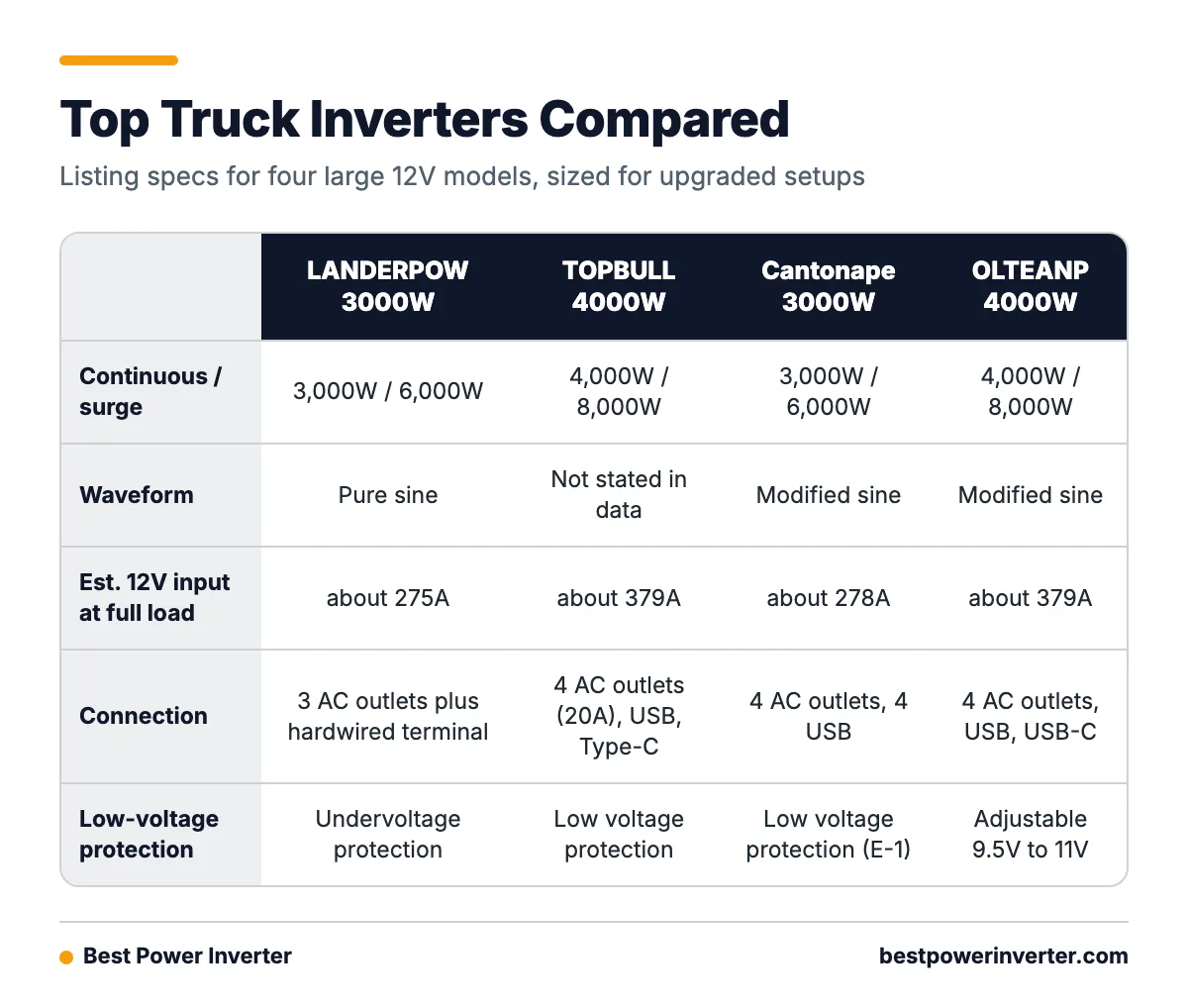
Large Truck Inverter Specification Comparison
| Model | Continuous / Surge | Est. 12V Input at Full Load | Waveform | Connection | Low-Voltage Protection | Cooling | Recommended Truck Use |
|---|---|---|---|---|---|---|---|
| LANDERPOW 3000W | 3,000W / 6,000W | about 275A | Pure sine | 3 AC outlets plus hardwired terminal | Undervoltage protection | Metal shell, heat-dissipating | Heavy-duty trucks with a large battery bank |
| TOPBULL 4000W | 4,000W / 8,000W | about 379A* | Not stated in data | 4 AC outlets (20A), USB, Type-C | Low voltage protection | Metal shell | Large bank only, short bursts |
| Cantonape 3000W | 3,000W / 6,000W | about 278A | Modified sine | 4 AC outlets, 4 USB | Low voltage protection (E-1) | Aluminum body, temperature-controlled fan | Basic resistive loads, budget builds |
| OLTEANP 4000W | 4,000W / 8,000W | about 379A* | Modified sine | 4 AC outlets, USB, USB-C | Adjustable 9.5V to 11V | Intelligent cooling system | Lithium or AGM banks with upgraded cables |
| B0CSYS85FQ listing | Not stated in data | Not stated | Not stated | Not stated | Not stated | Not stated | Verify on the listing first |
*Estimated at 88% efficiency because efficiency is not stated in the available listing data. The LANDERPOW figure uses its listed efficiency above 91%, and the Cantonape figure uses its listed efficiency above 90%. These are calculations, not manufacturer ratings.
In-Depth Reviews

1. 3000W Pure Sine Wave Inverter 12V DC to 120V AC 6000W Peak (LANDERPOW) – Best Overall
Our Verdict: The best fit for heavy-duty trucks and upgraded pickups, thanks to pure sine output, a hardwired terminal, and included heavy cables.
Based on the listing, this unit delivers 3,000W continuous and 6,000W surge with efficiency above 91%. It has 3 AC outlets, 1 hardwired terminal, a 5V/3.1A USB port, and a 30W PD port. The two 1 AWG, 2-foot copper cables are a useful starting point for a short run.
At full load the draw is near 275A, so confirm cable ratings and fuse sizing before running anything close to the label. The 15-foot wired remote shows battery level, output, and errors, which helps spot voltage sag early. Protections listed include undervoltage, overvoltage, overload, overheating, short circuit, and reverse connection. The listing adds 3-year coverage (1-year replacement plus 2-year extended support) and a rating of 4.4 out of 5.
Why We Like It
- Pure sine output suits sensitive electronics, CPAPs, and motors
- Hardwired terminal for high-current tools and appliances
- Wired remote with status screen
- 3-year coverage listed
Pros & Cons
Pros
- Pure sine with efficiency above 91% per the listing
- Hardwired terminal plus 3 outlets
- Cables included, remote with screen
Cons
- Full-load draw near 275A exceeds most stock truck systems
- 1 AWG cables may be undersized for sustained full output
- Needs a ventilated mounting spot

2. 4000 Watt Power Inverter 12V DC to 120V/110V AC (TOPBULL) – Best High Capacity
Our Verdict: The highest-rated model here at 4.6 out of 5, suited to large battery banks where surge headroom matters.
The listing gives 4,000W continuous and 8,000W peak, with 4 AC outlets rated 20A, 2 USB ports at 3.4A, and a 30W Type-C port. It includes a color display, a remote, and 10 listed protections covering low and high voltage, overload, short circuit, overheating, reverse polarity, and grounding.
The listing does not state the waveform in the data available, so confirm it before buying for sensitive electronics. At 4,000W the input current approaches 380A by our estimate, which no stock pickup alternator can sustain. Treat it as a surge-capable unit for a serious battery bank, and plan for heavy cabling.
Why We Like It
- Highest surge rating at 8,000W
- Ten listed protection functions
- Color display and remote
- 24/7 online support listed
Pros & Cons
Pros
- 4.6 out of 5 rating on Amazon
- Broad protection list
- USB and Type-C charging
Cons
- Waveform not confirmed in available data
- Very high DC current at full load
- No hardwired AC terminal listed

3. Cantonape 3000W Power Inverter 12V to 110V/120V with LCD Display – Best Budget
Our Verdict: The lowest-cost route to 3,000W, best for simple resistive loads where modified sine is acceptable.
The listing states 3,000W continuous modified sine and 6,000W surge, with efficiency above 90%. It has 4 AC outlets, 4 USB ports, an LCD showing voltage, battery level, load, and fault codes such as E-1 for low voltage, and a remote. The remote needs its own 12V 23A battery, which is not included. Six protections are listed, and the aluminum body has a temperature-controlled fan and isolated ground neutral. The listing includes a 12-month warranty.
Modified sine is the main tradeoff. Sensitive electronics, chargers, and motors may run less smoothly. It rates 4.5 out of 5.
Why We Like It
- LCD fault codes simplify troubleshooting
- Efficiency above 90% per the listing
- Temperature-controlled fan
- Low entry cost for a 3,000W unit
Pros & Cons
Pros
- Budget-friendly 3,000W capacity
- Six protections and clear LCD
- 4 outlets and 4 USB ports
Cons
- Modified sine only
- Remote battery not included
- Only a 12-month warranty

4. 4000 Watts Power Inverter 12V DC to 120V AC with LCD Remote (OLTEANP) – Best for Lithium Banks
Our Verdict: The adjustable low-voltage cutoff makes it the most flexible match for LiFePO4, AGM, and GEL banks.
The shutdown threshold can be set between 9.5V and 11V, which lets you protect the battery chemistry you use. The listing gives 4,000W modified sine output with 8,000W peak, 4 AC outlets, a 3.1A USB port, and 30W USB-C. It also lists LCD readouts and protection against overload, overvoltage, undervoltage, overheating, and overcurrent. It is listed at $199.99 and rated 4.4 out of 5.
The supplied cable kit deserves scrutiny. It includes four 23.6-inch cables of 16 mm² (about 5 AWG) each, which the listing says combine to about 2 AWG per polarity. That is light for a 4,000W unit that could draw near 380A, so plan on heavier cable and a properly rated fuse. Body dimensions are 11.81 x 7.87 x 3.98 inches, or 14.02 x 9.06 x 4.41 inches with brackets and terminals, so check mounting space.
Why We Like It
- Adjustable low-voltage cutoff from 9.5V to 11V
- Works with LiFePO4, AGM, GEL, and flooded batteries per the listing
- Wired remote included
- USB-C 30W port
Pros & Cons
Pros
- Flexible battery protection settings
- 8,000W peak for surge loads
- Complete kit with remote
Cons
- Modified sine output
- Included cables are light for the rated power
- Large footprint

5. Large Power Inverter for Truck (B0CSYS85FQ) – Verify Before Buying
Our Verdict: A 4.5 out of 5 rated listing, but the available data has no wattage, waveform, or protection details, so it cannot be ranked higher.
The product data for this ASIN contains only a generic title, an image, and the rating. We cannot confirm continuous power, surge rating, waveform, cable kit, or low-voltage settings. Before buying, check the listing for continuous wattage, pure or modified sine, input cable gauge, fuse guidance, and protections. Use the 12V amp formula above to confirm your truck can supply the current.
Why We Like It
- Rated 4.5 out of 5 on Amazon
- Marketed for truck use by its listing title
Pros & Cons
Pros
- Strong star rating
Cons
- Specifications unavailable in the data reviewed
- Cannot be matched to a truck’s electrical limits yet
Why does a truck inverter shut down from low voltage or overheating?
Most shutdowns come from the installation, not a defective inverter. Voltage drop in undersized or long cables, a weak battery, or a loose terminal pulls voltage below the cutoff under load, often around 9.5 to 10.5V.
- Low-voltage shutdown: Shorten cables, upgrade gauge, clean and tighten terminals, and check battery health. Read voltage at the inverter terminals while under load.
- Thermal shutdown: Move the unit out of enclosed spaces, clear the vents, and avoid mounting it near engine heat.
- Battery drain: Switch the inverter off when parked. Even with no load it draws idle current.
- Alternator strain: Add an auxiliary battery, reduce load, or upgrade charging capacity.
- Fan noise: Expect more noise under sustained load. Lowering the load lowers the fan speed.
Pre-Purchase and Installation Checklist
- Confirm usable alternator output after the truck’s own loads, using about 50% of rating as a planning figure.
- Decide on an auxiliary battery and a charge method (isolator or DC-DC charger).
- Measure the cable run and choose gauge to keep voltage drop low.
- Choose a fuse near the battery and a disconnect that suit the cable rating.
- Pick a ventilated, dry mounting location with room for cables and the fan.
- Plan a short, heavy ground connection per the manual.
- Add up simultaneous loads and their startup surge, then check against continuous rating.
- Test with a realistic load before relying on it for work.
What do owners say?
Owners like
- Pure sine output runs sensitive electronics, chargers, and motor-driven equipment more reliably than modified sine models.
- Hardwired terminal connections are preferred for large loads because they avoid overloading a 12V accessory socket.
- Remote switches and automatic low-voltage protection make daily truck operation more convenient.
- Heavy-duty models are valued for powering tools and appliances in sleeper and work-truck applications.
- Quiet or temperature-controlled fans are appreciated during overnight use.
Common complaints
- Low-voltage shutdowns caused by undersized cables, long cable runs, weak batteries, or voltage drop at the inverter.
- Thermal shutdowns when large units are installed in enclosed or poorly ventilated spaces.
- Battery drain when the inverter is left switched on while parked.
- Fan noise under sustained loads.
- Alternator or charging-system strain when high-wattage inverters are used without an auxiliary battery or adequate charging capacity.
Summarised from owner reviews and long-term user reports; individual experiences vary.
Frequently Asked Questions
How big of a power inverter can my truck handle?
Most stock pickups are best kept to about 1,000 to 1,500W continuous. Heavy-duty trucks may support 1,500 to 2,000W when the alternator, auxiliary battery, and cables are verified. Larger labels, such as 3,000W or 4,000W, mainly add surge capacity.
Is a pure sine wave inverter worth it in a truck?
Yes for electronics, chargers, CPAPs, and motors. It costs more than modified sine, but owners report fewer compatibility issues. Modified sine can suit simple resistive loads.
Can I run a 4000W inverter on a 12V truck system?
Only with a very large battery bank, heavy cables, and a load kept far below the label. Full output would draw roughly 380A at 12V by our estimate, which is beyond what a stock system can supply.
Should I leave the inverter on while the truck is parked?
No, unless a load needs it. Idle draw drains batteries, and owners commonly report dead batteries from this. Use the remote or switch to turn it off.
Conclusion
Start with your truck’s actual limits: usable alternator output, battery bank size, and cable run. Then pick the inverter. For most upgraded setups, the LANDERPOW 3000W pure sine is the best match thanks to its waveform, hardwired terminal, and supplied cables. The TOPBULL 4000W suits large banks that need surge headroom, the Cantonape 3000W covers budget builds with simple loads, and the OLTEANP 4000W fits lithium banks that need an adjustable cutoff. Verify the B0CSYS85FQ listing before considering it. In every case, upgrade cables and fusing to match the real current, and keep sustained loads well below the label.
Affiliate Disclosure: As an Amazon Associate, we may earn commissions from qualifying purchases from Amazon.com. This comes at no extra cost to you and helps support our research.