

Battery voltage and output waveform decide which 3500-watt power inverter fits your setup, and pure sine wave is the safer choice for sensitive electronics. This guide suits RV owners, truck owners, off-grid solar users, and backup-power shoppers. Before buying, verify continuous output, surge rating, efficiency, and the grounding instructions for your exact unit.
Based on the listing specifications and features for the five products below, our top pick is the Jlouneo 12V 3500W pure sine model. It pairs a 4.5/5 rating with 91% advertised efficiency, 1 AWG copper cables in the box, and a remote with a display.
Our Winner: 3500W Pure Sine Inverter 12V DC to 120V AC, 7000W Surge
This model lists 3500W continuous and 7000W peak output, up to 91% conversion efficiency, three AC outlets, a hardwire terminal, USB-A, and a 30W USB-C port. It also includes 1 AWG pure copper cables and a remote with an LCD. It is built for 12V AGM, GEL, and LiFePO4 systems only, so confirm your battery voltage first.
How We Compared These Models
Based on the specifications and feature lists provided, we compared waveform type, input voltage, surge rating and efficiency, and installation extras such as cables, remotes, and transfer switches. Verified buyer ratings were used as a secondary signal. Input voltage matters most because it sets the battery current, which drives cable and fuse size.
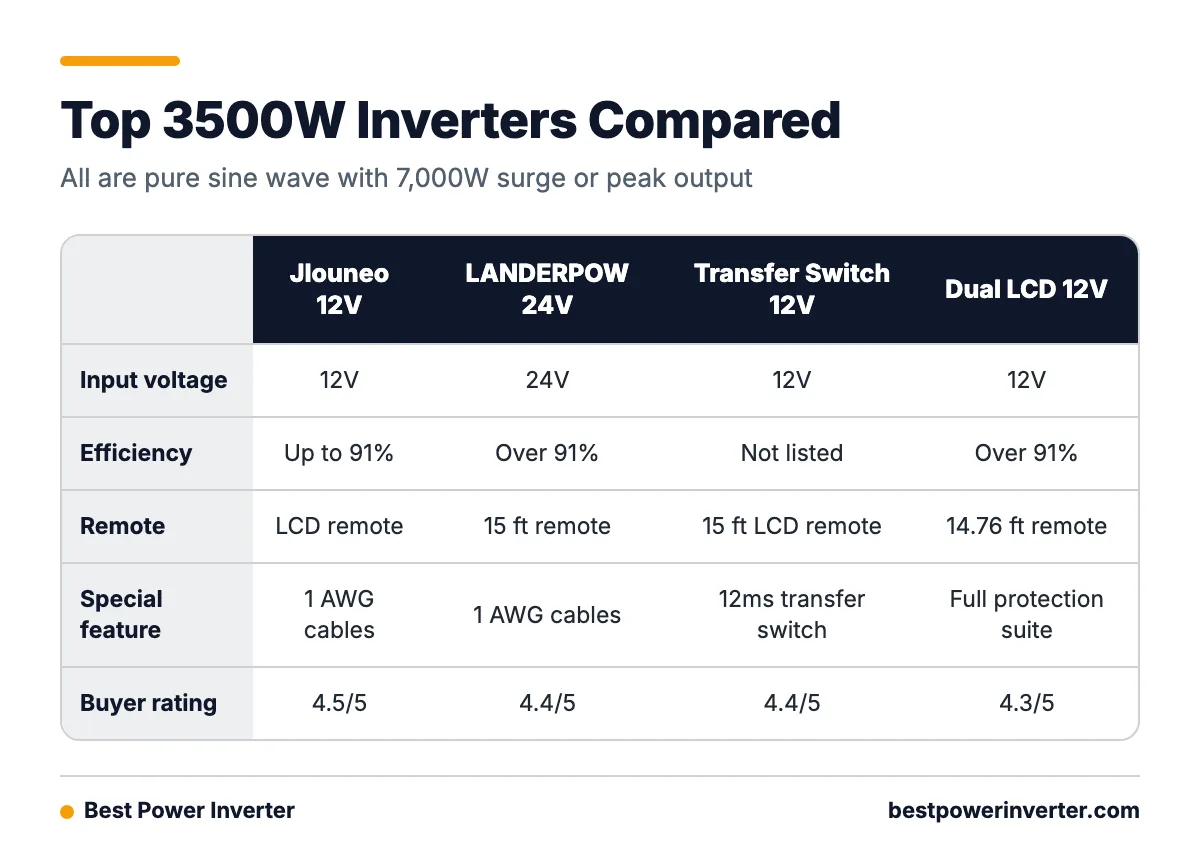
| Product | Key Specs | Our Choice | Action |
|---|---|---|---|
| Jlouneo 3500W Pure Sine 12V | 12V to 120V, 7000W surge, up to 91% efficiency, 1 AWG cables, LCD remote, 4.5/5 | Best Overall | |
| LANDERPOW 3500W Pure Sine 24V | 24V to 120V, 7000W surge, over 91% efficiency, 1 AWG cables, 15 ft remote, 4.4/5 | Best 24V Option | |
| 3500W Pure Sine Inverter with Transfer Switch | 12V to 120V, 7000W peak, 12ms transfer switch, 15 ft LCD remote, 4.4/5 | Best for RV Shore Power | |
| 3500W Pure Sine 12V with Dual LCD | 12V to 110V, 7000W peak, over 91% efficiency, full protection suite, 14.76 ft remote, 4.3/5 | Best for Monitoring | |
| 3500watt power inverters (B09KGPZ9KM) | Limited listing data, 4.5/5 | Honorable Mention |
How 3500W Inverters Work
A DC-AC power inverter converts battery voltage into household AC. A 3500W unit can supply 3,500 watts continuously and a higher surge, often 7,000W, for a few seconds. The surge covers the startup spike of motors and compressors.
Efficiency determines how much battery capacity you spend. At 91% efficiency, a full 3,500W load pulls about 3,846W from the battery. Idle draw also matters for always-on systems, so check the no-load consumption in the manual.
What Does 3500 Watts Actually Run?
At 120V, 3,500 watts is about 29 amps. That is more than a standard 15A outlet can carry, so the three outlets on these units will not each deliver the full rating. The hardwire terminal is what lets you use the full capacity, ideally through a properly sized breaker panel.
Load Planning Chart
| Appliance | Typical Running Watts | Startup Surge | Run Continuously? |
|---|---|---|---|
| Laptop, TV, LED lights | 20 to 150W | Minimal | Yes |
| CPAP machine | 30 to 90W | Minimal | Yes |
| Residential refrigerator | 100 to 200W | Up to 3 to 4x | Yes, cycles on and off |
| Coffee maker, kettle | 1,000 to 1,500W | None | Short runs only |
| Microwave (1,000W class) | 1,400 to 1,800W input | Moderate | Short runs only |
| Window air conditioner | 600 to 1,200W | 2 to 3x | Yes, if battery bank allows |
| Circular saw, air compressor | 1,200 to 1,800W | 2 to 3x | Intermittent |
| Well pump (1/2 hp) | 700 to 1,000W | Up to 3x | Cycles on and off |
These are typical ranges. Always check the nameplate on your appliance. A load that surges above 7,000W will trip the inverter regardless of the continuous rating.
Should I Buy a 12V, 24V, or 48V Inverter for 3500W?
Higher voltage means lower current for the same power. That reduces cable thickness, voltage drop, and heat. The tradeoffs are a larger battery bank and fewer plug-and-play options at 48V in this price range.
| System | Battery Current at 3,500W (before losses) | Cabling | Best For |
|---|---|---|---|
| 12V | About 290A | Very heavy, short runs only | Existing 12V RV or truck systems |
| 24V | About 146A | Heavy, more manageable | Mid-size solar and van builds |
| 48V | About 73A | Moderate | Home backup and larger off-grid systems |
Worked Example: Battery Current at Full Load
Current equals power divided by voltage. At 12V, 3,500W divided by 12 is roughly 292A. At 48V, the same load is roughly 73A.
Now add losses. At 91% efficiency, battery-side power is 3,500 divided by 0.91, or about 3,846W. That is about 321A at 12V, 160A at 24V, and 80A at 48V.
For runtime, a 12V 200Ah LiFePO4 battery stores about 2,560Wh. At 3,846W, that is under 40 minutes at full load, before accounting for depth-of-discharge limits. Size your bank for your real average load, not the inverter rating.
Pure Sine Wave vs. Modified Sine Wave
Pure sine wave output matches grid power. It suits inductive loads such as motors, compressors, and microwaves, and sensitive electronics such as CPAPs and laptops. Modified sine wave units can cause hum, heat, and reduced efficiency in some devices. All four products with detailed listings here are pure sine wave, which is the right choice at this power level.
Surge Rating and Starting Loads
The 7,000W surge listed on these models is a short-duration figure. Motors and compressors can draw two to four times their running watts at startup. Add up the largest single starting load plus anything already running, and keep that total under the surge rating.
Can a 3500W Inverter Run on a 48V Battery Bank and Produce 240V AC?
Yes, but only with a 48V-input model. The 12V and 24V units reviewed here output 120V only. Manufacturer documentation for 48V inverters commonly lists AC output options of 110V, 120V, 220V, 230V, and 240V, with battery operating ranges around 40V to 60V DC. See XINDUN Power’s 48V inverter range for examples of output options.
240V matters when you run well pumps, larger air conditioners, or split-phase home panels. Split-phase 120/240V inverters can support North American loads when the battery bank and load balance are set up correctly.
Grounding and Neutral-to-Ground Bonding
Grounding rules vary by model, so the manual for your exact unit overrides general advice. Manufacturers typically say to connect the inverter chassis to earth ground, the vehicle chassis, or a boat bonding system, depending on the installation. The AC-side ground and the enclosure ground are not always the same connection.
Neutral bonding is where mistakes happen. At least one 3500W inverter manual states the neutral cannot be bonded to ground in that model. You can read that kind of guidance in the VEVOR 3500W inverter manual. When a transfer switch or shore power is involved, the neutral-ground bond should exist in only one place in the system.
Grounding and Installation Checklist
- RV: Bond the inverter chassis to the RV chassis ground. Use the transfer switch or shore-power panel for neutral-ground bonding as directed by the manual.
- Truck or vehicle: Connect the chassis lug to the vehicle frame with a short, thick, bare-metal connection.
- Off-grid: Connect the chassis to an earth ground rod or the system ground bus. Follow local electrical code.
- All installs: Mount in a ventilated, dry location. Keep DC cables as short as possible. Install a fuse or breaker within inches of the battery positive terminal. Add a DC disconnect that can be opened without tools.
Cables, Fuses, and Disconnects
At 12V, full load can exceed 300A, so cable and fuse selection is the most safety-critical part of the install. Use the manufacturer’s cable and fuse table. Many installers use 4/0 AWG or larger for full-load 12V runs, kept short, with a Class T fuse sized to the manual. The 1 AWG cables included with two products here are short pigtails and are not a substitute for correct sizing over longer distances at full load. The 24V model halves the current, and 48V cuts it further.
Safety Certifications and Protections
Look for under-voltage, over-voltage, overload, over-temperature, short-circuit, and reverse-polarity protection. Also look for listed safety certifications such as ETL or UL on the unit itself. Listings often mention protections but not certifications, so confirm the label or documentation before relying on it for a permanent install.
In-Depth Reviews

1. 3500W Pure Sine Inverter 12V DC to 120V AC, 7000W Surge – Best Overall
Our Verdict: The most complete 12V package in this group, with the highest buyer rating, included heavy cables, and a full set of outputs.
Based on the listing, this Jlouneo inverter delivers 3500W continuous and 7000W peak from a 12V battery. It targets AGM, GEL, and LiFePO4 systems. Efficiency is advertised at up to 91%, which is at the higher end for this class. The aluminum body and the dual display (inverter and remote) cover the monitoring needs most RV and off-grid owners have.
Outputs include three AC outlets, a hardwire terminal, a 5V/3.1A USB port, and a 30W USB-C port. Built-in alarms and auto shut-off address overload, overheating, and short circuits.
Why We Like It
- 4.5/5 rating, tied for the highest in this group
- 1 AWG pure copper cables included
- Remote with real-time input, output, load, and fan status
- Hardwire terminal for full-capacity loads
Pros & Cons
Pros
- Pure sine output suits sensitive electronics
- Strong efficiency claim of up to 91%
- Wide output selection including USB-C
Cons
- 12V only, so full-load current is very high
- Included cables are short and not sized for long runs
- No built-in transfer switch

2. LANDERPOW 3500W Pure Sine Wave Inverter 24V DC to 120V AC – Best 24V Option
Our Verdict: The pick for anyone with a 24V bank who wants lower current and a longer warranty.
This LANDERPOW model outputs 3500W continuous and 7000W surge with efficiency listed above 91%. Running at 24V roughly halves battery current compared with 12V, about 146A at full load before losses. That eases cable heat and voltage drop.
It includes two 1 AWG, 2 ft pure copper cables, a 15 ft wired remote with an LED screen, three AC outlets, a hardwire terminal, USB, and 30W PD. The listing also states a three-year coverage package: one-year replacement and two years of extended support.
Why We Like It
- Lower current than 12V models
- Three-year coverage listed
- Full protection set including reverse connection
- Full metal shell for heat dissipation
Pros & Cons
Pros
- Better cable economics at full load
- Strong warranty terms
- Hardwire port for high-draw appliances
Cons
- Requires a 24V battery bank
- 120V output only, not 240V

3. 3500W Pure Sine Wave Power Inverter with Transfer Switch for RV, 7000W Peak – Best for RV Shore Power
Our Verdict: The right choice when you want automatic switching between shore power and battery power.
This 12V model includes a built-in automatic transfer switch. When 120V shore power is present, it passes AC through to connected appliances. If shore power drops, it switches to inverter output in approximately 12ms. That is quick enough to keep many devices running, though sensitive equipment may still warrant a UPS.
The listing states it is not a battery charger. It ships with a pair of 60 cm dual 5 AWG cable assemblies and a 15 ft LCD remote. Compared with the 1 AWG sets on other models, check the manufacturer’s current guidance on cable sizing for your load and run length.
Why We Like It
- 12ms automatic transfer switch
- Designed for RVs, trucks, boats, and cabins
- 15 ft LCD remote with fault alerts
Pros & Cons
Pros
- Simplifies RV wiring with shore-power passthrough
- Pure sine output at 3500W continuous
- Protection against low voltage, over-voltage, overload, short circuit, and overheating
Cons
- Does not charge batteries
- Heavier-gauge cabling is likely needed for full-load use
- Neutral and ground handling with the transfer switch must follow the manual

4. 3500W Pure Sine Wave Inverter, 12V DC to 110V AC with LCD Remote – Best for Monitoring
Our Verdict: A solid 12V option with a clear protection list and a long remote cable, at a listed price of $219.99.
The listing cites 3500W continuous, 7000W peak, and conversion efficiency above 91%. The protection set covers under-voltage, over-voltage, overload, over-temperature, short-circuit, and reverse connection. The housing is aluminum alloy and durable plastic.
The dual LCD setup includes a 14.76 ft wired remote for on/off control and shows input and output voltage and battery load status. Outputs include three AC outlets, a 15A socket, a 5V 3.1A USB port, a Type-C fast-charging port, and hardwire terminals. Its 4.3/5 rating is slightly below the others, so read recent buyer feedback before ordering.
Why We Like It
- Complete protection suite including reverse connection
- Long 14.76 ft remote cable
- Hardwire terminals for full-capacity wiring
Pros & Cons
Pros
- Good monitoring for troubleshooting
- Pure sine wave suits long-term use with precision loads
- Versatile output mix
Cons
- Lowest rating of the detailed listings
- 12V only
- Cable details are not listed in the provided data

5. 3500watt power inverters (ASIN B09KGPZ9KM) – Honorable Mention
Our Verdict: Highly rated at 4.5/5, but the listing data available to us is too thin to rank it higher.
We do not have a feature list, input voltage, waveform type, or surge rating for this listing. Only the title and rating were available. Before buying, confirm on the Amazon page whether it is 12V, 24V, or 48V, whether the output is pure sine wave, and what the surge rating and protections are.
Why We Like It
- 4.5/5 buyer rating
- Fits the 3500W category
Pros & Cons
Pros
- Strong buyer rating
Cons
- Key specifications must be verified on the listing
- No confirmed information on waveform or input voltage
Buying Checklist and Common Mistakes
- Match inverter input voltage to your battery bank before anything else.
- Choose pure sine wave for electronics, motors, and compressors.
- Add up running watts and the largest startup surge.
- Size cables, fuse, and disconnect for roughly 320A at 12V or 160A at 24V.
- Follow the manual for grounding and neutral bonding.
- Do not assume the outlets can deliver the full 3,500W. Use the hardwire terminal for heavy loads.
- Do not undersize the battery bank. A 3,846W draw drains small batteries quickly.
- Do not mount the inverter in an unventilated, damp space.
Frequently Asked Questions
What are 3500watt power inverters best used for?
They suit RVs, trucks, cabins, solar systems, and backup power for mixed loads. They can run tools, small air conditioners, and kitchen appliances, but not all at once.
Can a 48v to 240v power inverter replace these 12V models?
Only if your battery bank is 48V. The 12V and 24V models here output 120V. Manufacturer pages for 48V inverters commonly list 110V to 240V options. The HOULI 48V pure sine wave inverter collection is one example.
How are portable power stations with inverters grounded?
Most portable power stations have an internal inverter and rely on their own bonding design, so no external ground is typically needed. Standalone inverters differ. Connect the chassis to earth, vehicle chassis, or boat ground as the manual directs, and do not bond neutral to ground if the manual forbids it.
How do 1000 watt power inverters and 300w power inverters compare to a 3500W model?
A 300W unit handles phone chargers, laptops, and small electronics. A 1000W unit can run a coffee maker or small appliance. Neither is suitable for microwaves, air conditioners, or power tools. A 3500W model covers these but needs much heavier cabling and a larger battery bank.
Are these suitable as home power inverters?
For backup power, yes, with a properly sized battery bank and professional wiring through a transfer switch or sub-panel. For whole-home or 240V needs, a 48V split-phase inverter is usually a better fit. The Liniotech 48V split-phase inverter charger is an example of that category.
Conclusion
For most 12V buyers, the Jlouneo 3500W pure sine inverter is the best overall pick based on its rating, included cables, and output options. Choose the LANDERPOW 24V model if you want lower battery current and longer coverage. Choose the transfer-switch model for RV shore-power switching. Whatever you pick, confirm your battery voltage, size your cables and fuses for the full current, and follow the grounding instructions for that specific unit.
Affiliate Disclosure: As an Amazon Associate, we may earn commissions from qualifying purchases from Amazon.com. This comes at no extra cost to you and helps support our research.