
The 2023 NEC requires a Type 1 or Type 2 surge protective device (SPD) on services that supply dwelling units, and inverter systems face the same threats. Inverters need protection too. Lightning and switching surges can reach the battery or PV side, the AC side, and the signal wiring, so each path may need a correctly rated SPD.
Quick answer
Most inverter systems benefit from a coordinated SPD on the AC side, plus DC-side protection when long PV or battery cables are involved. Pick a UL 1449-listed (or IEC 61643) device and match its voltage, MCOV, SCCR, and kA ratings to your system.
- Best for small RV or car inverters: AC-side point-of-use protection
- Best for solar or hybrid systems: DC PV SPD plus AC SPD
- An inverter’s surge wattage is for starting motors. It does not protect against overvoltage.
- Protect the DC side, AC side, and communication lines where they leave the building or run long.
- kA ratings alone do not make a good choice. Check MCOV, VPR, and SCCR too.
- Keep SPD wires short. One solar guide suggests 0.5 m or less on the DC side.
- An SPD lowers the risk of damage. It does not make an inverter lightning-proof.
- What Does Surge Protection Do for a Power Inverter?
- Inverter Surge Rating vs. External Surge Protector
- Does a 12V, 24V, or 48V Inverter Need a Surge Protector?
- Where Should an SPD Be Installed?
- Do I Need Protection on Both DC Input and AC Output?
- Type 1 vs. Type 2 Surge Protection
- How Do I Choose the Correct Ratings?
- Lead Length, Grounding, and Bonding
- Can a Surge Protector Protect an Inverter From Lightning?
- Is It Surge Damage or Something Else?
- When Should an Electrician Install It?
- Inspection and Replacement
- Frequently Asked Questions
What Does Surge Protection Do for a Power Inverter?
An SPD limits the voltage that reaches your equipment. When a spike arrives, the device diverts the extra energy toward ground and clamps the voltage to a safer level.
Inverters use sensitive power electronics. A spike that lasts a few microseconds can still damage transistors, capacitors, and control boards.
Lightning surges versus switching transients
Lightning surges come from outside. A strike near a building or power line can induce high voltage on PV cables, AC lines, and data wiring. The strike does not need to hit your house.
Switching transients start inside. Per the research behind this guide, switching large motors and other inductive loads can create damaging transient overvoltages. Think pumps, compressors, and air conditioners on the same AC circuit as the inverter.
So the threat is not only storms. A system in a dry climate can still see repeated small spikes that age the electronics over time.
What Is the Difference Between an Inverter’s Surge Rating and an External Surge Protector?
They solve different problems. An inverter’s surge rating is a short burst of watts that helps start motor loads. An SPD diverts overvoltage. One does not replace the other.
For example, a 3,000 W inverter with a 6,000 W surge rating can start a well pump for a moment. That number says nothing about how it handles a lightning-induced spike. Manufacturer information treats surge wattage as a motor-starting feature, not overvoltage protection.
| Feature | Inverter surge rating | SPD rating |
|---|---|---|
| Measured in | Watts (short duration) | Volts and kA |
| Purpose | Start motors and compressors | Divert overvoltage |
| Protects against | Brief load overload | Lightning and switching transients |
Does a 12V, 24V, or 48V Inverter Need a Surge Protector?
Often, yes, but the need depends on the wiring, not the battery voltage. A low-voltage battery bank does not make the system immune.
A battery can soak up some small DC spikes. It is not a rated protective device, though. The AC side of the inverter, long PV cables, and generator or shore connections can still carry surges in.
- 12V inverter in a vehicle or RV: The main risk is the AC side, such as shore power or a generator. Use a listed AC protector there.
- 24V or 48V home battery inverter: It usually connects to a panel and often to solar. Protect both AC and any DC lines that run outside.
- Short, indoor-only DC wiring: Lower risk, but the AC output still deserves an SPD.
Where Should an SPD Be Installed in an Inverter System?
Install it at each point where a surge can enter, as close to the protected equipment as practical. The table below shows common placements. Always confirm against your inverter manual and local code.
| System | DC side | AC side | Signal lines |
|---|---|---|---|
| Battery inverter (home backup) | Usually not a separate SPD if cables are short and indoors; follow the maker’s guidance | SPD at the main or sub panel; optional point-of-use | Protect network or monitoring cables that run outdoors |
| RV inverter | Short runs; fuse and cable sizing matter more | Listed SPD on shore-power or generator input | Usually minimal |
| Off-grid solar | DC PV SPD near the array or inverter inputs | AC SPD at the inverter output or panel | Protect battery monitor and communication cables |
| Grid-tied solar | DC PV SPD matched to maximum PV voltage | Type 1 or 2 at the service; second SPD near the inverter if the run is long | Protect internet and monitoring lines |
| Hybrid battery system | PV SPD plus battery-side protection per maker | SPD at the inverter and at the main panel | Protect CAN, RS485, and Ethernet runs that leave the building |

Do I Need Surge Protection on Both the DC Input and AC Output?
For most solar and hybrid systems, yes. A surge can enter from either side, and an AC SPD does not protect the DC input.
DC-side protection for batteries and PV arrays
PV arrays sit outdoors, often on a roof. They are the most exposed part. Use a DC-rated SPD. An AC SPD on a DC circuit can fail dangerously. The solar PV SPD guide from SurgePV explains Type 1 and Type 2 options for arrays.
AC-side protection at the inverter output and main panel
The AC side connects to the grid, a generator, and your loads. Surges from the utility line and from internal motor switching both arrive here. Protect the main panel and, if the cable run is long, the inverter output as well.
Protection for communications, monitoring, and auxiliary circuits
Many people forget these. Ethernet, RS485, CAN bus, and sensor cables can carry a surge straight into the inverter’s control board. Use signal-line protectors rated for the data type, and run them to a proper ground.
What Is the Difference Between Type 1 and Type 2 Surge Protection?
The difference is mainly where you can install them. NEC Article 242 defines both types for systems rated up to 1,000 V. Type 1 devices may be installed on either side of the service equipment. Type 2 devices go on the load side.
| Device | Location | Best use | Limits | Code status |
|---|---|---|---|---|
| Type 1 | Line or load side of service equipment | Service entrance, exposed sites | Check listing and rating for your panel | Defined in NEC Article 242 |
| Type 2 | Load side of service equipment | Main or sub panels, inverter output | Cannot go ahead of the service disconnect | Defined in NEC Article 242 |
| DC PV SPD | Array, combiner, or inverter DC input | Solar and some battery DC circuits | Must match maximum PV voltage | Check product listing and local code |
| Plug-in protector | At the outlet | Final defense for electronics | Not a substitute for panel protection | Listed under UL 1449 when labeled |
UL 1449 is the main North American safety standard for SPDs. IEC 61643-11 is widely used where IEC rules apply. Look for the listing mark on the label, not just a claim in the ad.
How Do I Choose the Correct Voltage, MCOV, VPR, SCCR, and kA Ratings?
Match each rating to your system. A high kA number means little if the voltage or fault-current rating is wrong.
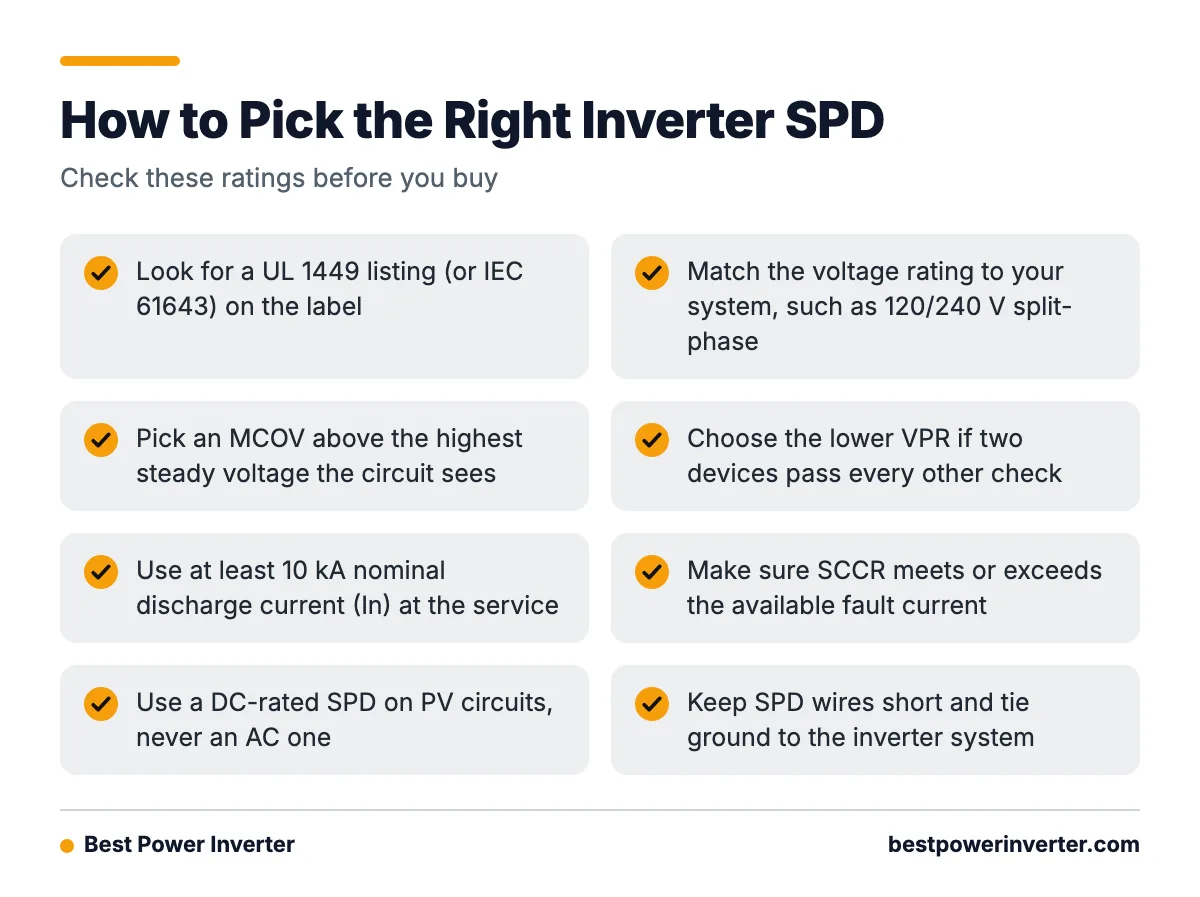
- Voltage rating: Must fit the system, such as 120/240 V split-phase. For PV, it must cover the worst-case open-circuit voltage.
- MCOV: Maximum continuous operating voltage. It must sit above the highest steady voltage the circuit can see.
- VPR: Voltage protection rating from UL 1449 testing. Lower means less voltage passes through.
- In: Nominal discharge current. The 2023 NEC sets a 10 kA minimum for relevant service equipment applications.
- Imax: Maximum discharge current. It shows the biggest single surge the device is built to handle.
- SCCR: Short-circuit current rating. It must meet or exceed the available fault current where you install it.
For PV, one manufacturer example lists a device for systems up to 1,500 VDC, with 20 kA nominal and 40 kA maximum discharge current. Your array needs its own check against its own maximum voltage.
Worked example: 120/240 V split-phase inverter
These numbers are an illustration. Use your own values from the nameplate and a fault-current calculation.
| Check | Example value | Result |
|---|---|---|
| System | 120/240 V split-phase, 120 V to neutral | Choose a split-phase SPD |
| MCOV | Assume highest steady output of 126 V per leg. SPD listed at 150 V MCOV. | Pass: 150 V is above 126 V |
| VPR | Compare 600 V and 800 V options on the label | Prefer the lower VPR if all else matches |
| In | Need at least 10 kA at the service. Exposed site: pick 20 kA. | Pass with 20 kA |
| SCCR | Assume 10 kA available fault current at the panel, with battery contribution included | Pass with a 25 kA SCCR. Fail with a 5 kA SCCR. |
Battery banks can deliver very high fault current. Ask the battery and inverter makers for their contribution, then add it to the grid’s value.
- If the SPD’s SCCR is lower than the available fault current, choose a different device.
- If the MCOV is below your highest normal voltage, the SPD will wear out early. Choose a higher MCOV.
- If two devices pass every check, pick the one with the lower VPR.
Lead Length, Grounding, and Bonding
Short wires matter. Lead inductance raises the voltage that actually reaches your equipment. One solar installation guide recommends keeping total DC lead length to the inverter terminals within 0.5 m.
- Mount the SPD close to the inverter or panel it protects.
- Keep the wires straight. Avoid loops and sharp bends.
- Do not coil extra wire. Cut it to length.
- Tie the SPD ground to the same grounding system as the inverter and panel.
Bonding links all metal parts so they rise and fall in voltage together. For rules on array grounding, see this guide to NEC 690.43 and 250 bonding.
Coordinate devices too. If you use SPDs at both the panel and the inverter, follow the manufacturer’s guidance on spacing between them so they share energy correctly. For larger sites, CITEL’s surge protection notes for microgrids show how layered protection works.

Can a Surge Protector Protect an Inverter From Lightning?
It can reduce the risk, but it cannot guarantee safety. A direct strike carries enormous energy. No SPD makes an inverter lightning-proof.
Good protection layers several steps: a proper grounding system, bonding, SPDs on each entry path, and short wiring. Some owners also unplug equipment or disconnect PV during severe storms. In high-strike areas, a site risk assessment is worth the cost.
Is It Surge Damage or Something Else?
Not every shutdown is a surge. Check these first before you blame lightning.
| Problem | Typical signs | First checks |
|---|---|---|
| Overload shutdown | Fault code or alarm when a big load starts; restarts after load is removed | Compare load watts and motor start surge with inverter ratings |
| Battery-current problem | Shutdown under heavy load, hot cables, or BMS cutoff | Cable size, fuse, terminal tightness, battery current limits |
| Low-voltage fault | Alarm as battery voltage sags, often with a weak or discharged battery | Battery state of charge, voltage drop at terminals |
| Actual surge damage | Dead unit, burn smell, blown input components, failed SPD indicator, several devices fail after a storm | Inspect SPD window, look for scorch marks, call a qualified technician |
If the SPD indicator shows it has failed, replace it. A failed SPD means it did its job, but it will not protect the next surge.
When Should Surge Protection Be Installed by a Licensed Electrician?
Use a licensed electrician whenever the work touches the service panel, PV array wiring, or any permanent AC circuit. Plugging in a point-of-use protector is a homeowner task. Everything else usually needs a permit and an inspection.
- Installing a Type 1 or Type 2 device at the main panel.
- Adding DC protection on PV strings above safe-touch voltage.
- Calculating available fault current for SCCR checks.
- Any system tied to the utility grid.
Local code can add rules beyond the NEC. An electrician will know them.
Inspection and Replacement
SPDs wear out. Each surge uses up part of the protection. Check them on a schedule.
- Look at the status window or LED after every nearby storm.
- Replace modules that show a fault indicator.
- Check wire tightness and ground connections once a year.
- Replace the SPD after a known large surge, even if it still looks fine, if the maker says so.
Frequently Asked Questions
Does a power inverter need surge protection?
Usually, yes. Inverters can see lightning-induced surges and switching transients on the DC side, the AC side, and signal lines. Use a correctly rated, coordinated SPD that carries a UL 1449 listing in North America or meets IEC 61643 where it applies.
What is the difference between an inverter’s surge rating and an external surge protector?
The surge rating shows how many watts the inverter can deliver briefly to start motors. An external SPD limits overvoltage from lightning or switching. The wattage figure does not tell you how the inverter handles a voltage spike.
Where should an SPD be installed in an inverter system?
Install SPDs at the points where surges can enter: the PV or battery DC input, the AC output or main panel, and any outdoor communication lines. Keep the wires short and ground the device to the system’s grounding network.
Do I need surge protection on both the DC input and AC output?
In most solar and hybrid systems, yes. DC and AC protection do different jobs, and each covers a separate entry path. A small RV inverter with short DC cables may need only AC-side protection.
What is the difference between Type 1 and Type 2 surge protection?
Under NEC Article 242, Type 1 can be installed on either side of the service equipment. Type 2 is installed on the load side. Pick based on location and the device’s listing.
Can a surge protector protect an inverter from lightning?
It can lower the chance and size of damage, but it cannot make the inverter lightning-proof. A direct strike can overwhelm any SPD. Grounding, bonding, and layered protection all help.
How should I protect solar, battery, generator, and grid-tied inverters?
Use a DC PV SPD on arrays sized to the maximum PV voltage, an AC SPD at the inverter and panel, and protectors on data lines. For generator setups, protect the AC input, since switching loads can create transients.
Sources