
A pure sine wave inverter and a modified sine wave inverter work the same way at the core. Both switch battery DC on and off very fast with transistors, step the voltage up, and filter the result into AC. The difference is how clean that final waveform is, and that decides which appliances will run well on it.
Quick answer
An inverter chops battery DC into a fast pulse pattern, raises the voltage with a transformer or DC-DC stage, and smooths the output into roughly 120V/60Hz or 230V/50Hz AC. Pure sine units copy utility power most closely.
- Best for sensitive loads: pure sine, for CPAP, laptops, motors
- Best for simple heaters or lights on a budget: modified sine
- Best for RVs: inverter/charger with transfer switch
- Every inverter has four stages: DC input, switching, voltage step-up, and filtering.
- Output voltage goes up, so current on the battery side goes way up. A 1,000W load pulls about 83A at 12V before losses.
- Pure sine wave is the safe pick for motors, audio gear, chargers and medical devices.
- Idle draw and efficiency losses shorten battery runtime more than most beginners expect.
- In an RV, only selected circuits are usually fed by the inverter.
- How Does a Power Inverter Work, Step by Step?
- What Is the Difference Between DC and AC?
- How Do Voltage Inverters Change 12V Into 120V or 230V?
- Modified Sine Wave vs Pure Sine Wave
- Low-Frequency vs High-Frequency Inverters
- What Protection Circuits Does an Inverter Have?
- How Does a Power Inverter Work in an RV?
- Why Does an Inverter Drain the Battery?
- What Size Inverter, Cable and Fuse Do I Need?
- Common Problems and Safe-Use Tips
- What Do Owners Say?
- Frequently Asked Questions
How Does a Power Inverter Work, Step by Step?
An inverter works in four stages: it takes in DC, switches it rapidly to make an alternating pattern, raises the voltage, and filters the result into smooth AC. Each stage has one job.
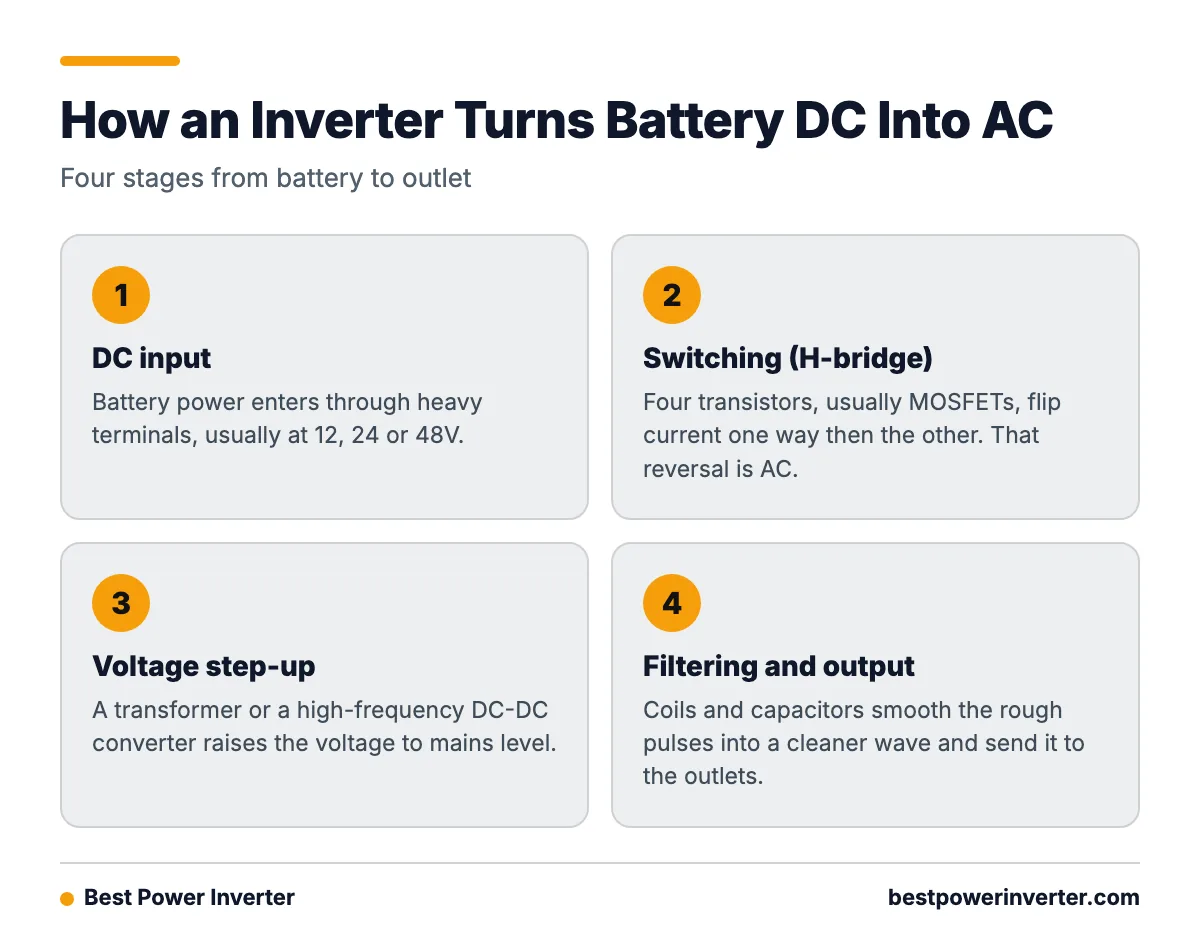
- DC input. Battery power enters through heavy terminals, usually at 12, 24 or 48V.
- Switching (H-bridge). Four transistors, usually MOSFETs, are arranged in an H shape. A control chip turns opposite pairs on and off. First current flows through the load one way, then the other way. That reversal is AC.
- Voltage step-up. A transformer or a high-frequency DC-DC converter raises the voltage to mains level.
- Filtering and output. Coils and capacitors smooth the rough pulses into a cleaner wave, then send it to the outlets.
Think of the H-bridge like a person flipping a switch back and forth 60 times a second. The control circuit does it far faster than that, using pulse width modulation (PWM). It makes the pulses wide in the middle of each half-cycle and narrow at the edges. After filtering, the average of those pulses looks like a smooth sine curve.
Simple diagram in words: Battery + and − go to the H-bridge. The H-bridge feeds the transformer or boost stage. The boost stage feeds the output filter. The filter feeds the outlet. A control board watches voltage, current and heat the whole time.
For another plain-language walkthrough, see this explanation of how inverters work.
What Is the Difference Between DC and AC, and Why Do Appliances Need AC?
DC flows in one direction at a steady voltage. AC reverses direction many times a second: 60 times in North America (60Hz) and 50 times in much of the rest of the world (50Hz).
Batteries and solar panels make DC. Wall outlets deliver AC because utilities can raise and lower AC voltage easily with transformers, which makes long-distance power practical. Most household appliances were built around that supply. Motors, transformers and power supplies in them expect a certain voltage and frequency. An inverter bridges the gap, so a 12V battery can run a device designed for a wall socket.
How Do Voltage Inverters Change 12V Into 120V or 230V?
They raise the voltage with either a transformer or a high-frequency DC-DC converter. A transformer only works on changing current, which is why the switching stage comes first.
The switched 12V pulses flow through the transformer’s primary coil. The secondary coil has many more turns of wire, so it produces a higher voltage. The turns ratio sets the step-up. In high-frequency designs, a small ferrite transformer first boosts the DC to a high internal voltage, then a second H-bridge turns it into 120V or 230V AC.
Power does not appear from nowhere. Raise the voltage and the current drops on the output side, but the battery side must supply the big current. That is why inverter cables are so thick.

What Is the Difference Between Modified Sine Wave and Pure Sine Wave Inverters?
A pure sine wave inverter makes a smooth curve that closely matches utility power. A modified sine wave inverter makes a stepped approximation that is cheaper to build but rougher on some loads.
| Waveform | Shape | Usually works fine | May struggle |
|---|---|---|---|
| Square wave | On/off blocks | Basic resistive heaters, incandescent bulbs | Most electronics, motors, anything with a power supply |
| Modified sine | Stepped approximation | Simple tools, lights, phone chargers, resistive heat | Audio gear (buzzing), motors (run hot), CPAP, some battery chargers, variable-speed tools |
| Pure sine | Smooth curve | Nearly everything | Little; costs more |
Pure sine wave inverters are generally recommended for sensitive electronics, motors and medical devices such as CPAP machines. If a device has a motor, a speed control, a dimmer or a charger, choose pure sine. Cheap modified sine units are the usual source of buzzing speakers and warm motors.
If you run a CPAP, laptop, fridge or audio gear, then buy pure sine.
If you only run a work light or a plain heating element, then modified sine can be enough.
If you are unsure, then buy pure sine. The price gap is usually smaller than the cost of a damaged device.
What Is the Difference Between Low-Frequency and High-Frequency Inverters?
Low-frequency inverters use a heavy iron-core transformer and handle surges well. High-frequency inverters use a switching DC-DC stage with a small transformer, so they are lighter and usually cheaper.
| Feature | Low-frequency (transformer) | High-frequency |
|---|---|---|
| Weight | Heavy | Light |
| Surge handling | Strong | More limited |
| Price | Usually higher | Usually lower |
| Best fit | Motor loads, fixed installs | Portable, mobile, general use |
What Protection Circuits Does an Inverter Have?
Most inverters include low-battery shutdown, overload, over-temperature and short-circuit protection. Good ones add reverse-polarity protection too.
- Low-voltage cutoff: commonly near 10 to 10.5V on a 12V system. It stops the inverter before it drains the battery too far.
- Overload and short-circuit: shuts the output off if the load is too big.
- Over-temperature: fans spin up, then the unit shuts down if it still runs hot.
- Reverse polarity: a fuse or circuit blows if you swap + and −. Not every unit has it, so check twice.
- GFCI: some units have a ground-fault outlet for wet areas.
How Does a Power Inverter Work in an RV?
In an RV, the inverter pulls from the house battery bank and powers selected AC outlets. A transfer switch moves those outlets between inverter power and shore or generator power.
Signal path in text:
Battery bank → fuse or disconnect (close to the battery) → inverter/charger → transfer switch → AC subpanel → outlets. Shore power or generator power enters the transfer switch from the side.
An inverter only converts battery power to AC. An inverter/charger also does the reverse: when shore power is present, it charges the batteries. Its built-in transfer switch passes shore power to the loads automatically and switches back to battery in a fraction of a second if shore power drops. A separate inverter needs a separate transfer switch to do the same job.
Many RVs do not run the whole coach from the inverter. Large loads such as an air conditioner are too heavy for most RV inverters, so the inverter feeds a smaller subpanel.
| Circuit | Typically inverter-fed? |
|---|---|
| Living area outlets, TV | Often yes |
| Residential fridge | Often yes |
| Microwave | Sometimes, if inverter is large enough |
| Air conditioner | Usually no |
| Water heater element, electric heater | Usually no |
Check your panel labels or the manual to see which breakers sit on the inverter subpanel. For more on RV setups, see this RV inverter overview from Outdoorsy.
Why Does an Inverter Drain the Battery, and How Do I Estimate Runtime?
An inverter drains the battery for two reasons: it supplies your load, and it wastes some power as heat. Quality units are roughly 85 to 95% efficient, and even with no load they draw several to tens of watts to keep the electronics running.
Idle draw adds up. As an example, a unit that idles at 15W uses 150Wh over ten hours with nothing plugged in. That is real battery capacity gone by morning. Switch the inverter off when you do not need it.
Runtime formula: battery Ah × battery voltage × usable depth of discharge × inverter efficiency ÷ load watts.
The table below uses my assumptions: a 12V 100Ah battery, 80% usable for LiFePO4, 50% usable for AGM, and 88% inverter efficiency. It ignores idle draw, so real runtimes will be a little shorter.
| Load | 100Ah LiFePO4 (about 845Wh usable) | 100Ah AGM (about 528Wh usable) |
|---|---|---|
| 100W | About 8.4 hours | About 5.3 hours |
| 300W | About 2.8 hours | About 1.8 hours |
| 1,000W | About 50 minutes | About 30 minutes |
AGM batteries often deliver less than rated capacity at heavy loads, so treat the AGM numbers as optimistic at 1,000W.
What Size Inverter, Cable and Fuse Do I Need?
Add up the watts of everything you will run at the same time, then pick an inverter whose continuous rating is above that total. Next, size the cable and fuse for the battery-side current, which is much higher than you expect.
Current equals power divided by voltage. A 1,000W load at 12V needs about 83A before losses, and about 97A at roughly 86% efficiency. The same load at higher voltage needs far less current:
| System | Current at 100% | Current at about 86% | Example fuse (about 125%) | Example copper cable, short run |
|---|---|---|---|---|
| 12V | 83A | 97A | 125A | 2 AWG |
| 24V | 42A | 48A | 60A | 6 AWG |
| 48V | 21A | 24A | 30A | 10 AWG |
These fuse and cable sizes are example values based on a common rule of sizing the fuse at about 125% of maximum continuous current. Cable length, insulation rating and temperature all change the answer, so use the chart in your inverter’s manual. Higher voltage means thinner cable, less heat and less voltage drop, which is why larger systems move to 24V or 48V.

What is surge power, and can an inverter run a fridge, microwave or air conditioner?
Surge (peak) power is the short burst an inverter can supply above its continuous rating, often about 2x continuous for a brief time. Motor loads need more because inductive loads like compressors can draw several times their running current at start.
- Fridge: yes, if the inverter’s surge rating covers the compressor start.
- Microwave: yes, but check the label. A microwave sold as 1,000W cooking power draws more than 1,000W from the wall.
- Air conditioner: usually needs a large inverter, a big battery bank and often a soft-start device. Many small systems cannot run one.
For a general buying checklist, the Eaton power inverter buying guide is a useful second reference.
Common Problems and Safe-Use Tips
From the Shop
Buyers frequently describe the same pattern: an inverter that trips the moment a kettle or power tool starts, even though the label says it should handle it. The cause is often a thin cable, a loose lug or a budget unit with an overstated rating, not a faulty battery.
- Keep cables short and tight. Loose connections cause heat and voltage drop.
- Fuse close to the battery. Place the fuse on the positive cable near the battery terminal.
- Give it air. Do not bury the inverter under blankets or gear.
- Match the load to the rating. Leave headroom, rather than running at the limit.
- Turn it off when idle. This stops standby drain.
- Respect the AC side. The output is real mains voltage and can hurt you.
What do owners say?
Owners like
- Pure sine wave models run sensitive electronics, CPAP machines and laptops quietly and without issues
- Inverter/charger units with automatic transfer switching make RV use seamless when moving between shore power and battery
- Remote panels or apps with battery voltage and load display help owners monitor use
- Higher-quality units handle the rated surge loads such as power tools and small microwaves reliably
Common complaints
- Idle draw drains the battery overnight if the inverter is left on
- Cooling fans are noisy under load
- Undersized cables or weak connections lead to voltage drop and low-voltage shutdowns
- Cheap modified sine units cause buzzing in audio equipment or run motors hot
- Advertised peak or continuous wattage is overstated on budget units, causing overload trips
Summarised from owner reviews and long-term user reports; individual experiences vary.
Frequently Asked Questions
How does power inverter work?
A power inverter takes DC from a battery and switches it on and off with transistors to make an alternating waveform. A transformer or DC-DC stage raises the voltage, and a filter smooths the output into about 120V/60Hz or 230V/50Hz AC.
How do voltage inverters work?
Voltage inverters use an H-bridge of MOSFETs to reverse current direction many times a second. A transformer or boost converter then steps the voltage up to mains level. Output can be modified sine or pure sine, depending on the design.
How does power inverter work in RV?
The inverter draws from the house batteries through a fuse or disconnect and feeds a transfer switch. When shore or generator power is present, the switch passes that power through. When it is not, the switch moves selected outlets to the inverter. Only some circuits are inverter-powered, and large loads like the air conditioner are usually left out.
How does power inverter work nms?
“NMS” is not a standard inverter term, so it is likely a typo, a shorthand or part of a model code. Check the label or manual of your unit. How an inverter works does not change: DC in, switching, step-up, filtering, AC out.
What is the difference between grid-tie and off-grid inverters?
An off-grid inverter powers your loads from batteries on its own. A grid-tie inverter, usually used with solar panels, syncs with the utility and sends power to the grid, and it typically shuts down when the grid goes out. The two are not interchangeable.
Sources