
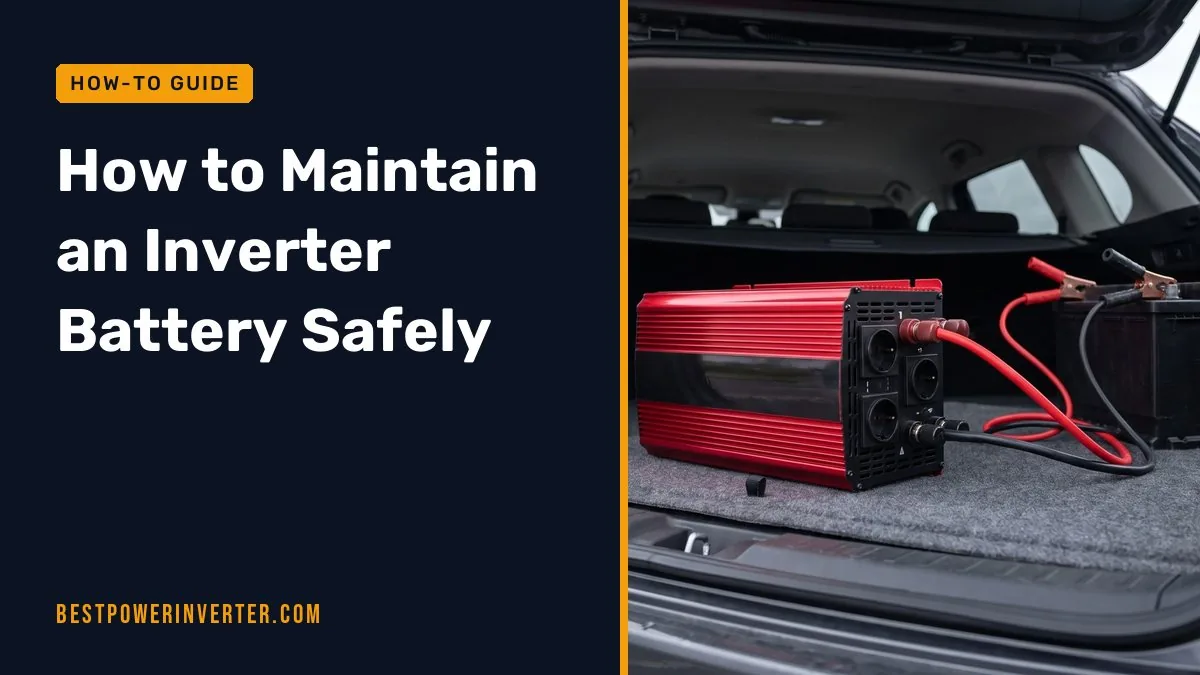
Most inverter battery problems come from two choices: how you charge the battery and how deeply you drain it. Good maintenance means correct charging, ventilation, clean terminals, regular inspection and, for flooded lead-acid batteries only, topping up with distilled water. Corrosion and loose cables you can fix at home. A cracked, swollen, leaking, overheated or internally failed battery needs replacing, not repair.
Quick answer
Check your battery monthly: case, terminals, cables, charging and temperature. Add distilled water only to flooded batteries. Clean corrosion, tighten connections, and replace any battery that is swollen, cracked, leaking or will not hold charge.
- Best for low upkeep: LiFePO4 or sealed AGM
- Best for lowest upfront cost: flooded lead-acid, with regular watering
- Only flooded lead-acid batteries get distilled water. Never open sealed AGM, gel or lithium batteries.
- Surface corrosion and loose cables are fixable. Sulfation, swelling, cracks and leaks are not.
- Overcharging, deep discharge, heat and mismatched batteries are the main life-shorteners.
- A 5000W load on a 48V bank draws about 123A from the battery, so cables, BMS and fuses must match.
- An inverter does not damage a healthy battery if it is sized and wired correctly.
- What a battery inverter does
- How do I maintain an inverter battery?
- Maintenance by battery type
- How do I clean corroded terminals safely?
- Charging, heat and deep discharge
- How can I repair an inverter battery at home?
- Repair or replace?
- Can an inverter damage the battery?
- What size inverter and battery bank for 5000W?
- What is the best battery type?
- Replacement and recycling
- What do owners say?
- Frequently Asked Questions
What is a battery inverter and how does it convert DC to AC?
A battery inverter turns stored direct current (DC) from your battery into alternating current (AC) for household loads. The battery holds the energy. The inverter only converts it, and some energy is lost as heat during the conversion.
That loss matters. A typical inverter runs at roughly 85% efficiency in the brief used for this guide, so the battery must supply more power than the load uses. A charger or the grid refills the battery. The inverter never adds energy of its own.
So three parts work together: the battery (DC storage), the inverter (conversion) and the AC loads (lights, router, fans, fridge). A fault in any one of them can look like a battery problem.
How do I maintain an inverter battery?
Inspect it monthly, keep it clean, cool and ventilated, charge it correctly and avoid deep discharges. Add distilled water only if the battery is flooded lead-acid. Write down what you find each time so changes stand out.
Safety before you touch anything
- Switch off the inverter and disconnect the mains input before any work.
- Remove rings, watches and necklaces. Metal across terminals can cause a severe short.
- Wear safety glasses, acid-resistant gloves and old clothes.
- Keep sparks, flames and cigarettes away. Lead-acid batteries release hydrogen and oxygen while charging.
- Work in a ventilated space with plain water nearby for rinsing splashes.
For deeper safety detail, see the Lead-Acid Battery Safety document from UC Riverside Environmental Health and Safety.

Printable monthly checklist
- ☐ Case: no cracks, bulges, wet spots or swelling
- ☐ Terminals: no white, green or blue crust; clamps tight
- ☐ Cables: insulation intact, no heat marks, no melted lugs
- ☐ Electrolyte (flooded only): plates covered; top up with distilled water if low
- ☐ Charging: inverter shows normal charge stages, no frequent fault codes
- ☐ Ventilation: vents and air gaps clear; nothing stacked on or around the battery
- ☐ Temperature: battery not hot to the touch after charging
- ☐ Runtime: note how long a known load runs, and compare with last month
How often should I check electrolyte levels and add distilled water?
Check flooded batteries about once a month, and more often in hot weather or with heavy use. Add distilled water only when plates are exposed or the level is below the marker, and do it after charging, since fluid rises as the battery charges. Tap water brings minerals that harm the plates. Do not overfill, because acid can spill from the vent caps.
Maintenance differences between flooded, AGM, gel and LiFePO4
Many guides mix these up and tell owners to add water to sealed batteries. Do not. Sealed AGM, gel and lithium batteries should not be opened or topped up.
| Type | Watering | Ventilation | Inspection | Charging | Typical failure signs |
|---|---|---|---|---|---|
| Flooded lead-acid | Distilled water, checked monthly | Needed; gasses during charging | Level, terminals, case, odor | Matched charger profile; avoid overcharge | Low fluid, heavy corrosion, sulfation, short runtime |
| AGM (sealed) | Never | Still needed; keep it cool | Case bulging, terminals, heat | AGM profile; avoid overcharge | Swelling, hot case, sudden runtime drop |
| Gel (sealed) | Never | Still needed; keep it cool | Case, terminals, heat | Gel profile; lower charge voltage limits | Bulging, voltage that will not hold |
| LiFePO4 | Never | Keep air space for heat | BMS alerts, cables, case | Lithium profile; BMS protects the cells | BMS cut-offs, cell imbalance, swelling |
How do I clean corroded inverter battery terminals safely?
Disconnect the inverter and mains, remove the negative cable first, then the positive. Scrub the crust off with a baking soda and water paste and a non-metal brush. Rinse lightly, dry fully, reconnect positive first and negative last, then coat with terminal grease or petroleum jelly.
- Power down the inverter and unplug the mains input.
- Put on gloves and eye protection.
- Loosen and lift off the negative clamp, then the positive.
- Brush with baking soda paste. It fizzes as it neutralizes acid residue.
- Wipe with a damp cloth. Keep water out of the vent caps.
- Dry everything, then refit and tighten the clamps firmly.
- Apply a thin layer of terminal protectant.
If a clamp is melted or the post is loose, stop. That is a heat fault, and cleaning will not solve it.
Charging, float voltage, overcharging, deep discharge and temperature
Four habits shorten battery life the most.
- Overcharging: Too much voltage causes excessive gassing, heat, electrolyte loss and plate damage. Use the right charge profile and a float voltage set by the battery maker.
- Deep discharge: Running a lead-acid battery flat again and again leaves it undercharged, and hard sulfate crystals form on the plates. Recharge soon after outages.
- Heat: A hot room speeds up wear. Keep the battery in a cool, shaded, ventilated spot.
- Mismatched batteries: Banks should match in type, voltage, capacity and condition. Adding one new battery to old ones, or mixing types, causes uneven charging and weak performance.
Letting a battery sit empty is also harmful. If you leave a property for weeks, keep the battery on a proper maintenance charge or follow the maker’s storage instructions.
How can I repair an inverter battery at home?
You can fix only the external problems: corroded terminals, loose or damaged cables, low water in flooded cells, and wrong charger settings. Anything inside the case is not a home repair.
DIY troubleshooting
- Low runtime: Check the load first. Then check that the battery is fully charged and not old. Many batteries lose capacity after repeated deep discharges.
- Slow charging: Look for loose or corroded terminals, a wrong charge profile, or a weak mains supply.
- Voltage drop under load: Warm cables or clamps point to poor connections or undersized cable. A weak battery also sags fast.
- Inverter faults or shutdowns: Corrosion and loose connections often trigger these. High loads such as air conditioners, pumps and heaters can also trip the inverter if its surge capacity or the battery’s current delivery falls short.
- Crust on terminals? Clean it and protect the posts.
- Clamps warm or loose? Disconnect, clean, tighten, and replace damaged lugs.
- Low water in a flooded battery? Add distilled water after charging.
- Still short runtime after a full charge? Have it load-tested by a technician.
Can an inverter battery actually be repaired, and how do I know when to replace it?
Rarely. Outside fixes work, but internal damage does not reverse. Cracked, swollen, leaking, severely sulfated, overheated or internally failed batteries should be replaced.
| Problem | Repair or replace? | Action |
|---|---|---|
| Surface terminal corrosion | Repair | Clean and protect |
| Loose cables | Repair | Tighten; replace damaged lugs or cable |
| Low electrolyte (flooded) | Repair | Add distilled water; watch for repeat loss |
| Low voltage after long storage | Maybe | Recharge with the right charger; replace if it will not hold |
| Severe sulfation | Replace | Capacity loss is usually permanent |
| Cracked case or leak | Replace | Handle with gloves; dispose properly |
| Swollen case | Replace | Stop using it; heat or overcharge damage |
| Rotten-egg smell | Replace / urgent check | Ventilate, disconnect, call a technician |
Even when a fix looks possible, weigh the cost. Reconditioning an old battery often costs time and risk for a short extension of life.

Can an inverter damage the battery?
Yes, if it is wrong for the system. An undersized battery bank, a wrong charge profile, loose cables, frequent overloads and deep discharges all shorten battery life. A correctly sized, correctly set inverter does not harm a healthy battery.
Check three things: the inverter’s DC input voltage matches the bank, the battery type setting is correct, and the low-voltage cut-off is not set too low for lead-acid.
What size inverter and battery bank do I need for a 5000W load?
For a 5000W load you need an inverter rated above 5000W continuous, plus a battery bank and cables able to deliver the battery-side current. Many guides stop at the inverter watts. The battery side is where systems fail. See also Size a Battery Bank for a 5000W Inverter from WattSizing.
Worked example: 5000W at 48V, 2 hours
| Step | Calculation | Result |
|---|---|---|
| Battery current | 5000 ÷ (48 × 0.85) | About 123A |
| Battery-side power | 5000 ÷ 0.85 | About 5,882W |
| Energy for 2 hours | 5,882 × 2 | About 11,765Wh |
| Amp-hours at 48V | 11,765 ÷ 48 | About 245Ah |
| LiFePO4 at 90% usable | 245 ÷ 0.9 | About 272Ah, so choose 280Ah or more |
| Lead-acid at 50% usable | 245 ÷ 0.5 | About 490Ah |
The 85% efficiency figure is an assumption. Check your inverter’s datasheet. The usable-capacity percentages are common planning rules, not fixed laws, so check your battery’s data sheet too.
Check the ratings
- Inverter continuous rating: Above 5000W, with headroom if the load runs for hours.
- Surge rating: Motors in pumps and air conditioners draw more at start-up. Check the inverter’s surge figure and the load’s start-up demand.
- BMS continuous discharge: For lithium, it should exceed the roughly 123A running current, and its surge limit should cover start-up peaks.
- Cables and fuses: Size them to the inverter manual’s instructions for the current, not just the wattage.
What is the best battery type for an inverter?
It depends on your budget and how much upkeep you accept.
- Want the lowest purchase price and can check monthly? Choose flooded lead-acid.
- Want sealed, no watering, and moderate cost? Choose AGM or gel.
- Want long life, deep discharge and low upkeep? Choose LiFePO4, with a BMS rated for your load.
- Have a hot or poorly ventilated room? Avoid flooded batteries, and keep any battery cool.
For the best battery power inverter, match the inverter to the bank voltage, pick a pure sine wave model for electronics, and make sure the continuous and surge ratings exceed your biggest load.
Battery replacement, recycling and professional service
Replace the whole bank when batteries are old or uneven, rather than adding one new unit to old ones. Use the same type, voltage and capacity. Lead-acid batteries are recyclable, so take old ones to a battery dealer or recycling center, never the household bin. The Top 5 Safety Precautions While Handling Inverter Batteries article from Livguard covers handling basics.
Call a professional for leaks, swelling, rotten-egg smell, heat at the terminals, repeated inverter faults, or any high-voltage bank work.
What do owners say?
Owners like
- Long backup runtime when the battery is correctly sized and regularly charged
- Low-maintenance operation from sealed AGM, gel and lithium batteries
- Simple installation when cables, terminals and bank voltage are matched
- Quiet, convenient backup for lights, networking gear and essential appliances
Common complaints
- Runtime falls noticeably after repeated deep discharges
- Terminal corrosion and loose connections cause charging or inverter-fault problems
- Flooded batteries need recurring distilled-water checks and produce odor or gas during charging
- High loads such as air conditioners, pumps and heaters can trigger shutdowns when surge capacity or battery current is short
- Overheating, overcharging and mismatched batteries shorten service life
Summarised from owner reviews and long-term user reports; individual experiences vary.
Frequently Asked Questions
How to maintain inverter battery?
Inspect it monthly for cracks, swelling, leaks and corrosion. Keep terminals clean and tight, keep the area ventilated and cool, use the correct charge profile, and avoid deep discharges. Add distilled water only to flooded lead-acid batteries.
How to repair inverter battery at home?
Only external faults are safe to fix: clean corroded terminals, tighten loose cables, top up flooded cells with distilled water, and correct charger settings. Do not open sealed batteries or try to rebuild cells.
Can we repair inverter battery?
Sometimes minor issues, yes. Cracked, swollen, leaking, severely sulfated or internally failed batteries should be replaced, as the damage is permanent and unsafe to work on.
How to repair inverter battery?
Start by finding the cause. Check the load, charger settings, cables and terminals. If the battery is fully charged and still has short runtime, have a technician load-test it. A failed test normally means replacement.
Maintenance of inverter battery: how often?
Do a quick visual check monthly. For flooded batteries, check electrolyte monthly as well, and more often in hot weather or heavy use.
Can inverter damage battery?
It can, when the setup is wrong. Undersized banks, wrong charge profiles, frequent overloads, loose connections and repeated deep discharge all shorten life. A properly matched system does not harm a healthy battery.
How big power inverter for 5000W battery?
Choose an inverter rated above 5000W continuous with enough surge capacity. At 48V and about 85% efficiency, the load draws roughly 123A. For two hours you need about 245Ah at 48V of usable capacity, so more nominal capacity is needed once depth-of-discharge limits are applied.
Best battery power inverter?
The best one matches your bank voltage, outputs pure sine wave, has continuous and surge ratings above your largest load, and has a charger profile for your battery type.
Battery inverter DC to AC: does it create extra power?
No. It converts stored DC into AC and loses some energy as heat. Total runtime depends on battery capacity, load and inverter efficiency.
Sources