
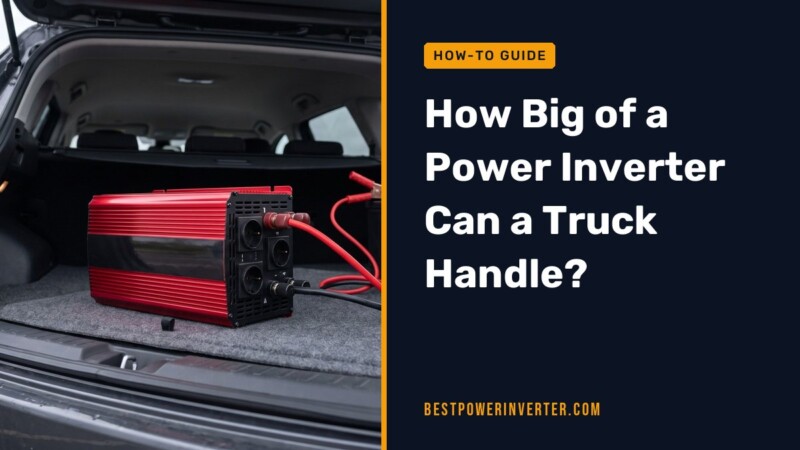
Truck owners, owner-operators, and DIY upfitters who want 120V power need to size the inverter to the truck, not the other way around. Your limit is set by the alternator, the batteries, and the cables, not by the label on the inverter. A 2,000W inverter pulls roughly 170A from a 12V system before losses, so many stock pickups are more comfortable at 1,000W to 1,500W continuous unless the charging system and wiring are upgraded.
- Divide inverter watts by 12 to find the DC amps. 1,000W is about 83A, 2,000W is about 167A, and 3,000W is about 250A, all before losses.
- Plan continuous use at 70-80% of alternator output or less.
- Wire and fuse size follow current, not watts. Big inverters need 1/0 to 4/0 AWG copper cable.
- Put the fuse on the positive cable, within about 18 inches of the battery.
- High loads drain a starter battery fast. Run the engine, and add a separate battery bank for anything over 1,000W.
- How Inverter Sizing Works on a 12V Truck
- How Much Current Does an Inverter Draw?
- Alternator Output vs. Inverter Load
- Worked Example: 140A Alternator, 2,000W Inverter
- Battery Capacity and Runtime
- Wire Gauge and Fuse Size
- Where to Put the Fuse
- Pickups vs. Semi Trucks
- Pre-Install Checklist
- What Happens If You Go Too Big
- Frequently Asked Questions
How Inverter Sizing Works on a 12V Truck
An inverter turns 12V DC into 120V AC. It cannot make power from nothing. Every watt you pull from the outlet comes from the truck’s electrical system, plus a little extra lost as heat. Most inverters run around 85-90% efficient, so plan for about 10-15% more DC current than the math alone shows.
Three parts of your truck set the limit:
- Alternator: supplies power while the engine runs.
- Batteries: cover the gap and carry the load when the engine is off.
- Cables and fuse: must carry the current without overheating.
The weakest of the three is your real limit. To learn how many watts your truck can safely run, check the alternator rating, count your battery capacity, and measure the cable run.
How Much Current Does an Inverter Draw?
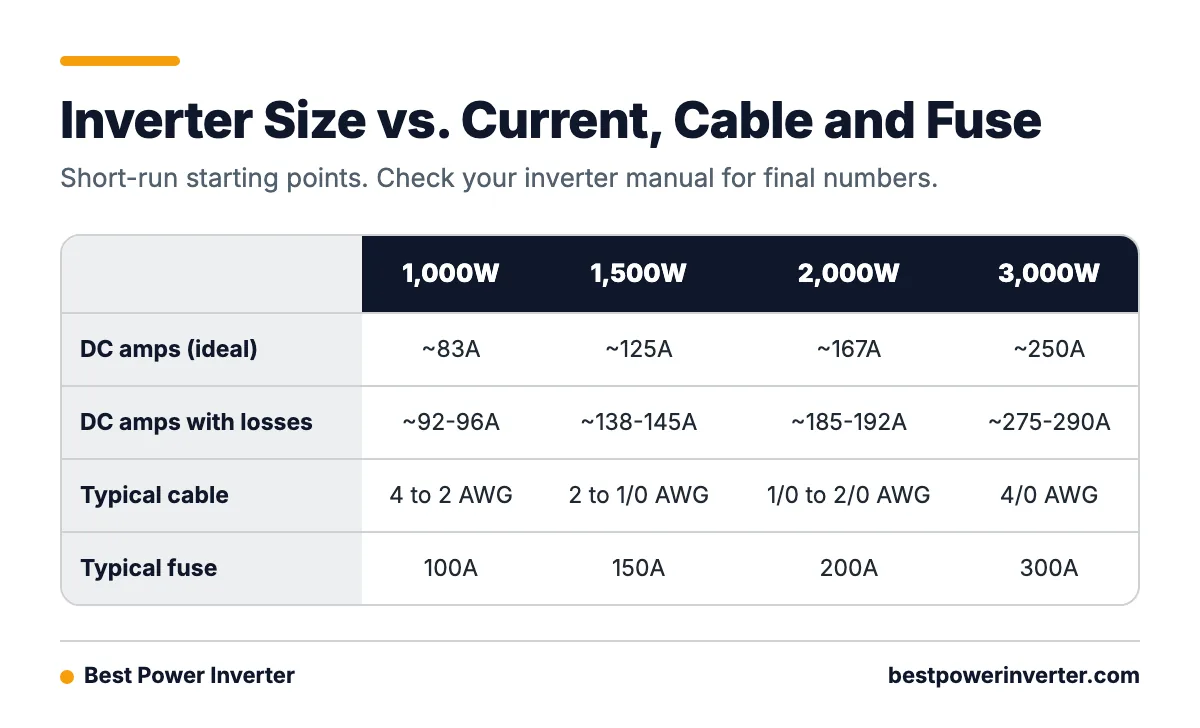
The formula is simple: watts divided by volts equals amps. Add 10-15% for losses. The table below also shows common cable and fuse ranges. Treat these as general starting points. Your inverter’s manual and cable length decide the final numbers.
| Inverter Size | DC Amps (Ideal) | DC Amps (With Losses) | Typical Cable (Short Run) | Typical Fuse |
|---|---|---|---|---|
| 1,000W | ~83A | ~92-96A | 4 AWG to 2 AWG | 100A |
| 1,500W | ~125A | ~138-145A | 2 AWG to 1/0 AWG | 150A |
| 2,000W | ~167A | ~185-192A | 1/0 AWG to 2/0 AWG | 200A |
| 3,000W | ~250A | ~275-290A | 4/0 AWG | 300A |

Alternator Output vs. Inverter Load
Common pickup alternators fall in the roughly 90-140A range. Heavy trucks often run 120-200A or more. That number is the peak, not what you should use all day.
Some guidance says to keep continuous inverter use around 70-80% of alternator output. An alternator that runs flat out for hours runs hot and wears faster. Also remember the truck needs its own power for the ignition, fuel pump, fans, lights, and electronics. Those loads come off the top first.
Worked Example: 140A Alternator, 2,000W Inverter
Here is why this pairing is borderline on a stock pickup.
- Inverter at full load: 2,000W ÷ 12V = about 167A. With 10-15% losses, about 185-192A.
- Safe alternator budget: 140A × 70-80% = about 98-112A.
- The truck’s own loads take a share of that, so even less is left for the inverter.
- The gap is 75-90A or more. The battery has to cover it.
That works for a short burst. It does not work for a long, steady load. The same truck is much happier with a 1,000W inverter at about 92-96A, which fits inside the alternator budget. If the load is light, such as a laptop and a phone charger, even a 2,000W inverter is fine because it only draws what the devices need. The danger is a heavy load, not the size on the box.
Battery Capacity and Runtime
Can you run a big inverter from the starter battery alone? You can, but not for long. Starter batteries are built for short, strong bursts, not deep discharge. Lead-acid batteries should not be routinely discharged below 50% if you want them to last. A 100Ah battery gives about 50Ah of usable power.
At an 80A draw, that is under 40 minutes in a perfect case. Real-world runtime is shorter because heavy loads reduce usable capacity. Cold weather and age cut it more. This is why runtime drops so fast at high wattage.
To check if your batteries can support the load, divide usable amp-hours by the DC amps your load draws. Then cut the answer to leave a safety margin. Never run the starter battery low enough that the truck will not start.
- Under 600W, short use: The starter battery with the engine running is usually fine.
- 600-1,500W, regular use: Run the engine and keep the load under 70-80% of alternator output. Consider a second battery with an isolator.
- Over 1,500W, or any use with the engine off: Add a dedicated battery bank and heavy cabling. Check that the alternator can recharge it.
Wire Gauge and Fuse Size
Wire and fuse sizing is set by current, not watts alone. Cable that is too thin heats up, drops voltage, and can start a fire. Large inverters typically need heavy copper cable, with examples falling in the 4 AWG to 4/0 AWG range depending on wattage and run length. The table above gives short-run starting points.
Longer cable means more voltage drop, so go up a size when the run is long. Keep the inverter close to the battery. A short run of thick cable beats a long run of thin cable every time. Use copper, not copper-clad aluminum, and crimp lugs with a proper tool.
The fuse protects the cable, not the inverter. Size it to the cable’s capacity and the inverter’s manual. Learn more in this complete DC to AC inverter installation guide.
Where to Put the Fuse
How close to the battery should the fuse be? Put it on the positive cable as close to the battery as possible, commonly within 18 inches. If the cable shorts between the battery and the fuse, nothing protects it. The shorter that unprotected length, the safer the install. For more on safe truck setups, see this truck inverter safety and performance guide.

Pickups vs. Semi Trucks
| Setup | Typical Alternator | Battery Setup | Realistic Continuous Inverter |
|---|---|---|---|
| Stock pickup | ~90-140A | One starter battery | About 1,000-1,500W |
| Heavy-duty pickup | ~120-200A (varies by trim) | One or two batteries; add a house battery for more | About 1,500-2,000W with upgrades |
| Semi truck | ~120-200A or more | Multiple batteries, often a bank | About 2,000-3,000W with proper cable and fuse |
These are planning ranges, not guarantees. Check your own alternator’s rating and your cable and battery setup first. For a trucker-focused view, see this truck inverter and generator guide.
Continuous Power vs. Surge Power
Every inverter has two ratings. Continuous watts is what it can supply all day. Surge watts is a short burst, often for a second or two. Motors, compressors, and some tools draw several times their running watts at startup. Size the inverter so its surge rating covers the startup spike. Then size the truck’s wiring and alternator for the continuous load, since that is what stresses them over time.
Pre-Install Checklist
- Alternator rating: Find the amp rating. Multiply by 0.7-0.8 for your safe continuous budget.
- Total load: Add up the watts of everything you will run at once. Convert to DC amps with losses.
- Battery bank: Confirm usable amp-hours (50% of rated for lead-acid) and the runtime you need.
- Cable length: Measure the run. Keep it as short as possible and size up for longer runs.
- Fuse location: Plan it on the positive cable, within about 18 inches of the battery.
- Inverter location: Pick a dry, ventilated spot close to the battery, away from fuel and loose cargo.
What Happens If You Go Too Big
Exceeding the alternator limit means the battery covers the gap and drains. Voltage sags, and the inverter may alarm or shut down on low voltage. An alternator pushed too hard for too long can overheat and fail early. Exceeding the wiring limit is worse. Thin cable gets hot, melts insulation, and can start a fire. A correctly sized fuse should blow first, but only if the fuse itself matches the cable.
The car-focused truck inverter installation overview covers more of the basics if you are new to this.
Frequently Asked Questions
How big of a power inverter can my truck handle?
It depends on your alternator, batteries, and wiring. Many stock pickups handle about 1,000-1,500W continuous. Larger inverters need a bigger alternator, a battery bank, and heavy cable and fuse. A 2,000W inverter can draw about 167A before losses, and 3,000W about 250A.
How do I tell how many watts my truck can safely run?
Take your alternator’s amp rating and multiply by 0.7-0.8. Subtract the truck’s own needs. Multiply what is left by about 12 volts, then reduce for inverter losses. The result is a rough continuous watt limit.
Can I run a big inverter from the starter battery alone?
Only for short, light use. Starter batteries are not made for deep discharge, and a big load drains one quickly. For loads over about 1,000W, or use with the engine off, add a separate battery bank.
How close to the battery should the fuse be installed?
On the positive cable, as close to the battery as you can get it. Within about 18 inches is common.
What happens if I exceed the alternator or wiring limit?
Over the alternator limit, the battery drains and the alternator runs hot. Over the wiring limit, cables overheat, which is a fire risk. Use correctly sized cable and a fuse near the battery to stay safe.