
Cobra inverters beep most often because the input voltage has dropped too low. The cause is usually a weak battery, a loose or undersized cable, a loose 12-volt socket, or an appliance pulling too much power. This guide shows you how to tell which one it is and the safe order to fix it.
Quick answer
Unplug everything from the inverter first. Then check the battery, the cable connections, and the airflow around the unit. Reconnect only a small load that fits the inverter’s continuous and surge ratings. If the beeping stops, the load or the voltage was the problem.
- Cobra says a low-battery alarm can come from a discharged battery, loose cables, a loose accessory connection, undersized cables, or a load that draws too much.
- Do not diagnose by sound alone. Check the load, the red light, battery voltage, cable condition, and your exact model manual.
- Alarm thresholds differ by model. Two Cobra manuals list different warning and shutdown voltages.
- Motors and compressors pull a startup surge far above their running watts.
- Always remove the load first, then inspect wiring, then measure voltage, then retest with a small load.
- Why Is My Cobra Power Inverter Beeping?
- How Do I Tell Whether the Problem Is Low Voltage, Overload, or Overheating?
- What Should I Do If My Inverter Is Beeping Continuously?
- Does a Beeping Cobra Inverter Mean the Battery Is Dead?
- Can a Loose or Undersized Cable Make My Cobra Inverter Beep?
- Why Does My Inverter Beep When I Plug In a Fridge, Microwave, Pump, or Other Motor?
- Why Is My Power Inverter Beeping When Nothing Is Plugged In?
- Why Is My Inverter Beeping and Shutting Off?
- Accessory-Plug Models vs. Direct-Battery Models
- When Should I Stop Using the Inverter and Replace It or Seek Service?
- Frequently Asked Questions
Why Is My Cobra Power Inverter Beeping?
Your Cobra inverter is warning you about a fault. Most often that fault is low input voltage. According to Cobra’s support article on inverter alarms, the usual causes are:
- A discharged battery
- Loose battery cables
- A loose 12-volt accessory connection
- Undersized battery cables
- An appliance drawing excessive power
Overload and heat can also trigger alarms. A beep tells you something is wrong. It does not tell you what. You need to look at the red light, the connected load, the battery, and the wiring together.
One more point. A brief beep or red-light flash right at startup can be normal on some Cobra models, according to the CPI490 manual. A short chirp when you switch on is not a fault. A beep that keeps going is.
How Do I Tell Whether the Problem Is Low Voltage, Overload, or Overheating?
Match what you see and hear to the table below. It is a general guide. Exact patterns vary by Cobra model, so confirm with your manual.
| Symptom | Likely cause | First thing to check |
|---|---|---|
| Intermittent beeps that start when a load turns on | Low voltage or voltage sag under load | Battery charge, cable connections, socket fit |
| Steady, continuous alarm with a load attached | Overload | Appliance running and startup watts |
| Red light on and unit shuts off | Low-voltage shutdown or overload shutdown | Unplug load, check voltage, switch off and on |
| Alarm or shutdown after long use, unit feels hot | Overheating | Airflow, vents, ambient heat |
If the unit beeps with nothing attached, that points to the input side: voltage, connections, or the inverter itself.

What Should I Do If My Inverter Is Beeping Continuously?
Remove the load first. Then work through the checks in order. This order keeps you safe and keeps you from chasing the wrong problem.
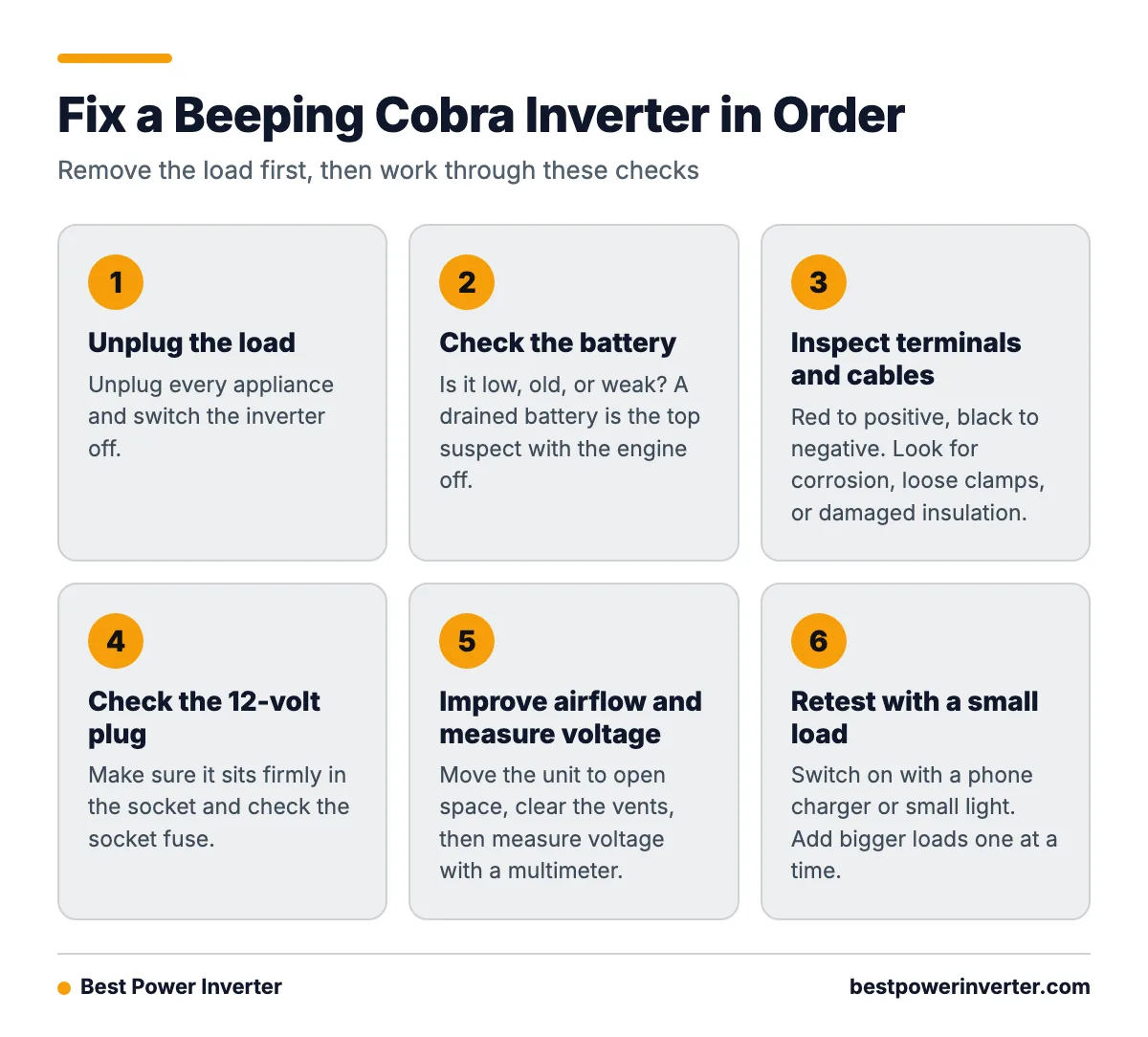
- Unplug every appliance. Switch the inverter off.
- Check the battery. Is it low, old, or weak? If the engine is off, a drained battery is the top suspect.
- Inspect polarity and terminals. Red goes to positive, black to negative. Look for corrosion, loose clamps, or damaged insulation.
- Check the cables. Confirm they are the size and length your manual calls for. Make sure nothing is pinched or warm.
- Check the 12-volt plug. On plug-in models, make sure it sits firmly in the socket. Check the vehicle’s fuse for that socket as well.
- Improve airflow. Move the unit to open space. Clear the vents.
- Measure voltage. See the next section for how.
- Switch the inverter back on and retest with a small load. A phone charger or a small light works well. Then add bigger loads one at a time.
Cobra’s manuals say that for an overload shutdown, you remove the excessive load and switch the unit off and on to restore normal operation. The manual also says the inverter may check voltage or current repeatedly while it tries to restart after a fault. So a few extra clicks or chirps after a reset can be part of that process.
Does a Beeping Cobra Inverter Mean the Battery Is Dead?
Not always. The battery may be low, or it may be fine while voltage drops at the inverter because of poor cables or connections. A multimeter will tell you which.
What battery voltage makes a Cobra inverter sound its alarm?
It depends on the model. Two Cobra manuals show how much the numbers differ:
How do I measure voltage at the battery and inverter terminals?
- Set a multimeter to DC volts.
- Touch the red probe to the battery’s positive post and the black probe to the negative post. Write down the reading.
- Now measure at the inverter’s input terminals, or at the plug end, with the same method.
- Repeat step 3 while a small load runs, if the inverter stays on.
A healthy, fully charged 12-volt battery rests at about 12.6 volts. With the engine running, most vehicles show roughly 13.5 to 14.5 volts. If the battery reads fine but the inverter terminals read much lower under load, the problem sits in the cables or connections, not the battery.
Can a Loose or Undersized Cable Make My Cobra Inverter Beep?
Yes. Cobra lists loose battery cables and undersized battery cables as direct causes of low-battery alarms. Thin, long, or corroded cables resist current. When the inverter pulls hard, voltage falls along the cable. The battery looks healthy, but the inverter sees low voltage and sounds off.
Look for these common failure points:
- Clamps that move when you wiggle them
- White or green corrosion on terminals
- Cables that are longer or thinner than the manual allows
- Cables that feel warm after a short run
- A plug that sits loose in the vehicle socket
Keep cables as short as the setup allows. Clean terminals and tighten clamps. Never swap polarity.
Why Does My Inverter Beep When I Plug In a Fridge, Microwave, Pump, or Other Motor?
Motors and compressors need a burst of power to start. That startup surge can be several times the running wattage printed on the label. The inverter sees the spike and trips its overload alarm.
Here is a worked example. The numbers are for illustration only:
- A pump’s label says 1,000 watts running.
- Assume its startup surge is three times that, or about 3,000 watts for a moment.
- A 1,000-watt inverter is already at its continuous limit while the pump runs. The surge pushes far past it.
So a 1,000-watt appliance can overload a 1,000-watt inverter before it even gets going. To match loads properly:
- Find the appliance’s running watts on its label. If only amps are listed, multiply amps by volts (120 in the US).
- Find or estimate the startup watts. Motor-driven items, such as fridges, pumps, and power tools, usually need much more at startup.
- Compare both numbers to your Cobra’s continuous and surge ratings in the manual.
- Leave headroom. Do not run the inverter at its limit.
Microwaves are a trap too. The wattage on the front is cooking power. The unit draws more from the wall than that.

Why Is My Power Inverter Beeping When Nothing Is Plugged In?
With no load, the cause is almost always on the input side. Check these:
- The battery is low or weak.
- A cable or clamp is loose.
- The 12-volt plug is not seated.
- The inverter is in its brief startup alarm. This is normal on some models and should stop within a moment.
- The inverter has an internal fault, if the alarm continues after you have ruled out the rest.
Measure voltage at the inverter terminals while it sits idle. If voltage is fine and the unit still alarms, check the manual for your model’s fault indicators.
Why Is My Inverter Beeping and Shutting Off?
The inverter is protecting itself. It shuts off for low voltage, overload, or heat. The red light usually shows a fault condition. After a shutdown, unplug the load and switch the unit off and on, as the Cobra manuals describe.
For heat, check the environment:
- Keep vents clear. Do not cover the unit with bags, blankets, or gear.
- Do not mount it in direct sun or in a hot, closed compartment.
- Give it open air on all vent sides.
- Let it cool before restarting.
If it shuts down again with a small load and good airflow, the cause is likely voltage or the unit itself.
Accessory-Plug Models vs. Direct-Battery Models
The two types fail in different ways.
If you use a plug-in (12-volt socket) model: Keep the load small. Many vehicle sockets are fused at around 10 to 15 amps, so check your owner’s manual. A 150-watt load at 12 volts already pulls about 12.5 amps. A loose socket fit can cause beeping too.
If you use a direct-battery model: Cable size, length, and clamp tightness matter most. Check the inline fuse and the terminal connections.
If you are unsure which model you have: Read the label on the unit, then find that exact model’s manual.
When Should I Stop Using the Inverter and Replace It or Seek Service?
Stop using it if any of these apply:
- The battery, cables, and fuse all check out, yet it still alarms with a small load.
- The unit alarms with no load and good input voltage.
- It overheats with good airflow and a light load.
- You smell burning, see melted plastic, or find hot cables or plugs.
- A fuse keeps blowing.
Repeated alarms after you have fixed the wiring and the load point to a battery, wiring, fuse, or inverter fault. Test the battery at a parts store if you can. If it passes, contact Cobra’s support or a qualified technician. Do not open the inverter yourself.
Frequently Asked Questions
Why is my Cobra power inverter beeping?
The most common reason is low input voltage. Cobra points to a discharged battery, loose or undersized cables, a loose 12-volt connection, or an appliance drawing too much power. Unplug the load, check the battery and connections, and retest with a small load.
Why is my power inverter beeping?
Any inverter beeps to warn of low voltage, overload, or overheating. Check the red light, the connected load, and the battery. Then read the manual for your exact model, since alarm patterns differ.
Why is my inverter beeping?
Start with the battery and cables. Voltage can sag at the inverter even when the battery is healthy. Also confirm the appliance’s running and startup watts fit the inverter’s ratings, and make sure the vents are clear.
What to do if inverter is beeping?
Switch the inverter off and unplug the load. Inspect the battery, polarity, terminals, cables, and socket fit. Measure voltage, improve airflow, then switch it back on and test with a small load. Add bigger loads one at a time.
Does a short beep at startup mean something is wrong?
Not necessarily. A momentary alarm or red-light flash at startup can be normal on some Cobra models, according to the CPI490 manual. A beep that continues is a fault.
Sources