

Dividing 18,000 BTU/h by an EER of 10 gives about 1,800 watts of electrical input. Run that for 8 hours a day over 30 days and you get 432 kWh. To estimate any inverter AC, divide cooling capacity by efficiency, then multiply by hours and your electricity price. Treat the result as an estimate, because an inverter compressor speeds up and slows down with the heat load.
Quick answer
Electrical input in watts equals BTU/h divided by EER. Then kWh equals kW times hours, and cost equals kWh times your tariff. Use a low, typical, and maximum scenario instead of one number. Use average watts for bills and the nameplate maximum for inverter, generator, and battery sizing.
- Watts = BTU/h ÷ EER. An 18,000 BTU/h unit at EER 10 draws about 1,800 W at its test condition.
- Multiplying maximum wattage by all your hours overstates what a modulating inverter AC uses.
- SEER is a seasonal average, not an hourly wattage.
- Size inverters and generators on peak VA. Size bills and batteries on average watts.
- A plug-in energy meter beats any formula. Measure during peak heat.
- What do you need before you calculate?
- What formula calculates inverter AC power consumption?
- How do I convert BTU/h into electrical input power?
- 1-ton, 1.5-ton, and 2-ton inverter AC use
- Which rating should I use?
- Why does consumption vary?
- How do I calculate the inverter VA rating?
- How large must a battery or solar system be?
- How can I measure the actual wattage?
- What makes an estimate unreliable?
- How to cut inverter AC electricity use
- Frequently Asked Questions
What do you need before you calculate?
You need eight numbers. Most are printed on the unit’s rating plate or in the manual.
- Cooling capacity: in BTU/h or kW. One ton is 12,000 BTU/h.
- Rated input range: the minimum and maximum watts on the plate, if listed.
- Efficiency rating: EER, SEER, SEER2, or COP.
- Daily hours: how long the compressor is actually working, not just how long the AC is on.
- Days per month: usually 30.
- Electricity tariff: price per kWh on your bill.
- Voltage: for example 120 V, 230 V, or 240 V.
- Power factor: needed to turn watts into VA. Use 0.9 if the plate does not say.
For a second view on reading consumption data, see Enel’s guide to air conditioner consumption.
What formula calculates inverter AC power consumption in watts and kWh?
Four short formulas do the job. Run them in this order.
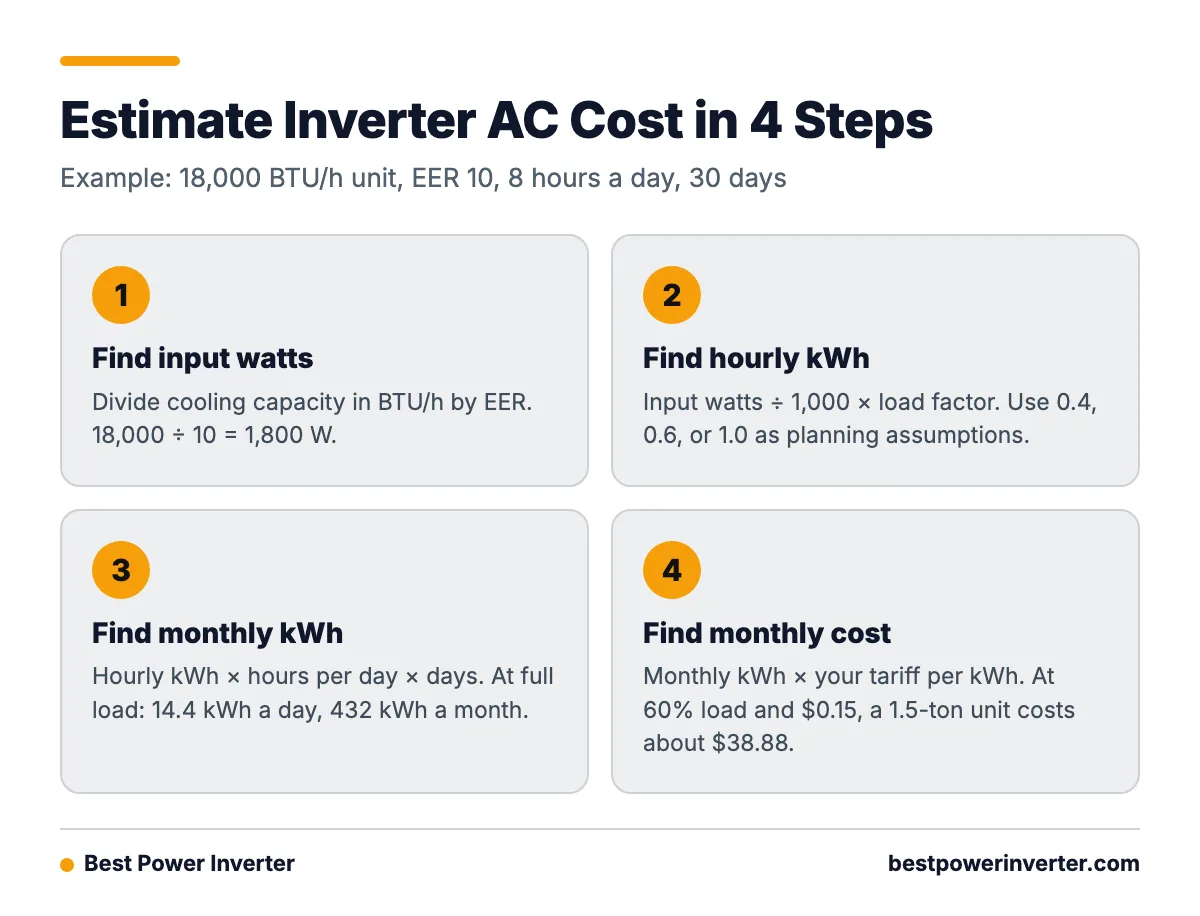
- Input watts = cooling capacity (BTU/h) ÷ EER
- Hourly energy (kWh) = input watts ÷ 1,000 × load factor
- Monthly energy (kWh) = hourly kWh × hours per day × days
- Monthly cost = monthly kWh × tariff per kWh
The load factor is the share of the rated input the AC averages. Use 1.0 for the worst case. An inverter AC that has settled into steady cooling often runs well below its maximum, so a typical load factor is lower. The 0.4, 0.6, and 1.0 values used below are planning assumptions, not measured data. Replace them with your own meter readings as soon as you have them.

How do I convert BTU/h or cooling capacity in kW into electrical input power?
Divide BTU/h by EER to get watts. If your capacity is in kW, divide it by the COP instead.
EER is cooling capacity in BTU per hour divided by electrical input in watts, according to GE Appliances’ explanation of EER, CEER, and SEER. A higher EER means more cooling per watt at the stated test condition.
Worked example: an 18,000 BTU/h unit with EER 10.
- Input = 18,000 ÷ 10 = 1,800 W
- 8 hours a day = 14.4 kWh per day
- 30 days = 432 kWh
That 432 kWh is the ceiling at the test condition. It does not account for inverter modulation or cycling.
If you only have kW, use these conversions. 1 kW equals 3,412 BTU/h. COP equals EER divided by 3.412. Our unit has 18,000 BTU/h, which is about 5.28 kW. EER 10 is a COP of about 2.93. Then 5.28 ÷ 2.93 gives 1.8 kW, the same answer.
1-ton, 1.5-ton, and 2-ton inverter AC: how much electricity per hour and per month?
At EER 10, a 1-ton unit has a rated input near 1,200 W, a 1.5-ton unit near 1,800 W, and a 2-ton unit near 2,400 W. Real hourly use is usually lower. The table uses a 60% typical load factor, 8 hours a day, 30 days, and an example tariff of $0.15 per kWh. Swap in your own rate.
| Size | Rated input (EER 10) | Typical kWh per hour | Daily kWh (8 h) | Monthly kWh | Monthly cost | Peak VA (PF 0.9) | Backup size with 25% margin |
|---|---|---|---|---|---|---|---|
| 1 ton (12,000 BTU/h) | 1,200 W | 0.72 | 5.76 | 172.8 | $25.92 | 1,333 VA | about 1,700 VA |
| 1.5 ton (18,000 BTU/h) | 1,800 W | 1.08 | 8.64 | 259.2 | $38.88 | 2,000 VA | about 2,500 VA |
| 2 ton (24,000 BTU/h) | 2,400 W | 1.44 | 11.52 | 345.6 | $51.84 | 2,667 VA | about 3,400 VA |
How much does an inverter AC cost to run for 8 hours a day or 30 days a month?
Use a range, not one figure. Here is the same example with low (40%), typical (60%), and maximum (100%) load factors.
| Size | Low: kWh (cost) | Typical: kWh (cost) | Maximum: kWh (cost) |
|---|---|---|---|
| 1 ton | 115.2 ($17.28) | 172.8 ($25.92) | 288 ($43.20) |
| 1.5 ton | 172.8 ($25.92) | 259.2 ($38.88) | 432 ($64.80) |
| 2 ton | 230.4 ($34.56) | 345.6 ($51.84) | 576 ($86.40) |
Many online calculators show only the maximum column. That overstates the bill for a modulating compressor. It is a fair worst case, though, for a heat wave.
One more check on hours. LG uses a standard example of 941 operating hours over a four-month cooling period, which averages about 7.8 hours a day over 120 days, according to LG’s monthly power consumption page. So 8 hours a day is a reasonable planning figure.
Should I use rated power, maximum input power, EER, SEER, or the appliance energy-label figure?
Use each number for a different job. No single figure fits every question.
- EER: best for converting capacity to watts at one test condition.
- Maximum input power: best for sizing inverters, generators, and wiring.
- SEER or SEER2: best for comparing models and rough seasonal energy.
- Energy-label kWh: best for comparing models under the label’s own assumptions.
- Measured watts: best for your real bill.
SEER is total seasonal cooling divided by total electrical energy used across the cooling season, as GE Appliances describes it. It is not an hourly wattage. A basic estimate of absorbed power is cooling output in kW divided by SEER, but that is only an approximation. The units and test standard must match. SEER2 uses an updated test procedure, so do not mix SEER and SEER2 figures in one calculation.
- If you want a monthly bill estimate, use average watts from a meter, or EER with a 40% to 100% load factor.
- If you are sizing an inverter or generator, use the maximum input on the rating plate, converted to VA.
- If you are comparing two models, compare SEER or SEER2 on the same standard.
- If you have no plate data, use the capacity ÷ EER method and the maximum scenario.
Why does inverter AC consumption vary instead of staying at the nameplate wattage?
An inverter AC changes compressor speed to match the heat in the room. It does not just switch fully on and off. At start-up it works hard to pull the room down. Once the room reaches the setpoint, the compressor slows and the watts drop.
Several things push the number up or down:
- Outdoor temperature. LG states that higher outdoor temperatures generally raise power consumption and billing.
- Thermostat setting. A lower setpoint means a bigger gap to close.
- Insulation and sun exposure. A west-facing room with thin walls keeps the compressor busy.
- Room load. People, cooking, and electronics all add heat.
- Test assumptions. EER and SEER are measured under set lab conditions, not your living room.
How do I calculate the inverter VA or kW rating needed to run an inverter air conditioner?
Take the maximum input watts, divide by power factor to get VA, then add a margin of 20% to 30%. Sizing is about the peak, not the average.
- Peak watts: use the maximum input on the plate. If none is listed, use BTU/h ÷ EER.
- Convert to VA: VA = watts ÷ power factor.
- Add margin: multiply by 1.25 for hot days and other loads.
- Add other loads: fridge, fans, lights, and router.
Example for a 1.5-ton unit: 1,800 W ÷ 0.9 = 2,000 VA. Times 1.25 is 2,500 VA. A 3 kVA inverter fits that. Inverter ACs usually have a gentler start than fixed-speed units, but check the manufacturer’s data for start-up current. A generator needs the same peak figure, with a similar margin.
How large must a battery or solar system be to operate an inverter AC for a specified number of hours?
Battery size equals the energy the AC uses, plus losses in the inverter, plus the part of the battery you cannot use, plus a reserve. Here is the formula:
Battery Wh = (average watts × hours) ÷ (inverter efficiency × usable battery %) × (1 + reserve)
Example: a 1.5-ton unit at a 60% typical load (1,080 W) for 5 hours.
- Load: 1,080 W × 5 h = 5,400 Wh
- Inverter efficiency 90%: 5,400 ÷ 0.90 = 6,000 Wh
- Usable battery 80%: 6,000 ÷ 0.80 = 7,500 Wh
- 10% reserve: 7,500 × 1.10 = 8,250 Wh
At 48 V that is about 172 Ah. The 90%, 80%, and 10% figures are planning assumptions. Check your inverter and battery data sheets.
To find runtime from a battery you already own, flip the formula: hours = (battery Wh × usable % × inverter efficiency) ÷ average watts ÷ (1 + reserve). A 5 kWh lithium battery with 80% usable and a 90% inverter delivers 3,600 Wh to the AC. Divide by 1,080 W and you get about 3.3 hours, or about 3 hours with a 10% reserve.
For solar, use daily energy: panel kW = daily kWh ÷ (peak sun hours × system efficiency). With 8.64 kWh a day, 5 peak sun hours, and 75% system efficiency, you need about 2.3 kW of panels for the AC alone. Add more for other loads and for charging the battery.
How can I measure the actual wattage of my inverter AC at home?
Use a plug-in energy meter, a clamp meter, or a smart energy monitor on the AC circuit. For a hard-wired split unit, have an electrician fit a meter or clamp. Do not open the unit yourself. Then follow this checklist:
- Photograph the rating plate, including the rated and maximum input.
- Record the minimum and maximum input listed in the manual.
- Read real-time watts at start-up, after 30 minutes, and after 2 hours.
- Write down the outdoor temperature and your setpoint each time.
- Note the kWh counter at the start and end of a full day.
- Repeat during the hottest week of the year.

Divide the day’s kWh by the hours the AC ran. That is your real average input. Use it in place of the load factor.
What assumptions make an inverter AC consumption estimate unreliable?
Most errors come from five assumptions:
- Using maximum watts as the average. This overstates use.
- Treating SEER as hourly watts. It is a seasonal ratio.
- Mixing units. BTU/h is cooling output. Watts is electrical input.
- Ignoring weather. A mild week and a heat wave can differ a lot.
- Counting on-time as compressor time. The AC may idle at low speed.
Plan with a range. For the 1.5-ton example, expect roughly 173 to 432 kWh a month at 8 hours a day. Then narrow it down with a meter. Also note that EER is measured at one test condition. Hot days push the real figure lower in efficiency, so input rises.
How to cut inverter AC electricity use
- Raise the setpoint. Each degree you do not chase is less work for the compressor.
- Block the sun. Use curtains, shades, or window film on sunny sides.
- Seal gaps. Leaky doors and windows leak cooling too.
- Clean the filters. Clogged filters reduce airflow and efficiency.
- Shade the outdoor unit. Keep it clear of walls, leaves, and direct afternoon sun.
- Avoid frequent restarts. A steady moderate setting often beats on-off use.
- Match the size to the room. An oversized unit cycles more, and an undersized one runs flat out.
Frequently Asked Questions
How much electricity does a 1-ton, 1.5-ton, or 2-ton inverter AC use per hour?
At EER 10, rated input is about 1,200 W, 1,800 W, and 2,400 W. With a typical 60% load factor, hourly use is roughly 0.72, 1.08, and 1.44 kWh. At maximum output it matches the rated figure. Your real numbers depend on weather, room, and setpoint.
How much does an inverter AC cost to run for 8 hours a day or 30 days a month?
Multiply daily kWh by 30 and then by your tariff. A 1.5-ton unit at a typical load uses about 8.64 kWh a day, or 259.2 kWh a month. At $0.15 per kWh that is about $38.88. The range runs from about $26 to $65 with the low and maximum scenarios.
What is the fastest way to get a reliable number?
Measure it. Put a meter on the AC for a full day during hot weather. Divide the kWh by the hours of use and use that average in the formulas above.
Sources