

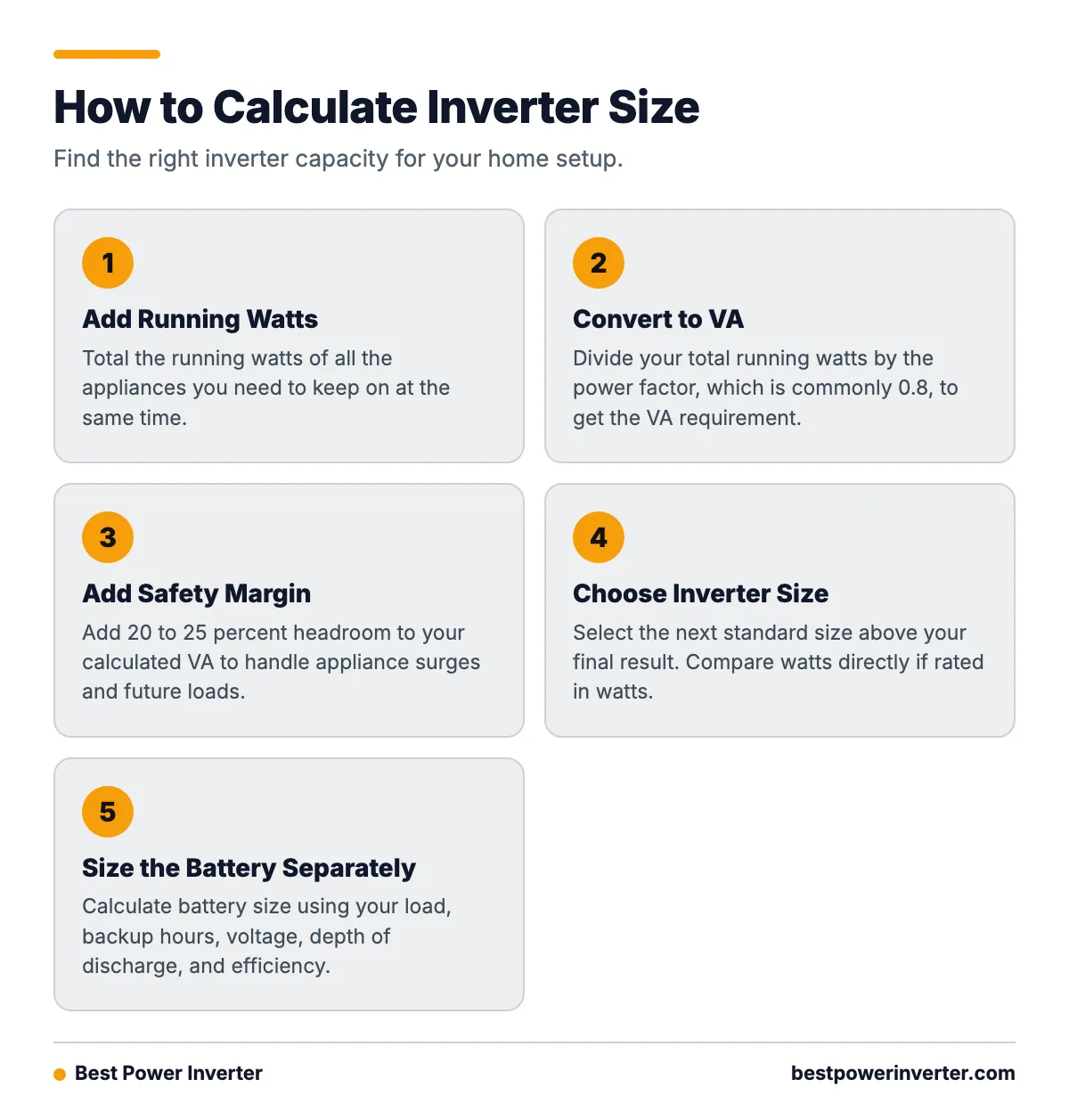
Total the running watts of the appliances you must keep on, divide by 0.8 to get VA, and choose the next inverter size with 20 to 25% headroom. Size the battery separately, because the inverter sets what can run at once while battery voltage, Ah, usable capacity, and efficiency set how long it runs. The five 12V pure sine wave models below fit that method, and the Renogy P2 1000W is the best match for most home essentials.
Quick answer
Total your running watts, divide by 0.8 for VA, then add 20 to 25% headroom. Size the battery separately from voltage, Ah, usable capacity, and efficiency.
- Best for essentials: Renogy P2 1000W, UL 458 certified
- Best for motor loads: 2200W model, 4400W peak
- Best for heavy loads: 3000W model, 6000W peak
Our Winner: Renogy Inverter P2 1000W Pure Sine Wave Inverter 12V DC to 120V AC
Based on the specifications, this is the most sensible choice for lights, fans, a TV, and a router. It is rated 1000W continuous with 2000W peak surge, carries UL 458 and CSA C22.2 No. 107.1 certification, and includes GFCI protection, a hardwire terminal, and a 16.4ft wired remote. It is also the only model here whose listing names a safety standard.
How We Compared These Models
This comparison uses the product specifications and listing details, not hands-on testing. The criteria are continuous and peak wattage (what can run, and what survives motor startup), battery compatibility and protections, safety certification, and installation hardware such as cables, remote, and hardwire output.
One caveat applies to all five. These are 12V DC to 120V AC inverters. The listing data does not mention a built-in battery charger or automatic transfer switch, so none of them is a complete UPS-style home backup system on its own. You supply the battery, fusing, and any changeover arrangement.
| Product | Key Specs | Our Choice | Action |
|---|---|---|---|
| Renogy P2 1000W | 1000W continuous, 2000W peak, UL 458 and CSA listed, GFCI, 12V | Best Overall | |
| 2200W Pure Sine Wave Inverter with LCD Remote | 2200W continuous, 4400W peak, 12V, 12-month support | Best Budget | |
| 3000W Pure Sine Wave Inverter with LCD Remote | 3000W continuous, 6000W peak, adjustable 9.5V to 11V cutoff, 12V | Best Premium | |
| BELTTT 3000W Pure Sine Wave Inverter | 3000W, 12V DC to 120V AC, rated 4.5/5 | Best High-Capacity Alternative | |
| 1500W Pure Sine Wave Inverter, 12V to 110V/120V | 1500W continuous, 3000W referenced in title, 12V, rated 4.5/5 | Best Mid-Size Option |
In-Depth Reviews

1. Renogy Inverter P2 1000W Pure Sine Wave Inverter – Best Overall
Our Verdict: The right size and the clearest safety credentials for a basic home essentials setup. It is rated 4.3/5 on Amazon.
The manufacturer lists 1000W continuous output, 2000W peak surge, and conversion efficiency above 90%. That efficiency figure matters for runtime, since every point of loss comes out of the battery. It has two AC outlets, an AC terminal block, a 5V/2.1A USB port, and a metal housing with cooling fans.
Protection covers under-voltage, over-voltage, over-temperature, overload, and short circuit, with LED indicators and GFCI. The listing cites UL 458 and CSA C22.2 No. 107.1 certification. The kit includes two 3ft 4AWG cables and a 16.4ft wired remote.
A 1000W unit covers a load of roughly 800W with headroom. That fits fans, LED lights, a TV, and a router, but a refrigerator compressor needs a surge check first.
Why We Like It
- UL 458 and CSA C22.2 No. 107.1 listing
- GFCI plus five protection indicators
- Hardwire terminal and long wired remote
Pros & Cons
Pros
- Named safety certifications
- Efficiency above 90% per the manufacturer
- Right-sized for lights, fans, TV, and Wi-Fi
Cons
- 2000W peak limits larger motor loads
- Costs more than the larger 2200W model

2. 2200W Pure Sine Wave Inverter 12V DC to 120V AC with LCD Remote – Best Budget
Our Verdict: The lowest verified price in this group at $125.39, with more capacity than the Renogy. It is rated 4.4/5 on Amazon.
The listing states 2200W continuous and 4400W peak output, which leaves room for motor startup surges. Low-voltage shutdown is adjustable from 9.5V to 11V, and the listing says it supports LiFePO4, AGM, GEL, and deep-cycle batteries. That flexibility helps if you may switch battery chemistry later.
It has four AC outlets, a USB port, a Type-C port, and a wired LCD remote on a 15ft cable showing input voltage, output voltage, load wattage, and fault alerts. The kit includes a pair of 31.5-inch 25 mm² (about 3 AWG) cables. Support is listed as 12 months with 24/7 customer service.
Dimensions are 13.50 x 9.13 x 4.41 inches including brackets and terminals. Allow extra room for cabling and airflow. The listing does not name a safety certification.
Why We Like It
- Lowest verified price with 2200W capacity
- 4400W peak for compressor and pump startup
- Adjustable low-voltage cutoff and LCD remote
Pros & Cons
Pros
- Strong capacity for the price
- Supports lithium, AGM, GEL, and deep-cycle batteries
- Includes remote and cables
Cons
- No safety standard named in the listing
- Marketed toward RV and van use

3. 3000W Pure Sine Wave Inverter 12V DC to 120V AC with LCD Remote – Best Premium
Our Verdict: The most capable model here for heavy loads, with the most complete installation kit. It is rated 4.4/5 on Amazon.
The listing states 3000W continuous and 6000W peak output. The scraped price appeared in pounds (GBP156.08), so confirm the current U.S. dollar price on the listing.
Low-voltage shutdown is adjustable from 9.5V to 11V, and the unit supports LiFePO4, AGM, GEL, and deep-cycle batteries. Protections cover overload, overheating, short circuit, and high or low input voltage. It has four AC outlets, USB, Type-C, an AC hardwire terminal block, and a wired LCD remote on a 15ft cable.
The kit includes four 31.5-inch 16 mm² cables, two per polarity, equal to roughly 2 AWG per polarity. This matters because 3000W on a 12V system means about 250A before conversion losses (3000W divided by 12V). Cable gauge, fusing, and a short cable run are not optional at that current. Body size is 14.17 x 7.87 x 3.98 inches.
Why We Like It
- 3000W continuous and 6000W peak
- Heavy-gauge cable set included
- Adjustable cutoff protects the battery
Pros & Cons
Pros
- Handles large and motor-driven loads
- Hardwire output and remote monitoring
- Broad battery compatibility
Cons
- Needs a very large 12V battery bank
- Roughly 250A draw at full load
- No safety standard named in the listing

4. BELTTT 3000W Pure Sine Wave Inverter 12V DC to 120V – Best High-Capacity Alternative
Our Verdict: A well-rated 3000W option for buyers who want a second choice at this size. It is rated 4.5/5 on Amazon.
The listing data for this model was limited. The title confirms a 3000W pure sine wave inverter converting 12V DC to 120V AC, and the rating is the highest in the group, tied with the 1500W model. No price, protection list, certification, or warranty came through in the data, so those need checking on the listing page before you buy.
Pure sine output is the right waveform for sensitive electronics and motor loads. At 3000W on 12V, the same current, cable, and battery bank demands apply as for the other 3000W unit.
Why We Like It
- 3000W pure sine wave output
- Top-tier 4.5/5 rating
Pros & Cons
Pros
- High capacity for larger loads
- Strong buyer rating
Cons
- Limited feature and warranty detail in the data
- Needs a large, heavily fused 12V battery bank

5. 1500 Watt Pure Sine Wave Inverter, 12V DC to 110V/120V AC – Best Mid-Size Option
Our Verdict: A middle step between the 1000W and 2200W models, rated 4.5/5 on Amazon.
The title lists 1500W pure sine wave output at 12V DC to 110V/120V AC and references 3000W, presumably the peak surge rating. Confirm that on the listing. As with the BELTTT, price, protections, certifications, and warranty were not in the data.
At 1500W, the planning load with 25% headroom is about 1200W. That suits a larger essentials list with a TV, fans, lights, Wi-Fi, and a small appliance. A surge rating twice the continuous figure is typical for compressor-based loads, but check your refrigerator nameplate.
Why We Like It
- Mid-size capacity with pure sine output
- Top-tier 4.5/5 rating
Pros & Cons
Pros
- More headroom than a 1000W unit
- Smaller battery bank than the 3000W models
Cons
- Limited feature and certification detail in the data
- Peak rating needs confirmation
How to Choose the Best Inverter for Home: Buying Guide
Sizing guides from Adwin, Schneider Electric, and Microtek follow the same logic used below: list loads, convert to VA, add margin, then size the battery.
Should you back up essential circuits or the whole home?
Most households should back up essential circuits only. Lights, fans, Wi-Fi, a TV, and possibly a refrigerator need far less battery than electric heating, ovens, or air conditioning.
Whole-home backup requires much larger inverters and battery banks than any 12V model here. Decide your goal first, since it drives every other number.
How do I calculate the inverter size for my home?
Add the running watts of everything you need at the same time, divide by the power factor (commonly 0.8), then add 20 to 25% headroom. Choose the next standard size above that result.
Worked example: three 75W fans (225W), five 10W LED lights (50W), a 100W TV, and a 10W router total 385W. Divided by 0.8, the base requirement is about 481VA. With 25% headroom it is about 601VA, so a 1000W-class inverter is the next practical size.
Many U.S. inverters, including the five above, are rated in watts rather than VA. In that case, compare your watts plus 25% directly against the continuous rating.
What is the difference between watts, VA, power factor, and battery Ah?
Watts measure real power an appliance uses. VA measures apparent power. Power factor is the ratio between them, so a 1,000VA inverter at 0.8 delivers about 800W of real load.
Ah measures battery charge, not power. To convert, multiply Ah by battery voltage to get watt-hours.
How much inverter capacity do I need for lights, fans, a TV, router, and refrigerator?
Lights, fans, a TV, and a router are low and steady loads. The 385W example above fits comfortably on a 1000W inverter. A refrigerator changes the picture because its compressor draws well above running watts at startup.
Check the refrigerator nameplate and add its starting surge to the rest of your running load. Then compare that total with the inverter’s peak rating, not just its continuous rating.
How much safety margin should I leave for appliance surges and future loads?
Plan for 20 to 25% above your calculated load, as sizing guides commonly recommend. Motor-driven appliances such as refrigerators, mixers, and pumps can draw substantially more at startup than while running.
Owners frequently report overloads when an undersized inverter meets a motor start. Extra headroom also covers appliances you add later.
How do I calculate the battery size and expected backup time?
Use this common formula: Ah = load watts x backup hours / (battery voltage x depth of discharge x inverter efficiency). For lead-acid, a practical planning assumption is 50% usable capacity.
For the 385W example, 2 hours at 12V, 50% depth of discharge, and 90% efficiency: 770Wh / (12 x 0.5 x 0.9) = about 143Ah. A single 100Ah lead-acid battery would run that load for roughly 1.4 hours.
Runtime comes from the battery and load, while the inverter rating only sets what can run together. Mixing these two up is the most common sizing error.
Do I need a 12V, 24V, or higher-voltage system?
A 12V system suits loads up to roughly 1000 to 1500W. Above that, higher voltage reduces current for the same power, though it adds configuration complexity.
A 24V system generally uses two compatible 12V batteries in series. All five inverters here are 12V, so a 2400W planned load needs a very large parallel bank and heavy cabling.
Should I choose a pure sine wave or modified sine wave inverter?
Choose pure sine wave for a home. It produces output equivalent to grid power, which suits sensitive electronics, TVs, and motor loads. All five models here are pure sine wave.
What battery type is best for home backup: tubular lead-acid, flat-plate, AGM, or lithium?
Tubular lead-acid is the common choice for frequent deep cycling at lower upfront cost, while flat-plate batteries suit light use. AGM is sealed and lower-maintenance. Lithium (LiFePO4) costs more upfront but is lighter and offers more usable capacity.
Flooded lead-acid needs maintenance, ventilation, and eventual replacement. Check that your inverter’s low-voltage cutoff suits your battery. The 3000W and 2200W models list LiFePO4, AGM, GEL, and deep-cycle support.
Sizing comparison: which model fits which load?
This table uses the formula above with 50% usable capacity and 90% efficiency. Battery figures are planning estimates, not measured results.
| Planned Load | Inverter | Usable Output | Battery Voltage | Ah for 2 Hours | Runtime on One 100Ah | Waveform | Warranty | Best Use |
|---|---|---|---|---|---|---|---|---|
| 385W | Renogy P2 1000W | 1000W rated, about 800W planned | 12V | About 143Ah | About 1.4 hours | Pure sine | Check listing | Fans, lights, TV, router |
| 1,200W | 1500W model | 1500W rated, about 1200W planned | 12V | About 444Ah | About 27 minutes | Pure sine | Check listing | Larger essentials list |
| 1,760W | 2200W model | 2200W rated, about 1760W planned | 12V | About 652Ah | About 18 minutes | Pure sine | 12-month support | Motor loads, short outages |
| 2,400W | 3000W models | 3000W rated, about 2400W planned | 12V | About 889Ah | About 13 minutes | Pure sine | Check listing | Heavy loads, large battery bank |
The table shows why higher loads on 12V get impractical fast. Runtime on a single battery collapses as load rises, so heavier loads call for 24V or a much larger bank.
Sizing worksheet
Fill in each row, then apply the formulas above.
| Appliance | Running Watts | Qty | Subtotal | Surge-Sensitive? |
|---|---|---|---|---|
| Fan | 75 | 3 | 225 | Mild |
| LED light | 10 | 5 | 50 | No |
| TV | 100 | 1 | 100 | No |
| Router | 10 | 1 | 10 | No |
| Your appliance | ____ | ____ | ____ | ____ |
- Running total: ____ W
- Divide by 0.8: ____ VA
- Multiply by 1.25 for headroom: ____
- Target backup hours: ____
- Battery voltage and efficiency: ____ V, ____
- Estimated Ah: watts x hours / (voltage x 0.5 x efficiency)
Which features matter most?
Look for overload protection, low-battery cutoff, and a display showing voltage and load. Charging current, bypass, solar input, and transfer time matter if you want UPS-style behavior. Owners praise fast changeover that keeps routers and computers running, and clear status displays with alerts.
None of the five listings mention transfer time or a built-in charger, so confirm those if automatic switchover matters.
Which brand inverter is best for home, and how should warranty and service affect the choice?
No single brand wins everywhere. Choose based on local service, replacement battery availability, warranty terms and exclusions, certifications, and total ownership cost.
Among these five, Renogy is the only listing that names UL 458 and CSA C22.2 No. 107.1 certification. The 2200W model lists 12 months of product support. Owners report that warranty and installation support vary significantly by location, so check who services your area before buying.
What installation, ventilation, maintenance, noise, and safety checks should I make before buying?
Match cable gauge and fusing to the current draw, ground the unit, and keep batteries in a ventilated space. Have a qualified electrician handle any hardwiring to household circuits and follow local electrical code. Other sources, such as this inverter and battery guide, cover similar installation basics.
- Pure sine wave output confirmed
- Transfer time and charger behavior checked
- Overload and low-battery protection present
- Battery warranty and local service confirmed
- Ventilation space and cable run planned
- Total installed price calculated, including battery, cables, and fuses
Cooling fans can be audible in quiet rooms, so place the inverter away from bedrooms where possible.
What do owners say?
Owners like
- Long backup time when the battery is correctly matched to the household load
- Quiet operation during outages
- Fast changeover that keeps lights, routers, and computers running
- Clear battery-status displays and useful overload or low-battery alerts
- Reliable performance when installation, ventilation, and battery maintenance are handled correctly
Common complaints
- Backup time is much shorter than expected when calculated from nominal Ah without usable capacity and inverter losses
- Refrigerators, pumps, and other motors can trip or overload an undersized inverter at startup
- Lead-acid batteries need maintenance, ventilation, and eventual replacement
- Fans or cooling systems can be audible in quiet rooms
- Warranty and installation support vary significantly by location and service provider
Summarised from owner reviews and long-term user reports; individual experiences vary.
Frequently Asked Questions
How to choose home inverter?
List your essential appliances, total their running watts, divide by 0.8 for VA, and add 20 to 25% headroom. Then check motor surge ratings and size the battery separately for your outage length.
How to choose best inverter for home?
Prioritize pure sine wave output, adequate peak surge, overload and low-voltage protection, battery compatibility, and a safety certification. Then confirm warranty terms and local service before comparing price.
Which brand inverter is best for home?
It depends on local service and warranty coverage more than on the badge. In this group, Renogy lists UL 458 and CSA certification, which makes it the most verifiable on safety.
Can a 12V inverter run a refrigerator?
Some listings say compatible small refrigerators can run within the inverter’s capacity. Check the nameplate for running and starting watts, and compare the start surge with the inverter’s peak rating.
Conclusion
For most households backing up fans, lights, a TV, and Wi-Fi, the Renogy P2 1000W is the best overall choice thanks to its named safety certifications and right-sized output. The 2200W model is the budget pick when you want surge headroom, and the 3000W models suit heavy loads if you can support a large battery bank and heavy cabling.
Whichever you choose, calculate your load, add headroom, and size the battery using usable capacity and efficiency. That step prevents the most common complaint: runtime far shorter than expected.
Sources
Affiliate Disclosure: As an Amazon Associate, we may earn commissions from qualifying purchases from Amazon.com. This comes at no extra cost to you and helps support our research.