
The 2000W LANDERPOW is the strongest pick in this group for most 12V buyers, while the 1000W LANDERPOW suits lighter loads like laptops, CPAPs, and small appliances. A 12V pure sine wave inverter is the right choice when you need clean AC power for sensitive electronics. A 2500W model works for medium-to-heavy loads only if the battery bank, cables, and fuse are sized correctly, because at 12V it can pull roughly 200A or more from the battery.
One note on scope: none of the listings below is confirmed as a 2500W unit. Two listings include full feature data (1000W and 2000W). Three listings carry only a title, a rating, and an ASIN, so their wattage is not verified here. This guide covers the sizing math so you can judge any inverter, including 2500W models.
Our Winner: 2000 Watt Inverter, 12V DC to 120V AC Pure Sine Wave 4000W Surge
Based on the listing specifications, this LANDERPOW model offers 2000W continuous and 4000W surge output, three AC outlets, a hardwired AC terminal, USB and 30W USB-C PD ports, a 15 ft wired remote with an LED screen, and a full set of protections. It is the only listing here with a hardwired terminal for high-current loads. It carries a 4.4/5 rating and a 3-year coverage plan.
What Does Pure Sine Wave Mean, and Why Does It Matter?
Pure sine wave output reproduces the smooth waveform that utility power delivers. Modified sine wave units produce a stepped approximation instead.
That difference matters for sensitive loads. CPAP machines, laptop chargers, audio gear, LED drivers, and motor-driven appliances generally run cooler and quieter on pure sine wave power. A 12V pure sine wave inverter is generally preferred over modified sine wave for these devices.
Why 12V Systems Are So Common
12V is the native voltage of vehicle batteries, most RV house banks, and many boat and small solar setups. Batteries, chargers, and fuses are easy to find at this voltage, so inverters in the 1000W to 2500W range are popular for vans, trucks, and backup power.
The tradeoff is current. Power equals volts times amps, so the same wattage at 12V needs four times the current of a 48V system.
How We Compared These Models
We compared these inverters using four criteria: continuous versus surge rating, included cable gauge and protections, remote and display features, and verified buyer ratings. Based on the specifications in each listing, those factors best predict safe, reliable operation at 12V. Where a listing offers no feature data, we say so instead of guessing.
| Product | Key Specs | Our Choice | Action |
|---|---|---|---|
| LANDERPOW 2000W Pure Sine Wave Inverter | 2000W continuous, 4000W surge, 3 AC outlets plus hardwired terminal, 2 AWG cables, 4.4/5 | Best Overall | |
| LANDERPOW 1000W Pure Sine Wave Car Inverter | 1000W continuous, 2000W surge, 3 AC outlets, 7 AWG cables, 4.4/5 | Best Budget | |
| 12V Power Pure Sine Wave Inverter (B07JMQ27WJ) | Pure sine wave, 12V, wattage not listed, 4.5/5 | Highest Rated Alternative | |
| 12V Power Pure Sine Wave Inverter (B0F1SR9L9W) | Pure sine wave, 12V, wattage not listed, 4.5/5 | Also Considered | |
| 12V Power Pure Sine Wave Inverter (B0GKG3CXNF) | Pure sine wave, 12V, wattage not listed, 4.5/5 | Also Considered |
In-Depth Reviews

1. 2000 Watt Inverter, 12V DC to 120V AC Pure Sine Wave 4000W Surge – Best Overall
Our Verdict: The best balance of capacity, connectivity, and protections among the listings with full data. It covers microwaves, power tools, and many refrigerators without stepping up to 2500W.
Based on the listing, it is rated at 2000W continuous with a 4000W surge and over 91% efficiency. The hardwired AC terminal is useful for high-current tools or a permanent install. The 15 ft wired remote shows battery level, output, and errors, so you can monitor and shut it down from inside a cabin or van.
Protections listed include undervoltage, overvoltage, overload, overheating, short circuit, and reverse connection. The listing describes a full metal heat-dissipating shell and a 3-year coverage plan.
Current matters here. At full load, 2000W at 12V draws about 167A before losses, and roughly 183A at 91% efficiency. A fuse around 125% of that is about 230A, so an ANL or Class T fuse near 250A fits. The included 2 AWG, 2 ft cables are short jumpers. Many installer guides call for heavier cable, such as 1/0 or 2/0 AWG, for continuous loads near full rating, so check the manual and your run length.
Why We Like It
- 2000W continuous and 4000W surge rating handles motor startup better than smaller units
- Hardwired terminal supports high-current appliances
- Remote display tracks battery level, output, and errors
- Full protection suite and a 3-year coverage plan
Pros & Cons
Pros
- Strong continuous and surge ratings for the price
- USB and 30W USB-C PD ports for devices
- 15 ft remote with LED screen
Cons
- Needs a large battery bank and heavy cabling at 12V
- Not a 2500W unit if you need more headroom

2. 1000 Watt Car Power Inverter, Pure Sine Wave, 12V DC to 120V AC – Best Budget
Our Verdict: A sensible entry point for laptops, CPAPs, LED lighting, and small appliances, with the same remote and protections as its larger sibling.
The listing states 1000W continuous, 2000W surge, and over 91% efficiency. It has three AC outlets, a 5V/3.1A USB port, a 30W USB-C PD port, and a 15 ft wired remote with an LED screen. The same protection list applies, and it has the same 3-year coverage plan.
At full load, 1000W draws about 83A at 12V, or roughly 92A with losses. A fuse near 115A is typical. The included cables are 7 AWG, 2 ft long. Based on common wire gauge charts, that is light for the current at full load, so keep runs short and confirm the rating in the manual.
Why We Like It
- Lower current draw makes wiring simpler than 2000W and up
- Remote display and USB-C PD port add convenience
- 2000W surge rating covers many brief startup loads
Pros & Cons
Pros
- Fits small batteries and short cable runs
- Full protection set and 3-year coverage
- Pure sine wave output for sensitive devices
Cons
- Too small for most microwaves, kettles, or heaters
- Included 7 AWG cables suit short, moderate-load use only

3. 12V Power Pure Sine Wave Inverter (B07JMQ27WJ) – Highest Rated Alternative
Our Verdict: A well-rated pure sine wave option, but the data available to us does not list its wattage, outlets, or protections.
The listing shows a 4.5/5 rating and a pure sine wave 12V design. Features and specifications were not available in our data, so we cannot confirm continuous watts, surge watts, cable gauge, or remote support. Check those on the Amazon page and run them through the sizing math below before buying.
Why We Like It
- 4.5/5 rating, the highest in this group
- Pure sine wave design suits sensitive electronics
Pros & Cons
Pros
- Strong buyer rating
- Pure sine wave output per the title
Cons
- Wattage and protections not confirmed in our data
4. 12V Power Pure Sine Wave Inverter (B0F1SR9L9W) – Also Considered
Our Verdict: Worth checking if you want another 4.5/5 pure sine wave option, but we have no feature data to compare it fairly.
The listing provides a title, rating, and ASIN only. Confirm the continuous rating, surge rating, and included cables on the product page before choosing it over the models above.
Why We Like It
- 4.5/5 rating
- Pure sine wave design per the title
Pros & Cons
Pros
- Strong buyer rating
Cons
- Specifications and features not available to verify
5. 12V Power Pure Sine Wave Inverter (B0GKG3CXNF) – Also Considered
Our Verdict: Another 4.5/5 listing with limited data. Treat it as a candidate to verify, not a confirmed pick.
As with the previous listing, wattage, protections, and cable details were not provided. Compare them against the buyer checklist below.
Why We Like It
- 4.5/5 rating
- Pure sine wave design per the title
Pros & Cons
Pros
- Strong buyer rating
Cons
- Specifications and features not available to verify
How Much Current Does a 2500W 12V Inverter Draw?
Divide watts by volts. 2500W divided by 12V is about 208A before losses. At 90% efficiency, the inverter pulls about 231A from the battery. A 3000W unit is often cited at about 250A continuous, which shows how fast current climbs at 12V.
Worked example for a 2500W inverter at full load:
- Ideal DC current: 2500 / 12 = about 208A
- With 90% efficiency: 2500 / 0.90 / 12 = about 231A
- Fuse at 125%: about 260A to 290A, so a 300A ANL or Class T fuse is typical
Place the main fuse within about 18 inches (30 cm) of the battery positive terminal. Industry wiring guides generally recommend ANL or Class T fuses over small blade fuses for this current. See the inverter-to-battery wiring guide for fuse and cable details.
Cable Size and Fuse for a 12V 2500W Inverter
Cable gauge depends on current, run length, and acceptable voltage drop. For 200A-plus loads, expect very heavy cable, commonly 4/0 AWG for short runs. Keep cables as short as possible, since long runs raise resistance and heat. The RV solar wiring guide covers gauge and fuse specs in more detail.
Continuous Watts vs. Surge Watts
Continuous watts is what the inverter can supply indefinitely. Surge (peak) watts is a brief burst, usually a fraction of a second to a few seconds. Many 2500W 12V models list peaks around 5000W.
Motor loads like compressors and pumps can need several times their running watts at startup. Size for the surge, not just the label on the appliance.
Is a 2500 Watt Pure Sine Wave Power Inverter Enough for My Appliances?
It depends on what runs at once. Add the running watts of everything simultaneously, then check the largest startup surge. The table below shows typical examples, using approximate wattages that vary by model.
| Appliance | Typical Running Watts | Runs on 2500W / 12V? |
|---|---|---|
| Laptop | 50 to 100W | Yes |
| CPAP machine | 30 to 60W | Yes |
| Mini fridge | 100 to 150W (higher surge) | Yes |
| Microwave | 1000 to 1500W input | Yes, alone |
| Coffee maker | 800 to 1200W | Yes, alone or with light loads |
| Window AC | 500 to 1500W (high surge) | Often, check surge |
| Electric kettle | 1200 to 1800W | Yes, alone |
| Space heater (high) | 1500W | Yes, but drains the battery fast |
A microwave plus a kettle together exceeds 2500W. Run high-wattage heating appliances one at a time.
Can a 12V Battery Bank Safely Run a 2500W Inverter for Long Periods?
Only with a properly sized bank. A 200A draw on a single small battery will trip low-voltage cutoffs quickly and stress the cells. As a rough guide, 2500W for one hour needs about 230Ah at 12V from the battery, and you should not drain lead-acid batteries fully. Lithium (LiFePO4) banks tolerate high discharge better, but check the battery’s continuous discharge rating and BMS limits.
If your regular load is above roughly 2000W continuous, consider a 24V or 48V system. Current halves or drops to a quarter, which means thinner cable, lower heat, and less voltage drop.
1000W vs. 2000W vs. 2500W: Best Use Cases
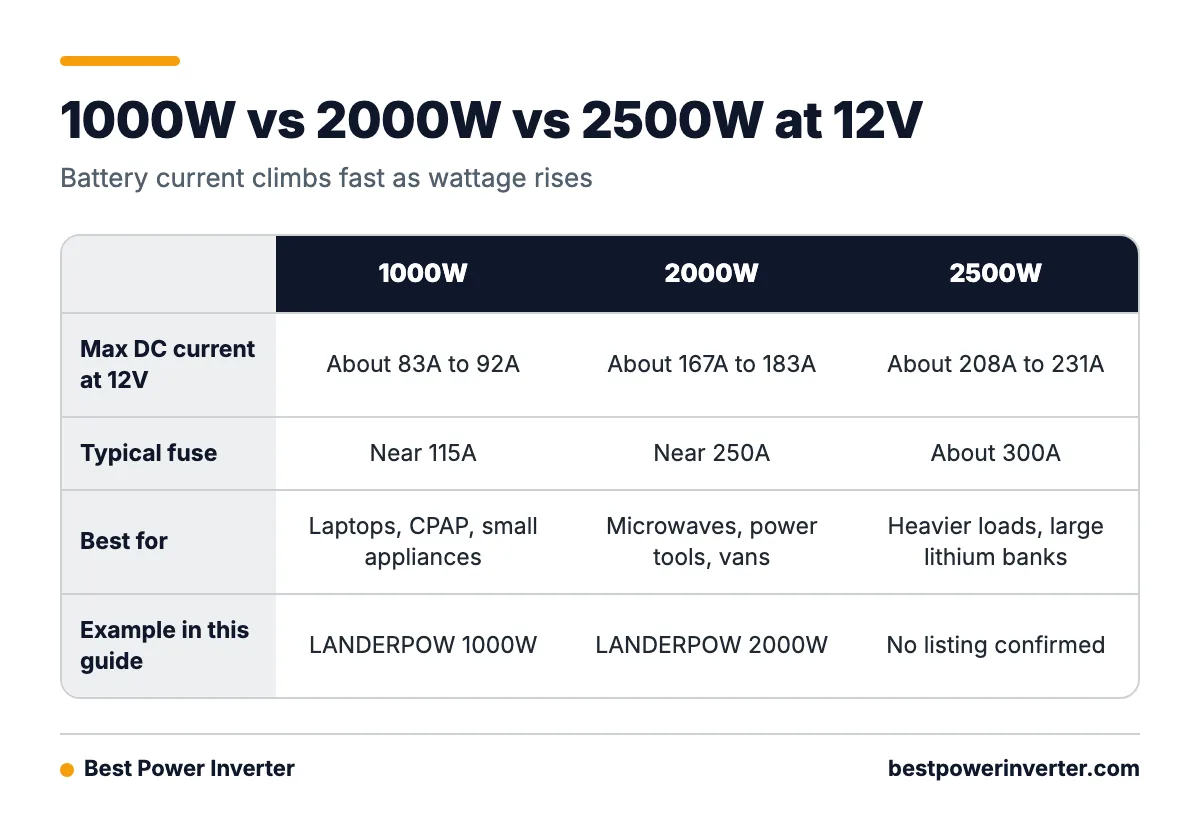
| Size | Approx. Max DC Current at 12V | Best For |
|---|---|---|
| 1000W | About 83A to 92A | Laptops, CPAP, LED lights, small appliances, car use |
| 2000W | About 167A to 183A | Microwaves, power tools, vans, RVs with a mid-size bank |
| 2500W | About 208A to 231A | Heavier loads, bigger surge, large lithium banks, off-grid backup |
What to Look for When Comparing 12V Pure Sine Wave Inverters
- Continuous rating that exceeds your largest combined load
- Surge rating that covers motor startup
- Low-voltage cutoff and overload, short circuit, overheat, and reverse polarity protection
- Idle draw and efficiency, since idle current drains batteries during off-grid use
- Cooling design and fan noise
- Remote switch or display for monitoring
- Outlet count, hardwired terminal, and USB ports
- Included cable gauge and warranty length
Installation Mistakes That Cause Failures or Fire Risk
- No main DC fuse, or a fuse mounted far from the battery
- Undersized cable or long cable runs that cause voltage drop and heat
- Loose lugs or poor crimps on high-current connections
- Using small blade fuses instead of ANL or Class T
- Poor ventilation around the inverter
- Pairing a large inverter with a battery that cannot supply the current
For step-by-step guidance, see this campervan inverter wiring guide.
Frequently Asked Questions
Is a 2500 watt pure sine wave power inverter enough for my appliances?
It is enough for most single high-wattage appliances and several small ones at once. Add up the running watts, then check startup surge for motors. Your battery bank and cabling must support about 208A to 231A at full load.
What does pure sine wave mean?
It means the AC output matches the smooth waveform of grid power. This is gentler on sensitive electronics and motors than modified sine wave output.
How much current does a 2500W 12V inverter draw?
About 208A before losses and around 231A at 90% efficiency. That is why fuse and cable sizing matter as much as the inverter.
What fuse do I need?
Industry guidance often uses about 125% of the inverter’s maximum DC current. For a 2500W unit, that points to roughly a 300A ANL or Class T fuse, placed within about 18 inches of the battery positive terminal.
What is the difference between continuous and surge watts?
Continuous watts is sustained output. Surge watts is a brief burst for startup loads like compressors and pumps.
Conclusion
For most 12V buyers here, the 2000W LANDERPOW is the best overall pick, and the 1000W LANDERPOW is the better budget choice for lighter loads. The three listings with limited data may be good inverters, but verify their wattage and protections first. If you need 2500W, plan for about 230A of battery current, a 300A class fuse, and heavy short cables. If your loads regularly approach that level, a 24V or 48V system may be the safer long-term design.
Affiliate Disclosure: As an Amazon Associate, we may earn commissions from qualifying purchases from Amazon.com. This comes at no extra cost to you and helps support our research.