
For anyone sizing an inverter for a van, cabin or backup power, add the running watts of every device used at once, then multiply by 1.25. Check that the surge rating covers your biggest motor or compressor startup. For scale, 1000W on a 12V system pulls about 93 amps from the battery.
Quick answer
Add up the running watts of everything that runs together. Multiply by 1.25 and pick an inverter with at least that continuous rating. Then confirm its surge rating covers your largest startup load.
- Best for phones and laptops: 100W-300W continuous
- Best for a fridge or small tools: 1000W+ with a high surge rating
- Best for whole-site backup: 3000W on a strong battery bank
- Size by continuous watts, not the big peak number on the box.
- Total load x 1.25 gives a safe minimum continuous rating.
- Motors and compressors need extra power for a moment at startup. Fridges can need about 5 times their running watts.
- Battery current gets large fast. Watts / battery volts / 0.90 gives a close estimate.
- A car’s 12V socket is fuse-limited, so it only suits small inverters.
- Use the appliance label, not a generic chart, whenever you can.
- Continuous Watts vs. Surge Watts
- How Many Watt Power Inverter Do I Need?
- How Do I Calculate Inverter Watts From Appliance Labels?
- What Size Power Inverter Do I Need for Startup Loads?
- What Can 100W, 120W, 300W, 400W and 3000W Inverters Run?
- Do I Need Pure Sine Wave Output?
- How Do Battery Voltage, Efficiency and Wiring Affect Size?
- Worked Examples
- Printable Sizing Checklist
- Safety Checklist
- What Do Owners Say?
- Frequently Asked Questions
Continuous Watts vs. Surge Watts
Continuous watts are the power an inverter can supply for as long as it runs. Surge watts, also called peak watts, cover a short burst, usually when a motor starts. Samlex, an inverter maker, describes continuous rating as the amount of power the unit can supply indefinitely, with the surge rating covering short startup demands.
Here is where buyers get caught. A box may say “2000W peak” in large print and “1000W continuous” in small print. The 1000W number decides what you can run all day. The peak number only tells you what it survives for a moment.
How Many Watt Power Inverter Do I Need?
You need an inverter whose continuous rating is at least 20-25% above the total running watts of everything you will use together. This headroom rule is a common planning approach in inverter sizing guides. It keeps the unit cooler, quieter and less likely to trip.
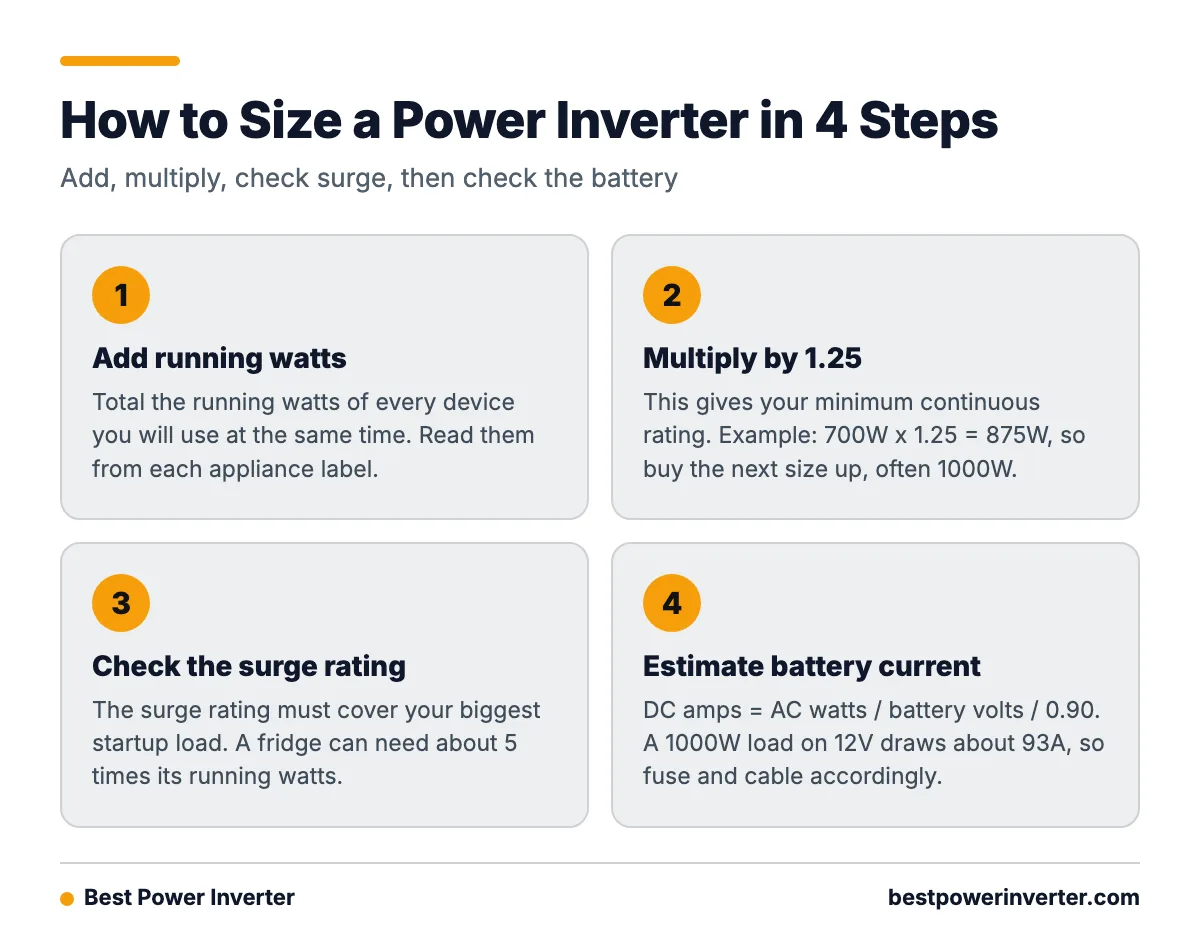
Use this formula:
Inverter continuous watts = (sum of running watts) x 1.25
Then do a second check: the largest startup surge in your list must fit inside the inverter’s surge rating.
How Many Watts Does My Inverter Need to Be? A Worked Example
Say you want to run these at once:
- Laptop: 65W
- Small TV: 100W
- Slow cooker: 200W
- Fan and lights: 100W
- Phone and tablet chargers: 35W
- Router and speaker: 50W
- Small blender or similar: 150W
The total is 700W. Multiply by 1.25 and you get 875W. So you need an inverter rated for at least 875W continuous. In practice, you would buy the next common size up, often 1000W. Then you check the blender and any other motor for startup surge.

How Do I Calculate Inverter Watts From Appliance Labels?
Read the rating label on the appliance. It usually lists watts (W) directly. If it only lists volts and amps, multiply them: watts = volts x amps. A tool marked 120V and 5A uses about 600W.
Labels beat broad online charts. A chart might say a fridge uses 150W, but your model could use more or less. Manufacturer starting-watt specs are even better when they exist. Plug-in watt meters can also show real draw.
- Look for: W, or V and A, on the nameplate.
- Check: the manual for “starting” or “locked rotor” figures on motors.
- Remember: labels often show maximum draw, not average draw.
What Size Power Inverter Do I Need for Continuous Loads and Startup Loads?
Size the continuous rating for everything running together. Size the surge rating for the running load plus the extra power the biggest motor needs to start. Samlex states that total starting surge equals normal running power plus additional starting power.
Samlex also lists rough startup multiples:
| Load type | Typical startup multiple (Samlex) |
|---|---|
| Refrigerator or freezer | About 5x running power |
| Air compressor | About 4x |
| Sump pump, furnace fan, dishwasher, washer, circular saw | About 3x |
Take a fridge that runs at 150W. Plan for around 750W at startup. Add 50W of lights and you need surge capacity near 800W, even though the running total is only 200W. A 300W inverter would trip. A 1000W unit with a proper surge rating would not.
- If your load is only electronics and chargers, size by running watts x 1.25.
- If it includes a fridge, pump, compressor or saw, size the surge rating first.
- If it includes a heater, kettle or microwave, check the label. These draw large continuous power and need a much bigger inverter and battery.
What Can 100W, 120W, 300W, 400W and 3000W Inverters Run?
Treat each inverter as a hard limit on total running watts. The table shows realistic uses, based on typical device ratings and the continuous limit. Always confirm with your own labels.
| Inverter size | Good for | Usually cannot run |
|---|---|---|
| 100W | Phone and tablet chargers, one laptop charger under 100W, LED lights | TVs with gaming consoles, fans with surge, any heater or motor |
| 120W | Laptop plus phone charger, camera battery charger, small LED lighting | Anything above 120W total, power tool chargers on fast mode |
| 300W | Laptops, small TV, router, chargers, lights, a small fan | Kettles, microwaves, hair dryers, fridges with big startup, tools |
| 400W | Everything a 300W runs, plus a larger TV or a small cooler-style fridge with low startup | Space heaters, coffee makers, most power tools |
| 3000W | Fridge, lights, electronics and a modest tool at once, if the surge rating and battery allow | Several high-draw appliances together; any startup beyond its surge rating |
What Will a 100 Watt Power Inverter Run?
A 100W inverter suits loads totaling roughly 100W or less. That means phone chargers, a tablet and LED lights. A laptop with a 90W charger will use nearly all of it, so leave nothing else plugged in.
What Will a 120 Watt Power Inverter Run?
A 120W inverter covers a single laptop charger plus a phone charger. It cannot run loads above its continuous rating, even briefly, if they start with a surge. Small units like this often plug into a car socket.
What Can You Run on a 300 Watt Inverter?
A 300W inverter runs low-power electronics and small chargers within its continuous limit. Think laptops, a small TV, lights and a router. It typically cannot run high-power heaters, kettles, microwaves or motor loads with big startup surge.
What Can a 400 Watt Inverter Power?
A 400W inverter adds some room. A 32-inch TV, laptop and phone chargers together fit comfortably. Still skip anything that heats, such as hair dryers and toasters. These need far more than 400W.
What Can a 3000 Watt Inverter Power?
A 3000W inverter can supply up to about 3000W continuously, but only if its specification gives that continuous rating. Its battery, cables, fuse and surge capability must also support the load. Many buyers assume a 3000W unit will start any fridge, pump or tool. It will not if the surge rating is short or the battery cannot deliver the current.
It can often run a fridge, lights, a TV and a laptop together. It will struggle with a pump, a microwave and a power tool all at once.

Do I Need Pure Sine Wave Output?
Pure sine wave is the safest choice for sensitive electronics, medical devices like CPAP machines, and motors. It matches the clean power from a wall outlet. Modified sine wave is cheaper and works for simple loads like basic lights and some chargers. It can make motors run hotter and cause buzzing in audio gear.
Samlex covers the differences between the two types in its inverter FAQ. Owners also say pure sine wave works well with sensitive electronics. If your budget allows, choose pure sine.
How Do Battery Voltage, Inverter Efficiency and Wiring Affect the Required Size?
A bigger inverter needs a bigger battery system and thicker cables. The inverter does not make power. It pulls it from the battery, and some is lost as heat. Use this formula to estimate battery-side current:
DC amps = AC watts / battery volts / 0.90
The 0.90 figure assumes about 90% efficiency. Check your inverter’s own efficiency rating.
Second Worked Calculation
Take the 875W inverter from earlier on a 12V battery. 875 / 12 / 0.90 = about 81A. That is a lot of current. It needs a properly sized fuse and thick cable. A 1000W load at 12V and 90% efficiency draws about 93A.
| Inverter load | 12V battery | 24V battery | 48V battery |
|---|---|---|---|
| 1000W | About 93A | About 46A | About 23A |
| 3000W | About 278A | About 139A | About 69A |
That table shows why large inverters usually go on 24V or 48V systems. Doubling the voltage halves the current. Lower current means thinner cable, less heat and less voltage drop.
Worked Examples
Car: Laptop and Phone
A 65W laptop charger and a 20W phone charger total 85W. Times 1.25 gives about 106W. A 150W inverter works, and it stays inside most car socket limits. Do not exceed the socket fuse.
Camping: Lights, Laptop and Chargers
Lights at 20W, a laptop at 65W and chargers at 30W total 115W. Times 1.25 gives about 144W. A 300W pure sine wave inverter gives comfortable room.
Refrigerator
A fridge runs at 150W. Using Samlex’s 5x rule, startup is near 750W. Add 50W of lights and you need about 800W of surge. Running load x 1.25 is only 250W, but the surge rule sets the real size. Choose a 1000W unit with a surge rating well above 800W.
Emergency Backup
Fridge at 150W, lights at 60W, router at 20W and chargers at 30W total 260W. Times 1.25 is 325W. The fridge startup of about 750W plus the others sets surge near 860W. A 1000W-1500W inverter fits, backed by a battery that can hold the load for hours.
Printable Sizing Checklist
- Appliance running watts (from the label): ______
- Appliance starting watts (manual or Samlex multiples): ______
- Total simultaneous running watts x 1.25: ______
- Inverter continuous rating (spec sheet): ______
- Inverter surge rating: ______
- Battery voltage (12V, 24V or 48V): ______
- DC amps (watts / volts / 0.90): ______
- Fuse size (above max current, within cable rating): ______
- Cable gauge (per the inverter maker’s chart): ______
For another sizing method, the Powelab inverter size calculator lets you check your numbers.
Safety Checklist
- Fuse: Fit a fuse close to the battery on the positive cable.
- Cables: Use the gauge the manufacturer specifies. Keep runs short.
- Ventilation: Leave space around the unit. Fans and heat sinks need airflow.
- Grounding: Follow the manual’s grounding steps.
- Overload protection: Pick a unit with overload, low-voltage and thermal shutdown.
- Dry location: Keep it away from water and flammable items.
What do owners say?
Owners like
- A convenient way to power laptops, chargers, lights and small electronics away from mains power
- Pure sine wave output works well with sensitive electronics
- Built-in overload, low-voltage and thermal protection is reassuring
- Higher-powered models can support several household or workshop devices when paired with an adequate battery system
Common complaints
- Cooling fans can be audible, especially under heavy loads
- Advertised peak wattage can mislead buyers when the continuous rating is much lower
- Small vehicle inverters may shut down when the car socket fuse or wiring cannot supply the required current
- High-power models place heavy demands on batteries and cables
- Some units trip or overheat when motor startup surge is underestimated
Summarised from owner reviews and long-term user reports; individual experiences vary.
Frequently Asked Questions
How many watts does my inverter need to be?
Add the running watts of everything used at once and multiply by 1.25. Then check that the surge rating covers the largest startup load, such as a fridge or compressor.
What size power inverter do I need?
It depends on your loads. Chargers and a laptop need 150W-300W. A fridge plus electronics usually needs 1000W or more with a strong surge rating. Use the formula in this guide.
What will a 120 watt power inverter run?
It runs a laptop charger and a phone charger, or a few LED lights, as long as the total stays under 120W. It cannot run heaters, kettles or motors.
What can you run on 300 watt inverter?
Laptops, a small TV, a router, lights and chargers. Skip microwaves, kettles, heaters and anything with a big motor startup.
What can a 400 watt inverter power?
The same devices as a 300W unit, with more room. A larger TV with a laptop and chargers fits. Heating appliances still do not.
What will a 100 watt power inverter run?
Phone and tablet chargers, LED lights, or one small laptop charger. Keep the total near or under 100W.
What can a 3000 watt inverter power?
It can run several devices up to about 3000W continuous, if the spec confirms that rating. It also needs a strong battery, thick cables, a proper fuse and enough surge capacity for motors.
Sources