
An inverter battery can sometimes be repaired, but only when the fault is a charging or connection problem, not physical damage. A lead-acid battery that was undercharged, has loose or dirty terminals, or shows early sulfation may recover with the right charger and a professional test. A battery that is cracked, leaking, swollen, has a shorted cell, or has worn-out plates needs replacing. This guide shows you how to tell which case you have without opening the battery or putting yourself at risk.
Quick answer
Some inverter batteries can be saved. Recharge the battery fully with the correct charger, let it rest 12 hours, then check the voltage and get a load test. If the case is damaged or the battery fails the load test, replace it.
- Best for low voltage with no damage: full charge, rest, retest.
- Best for cracks, leaks or swelling: stop, replace and recycle.
- Undercharging, loose terminals and early sulfation can often be fixed. Cracked cases, leaks, swelling and shorted cells cannot.
- The inverter’s built-in charger, a wrong battery setting or loose cables often cause what looks like a dead battery.
- After a 12-hour rest, a 12-volt battery below 12.4 volts is less likely to recover fully, according to BatteryMINDers.
- Only flooded batteries take distilled water. Never add acid. Never open a sealed or lithium battery.
- Voltage alone does not prove a battery is healthy. A load or capacity test does.
- Is it possible to repair an inverter battery?
- Which battery types can be serviced?
- What should you look for first?
- How can I tell whether the battery or the inverter charger is faulty?
- What voltage should a 12-volt inverter battery show after resting?
- Can battery sulfation be reversed?
- Should water or acid be added to an inverter battery?
- When should an inverter battery be replaced instead of repaired?
- Can an inverter battery be repaired at home?
- How should a damaged inverter battery be handled and recycled?
- Frequently Asked Questions
Is it possible to repair an inverter battery?
It depends on what went wrong. Most “repairs” are really careful recharging, cleaning and testing. True internal repairs, such as fixing plates or swapping a cell inside a sealed box, are not safe or practical for a homeowner.
Think of faults in two groups:
- Recoverable: the battery is low because it was not charged fully, the cables are loose or corroded, or the inverter is set to the wrong battery type. Light sulfation can sometimes be reversed too. (Sulfation means hard crystals building up on the lead plates inside.)
- Permanent: a cracked or swollen case, leaking acid, a shorted cell, heavy sulfation, or plates that are simply worn out with age.
Many pages online call every low battery “repairable.” That is wrong. A battery that is low because it was discharged is very different from one with a dead cell. The tests below help you tell them apart.
Which battery types can be serviced?
Flooded batteries allow the most home care. Sealed and lithium batteries allow almost none. Check the label before you do anything.
| Battery type | What you can safely do | What you must not do | Usual outlook |
|---|---|---|---|
| Flooded lead-acid (tubular or flat plate, with removable caps) | Clean terminals, charge correctly, top up with distilled water after charging, have a hydrometer test done | Add acid, drain acid, overfill | Often recovers if it was only undercharged |
| AGM (sealed, maintenance-free) | Clean terminals, charge using the AGM setting | Open vents, add water, drill the case | Limited recovery; replace if it fails a load test |
| Gel (sealed) | Charge only with a gel-compatible setting, which uses lower voltage | Open it, use high-voltage desulfation unless the maker approves it | Sensitive to overcharging; damage is usually permanent |
| Lithium (LiFePO4 or high-voltage packs) | Read error codes on the display or app, contact the installer | Open, rewire or “rebalance” cells yourself | Manufacturer or authorized technician only |
Lithium packs deserve a clear warning. User manuals for high-voltage lithium batteries, such as those from Fox ESS, forbid owners from taking them apart and reserve repairs for the manufacturer or authorized technicians. These packs store a lot of energy at high voltage. Do not open one.
What should you look for first?
Look before you test. Switch off the inverter, unplug it from the wall, and put on safety glasses and acid-resistant gloves. Then check the battery in good light.

- Swelling: sides that bulge outward. Stop here. Replace it.
- Cracks or leaks: wet patches, acid on the floor, or a stained tray. Stop. Replace it.
- Heat: a battery that feels hot when idle has a problem. Stop.
- Rotten-egg smell: often a sign of overcharging. Check the charger before using it again.
- Corrosion: white, blue or green crust on the terminals. This is usually fixable.
- Loose or melted terminals: loose cables cause voltage drop and heat. Melted posts mean replacement.
To clean light corrosion, disconnect the cables (negative first), scrub the crust with a mix of baking soda and water, rinse with a damp cloth, dry it, and tighten the cables firmly. Keep the mix out of the battery vents.
How can I tell whether the battery or the inverter charger is faulty?
Measure the voltage at the battery terminals with mains power on and the inverter charging. If the voltage climbs well above the battery’s resting level, the charger is working. If it stays flat, the charger, wiring or settings are the more likely problem.
For a 12-volt lead-acid battery, charging voltage usually sits somewhere between about 13.8 and 14.4 volts. Your inverter manual lists the exact figure. A reading stuck near 12 volts while the mains is on points away from the battery.
Other signs the battery is not the real problem:
- The charging light on the inverter never comes on.
- The inverter is set to the wrong battery type, such as “SMF” (sealed) for a flooded tubular battery.
- The battery holds up well after being charged on a separate, correct charger.
- Power cuts are long and frequent, but mains time is short. The battery never gets a full charge between outages. That is an undersized charging setup, not a broken battery.
What voltage should a 12-volt inverter battery show after resting?
A healthy, fully charged 12-volt lead-acid battery usually reads about 12.6 volts or a little more after resting. The rest matters. Right after charging, the reading is falsely high. BatteryMINDers’ guide to testing for sulfation says to let the battery rest at least 12 hours before you judge it.
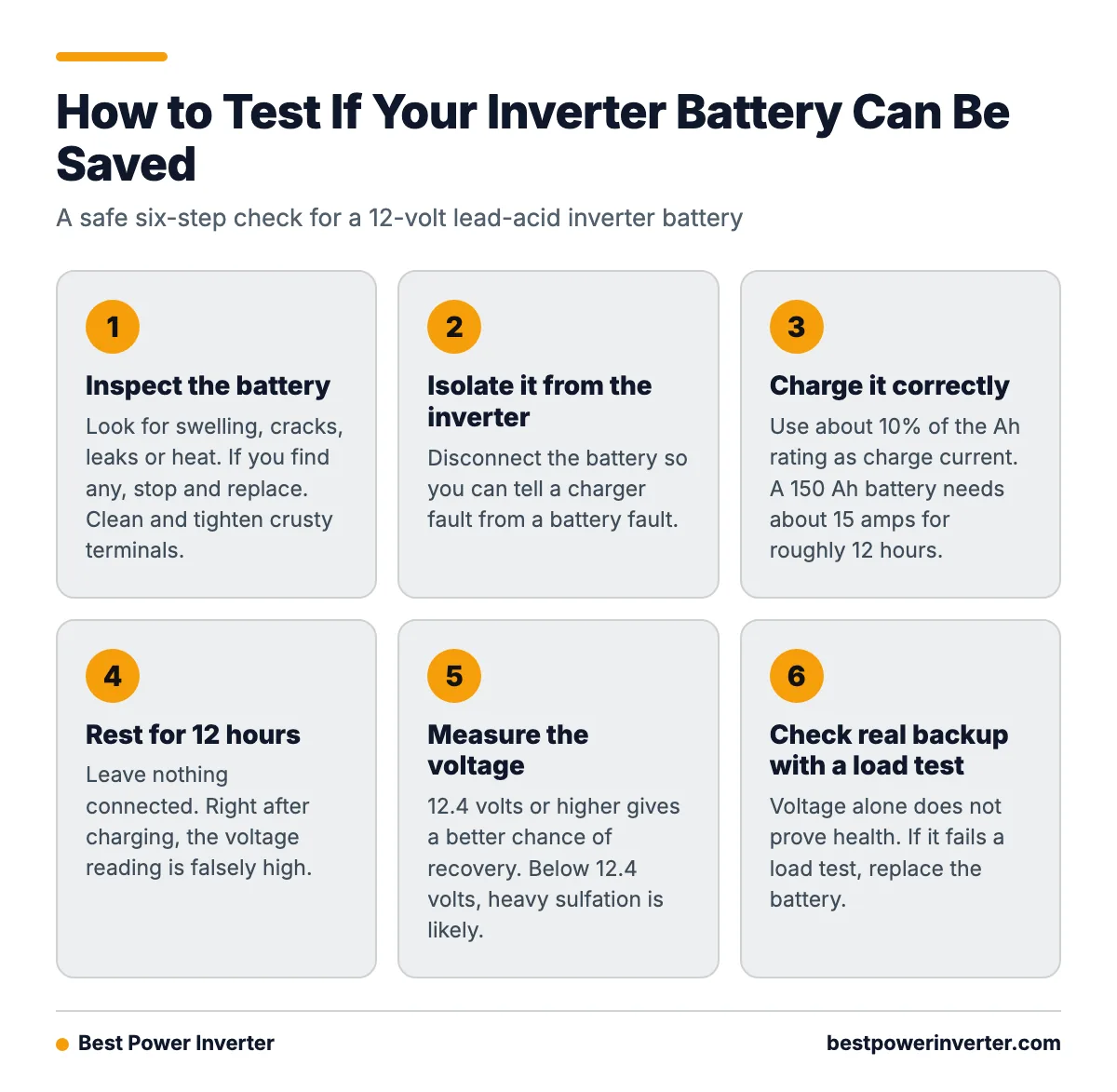
According to the same source, a battery reading below 12.4 volts after resting may be heavily sulfated and is less likely to recover fully. A reading of 12.4 volts or higher gives a better chance of recovery.
Voltage is only the first check. A battery can show good voltage and still have little real capacity. It may collapse as soon as you run a fan or a fridge. That is why a load test, which draws a heavy current and watches the voltage, gives the final answer.
Worked example
A homeowner has a 12-volt, 150 Ah flooded tubular battery. (Ah means amp-hours, a measure of stored charge.) Backup time has dropped sharply.
Step 1 – Inspect. No swelling, cracks or leaks. The positive terminal has white crust. They clean and tighten it.
Step 2 – Isolate. They disconnect the battery from the inverter.
Step 3 – Charge. A widely used rule for lead-acid batteries is a charge current of about 10% of the Ah rating: 150 × 0.10 = 15 amps. Time is roughly 150 Ah ÷ 15 A = 10 hours, plus about 20% for charging losses = about 12 hours. The battery maker’s charging time takes priority over this estimate.
Step 4 – Rest. They wait 12 hours with nothing connected.
Step 5 – Measure. Two possible results:
- 12.5 volts: above 12.4, so recovery looks possible. A battery shop load test is the next step.
- 12.1 volts: below 12.4, so heavy sulfation is likely. One desulfation attempt with an approved charger is reasonable. If it fails, replace the battery.
Step 6 – Check real backup. Rough capacity: 12 V × 150 Ah = 1,800 Wh. Lead-acid batteries are commonly used to about half their capacity, so about 900 Wh is usable. At a 300 W load, that is about 900 ÷ 300 = 3 hours before inverter losses. If the battery now runs that load for well under an hour, most of its capacity is gone.
Can battery sulfation be reversed?
Sometimes, but not always. Early, soft sulfation can often be broken down with a full, correct charge or a desulfation mode on a charger the battery maker approves. Hard sulfation that has built up over months of sitting undercharged is usually permanent.
Patience is part of the method. BatteryMINDers advises allowing at least 72 hours of desulfation before retesting. Continue only if the voltage or specific gravity improves. (Specific gravity is how dense the acid is, measured with a hydrometer. It shows how charged each cell is.)
Sulfation treatment is not a guaranteed cure. Results depend on how bad the sulfation is, the battery’s age, and whether your charger suits the battery type. The real test is whether capacity comes back under load, not just whether the voltage rises. Skip home remedies that involve opening the battery or pouring in chemicals. They add burn risk and can void the warranty.
Should water or acid be added to an inverter battery?
Add only distilled water, and only to flooded batteries with removable caps. Never add acid. During normal charging, a flooded battery loses water, not acid. Adding acid makes the mix too strong and shortens battery life.
- Top up after a full charge, not before. The liquid level rises while charging.
- Fill to the maker’s mark or float indicator. Do not overfill, or acid can spill out.
- Use distilled or deionized water. Tap water contains minerals that harm the plates.
- Never pry open a sealed AGM, gel or “maintenance-free” battery to add water.
Never drain the acid yourself. Opening a battery to remove acid calls for protective clothing, splash protection, gloves and proper hazardous-waste handling. It is not a casual job.
When should an inverter battery be replaced instead of repaired?
Replace the battery if it is cracked, leaking, swollen, keeps losing charge on its own, has a shorted cell, or fails a load or capacity test. Charging these batteries again and again wastes power and can be dangerous.
| Symptom | Likely cause | Safe test | Possible remedy | Recommendation |
|---|---|---|---|---|
| Short backup, no damage, inverter rarely shows “full” | Undercharging or wrong battery setting | Voltage at terminals while charging | Fix setting, full charge | Likely recoverable |
| Crust on terminals, “low battery” alarms | Corrosion or loose cables | Look and check tightness | Clean and tighten | Repair |
| Below 12.4 V after 12-hour rest | Heavy sulfation or deep discharge | Rest, then retest after 72-hour desulfation | Approved charger with desulfation mode | Replace if no improvement |
| Charges up, then drops within days while unplugged | Internal fault or aged plates | Recheck voltage after a few days disconnected | None reliable | Replace |
| Reads around 10.5 V; one cell bubbles hard while others don’t | Shorted cell (one 2.1 V cell gone from six) | Professional per-cell test | None at home | Replace |
| Swollen, cracked, leaking or hot | Physical damage or overcharging | Look only, do not charge | None | Replace and recycle |
| Lithium pack shows error or no output | BMS (battery management system) fault | Read display or app codes | Installer or maker service | Manufacturer only |
Stop-repair checklist:
- If the case is cracked, swollen, leaking or hot → stop and replace.
- If the voltage stays below 12.4 V after rest and does not improve after 72 hours of desulfation → replace.
- If the voltage drops noticeably within a few days while disconnected → replace.
- If it passes voltage but fails a load test → replace.
- If it passes everything → fix the charger, setting or cables that caused the problem, or it will happen again.
A battery shop can do a load test, a capacity test and a per-cell hydrometer check. Cell replacement is only practical for systems built from separate 2-volt cells, and only a technician should do it. For a standard 12-volt block battery, replacement is the normal fix for a dead cell.
Can an inverter battery be repaired at home?
You can safely do the simple parts at home: inspect, clean terminals, check voltage, charge correctly and top up a flooded battery with distilled water. Anything inside the battery belongs with a professional. Lead-acid batteries contain sulfuric acid that can cause severe burns. Charging also makes hydrogen and oxygen, which can form an explosive mix.

The Canadian Centre for Occupational Health and Safety’s battery charging guidance stresses good ventilation and keeping sparks and flames away. Use a charger approved for the battery’s voltage and amp-hour rating, and follow the maker’s charging time.
Printable safety checklist:
- ☐ Safety glasses or a face shield on
- ☐ Acid-resistant gloves on
- ☐ Room well ventilated, with no gas build-up
- ☐ No smoking, flames or sparks nearby
- ☐ Inverter off and mains unplugged before touching cables
- ☐ Charger set to the right voltage (12 V) and battery type
- ☐ Charger suits the battery’s amp-hour rating
- ☐ Metal tools kept away from both terminals at once
- ☐ Clean water nearby to rinse acid off skin or eyes
- ☐ Stop at once if the case is cracked, swollen, hot or leaking
If acid gets in your eyes, rinse with clean water for several minutes and get medical help right away.
How should a damaged inverter battery be handled and recycled?
Take it to a battery dealer, scrap recycler or local collection point. Never throw it in household trash. Lead and acid harm soil and water, and lead-acid batteries are widely recycled.
- Keep the battery upright so acid cannot spill.
- Put a leaking battery in a leak-proof plastic tub.
- Cover the terminals with tape so they cannot short.
- Do not drain, break or burn it.
- Ask about trade-in credit when buying a replacement. Many sellers take old batteries back.
The EPA’s lead-acid battery management document covers how damaged batteries should be stored and handled as hazardous material.
Frequently Asked Questions
Is it possible to repair an inverter battery?
Sometimes. A lead-acid battery that is low because of undercharging, loose terminals or early sulfation may recover with correct charging and a professional test. Cracked, leaking, swollen or shorted batteries need replacing.
Can inverter battery be repaired?
Only for surface or charging faults. Cleaning, tightening, charging and topping up a flooded battery with distilled water are safe. Internal repairs are not safe at home, and lithium packs should only be serviced by the manufacturer or authorized technicians.
How to repair inverter battery?
Inspect for damage, clean the terminals, disconnect the battery from the inverter, charge it with a correctly rated charger, rest it at least 12 hours and measure the voltage. If it reads 12.4 V or more, get a load test. If it reads lower, try one desulfation cycle and retest after 72 hours.
Can a dead inverter battery be repaired?
A battery that only seems dead because it was deeply discharged may take a charge again, but its capacity is often reduced. If it stays below 12.4 V after resting, keeps losing charge, or fails a load test, replacement is the practical choice.
What safety precautions are needed when testing or charging the battery?
Wear eye protection and acid-resistant gloves, charge in a well-ventilated area, keep sparks and flames away, use a charger matched to the battery’s voltage and type, and stop if the case is cracked, swollen, hot or leaking.
Sources