
Most people open the case of a dead inverter first, and that is the wrong move. Start outside the box instead. Most faults come from a blown fuse, a loose or corroded battery cable, low battery voltage, an overload, or heat, and you can fix all of these with basic tools. Burnt MOSFETs, failed capacitors and damaged control boards need real electronics skills, and on cheap units a new inverter often costs less than the repair.
Quick answer
Check the battery voltage, cables, terminals and fuses first. Then reduce the load and let the unit cool. If it still fails, internal repair only makes sense for skilled people or for expensive units. Otherwise replace it.
- Best for no power or beeping: check battery and fuses
- Best for a dead budget unit: replace it
- Work from the outside in: battery, cables, fuses, load, heat, then internals.
- Always disconnect the battery and discharge the capacitors before opening the case.
- Low-voltage alarms often start around 10.5-11V on a 12V system, with shutdown near 10V.
- Motors such as sump pumps can draw 2-3x their running watts at startup, so size for surge.
- A car 12V socket is usually fused at 10-15A, which limits you to roughly 120-180W.
- If a repair costs about half the price of a new unit, replace it.
- What safety steps must I take before opening an inverter?
- Quick diagnosis: symptom, cause and fix
- How do I fix an inverter that won’t turn on?
- How do I check and replace the fuse?
- How do I test an inverter with a multimeter?
- Overload, overheating and fan problems
- Which internal parts fail, and what do repairs cost?
- Can a power inverter be repaired, or should you replace it?
- How do I size an inverter so it stops overloading?
- How big a power drain is an inverter when idle?
- What size inverter can my truck or car handle?
- Preventive maintenance
- Frequently Asked Questions
What safety steps must I take before opening an inverter?
Turn the inverter off, disconnect the DC cables from the battery, unplug all loads, and wait. Then discharge the large capacitors before you touch anything inside. An inverter makes household-level AC, and the capacitors can hold a dangerous charge even after the battery is off.
- Switch the unit off. Remove the negative battery cable first, then the positive.
- Unplug everything from the AC outlets.
- Wait at least 10-15 minutes.
- Open the case. Find the large electrolytic capacitors (the big cylinders).
- Discharge each one through a resistor. Use a few hundred ohms to a few kilohms with a power rating of several watts, held with insulated leads.
- Check with a multimeter. The reading should fall to near 0V before you touch the board.
Quick diagnosis: symptom, cause and fix
Match your symptom to the table, then fix the cheapest cause first. Exact beep patterns and LED codes differ by brand, so check your manual for the details.
| Symptom | Likely cause | Fix |
|---|---|---|
| No lights, no output | Blown fuse, loose cable, dead battery | Check battery voltage, cables and fuses |
| Constant beeping, green or yellow light | Low battery voltage (often near 10.5-11V) | Charge battery, clean terminals, shorten or thicken cables |
| Red LED, shuts off with a device | Overload or startup surge | Remove load, use a bigger inverter |
| Red LED, hot case | Over-temperature | Cool the unit, clear vents, check fan |
| Fuse blows at once | Reversed polarity, short, failed MOSFETs | Check wiring; internal repair or replace |
| Loud or no fan | Dust, worn fan bearing | Clean or replace the fan |
| Works with small loads only | Voltage drop, weak battery, thin cables | Test voltage under load; upgrade cables |
| Burnt smell, visible damage | Failed internal parts | Stop using it; replace or send for repair |
How do I fix an inverter that won’t turn on or has no output?
Check the power going in before blaming the inverter. Most dead inverters are dead because the battery or the cable connection failed.
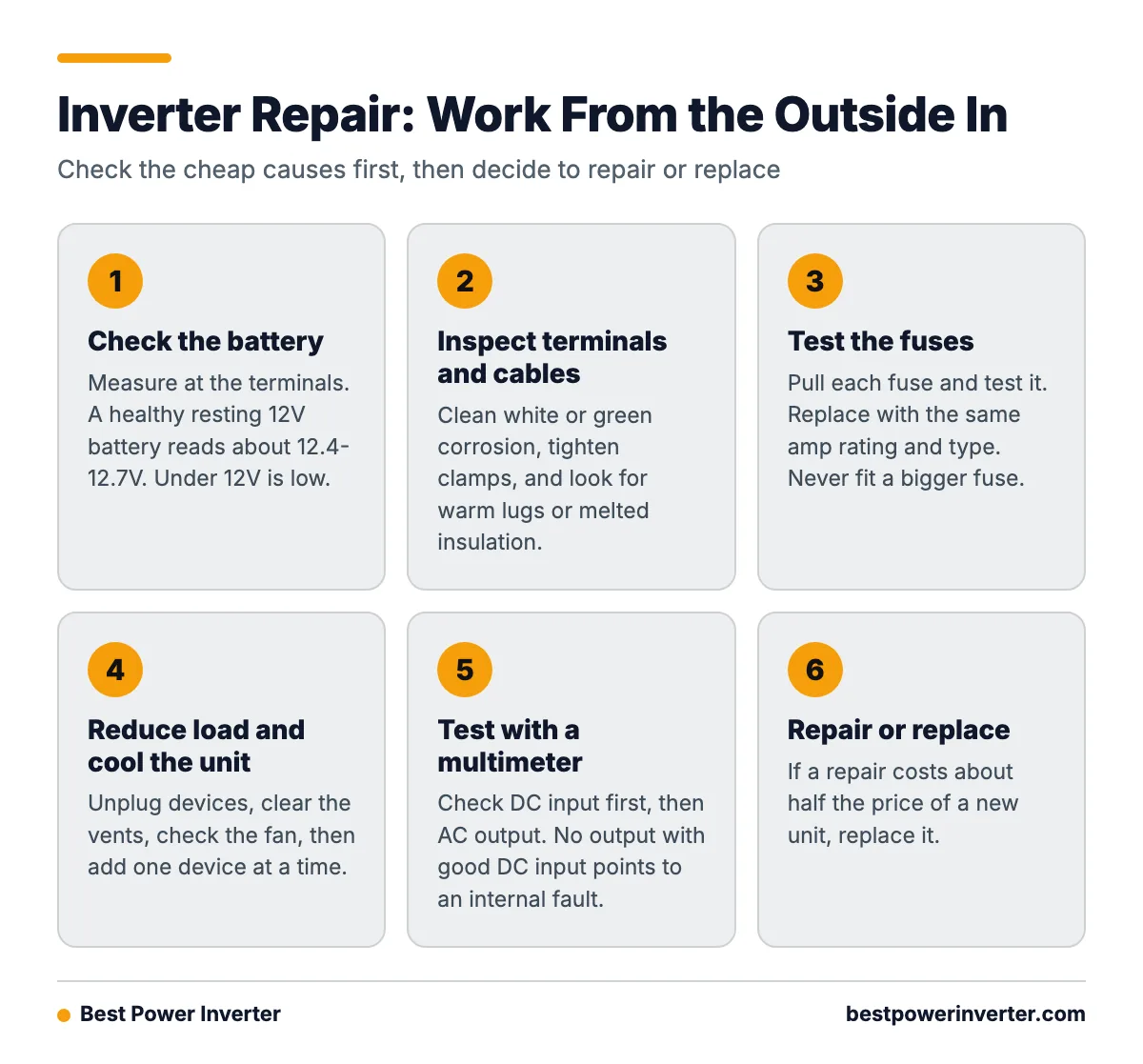
- Battery: Measure at the battery terminals. A healthy resting 12V lead-acid battery reads about 12.4-12.7V. Under 12V means it is low.
- Terminals: Look for white or green corrosion. Clean it with a wire brush and tighten the clamps.
- Cables: Check for warm lugs, melted insulation or loose bolts. A loose lug makes heat and voltage drop.
- Remote switch: Some units have a remote on/off panel. Bypass it or check its plug.
- Polarity: Red goes to positive and black to negative. Reversed polarity blows the fuse and may damage internal parts.
What do the beeping alarm and the red LED fault lights mean?
A beep or red light usually means one of three things: low voltage, overload, or over-temperature. Low-voltage alarms commonly sound around 10.5-11V on a 12V system, and the unit shuts down near 10V. Overload means the device asks for more watts than the inverter can give. Over-temperature means the case or heat sink got too hot. Manufacturers use different codes, so match the pattern to your manual. Then fix the cause, not the alarm.
How do I check and replace the fuse in an inverter or its DC cable?
Pull the fuse and test it with the multimeter on continuity or resistance. A good fuse reads near zero ohms. A blown one reads open. Many setups have two fuses: blade fuses on the inverter itself, and a larger inline fuse near the battery.
- Disconnect the battery first.
- Find the fuses on the inverter’s DC side and on the positive cable near the battery.
- Pull each one and test it.
- Replace it with the same amp rating and type. Never fit a bigger fuse.
- Reconnect and test with a small load.
If the new fuse blows right away, stop. Likely causes are reversed polarity, a short in the cable, or failed MOSFETs inside the unit.

How do I test an inverter with a multimeter?
Test the DC input first, then the AC output. This tells you whether the problem is the supply or the inverter.
Testing DC input
- Set the meter to DC volts.
- Touch the probes to the inverter’s input terminals (red to positive, black to negative).
- Read the voltage with the inverter on, and again with a load running.
A drop to under about 11V under load means a weak battery or a bad connection. To find the cause, measure at the battery terminals and again at the inverter terminals while the load runs. A large gap between the two readings points to a bad cable or terminal. As a rule of thumb, more than half a volt of difference deserves a closer look.
Testing AC output
Set the meter to AC volts and probe the outlet slots. In the US you should see about 120V. Modified sine wave inverters can confuse cheap meters, so use a true RMS meter for an accurate reading. No output with good DC input means the inverter has an internal fault, or the protection circuit has tripped.
Overload, overheating and fan problems
Inverters trip on overload and heat to protect themselves. That is the design working, not always a failure.
- Overload: Unplug devices, reset the unit, and add one device at a time.
- Blocked vents: Keep several inches of space around the case. Do not bury it under bags or blankets.
- Dusty fan: Clean with compressed air. A fan that spins slowly or makes grinding noise needs replacing.
- Hot location: Direct sun and engine bays reduce output. Mount it in a cool, dry, ventilated spot.
Which internal parts fail, and what do repairs cost?
Common failure points are MOSFETs, electrolytic capacitors, the cooling fan, and the transformer or control board. Only the fan is an easy DIY job for most people.
| Part | Sign of failure | DIY level | Rough parts cost* |
|---|---|---|---|
| Fan | Noise, no spin, overheating | Easy | Low (about $5-$20) |
| Fuses | No power | Easy | A few dollars |
| Capacitors | Bulging top, weak or noisy output | Skilled soldering | Low per part |
| MOSFETs | Fuse blows instantly, burnt marks | Skilled; often needs matched sets | Low per part, higher labor |
| Control board | Random faults, no startup | Advanced | Often near the cost of a new unit |
| Transformer | Burnt smell, hum, no output | Advanced | High |
*These are rough, parts-only estimates. Prices vary by brand and supplier.
A burnt MOSFET often takes other parts with it, such as drivers and resistors. Replacing one part without finding the root cause means it fails again.
Can a power inverter be repaired, or should you replace it?
Yes, an inverter can be repaired, but it is not always worth it. External faults are cheap to fix. Internal faults on low-cost units usually cost more in time and parts than a new inverter.
If the fault is a fuse, cable, terminal, battery or fan, then fix it yourself.
If the unit is a budget model and the fault is internal, then replace it.
If the unit is large, expensive or pure sine, and still under warranty, then contact the maker before opening it.
If you have electronics skills and a schematic, then a repair may be worth trying.
Use this checklist:
- Does the repair cost more than about half the price of a new unit? Replace it.
- Is the unit under warranty? Opening the case may void it, so call the seller first.
- Are there burn marks, a melted transformer or a burnt smell? Replace it.
- Do you lack a multimeter, soldering skills or a way to discharge capacitors? Do not open it.
How do I size an inverter so it stops overloading?
Add up the running watts of everything you plan to power, then check each device’s startup surge. Choose an inverter whose continuous rating covers the running total and whose surge rating covers the biggest startup. Motors cause most repeat overload trips, because induction motors such as sump pumps and compressors can draw 2-3x or more their running watts on startup.
| Device | Running watts | Surge watts | Suggested inverter size |
|---|---|---|---|
| 32-inch TV | About 50-100W | Low | 150-300W |
| Inkjet printer | About 30-60W | Low | 150-300W |
| Laser printer | Lower when idle | Up to about 400W | 600-1000W |
| Mini fridge | About 60-100W | About 3x running | 500-600W |
| Power drill | About 500-1000W | Higher on startup | 1000-1500W |
| 1/3 hp sump pump | About 800W | 2000W or more | 2000-3000W, pure sine |

For more help, use online tools such as the Gridwright inverter size calculator, or read this explanation of continuous versus surge watts.
Worked example: amps, cable and fuse
DC amps are roughly AC watts divided by battery voltage, divided by efficiency. For a 1000W load on 12V at about 85% efficiency: 1000 ÷ 12 ÷ 0.85 ≈ 98A. That is about 100A, which is why thin cables overheat and drop voltage. A common rule of thumb is to size the fuse at about 125% of the maximum current, so roughly 125A here. Cable gauge depends on the run length and the manufacturer’s chart, so follow your manual.
Size also matters for big systems. A 5000W inverter on 12V would draw over 400A. That is why units of that size are normally 24V or 48V. At 48V the same load is about 5000 ÷ 48 ÷ 0.85 ≈ 122A.
How big a power drain is an inverter when idle?
An idle inverter pulls power even with nothing plugged in. Many modified and pure sine units draw about 0.3-1.5A at 12V with no load. Multiply by 24 hours and you get roughly 7-36Ah per day.
Here is what that means for a 100Ah lead-acid battery. Deep-cycle lead-acid batteries should generally not be discharged below about 50% for longevity, so you have about 50Ah to use. An inverter idling at 1A uses 24Ah per day. That is about half your usable capacity in a day, with no devices running. Switch the inverter off when you do not need it, or pick a unit with a low-power or search mode.
What size inverter can my truck or 12V car socket handle?
A car’s 12V socket is typically fused at 10-15A, which limits an inverter plugged into it to roughly 120-180W. That covers a phone charger, a laptop or a small TV. For anything bigger, connect the inverter directly to the battery with properly sized cables and an inline fuse.
Your truck’s limit is then the battery, the alternator and the cable run. Keep the engine running for loads above a few hundred watts, because a heavy draw can flatten a starting battery fast. For larger loads, use a separate deep-cycle battery.
Preventive maintenance
- Check and tighten DC terminals every few months.
- Clean corrosion and keep terminals dry.
- Keep vents and the fan free of dust.
- Use cables rated for the amps, and keep them short.
- Install a fuse close to the battery.
- Do not run the unit at its limit for long periods.
- Recharge the battery before it falls into low-voltage alarm range.
Frequently Asked Questions
Can an inverter be repaired?
Yes, but it depends on the fault. Fuses, cables, terminals and fans are simple fixes. Burnt MOSFETs, failed capacitors and damaged boards need electronics skills, and on cheap units replacement is often the better choice.
How to fix a power inverter?
Turn it off and disconnect the battery. Check battery voltage, clean and tighten the terminals, test the fuses, and remove the load. Reconnect and test with a small device. If it still fails, test the DC input and AC output with a multimeter before considering internal repair.
How big power inverter to run sump pump?
A 1/3 hp sump pump runs at about 800W but can surge to 2000W or more at startup. Choose an inverter of about 2000-3000W, ideally pure sine, and confirm the pump’s startup rating on its label.
How big of a power drain is an inverter?
Many inverters draw about 0.3-1.5A at 12V with no load. That adds up to roughly 7-36Ah per day, which can drain a battery in days. Turn the inverter off when you are not using it.
How big power inverter for 5000w battery?
A 5000W inverter on 12V would draw over 400A, which is too much for most setups. Use a 24V or 48V battery bank instead. At 48V the draw is roughly 122A at about 85% efficiency. Size the battery bank, cables and fuses for that current.
How big an inverter to power a 32 tv?
A 32-inch TV uses about 50-100W, so a 150-300W inverter is enough. Check the label on the TV, and add any soundbar or streaming box to the total.
How big of a power inverter can my truck handle?
Through the 12V socket, only about 120-180W because of the 10-15A fuse. Wired directly to the battery, it can handle much more, limited by the battery, cables, fuse and alternator. Run the engine for large loads.
Sources