
Plug an inverter into the 12V socket only for small loads, up to about 150 watts. Wire anything bigger straight to the battery with thick cable and a fuse. A power inverter turns your car’s 12V DC power into 120V AC, but your socket, your wiring and your battery set the real limits, not the number on the box.
Quick answer
Use the socket for phone and laptop chargers under about 150W. Use a battery-wired inverter for 300W and up, with a fuse on the positive cable near the battery. Run the engine for anything beyond light, short use so the battery does not go flat.
- Best for laptops and phones: a 150W socket unit
- Best for TVs and small tools: 300W to 1000W, wired to the battery
- Best for CPAP and audio: pure sine wave
- Most car sockets are fused at 10A to 15A, which limits you to roughly 120-180W.
- Amps = watts ÷ 12, plus about 10-15% for inverter loss. A 300W load pulls about 28A.
- Put the inline fuse on the positive cable, within about 18 inches of the battery.
- A car starting battery should not be drained below about 50%.
- Heaters and hair dryers are not for a car inverter.
- How a car power inverter works
- Can I plug a power inverter into my car’s cigarette lighter socket?
- What size power inverter do I need?
- Pure sine wave vs modified sine wave
- How do I connect a power inverter directly to the car battery?
- What gauge cable and fuse size do I need?
- Will a power inverter drain my car battery?
- Start-stop, smart alternators and EVs
- Where should I mount an inverter, and is overnight use safe?
- Why does my inverter beep or shut off?
- Upgrades
- What do owners say?
- Frequently Asked Questions
How a Car Power Inverter Works
A car battery stores direct current (DC) at about 12 volts. Wall devices need alternating current (AC) at 120 volts in North America. The inverter bridges that gap. It switches the DC rapidly, steps the voltage up, and shapes the output into an AC waveform.
The catch is current. Lower voltage means higher amps for the same power. That one fact explains most of the rules in this guide: thin wires and small fuses cannot carry big loads.
Can I Plug a Power Inverter into My Car’s Cigarette Lighter Socket?
Yes, but only small ones. Most vehicle 12V sockets are fused at 10A to 15A. At 12V that limits sustained output to roughly 120-180W. A 150W inverter is the practical ceiling for most cars.
How do you find your socket’s fuse rating?
Check the owner’s manual or the diagram on the fuse box lid. Look for entries like “cigar,” “accessory,” “power outlet” or “AUX.” The amp number printed on the fuse is your limit. Many sockets also share a circuit with other items, such as a second outlet or the radio. If another device is on that circuit, your real budget is lower.
Why a 300W load will not work through the socket
Here is the math. A 300W load at 12V is 300 ÷ 12 = 25 amps. Add about 10-15% for inverter loss and you get roughly 28A. A 15A socket cannot supply that. The fuse blows, or worse, the wiring gets hot.
What Size Power Inverter Do I Need for My Laptop, TV or Power Tools?
Add up the running watts of everything you will use at once. Then pick an inverter with continuous output at least 20% above that total. Check each device label for watts, or multiply volts by amps.
Watch surge watts too. Devices with motors or compressors can pull 2-3 times their running wattage for a moment at startup. A drill rated at 600W may need a 1500W inverter to start cleanly.
| Device | Typical watts | Connection |
|---|---|---|
| Phone charger | 5-20W | 12V socket |
| Laptop charger | 45-100W | 12V socket |
| Camera battery charger | 10-30W | 12V socket |
| Small TV or monitor | 50-150W | Socket (small) or battery |
| Game console | 100-200W | Battery |
| Cordless tool charger | 100-300W | Battery |
| Corded drill or saw | 600-1500W | Battery, large inverter |
| Small microwave | 700-1200W | Battery, large inverter |
| Hair dryer, space heater, toaster | 1000-1800W | Do not run |
These are typical ranges. Your own label is the final word.
If it is 150W to 1500W: wire to the battery.
If it is over 1500W, or it makes heat: skip the car inverter and use a generator or a large power station.

Pure Sine Wave vs Modified Sine Wave: Which Is Right for a Car?
Pure sine wave is the better pick when your budget allows. It produces a waveform close to utility power. That suits sensitive electronics, medical devices such as CPAP machines, and motors. Modified sine wave units cost less but can cause buzzing, extra heat or odd behavior in some chargers and audio gear.
For a simple phone charger or a work light, modified sine wave is usually fine. For laptops you depend on, audio equipment or anything medical, go pure sine wave. Crutchfield’s car inverter explainer covers the same trade-off, and CarTechTalk’s pure sine wave roundup lists models worth comparing.
How Do I Connect a Power Inverter Directly to the Car Battery?
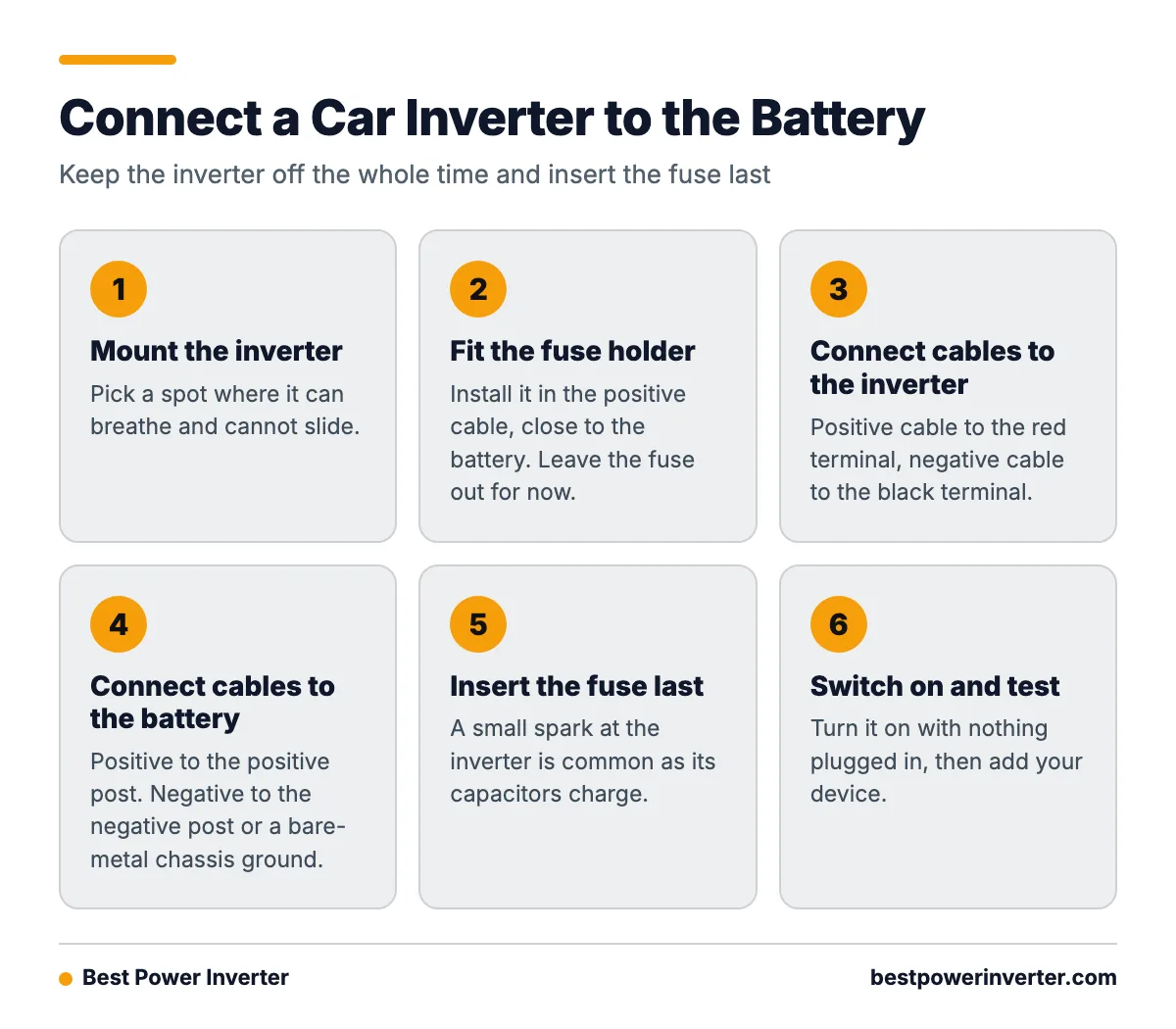
Run thick cables from the inverter to the battery, with a fuse on the positive cable near the battery. Follow the order below and keep the inverter off the whole time.
Pre-use safety checklist
- Inverter switch is OFF.
- Engine is off and the key is out.
- Cable gauge and fuse match the table below.
- Fuse holder will sit within about 18 inches of the battery.
- Inverter has airflow around it and is away from fuel and flammable items.
- You know which terminal is positive (red, +) and which is negative (black, -).
Step-by-step connection order
- Mount the inverter where it can breathe and cannot slide.
- Install the fuse holder in the positive cable, close to the battery. Leave the fuse out for now.
- Connect the positive cable to the inverter’s positive terminal (red).
- Connect the negative cable to the inverter’s negative terminal (black).
- Attach the positive cable to the battery’s positive post.
- Attach the negative cable to the negative post, or to a bare-metal chassis ground point recommended in your manual.
- Insert the fuse last. A small spark at the inverter is common as its internal capacitors charge.
- Switch the inverter on with nothing plugged in. Then add your device and test.
Reversed polarity can destroy an inverter in a second. Double-check red to positive, black to negative before the fuse goes in.
What Gauge Cable and Fuse Size Do I Need for a 300W, 1000W or 2000W Inverter?
A 1000W inverter at full load can draw about 85-100A from a 12V system. Short runs commonly use 4 AWG or heavier. The table below uses amps = watts ÷ 12 plus roughly 12% loss. The cable and fuse values are typical guidance for short runs, about 3 to 6 feet each way.
| Inverter watts | Approx. DC amps | Cable gauge (short run) | Fuse size |
|---|---|---|---|
| 150W | 14A | 14-12 AWG (or socket) | 20A |
| 300W | 28A | 10 AWG | 30-40A |
| 600W | 56A | 6 AWG | 60-70A |
| 1000W | 93A | 4 AWG | 100-125A |
| 1500W | 140A | 2 AWG | 150-200A |
| 2000W | 187A | 1/0 AWG | 200-250A |
Your inverter’s manual overrides this table. If your cable run is longer than a few feet, go one size thicker. Longer or thinner cable drops voltage, and a voltage drop triggers low-voltage alarms early.
Will a Power Inverter Drain My Car Battery, and How Long Can I Run It?
Yes, it will. Even idle, an inverter draws a small current. Under load it drains the battery fast. A typical car starting battery is about 40-70Ah, and discharging it below about 50% shortens its life and risks failure to start.
Worked run-time example
Take a 50Ah battery and a 100W laptop setup.
- Usable capacity at 50% depth of discharge: 50Ah × 0.5 = 25Ah.
- Load current: 100W ÷ 12V = 8.3A, plus about 12% loss = roughly 9.3A.
- Run time: 25Ah ÷ 9.3A = about 2.7 hours.
Treat that as a best case. An older or cold battery holds less. Aim for 1.5 to 2 hours and leave the rest as cranking reserve.
Should I keep the engine running while using an inverter?
For anything beyond light, short use, yes. With the engine on, the alternator carries the load and tops up the battery. Make sure the alternator has spare capacity. A 1000W inverter pulling around 90A can exceed what a small alternator has left over after the car’s own needs. Run it in a ventilated area, never in a closed garage.

Start-Stop, Smart Alternators and EVs
Newer vehicles complicate direct hookups. Many have a battery sensor clamped to the negative terminal. Wiring a load around or through it can confuse the car’s charging logic. Ground to a solid chassis point your manual allows instead of the sensor-side post.
Start-stop cars use special AGM or EFB batteries and shut the engine off at stops. Your inverter will not get steady alternator support then. Smart alternators may also lower charging voltage to save fuel, so the battery may refill slower than you expect.
Hybrids and EVs keep a small 12V battery that a DC-DC converter charges. A big inverter on it is a poor idea. Check the manual, use the factory outlet if one exists, and keep loads low.
Where Should I Mount an Inverter, and Is It Safe to Leave It On Overnight?
Mount it on a flat, solid surface with space around the fan and vents. Keep it dry and away from fuel, rags, bags and carpet. Do not bury it under luggage. Heat is the main enemy, and blocked vents lead to shutdowns or fires.
Leaving it on while parked is a bad idea. Even with no load, many inverters draw a small standby current that drains the battery over hours. Switch it off and unplug it when you are done. If you need overnight power, use a separate deep-cycle battery or a portable power station. For outage use, this car outage power guide adds more safety detail.
Why Does My Inverter Beep or Shut Off?
Beeping usually means one of three things: low voltage, overload or overheating. Inverters usually sound a low-voltage alarm near 10.5V and shut down around 10V.
- Low-voltage alarm: Start the engine. Check the battery charge and cable connections. Thin or long cables also cause voltage drop.
- Overload shutdown: Your load is above the inverter’s rating. Unplug something, or step up to a bigger unit.
- Overheating: Clear the vents and move it somewhere cooler.
- Blown socket fuse: The plug-in unit is too big for the circuit. Replace the fuse with the same rating and use a smaller load.
- Buzzing or radio noise: Common with modified sine wave. Try a pure sine wave unit or move the inverter away from the radio.
Upgrades: Auxiliary Battery, Isolator and Power Stations
If you use an inverter often, add a deep-cycle auxiliary battery and an isolator or DC-DC charger. It keeps the starting battery safe and charges while you drive. For occasional use or light loads, a portable power station avoids wiring altogether and is often simpler.
What do owners say?
Owners like
- Useful for charging laptops and camera batteries on road trips and while working remotely
- Pure sine wave models run quietly and handle sensitive electronics without buzzing
- Built-in USB ports and compact size make small units convenient for the socket
- Clamps and cables included in kits make battery hookup straightforward
Common complaints
- Cheap inverters fail to deliver their rated wattage or shut down under load
- Cooling fans are noisy
- Socket-plugged units blow the vehicle fuse when overloaded
- Modified sine wave units cause buzzing or issues with some chargers and audio gear
- Batteries drain faster than expected when used with the engine off
Summarised from owner reviews and long-term user reports; individual experiences vary.
Frequently Asked Questions
Can I plug a power inverter into my car’s cigarette lighter socket, and how many watts can it handle?
Yes. Most sockets are fused at 10A to 15A, so they handle roughly 120-180W at 12V. Stay near 150W and check your fuse box for the exact rating.
How do I connect a power inverter directly to the car battery step by step?
Turn the inverter off. Install a fuse holder on the positive cable near the battery, with the fuse out. Connect the cables to the inverter, then to the battery positive and negative. Insert the fuse last and test.
What gauge cable and what fuse size do I need for a 300W, 1000W, or 2000W inverter?
As typical guidance for short runs: 300W uses 10 AWG with a 30-40A fuse. 1000W uses 4 AWG with 100-125A. 2000W uses about 1/0 AWG with 200-250A. Follow your inverter’s manual.
Will a power inverter drain my car battery, and how long can I run it with the engine off?
Yes. With a 50Ah battery, 50% usable capacity and a 100W load, expect about 2.7 hours at best. Plan for 1.5 to 2 hours so you can still start the car.
Should I keep the engine running while using an inverter?
For anything beyond light, short use, yes. The alternator then supplies the power and keeps the battery charged. Keep the car in open air.
Pure sine wave vs modified sine wave: which is right for a car?
Pure sine wave is better for laptops, audio gear, motors and medical devices. Modified sine wave is cheaper and fine for simple chargers and lights.
Is it safe to leave an inverter plugged in overnight or when parked?
It is not wise. Standby draw can drain the battery, and heat can build up. Turn it off and unplug it when parked.
Sources