
Pick an inverter by adding up the running watts of everything you will use at once, then add 20-25% headroom and check any motor’s startup surge. For most cars, a 150-300W unit in the 12V socket covers laptops and chargers, while 400W and above should be wired straight to the battery.
Quick answer
Total your running watts, add 20-25%, then check surge on motors. Plug-in units suit loads up to about 150W because the socket fuse is the limit. Anything bigger needs thick cables and a fuse at the battery. Buy pure sine wave for electronics and motors.
- Best for laptops and chargers: 150-300W pure sine wave
- Best for tools and coffee makers: 1000-2000W, wired to battery
- Size the inverter 20-25% above your total running load.
- Amps = watts ÷ 12V ÷ efficiency. That math is why a 10-15A socket caps you near 120-180W.
- Motors can need 2-3x their running watts at startup, so check surge ratings.
- Pure sine wave is the safer buy for CPAP machines, laptops and tools.
- Cable gauge and an inline fuse near the battery matter more than the inverter brand.
- Kettles, toasters and hair dryers are the wrong job for a car inverter.
- How many watts of inverter do I need for my car?
- What is surge (peak) wattage and why does it matter?
- Can I run a power inverter from the cigarette lighter socket?
- Pure sine wave vs modified sine wave: which should I buy?
- What can each size run?
- Will an inverter drain my car battery?
- What cable size and fuse do I need?
- Safety features and common mistakes
- Buying checklist
- What do owners say?
- Frequently Asked Questions
How many watts of inverter do I need for my car?
You need an inverter rated about 20-25% above the combined running watts of every device you will use at the same time. This 20-25% headroom is the recommended practice, and it keeps the unit out of the heavy-load zone where efficiency drops and heat builds.
How do I calculate the total wattage of the devices I want to power?
Read the label on each charger or appliance. It lists watts (W) or amps (A) and volts (V). If you only see amps, multiply amps by 120V to get watts. Then add up only the devices that run together.
Worked example: a road-trip load
Say you want a laptop (65W), a phone charger (20W), a camera charger (15W) and a mini fridge (60W, with 3x startup surge).
- Running total: 65 + 20 + 15 + 60 = 160W
- With 25% headroom: 160 × 1.25 = 200W, so a 300W inverter is the sensible size
- Surge moment: fridge starts at about 180W, so the total briefly hits about 280W
- Running DC amps: 160W ÷ 12V ÷ 0.88 efficiency ≈ 15A
- Surge DC amps: 280W ÷ 12V ÷ 0.88 ≈ 26A
That load sits right at a 15A socket fuse when running and well over it at startup. Wire a 300W unit to the battery, or leave the fridge off the socket.

What is surge (peak) wattage and why does it matter for fridges, power tools and pumps?
Surge wattage is the short burst a motor pulls when it starts. Motor devices can need 2-3x or more of their running watts at startup, while inverter surge ratings are typically about 2x the continuous rating for a short time. If the surge is bigger than the inverter allows, it shuts down or trips.
- Compressor fridge: 60W running can briefly demand around 180W (3x).
- Corded drill: a 600W drill can spike well past 1,200W on trigger pull.
- Vacuum cleaner: often 600-1000W running, with a higher kick at startup.
- Water pump: small 12V-style loads on AC pumps can double or triple at start.
Check the appliance label or manual for “starting” or “locked rotor” watts. If it is not listed, assume 3x for anything with a compressor or motor.
Can I run a power inverter from the cigarette lighter socket, and how many watts is safe?
Yes, but only small loads. Most vehicle accessory sockets are fused at 10-15A, which supports roughly 120-180W of continuous power at 12V (10A × 12V = 120W; 15A × 12V = 180W). Because the inverter wastes some power as heat, the usable AC output is lower, closer to 105-160W.
When do I need to connect the inverter directly to the car battery?
Inverters above about 300-400W generally need direct battery connection with appropriately sized cables and an inline fuse near the battery. A 300W load already draws 28-30A, which is double what a 15A socket circuit is built to carry. The socket wiring can overheat before the fuse reacts if the fuse is oversized, so never swap in a bigger fuse to “fix” tripping.
- Total load under about 120W (laptop, phone, camera): use the socket.
- Load between 120W and 300W: wire to the battery, or check your car’s socket fuse rating first.
- Load above 300W: wire to the battery with a fuse near the terminal.
- Motors or startup surge involved: size by surge, then wire to the battery.
What is the difference between pure sine wave and modified sine wave inverters, and which should I buy?
Buy pure sine wave if your budget allows. It produces a waveform similar to grid power and suits sensitive electronics, CPAP machines and motors. Modified sine wave units are cheaper but can cause buzzing, heat or malfunction in some devices.
- Needs pure sine wave: CPAP machines, laptops with sensitive adapters, audio gear, battery chargers for power tools, motor loads.
- Usually fine on modified sine wave: simple resistive loads and basic phone chargers, though some still hum.
Buyers frequently mention audio hum and poor charger performance on modified units. For a medical device, do not gamble. Follow the device maker’s guidance.
What can each size run? Wattage tiers and connection method
Watt figures below are typical ranges. Always trust the label on your own device.
| Device | Running watts (typical) | Surge watts | Suggested inverter | Connection |
|---|---|---|---|---|
| Phone / camera charger | 5-20W | None | 150W | Socket |
| Laptop | 45-100W | Low | 150-300W | Socket (up to about 120W) |
| CPAP (no heated humidifier) | 30-60W (check label) | Low | 150-300W pure sine | Socket or battery |
| Compressor mini fridge | 60-100W | About 3x | 300-500W | Battery |
| Cordless tool charger | 50-150W | Low | 300-500W | Battery |
| Corded drill | 500-800W | 2-3x | 1000-2000W | Battery |
| Vacuum cleaner | 600-1000W | 2x or more | 1500-2000W | Battery |
| Coffee maker | 600-1000W | Low | 1500-2000W | Battery, short use |
| Kettle, toaster, hair dryer | 1000-1800W | Low | Not recommended | Avoid in a car |
Will an inverter drain my car battery, and can I run it with the engine off?
Yes, an inverter drains the battery, and you can run small loads with the engine off for a short time. A car’s starter battery is built for a quick, strong burst, not repeated deep discharge. Draining it far down shortens its life and can leave you unable to start.
How long can I run a device on an inverter with the engine off?
Use this rule of thumb: battery amp-hours × 12V × 0.5 (usable share) × 0.88 (efficiency) ÷ load watts = hours. For a 50Ah battery: 50 × 12 × 0.5 × 0.88 ≈ 264Wh usable. A 60W fridge could run roughly 4 hours; a 65W laptop about the same. Real life varies with battery age and temperature, so treat it as an estimate.
A unit with low-voltage shutdown protects the battery by cutting power before it drops too far. Buyers frequently praise this feature.
Is my car’s alternator able to support a large inverter?
Only partly. The alternator also runs the engine, lights, fans and electronics. A 1000W inverter at full load draws roughly 85-95A at 12V, and a 2000W unit draws about 170-190A. Check your alternator’s amp rating in the manual, then subtract what the car already uses. For heavy loads, keep the engine running, or add a second battery with an isolator.

What cable size and fuse do I need for a 1000W or 2000W inverter in a 12V car?
A 1000W inverter typically needs about 4 AWG cable and a 125A fuse, while a 2000W unit typically needs about 2/0 AWG and a 250A fuse. These are common installer rules of thumb for short runs of about three feet or less. Your inverter manual overrides them. Longer runs need thicker cable to limit voltage drop.
| Inverter size | DC amps at full load | Typical min. cable (short run) | Typical fuse |
|---|---|---|---|
| 150W | About 14A | 14-12 AWG (socket plug) | Socket fuse, 10-15A |
| 300W | 28-30A | 10 AWG | 40A |
| 500W | About 45-50A | 8 AWG | 60A |
| 1000W | 85-95A | 4 AWG | 125A |
| 2000W | 170-190A | 2/0 AWG | 250A |
The fuse is sized to protect the cable, not the inverter. Place it as close to the positive battery terminal as you can. Thin cable is the main fire risk on 1000W+ installs. The Parksafe Automotive inverter and charger install guide covers professional installation practice in more detail.
Wiring checklist
- Keep cables as short as practical, and match positive and negative sizes.
- Ground to bare metal on the chassis or directly to the battery negative.
- Use crimped lugs, not twisted wire, and tighten terminals firmly.
- Mount the inverter where air can flow. Do not bury it under blankets or cargo.
- Keep it away from the battery’s gas vent area and from moisture.
From the Shop
A pattern that shows up often in buyer reviews: someone buys a 1000W inverter, uses the thin clamp cables in the box, and then sees the unit shut down or the cable run warm. Owners commonly report replacing the supplied clamps with heavier cable and a proper fuse. Budget for cable and fuse when you set your price.
Safety features and common installation mistakes
Look for UL or ETL listing, plus protections against overload, short circuit, over-temperature, and low and high battery voltage. A listing means an independent lab checked the unit against a safety standard. Be wary of rated wattage claims on unlisted, cheap units. Owners often find that the stated rating is not sustained and the unit overheats.
- Oversized socket fuse: hides a problem and overheats the wiring.
- No inline fuse: a short on the cable can cause a fire.
- Running at maximum: keep continuous load under about 80% of the rating.
- Skipping ventilation: heat shortens life and triggers shutdowns.
- Wrong waveform: modified sine wave on a sensitive device.
For more background on sizing and battery connection, see the CS Inverter car battery guide and the EcoFlow overview of car power inverters.
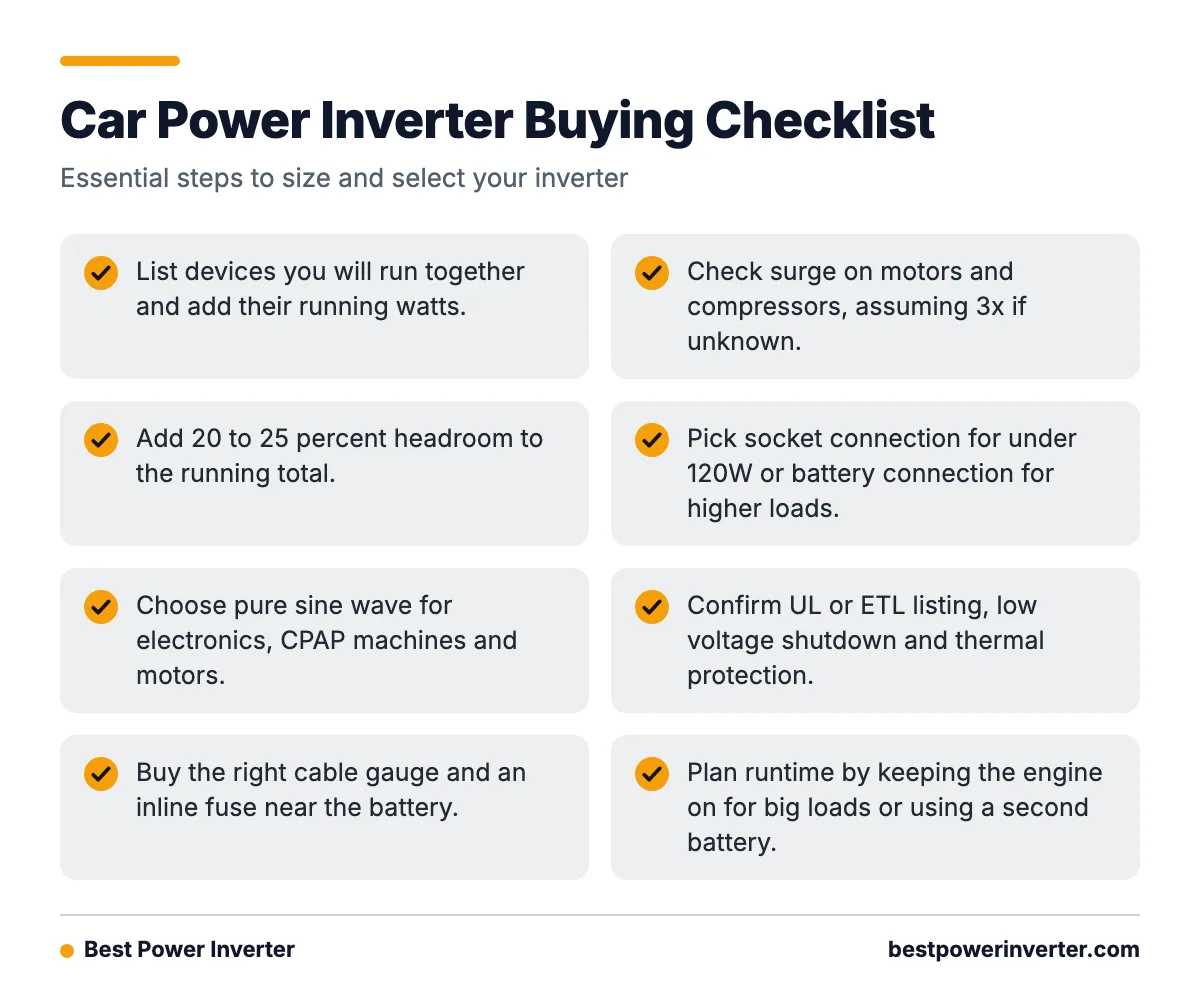
Buying checklist
- List devices you will run together and add their running watts.
- Check surge on motors and compressors (assume 3x if unknown).
- Add 20-25% headroom to the running total.
- Pick socket (under about 120W) or battery connection (above that).
- Choose pure sine wave for electronics, CPAP and motors.
- Confirm UL/ETL listing, low-voltage shutdown and thermal protection.
- Buy the right cable gauge and an inline fuse near the battery.
- Plan runtime: engine on for big loads, or a second battery.
Final recommendation: for laptops and chargers, a 150-300W pure sine wave unit is plenty. For tools and small appliances, choose 1000-2000W, wire it to the battery, and pay for good cable. Leave kettles and hair dryers at home.
What do owners say?
Owners like
- Pure sine wave models run laptops, CPAP machines and sensitive electronics quietly with no buzzing.
- Compact 150-300W plug-in units are convenient for charging laptops and cameras on trips.
- Units with built-in USB ports and low-voltage shutdown protect the car battery.
- Direct-to-battery 1000-2000W inverters run power tools and small appliances on job sites reliably.
Common complaints
- Plug-in units trip the socket fuse when users run more than they should, often because the stated wattage is optimistic.
- Cooling fans are noisy on higher-wattage models.
- Included battery clamps and cables are thin or too short, so owners replace them.
- Modified sine wave units cause audio hum, buzzing or poor performance with some chargers and tools.
- Rated wattage is often not sustained, with units overheating or shutting down under heavy loads.
Summarised from owner reviews and long-term user reports; individual experiences vary.
Frequently Asked Questions
How big of power inverter for 12v car?
Add up the running watts of everything you will use at once, then add 20-25%. For laptops and chargers, 150-300W is usually enough. For tools or small appliances, 1000-2000W is common. Check the surge rating of any motor device too.
Can I run a power inverter from the cigarette lighter socket?
Yes, for small loads. Sockets are typically fused at 10-15A, which limits you to roughly 120-180W at 12V, and less after efficiency loss. Stay near 120W or below to be safe.
Will an inverter drain my car battery?
Yes. Even with no device attached, an inverter draws a small idle current, and loads draw much more. Use low-voltage shutdown, and run the engine for larger loads.
What cable size and fuse do I need for a 1000W or 2000W inverter?
Typical short-run guidance is about 4 AWG with a 125A fuse for 1000W, and about 2/0 AWG with a 250A fuse for 2000W. A 1000W unit can draw 85-95A and a 2000W unit 170-190A. Follow your manual.
Is pure sine wave worth the extra cost?
For laptops, CPAP machines, audio gear and motors, yes. It matches grid-style power and avoids the buzzing, heat and malfunctions that modified sine wave units can cause with some devices.
Sources