
Choose a 48V to 240V inverter whose continuous rating exceeds the load you run at the same time, whose surge rating covers your hardest motor start, and whose output format (240V only or 120/240V split-phase) matches your panel. It converts 48V DC from your batteries into 240V AC for tools, pumps, or a fridge, and most good models use pure sine wave output. This guide focuses on what is specific to 48V: DC current, battery range, runtime and heat.
Quick answer
Pick pure sine wave, with continuous watts above your simultaneous load plus a reserve, and surge that covers your largest motor. Match the output to your panel: 240V-only cannot run 120V loads. Check that the DC input range suits your battery bank.
- Best for 240V pumps and tools: 240V-only pure sine wave
- Best for a mixed house panel: split-phase 120/240V
- Best for backup with a grid feed: inverter-charger with transfer switch
- A 240V-only inverter and a split-phase 120/240V inverter are not the same thing. Only split-phase runs both 120V and 240V loads.
- Choose pure sine wave for motors, pumps, and sensitive electronics.
- Size by continuous watts first, then check that surge power covers motor startup.
- Check the DC input range. Many cited models accept about 40-66VDC or 40-60VDC.
- Fuse the DC side, keep cables short and thick, and have a qualified electrician check the AC side.
- What a 48V to 240V Inverter Does
- Single-Phase or Split-Phase Output
- Pure Sine Wave vs Modified Sine Wave
- How Many Watts You Need
- Calculating Startup Surge
- Worked Sizing Example
- Battery Current from a 48V Bank
- Battery Capacity, Runtime and Input Voltage
- Efficiency, Idle Draw, Cooling and Noise
- Inverter, Inverter-Charger or Hybrid
- Spec Comparison Table
- Installation and Wiring
- Safety and Protection Features
- Worked Comparisons by Use
- Common Buying Mistakes
- What Owners Say
- Frequently Asked Questions
What does a 48V to 240V power inverter do?
It converts 48V DC from a battery bank into 240V AC, the kind of power found in a wall socket or a hardwired circuit. The first number is the input and the second is the output.
This setup is common in off-grid homes, backup systems, workshops, and larger mobile builds. A 48V system draws roughly one-quarter of the current of a 12V system for the same power, which reduces voltage drop and conductor losses. That allows thinner cables and less heat than a 12V system at the same power. It does not make the system harmless, because high-power 48V banks still carry hazardous current and voltage. Commercial examples range from 400W units up to 7,000W and higher.
Do I need 240V single-phase or 120/240V split-phase output?
You need split-phase if any load, such as outlets or lights, runs at 120V. If every load is 240V on its own circuit, a single-phase 240V output is enough. Many buyers mix these up, and product pages often do too. There are three common formats.
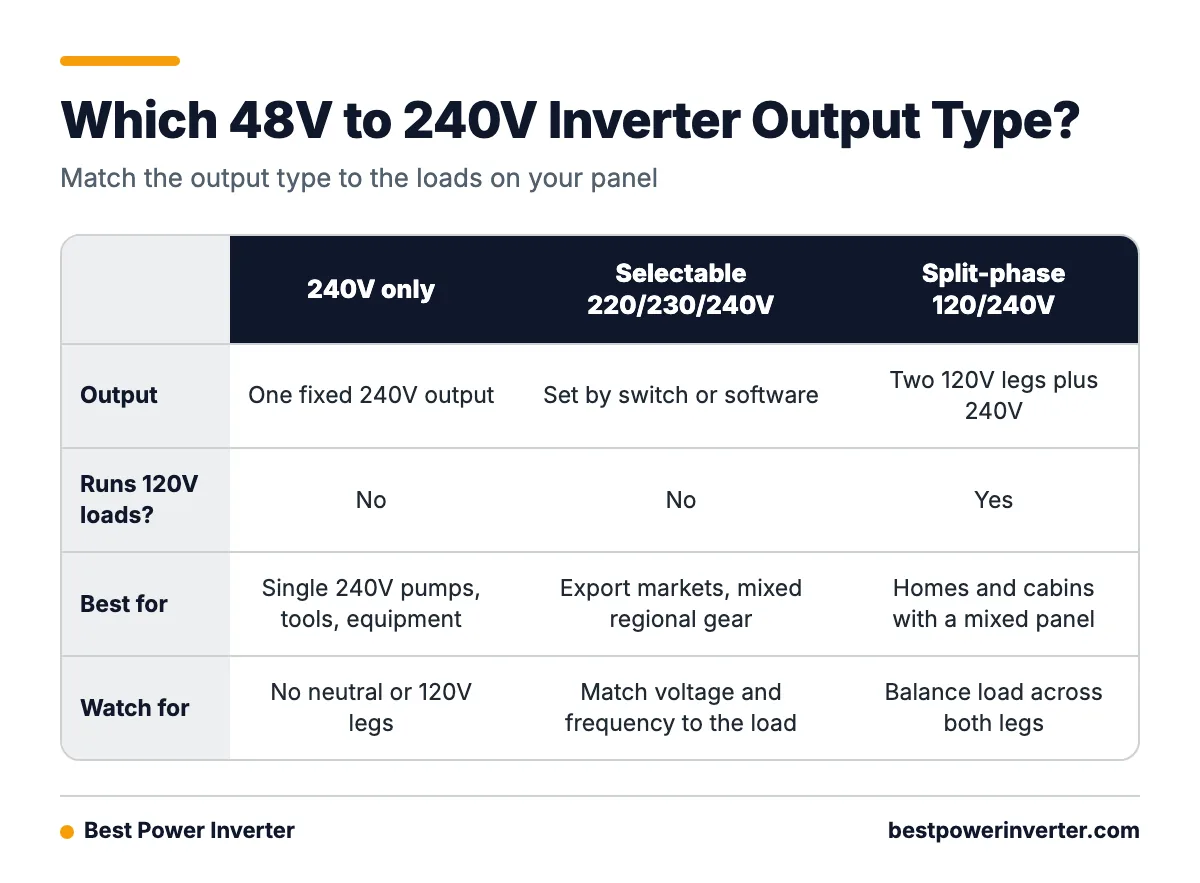
- 240V single output: One AC output at a fixed voltage. It cannot run 120V loads.
- Selectable 200/220/230/240V: You set the voltage to match your region or equipment. Some 48V models list this range, such as the Tripp Lite APS X Series 4000W datasheet for 220/230/240V output.
- Split-phase 120/240V: One unit gives two 120V legs and 240V across them. Standard in North American homes.
| Type | Output | Runs 120V loads? | Best for | Watch for |
|---|---|---|---|---|
| 48V pure sine, 240V only | One fixed 240V output | No | Single 240V pumps, tools, and equipment | No neutral or 120V legs |
| Selectable 220/230/240V | Set by switch or software | No | Export markets, mixed regional equipment | Match voltage and frequency to the load |
| Split-phase 120/240V | Two 120V legs plus 240V | Yes | Homes and cabins with a mixed panel | Balance load across both legs |

Regional voltage and frequency
220V, 230V, and 240V are nominal labels for similar mains systems. Most equipment built for one tolerates the others, but check the nameplate. Frequency matters more. Output is commonly 50Hz or 60Hz depending on configuration. Motors, timers, and clocks can misbehave on the wrong frequency, so confirm the setting before you connect anything.
- If every load is 240V and you have one circuit, pick 240V-only.
- If you travel or use gear built for different regions, pick selectable 220/230/240V.
- If you have a panel with outlets, lights, and 240V loads together, pick split-phase 120/240V.
- If you are unsure, read the nameplate on each appliance and count the 120V loads.
Is pure sine wave worth choosing over modified sine wave?
Yes, for almost any 48V system. Pure sine wave output matches the smooth waveform of utility power and is the safer general choice for motors, compressors, audio equipment, medical devices, and sensitive electronics. Modified sine wave is a stepped approximation. It can cause buzzing, extra heat, and poor motor performance, and some electronics will not run on it at all.
For a 48V system feeding pumps, refrigerators, power tools, or anything with a motor or circuit board, buy pure sine wave. The price gap is usually small compared with the cost of damaged equipment.
Output quality is also worth comparing. Victron’s published technical specifications for the Inverter Smart range list 230V AC output regulation of about plus or minus 2% and frequency regulation of about plus or minus 0.1% for applicable models. That is the kind of data to look for on any datasheet. A listing that only says “pure sine wave” with no regulation figures tells you less.
How many watts should my 48V inverter provide?
Provide more continuous watts than everything that can run at the same moment, plus a reserve. A practical reserve is 20 to 25% above the simultaneous total, so the inverter is not sitting at its limit for hours.
Continuous power is what the inverter can deliver all day without overheating. Surge power (also called peak) is a short burst, usually for a few seconds. Some units list surge around 2x continuous power or more. A manufacturer’s surge rating is not the same as continuous output, so never size the unit on the surge number.
Check whether the continuous rating applies at your room temperature. Many inverters reduce output as they heat up, so a unit rated at 4,000W in a cool room may deliver less in a hot enclosed cabinet.
How do I calculate startup or surge power for pumps, refrigerators, compressors, and tools?
Read the motor nameplate. Running watts are roughly volts times running amps, and startup watts are roughly volts times the locked-rotor or starting amps if the plate lists them. If it does not, use a multiple of running watts.
Motors draw several times their running watts for a moment when they start. A well pump or compressor may need two to three times its rated power at startup. If surge is too low, the inverter trips or shuts down, even though running watts look fine.
- Pumps and compressors: the hardest starts, especially under load or with a pressurised line.
- Refrigerators and freezers: a compressor kick on every cycle, so allow for it even though running watts are low.
- Power tools: brief but sharp surges, such as a circular saw biting into wood.
Some low-frequency, transformer-based units are praised for handling motor starts with fewer nuisance trips. Surge ratings on lower-cost units are a frequent owner complaint, so leave margin on your hardest motor.
Worked Sizing Example
These loads are example figures. Read your own nameplates, since real numbers vary by model.
| Load | Running watts | Startup surge (approx.) |
|---|---|---|
| Fridge | 150W | 600W |
| 1 HP 240V well pump | 1,000W | 3,000W |
| Circular saw | 1,400W | 2,000W |
- Add what runs together. Fridge plus pump: 150 + 1,000 = 1,150W continuous.
- Find the worst startup. Pump starts while the fridge runs: 3,000 + 150 = 3,150W surge.
- Check the saw. Saw plus fridge: 1,400 + 150 = 1,550W continuous.
- Add a reserve. 1,550W plus about 25% is roughly 1,940W.
- Pick a unit. A 2,000W inverter with at least 4,000W surge covers all of it with some margin. A 3,000W unit gives more room for added loads.
- Estimate battery current. Divide watts by efficiency times voltage. At 2,000W and 92% efficiency: 2,000 / (0.92 x 48) is about 45A from the battery at 48V.
Efficiency on cited models is around 91.6% to 93%. The rest is lost as heat, so plan for slightly more draw than the output watts.
Sizing checklist
- Total the running watts of loads that run at the same time.
- Identify the single largest startup surge and add the running watts of everything already on.
- Add a 20 to 25% reserve to the continuous total.
- Confirm the output format (240V only or split-phase) matches every load and your panel.
- Convert to DC amps and confirm the battery, cable and fuse can carry it.
- Calculate runtime from usable battery energy.
How much battery current does a 240V inverter draw from a 48V battery bank?
Divide the AC load by inverter efficiency, then by battery voltage. A 4,000W load at 90% efficiency draws approximately 92.6A from a 48V battery: 4,000 / (0.90 x 48). Actual current varies with battery voltage and load, and it rises as the bank sags.
| AC load | Efficiency used | Battery current at 48V |
|---|---|---|
| 2,000W | 92% | about 45A |
| 4,000W | 90% | about 92.6A |
| 5,000W | 90% | about 115.7A |
These are nominal figures before battery-voltage variation. At 5,000W, the cables, terminals, fuse and disconnects must all be rated for well over 115A, and the battery must support that discharge continuously. Heat in a conductor rises with the square of current, so doubling the current gives four times the heat. This is why short, thick cable matters. Confirm your battery’s continuous and peak discharge ratings against the figure for your own load.
What battery capacity do I need to run a 240V load for a specific number of hours?
A 48V, 100Ah bank holds about 4,800Wh on paper. You cannot use all of it. Lead-acid banks should not be drained deeply, and lithium banks have a usable limit set by the battery management system (BMS).
Use this formula: runtime in hours = battery voltage x amp-hours x usable depth of discharge x inverter efficiency, divided by load watts.
| Example bank (48V, 100Ah) | Usable depth (assumed) | Efficiency | Usable AC energy | Runtime at 1,150W |
|---|---|---|---|---|
| Lithium | 80% | 90% | 3,456Wh | about 3.0 hours |
| Lead-acid | 50% | 90% | 2,160Wh | about 1.9 hours |
The depth-of-discharge values are example assumptions, so use the limits from your battery’s datasheet. For a longer runtime, scale the bank. Running the 1,150W pump-and-fridge load for 8 hours needs about 9,200Wh of AC energy, which at 90% efficiency and 80% usable depth is roughly 12,800Wh of nominal battery, or around 267Ah at 48V.
Idle draw also eats capacity. As an example only, an inverter that uses 30W when switched on with no load consumes 720Wh over 24 hours, which is about 15% of the 4,800Wh bank above.
Input voltage range
Typical ranges on cited models are about 40-66VDC or 40-60VDC. A 48V nominal system can reach roughly 58V during charging, so the inverter must accept the bank’s full operating range. A fully charged 48V lithium bank can sit near the top of that range. A loaded lead-acid bank can sag toward the bottom. Too low, and the inverter shuts down. Too high, and it can fault or be damaged.
For more on high-capacity 48V setups, see this overview of 48V inverters for off-grid and backup systems.
What efficiency, idle-consumption, cooling, and noise specifications should I compare?
Compare peak and loaded efficiency, no-load idle draw, the temperature at which output derates, and the fan behaviour. Efficiency on cited models is around 91.6% to 93%, but one peak figure hides how the unit performs at light loads, where idle draw dominates.
- Efficiency: a 90% unit at 4,000W wastes about 444W as heat, which must go somewhere.
- Idle draw: matters for always-on systems. Look for a figure in watts, and check for a low-power or search mode.
- Thermal derating: check the output at higher temperatures, not only at 25C.
- Fans: owners commonly report fans that become loud or cycle often under sustained load. Consider where the unit will sit relative to living space.
- Ventilation: leave clearance around vents and keep the unit out of sealed cabinets.
What is the difference between an inverter, inverter-charger, and hybrid solar inverter?
A plain inverter only converts DC to AC. An inverter-charger also charges the battery from grid or generator and usually includes a transfer switch. A hybrid solar inverter adds solar charge control and can manage solar, battery and grid together.
- Inverter: simplest, suited to a fixed battery bank charged elsewhere.
- Inverter-charger: suits backup, because it switches automatically when mains power fails.
- Hybrid: suits solar homes. For an overview of the category, see this list of hybrid inverters for solar systems.
Spec comparison table
Use this as a template when comparing datasheets. Fill in the values from each listing and compare like with like.
| Spec | What to look for | Why it matters |
|---|---|---|
| Output type | 240V only, selectable, or split-phase 120/240V | Must match loads and panel |
| Continuous watts | Above simultaneous load plus reserve | Sustained capability |
| Surge watts | Value and duration in seconds | Motor starting without tripping |
| Waveform | Pure sine wave | Motors and electronics |
| Efficiency | Peak and loaded figures (cited models about 91.6% to 93%) | Runtime and heat |
| Idle draw | Watts with no load | Daily battery drain |
| Battery voltage range | Covers low shutdown through about 58V charging (cited models about 40-66VDC or 40-60VDC) | Avoids shutdown or faults |
| Charger | Charge current and battery type settings | Backup and generator use |
| Transfer switch | Built-in, with switchover behaviour described | Safe, automatic backup |
| Certifications | Marks that apply where you live | Safety and insurance |
| Warranty | Term and who handles claims | Support risk |
| Cooling | Fan or passive, derating curve, noise | Heat and noise under load |
Which safety features and installation protections are essential?
The essentials are a DC-rated fuse or breaker at the battery, correctly sized cable, a DC disconnect, proper grounding and a transfer switch for any house connection. Treat this as high-energy work. A 48V bank can deliver very large current in a short circuit.
- Fuse the DC side. Install a DC-rated fuse or breaker close to the battery, sized to the inverter manual.
- Use the cable size the manual lists. Keep runs short. Long or thin cable causes voltage drop and heat.
- Tighten lugs properly. Loose DC connections are a common cause of heat damage.
- Observe polarity. Reversing positive and negative can destroy the unit, even if it has some protection.
- Ground and bond as your local code requires. This is especially true for split-phase systems with a neutral.
- Use a transfer switch if the inverter will connect to a house panel, so it can never back-feed the grid.

First-time installers should not rely on the manual alone. Documentation and wiring instructions are often described as thin, so have a qualified electrician check the AC side.
Safety and protection features
Look for these on the datasheet:
- Low-voltage and high-voltage input shutdown
- Overload and short-circuit protection
- Over-temperature protection
- Reverse polarity protection (or a clear warning to fit your own fuse)
- Safety certifications that apply where you live
Smaller units such as the MEAN WELL 400W 48V inverter list output choices like 200V and 220V, which shows how much the output setting can vary even on one product line. Always read the listing for the exact voltage you will get.
Before buying, also check the warranty term, whether monitoring or an app is included, and how easy it is to reach support. Slow support and unclear Wi-Fi setup are recurring complaints on lower-cost models.
Worked comparisons by use
| Use | Output | Key priority | Watch for |
|---|---|---|---|
| Home backup | Split-phase 120/240V inverter-charger | Automatic transfer switching | Balance across both legs |
| Off-grid cabin | Split-phase or 240V hybrid | Low idle draw, solar input | Battery range and runtime |
| Well pump | 240V pure sine wave | Surge for motor start | Surge duration, soft starter |
| Workshop | 240V pure sine wave | Continuous watts, cooling | Heat and fan noise under load |
Common Buying Mistakes
- Buying 240V-only and expecting 120V outlets to work.
- Sizing by running watts and ignoring motor surge.
- Ignoring the input voltage range of the inverter.
- Choosing modified sine wave for motors or electronics.
- Skipping the DC fuse or using undersized cable.
- Forgetting frequency: 50Hz versus 60Hz.
- Trusting a surge number with no stated duration.
Quick matching checklist
- List every load with running and startup watts.
- Decide which loads run at the same time.
- Pick continuous watts above that total, with margin.
- Confirm surge covers your largest motor.
- Confirm battery discharge rating covers the DC current.
- Confirm voltage, frequency, and output type match your equipment.
What do owners say?
Owners like
- Reliable power during extended off-grid or backup use when the system is correctly sized and installed.
- Pure sine wave output running electronics and motors more smoothly and quietly than modified sine wave.
- Split-phase capability powering both 120V and 240V loads from one system.
- Automatic transfer switching and multiple operating modes on inverter-charger models.
- Solid construction and fewer nuisance trips on some low-frequency units serving motor-starting loads.
Common complaints
- Fans that become noticeably loud or cycle frequently during sustained or high loads.
- Units and cases that get hot during extended heavy operation, requiring careful ventilation.
- Documentation and wiring instructions that are too thin for first-time installers.
- Advertised surge ratings that do not reliably handle expected motor-starting loads.
- Support delays, unclear Wi-Fi setup, and occasional early failures among lower-cost models.
Summarised from owner reviews and long-term user reports; individual experiences vary.
Frequently Asked Questions
Is a 48V to 240V inverter the same as a 48V to 120V inverter?
No. They produce different output voltages, and loads built for one should not be plugged into the other. A split-phase unit is the exception, since it provides both 120V and 240V.
Do I need pure sine wave for a 48V to 240V inverter?
For motors, pumps, fridges, and electronics, yes. Pure sine wave is commonly specified for these loads. Modified sine wave can cause heat, noise, and failures.
Can a 48V inverter run both 120V and 240V loads?
Only a split-phase 120/240V model can do both from one unit. A 240V-only or selectable 220/230/240V inverter gives a single output voltage.
What is surge power and why does it matter?
Surge power is the short burst an inverter can supply above its continuous rating. Motors need that burst to start. If surge is too low, the inverter shuts down at startup.
How much current will a 5,000W inverter pull from a 48V bank?
At 90% efficiency, approximately 115.7A. That requires appropriately rated cables, overcurrent protection, terminals, and disconnects.
What appliances are commonly powered by 240V inverters?
Well pumps, air compressors, workshop tools, some water heaters, and heavy-duty fridges or freezers. Always check the nameplate for voltage, watts, and startup needs before connecting.
Where can I read an owner-written review of a 48V hybrid inverter?
One example is a forum thread on a PowMr 48V 3,500W hybrid inverter review. Individual reports vary, so compare several sources.
Sources