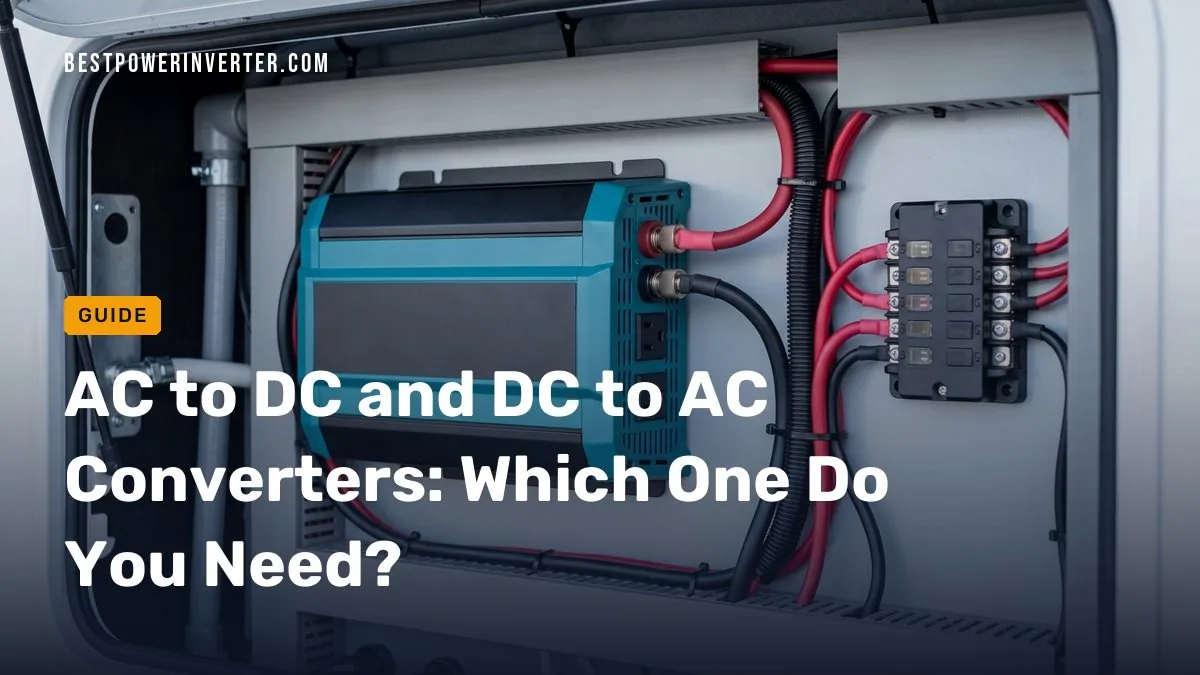
Anyone who wants to charge a battery from a wall outlet, or run a blender from a battery, needs two different devices. A rectifier turns AC into DC, and an inverter turns DC into AC. This guide explains how each one works, where you will find them, and how to size an inverter so it does not trip or overheat.
Quick answer
Use a rectifier (a charger, adapter or power supply) when the wall is the source and a battery or gadget is the load. Use an inverter when a battery or solar is the source and a household appliance is the load.
- Best for charging batteries or electronics: AC-to-DC charger or adapter
- Best for running appliances from a battery: pure sine wave inverter
- Best for RV or off-grid: inverter charger
- AC to DC uses a rectifier. DC to AC uses an inverter. They are not the same device.
- An RV ‘converter’ usually changes AC to DC. It does not run AC appliances.
- Size an inverter by continuous watts and surge watts, then add 20-25% headroom.
- A 1000W load on 12V pulls about 100A or more, so cable and fuse size matter.
- Above about 1500-2000W, 24V or 48V systems cut current and cable cost.
- Choose pure sine wave for motors, compressors and sensitive electronics.
- Can You Convert AC to DC, and How Does It Work?
- Why Do We Convert AC to DC?
- What Is a DC to AC Inverter and How Does It Work?
- Is an Inverter the Same as an AC to DC Converter?
- What Is an AC-DC-DC-AC System?
- Modified vs Pure Sine Wave
- How Do I Size a DC to AC Power Inverter?
- Which Battery Voltage, Fuse and Cable Should I Use?
- What Is an Inverter Charger?
- How Efficient Are the Conversions?
- Checklist: Choosing a DC to AC Inverter
- Frequently Asked Questions
Can You Convert AC to DC, and How Does It Work?
Yes. A rectifier does it, and it sits inside every phone charger, laptop brick and battery charger. Rectifiers use diodes, usually four of them in a bridge, to flip the negative half of the AC wave so current only flows one way.
That output is bumpy, so more parts clean it up. Most chargers follow these steps:
- Step down: A transformer lowers the voltage. Modern adapters skip the big transformer and use a switch-mode power supply (SMPS) instead.
- Rectify: The diode bridge turns AC into pulsing DC.
- Filter: Smoothing capacitors even out the pulses.
- Regulate: A regulator or control chip holds the voltage steady, such as 5V, 12V or 19V.
An SMPS rectifies the mains first, chops it at high frequency, then uses a tiny transformer. That is why a modern laptop charger weighs ounces, not pounds.
Why Do We Convert AC to DC?
We convert AC to DC because batteries store DC and microchips run on DC. The wall supplies AC because transformers can raise and lower its voltage easily, which makes long-distance power lines practical.
Household mains is nominally 120V at 60Hz in North America and 230V at 50Hz in much of Europe and Asia. Common AC-to-DC jobs include:
- Phone and laptop chargers
- Car, boat and RV battery chargers
- LED drivers
- TV, router and computer power supplies
What Is a DC to AC Inverter and How Does It Work?
A DC to AC inverter takes battery or solar power and makes mains-style AC from it. This is how a 12V battery can run a drill, a TV or a coffee maker.
Inside, switching transistors (MOSFETs or IGBTs) are arranged in an H-bridge. They flip the DC direction back and forth, 60 or 50 times a second. Pulse-width modulation (PWM) shapes those pulses, and a filter smooths them. Most units also have a DC-to-DC boost stage first, which raises 12V to a higher bus voltage before the H-bridge. The result is a square, modified or pure sine waveform, depending on the design.

Is a DC to AC Inverter the Same as an AC to DC Converter?
No. They work in opposite directions. The word ‘converter’ causes most of the confusion, because RV makers call an AC-to-DC charger a converter, while solar shops use it for any power device. Always ask which way the power flows.
| Device | Direction | Typical example | Typical use |
|---|---|---|---|
| Rectifier | AC to DC | Diode bridge in a power supply | Inside chargers and adapters |
| Adapter / power supply | AC to DC | Laptop brick | Powering electronics |
| Charger | AC to DC | Battery charger | Filling a battery |
| RV ‘converter’ | AC to DC | Converter in an RV power center | Running 12V items on shore power |
| Inverter | DC to AC | Pure sine wave 1000W unit | Running appliances from a battery |
| Inverter charger | Both | Combined unit with transfer switch | RV, boat and off-grid systems |
What Is an AC-DC-DC-AC System and Where Is It Used?
An AC-DC-DC-AC system, sometimes searched as an ‘AC DC DC AC converter’ or inverter, changes AC to DC and then back to AC. The DC stage in the middle gives you a place to store energy or control the output.
Online (double-conversion) UPS:
Wall AC → rectifier → DC bus (battery attached) → inverter → clean AC to the load
The load never touches raw mains, so spikes and dips are isolated from it. If the power fails, the battery already feeds the inverter, so there is no switch-over gap.
Solar hybrid system:
Solar panels (DC) → charge controller → battery (DC) → inverter → AC loads
Grid AC → rectifier/charger → battery (when the sun is low)
Variable frequency drive (VFD):
Mains AC → rectifier → DC bus → inverter → AC at a chosen frequency → motor speed control
Electric vehicle: A charger changes AC to DC for the battery, and a traction inverter changes DC back to AC to turn the motor. For deeper technical reading, Sandia National Laboratories covers power conversion in its Energy Storage Handbook chapter on power conversion systems.
What Is the Difference Between Modified Sine Wave and Pure Sine Wave Inverters?
A pure sine wave inverter makes a smooth wave like the grid. A modified sine wave inverter makes a stepped, blocky approximation. Pure sine costs more but runs more things well.
| Load | Modified sine | Pure sine |
|---|---|---|
| Incandescent bulbs, resistive heaters | Usually fine | Fine |
| Motors, fridges, compressors | Run hotter, noisier, less efficient | Best choice |
| CPAP, medical gear | Avoid (check the maker’s guidance) | Recommended |
| Laser printers, dimmers, audio | Often buzz or fail | Fine |
How Do I Size a DC to AC Power Inverter for My Appliances?
Add up the running watts of everything you will use at once. Then find the biggest surge, add 20-25% headroom, and match both to the inverter’s continuous and surge ratings. Motors and compressors can need 2-7x their running watts at startup, so surge matters.
Here is a worked example with typical, rounded numbers. Check your own labels.
| Appliance | Running watts | Surge watts |
|---|---|---|
| Small fridge | 150 | 600 |
| LED lights | 40 | 40 |
| TV | 100 | 100 |
| Laptop charger | 65 | 65 |
| Total | 355 | 805 peak (205 + 600 when the fridge starts) |
- Continuous: 355W × 1.25 ≈ 444W.
- Surge: 805W × 1.25 ≈ 1,006W.
- Pick: A 600W pure sine unit with a surge rating above 1,000W fits. A 1000W unit leaves room to add things later.
- Battery amps: Watts ÷ battery volts ÷ about 0.85 efficiency. At 444W on 12V, that is about 44A. At a full 1000W it is about 98A.
Do not forget idle draw. An inverter that idles at 25W burns 600Wh a day doing nothing (25W × 24 hours). Check the spec sheet.
What Battery Voltage Should I Choose, and What Fuse and Cable Do I Need?
Choose 12V for small inverters, and 24V or 48V once you pass roughly 1500-2000W. Higher voltage means lower current for the same watts, so you can use thinner, cheaper cable and lose less to heat.
| Inverter size | 12V draw | 24V draw | 48V draw |
|---|---|---|---|
| 1000W | about 98A | about 49A | about 25A |
| 2000W | about 196A | about 98A | about 49A |
These use the formula watts ÷ volts ÷ 0.85. For fuse and cable, follow your inverter’s manual first. As a rule of thumb, size the fuse at about 125% of the inverter’s maximum DC draw, so a 1000W/12V unit points to a 125A fuse. Many manufacturer cable tables call for around 2 AWG copper at 100A on short runs, and thicker for longer ones.

- Put the fuse on the positive cable, as close to the battery as you can.
- Keep cables short, and crimp lugs properly.
- Ground the inverter case as the manual says.
- Ventilate the unit. Heat shortens its life.
- Never plug an inverter’s output into a wall outlet. That can back-feed the grid and hurt line workers.
- If the load is under about 1500W, use 12V.
- If the load is 1500-3000W, use 24V.
- If the load is above 3000W or the system is whole-home, use 48V.
What Is an Inverter Charger and Does It Do Both Conversions?
Yes. An inverter charger combines a DC-to-AC inverter with an AC-to-DC battery charger in one box. It also has a transfer switch, so when shore power or a generator is on, it passes AC through and charges the battery. When that power drops, it switches to the battery and inverts.
How Efficient Are the Conversions, and What Are the Losses?
Quality pure sine wave inverters are roughly 85-95% efficient, and cheaper units are often 80-90%, based on typical manufacturer figures. The lost energy becomes heat.
Losses stack up in a double-conversion chain. If each stage is 95% efficient, the chain keeps about 90% (0.95 × 0.95). A battery runtime example: a 100Ah 12V lithium battery holds about 1,200Wh. Using 90% of it with a 90% efficient inverter at a 355W load gives roughly 2.7 hours, before idle draw. Lead-acid batteries should not be drained that deeply, so expect less.
Solar inverter makers also publish efficiency data. See this ABB article on solar inverters for more.
Checklist: Choosing a DC to AC Inverter
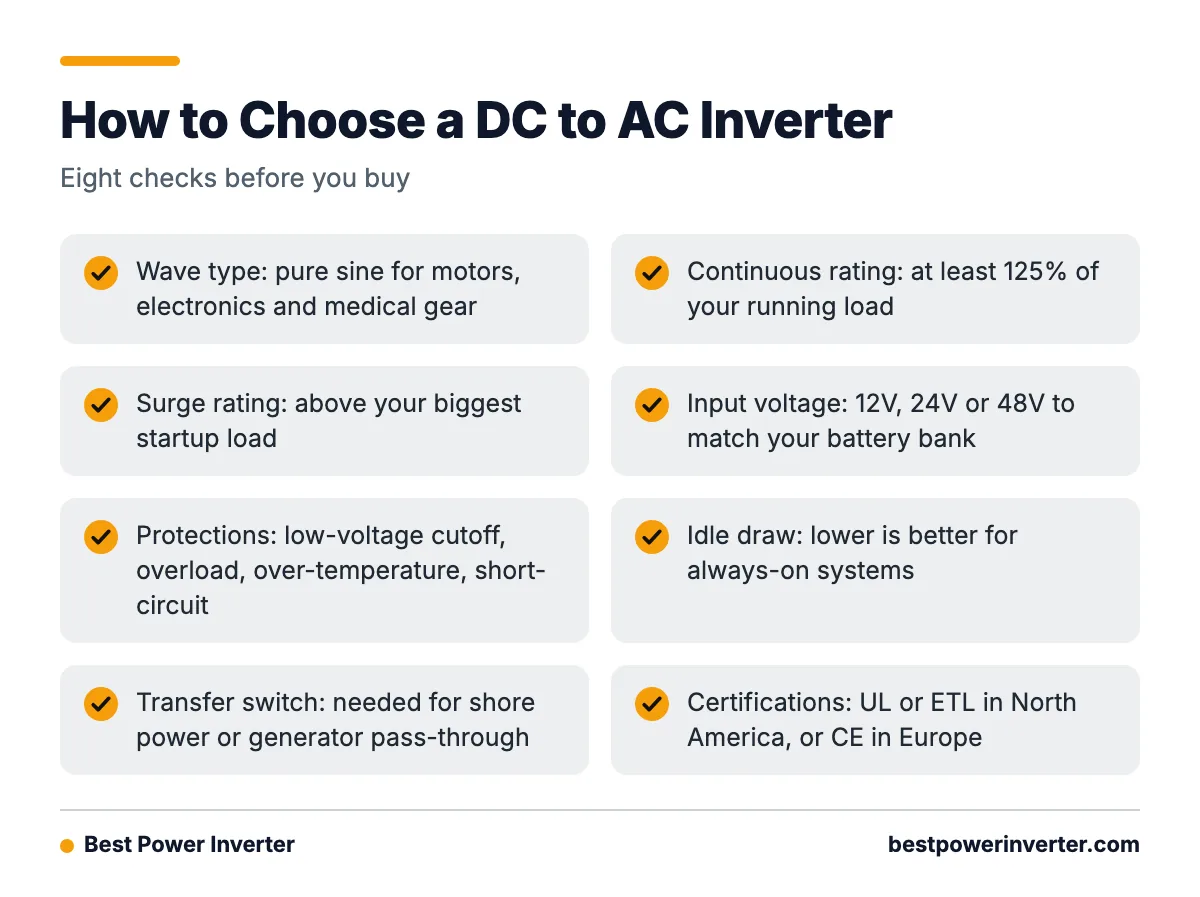
- Wave type: Pure sine for motors, electronics and medical gear.
- Continuous rating: At least 125% of your running load.
- Surge rating: Above your biggest startup load.
- Input voltage: 12V, 24V or 48V to match your battery bank.
- Protections: Low-voltage cutoff, overload, over-temperature and short-circuit protection.
- Idle draw: Lower is better for always-on systems.
- Transfer switch: Needed if you want shore power or generator pass-through.
- Certifications: Look for a recognized safety listing, such as UL or ETL in North America, or CE in Europe.
Frequently Asked Questions
What is an AC DC DC AC converter?
It is a two-stage system that changes AC to DC, then DC back to AC. Online UPS units, solar hybrid systems and VFDs all work this way. The DC middle stage lets them store energy or control the output.
Can you convert AC to DC?
Yes. A rectifier does it, usually with a diode bridge and smoothing capacitors. You already own several, in every charger and power adapter.
Why do we convert AC to DC?
Batteries and electronics need DC. The grid delivers AC because it is easy to transform for long-distance transmission. A rectifier bridges the two.
What is a DC to AC power inverter?
It is a device that turns battery or solar DC into household-style AC. It lets you run tools, TVs and appliances away from the grid. Pick the size by watts, and the wave type by the load.
Is a DC to AC inverter the same as an AC to DC converter?
No. DC-AC power inverters go from battery to AC. AC-DC converters, chargers and adapters go from AC to DC. An inverter charger does both jobs in one unit.
Can we convert AC to DC at home for a 12V device?
Yes, with a 12V power supply rated for your device’s amps. Match the voltage exactly, and choose a supply with at least 20% extra current capacity.
Sources