

Affiliate disclosure: As an Amazon Associate, we earn from qualifying purchases. This comes at no extra cost to you.
Pure sine wave inverters typically keep total harmonic distortion (THD, a measure of how far the output strays from a clean wave) below 3%. That clean output is what an inverter air conditioner, a compressor fridge or a CPAP machine needs. For most AC loads, pick a pure sine inverter with a continuous rating at least 25 to 30% above your running load and a surge rating that covers motor start-up. Then make sure your battery and cables can carry the DC current it pulls. Of the five Amazon models below, the two 2,000 W pure sine units handle real appliances. The three smaller units are for phones, laptops and other light loads.
Quick answer
Buy a pure sine inverter sized 25 to 30% above your running watts. A 12,000 BTU inverter mini-split is better served by a 24 V or 48 V system than by any 12 V unit here.
- Best overall: 2000W Pure Sine Wave Inverter with Remote, for its 4,000 W surge and over 91% efficiency.
- Best value: LCYMW 2000W, for its three AC outlets and included cables.
- Best for cars: Pro Chaser 400W.
Our Winner: 2000W Pure Sine Wave Inverter with Remote and USB-C
This 12 V to 120 V unit is rated by the manufacturer at 2,000 W continuous and 4,000 W peak surge, with conversion efficiency above 91%. It is the only model here that lists both a surge figure and an efficiency figure, and you need both to size a battery honestly. It also adds a 20 A socket, 100 W USB-C, a live input and output display and a remote, so it suits RV, truck and outage use with sensitive loads like a CPAP. The limit is the 12 V input: at full load it pulls well over 180 A from the battery, so it is not a long-runtime home backup for an air conditioner.
How We Compared These Models
We ranked these inverters on four things: waveform (pure sine or not stated), continuous and surge watts, input voltage and the DC current that results, and the protections listed by each manufacturer. The picks rely only on the Amazon listing data and published specifications. We did not test these units hands-on. None of the five listings states a UL 458 safety listing, so check the product page or the box before you buy if certification matters for your RV, boat or insurance.
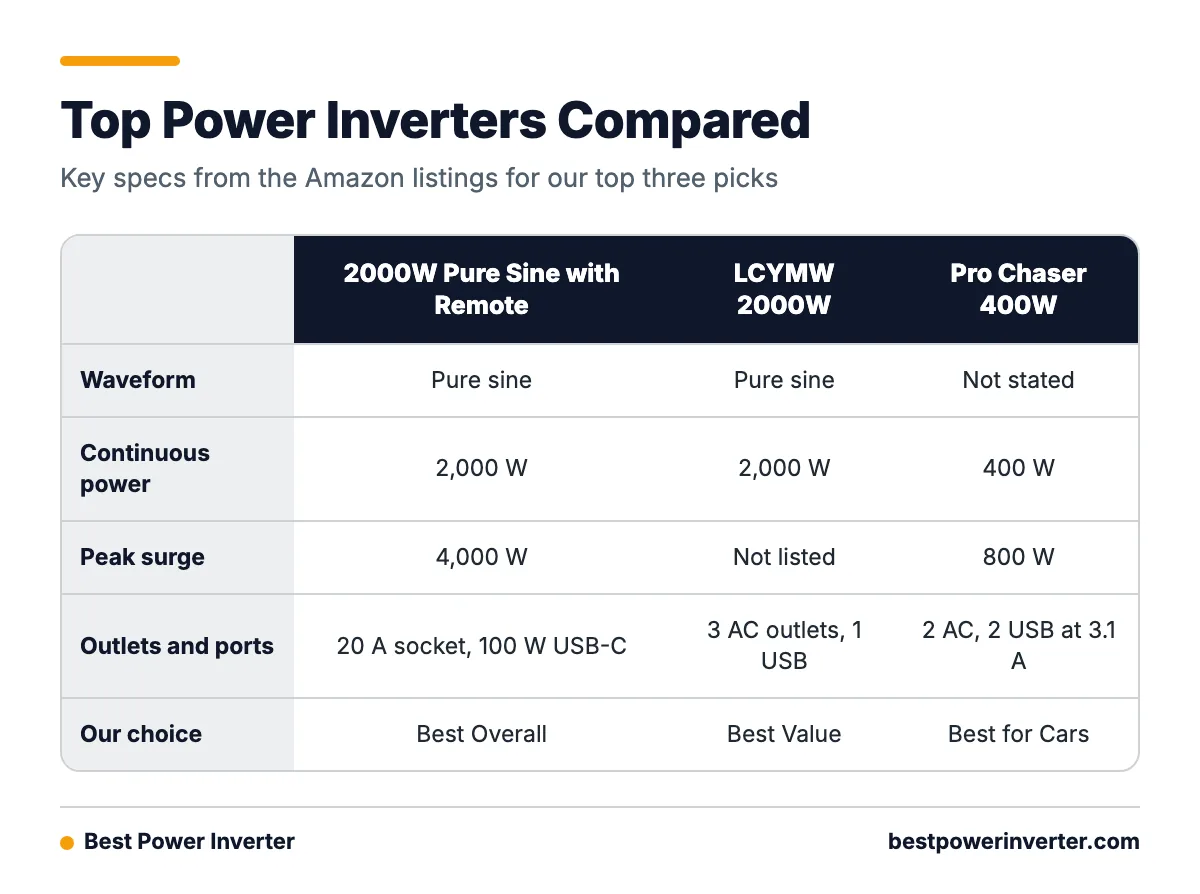
| Product | Key Specs | Our Choice | Action |
|---|---|---|---|
| 2000W Pure Sine Wave Inverter with Remote | 12 V in, 120 V out, 2,000 W continuous, 4,000 W surge, over 91% efficiency, 20 A socket, 100 W USB-C | Best Overall | |
| LCYMW 2000W Pure Sine Wave Inverter | 12 V in, 110 V out, 2,000 W, pure sine, 3 AC outlets, LCD, remote, dual fans, cables included | Best Value | |
| Pro Chaser 400W Car Inverter | 12 V in, 110 V out, 400 W continuous, 800 W peak, 2 AC, 2 USB at 3.1 A, 12-month warranty | Best for Cars | |
| PiSFAU 200W Car Plug Inverter | 12 V car plug in, 110 V AC out, 200 W | Best Budget | |
| LIVOWALNY 220W DeWALT Battery Inverter | DeWALT 20V battery in, 110 to 120 V out, 220 W continuous, 250 W peak, 2 USB, USB-C, LED light | Best for Tool Batteries |
In-Depth Reviews

1. 2000W Pure Sine Wave Inverter with Remote and USB-C – Best Overall
Our Verdict: Buy this if you have a solid 12 V battery bank in an RV, truck or small solar setup and want to run real appliances: a TV, a CPAP, power tools, or a small inverter AC for a few hours. Skip it if you want whole-night air conditioning or home backup. At that scale a 24 V or 48 V inverter/charger is the right tool. It earns Best Overall because it lists the most complete set of sizing numbers in this roundup.
The listing gives no structured specifications such as weight or dimensions, so the figures here come from the feature text. The manufacturer rates it at 2,000 W continuous and 4,000 W peak, with efficiency above 91% and low no-load losses. No-load loss is the power the inverter burns just by being switched on. The case is aluminum alloy. The display shows input voltage, output voltage, battery status and load status, and you can adjust the output voltage and the screen independently.
Here is what 2,000 W means on the battery side: 2,000 W divided by 12 V divided by 0.91 is about 183 A. Even a 1,000 W load pulls roughly 92 A. A 100 Ah lithium battery would last a little over an hour at that rate. The 4,000 W surge covers the start-up spike of a fridge or a small fixed-speed compressor, as long as the battery and cables can deliver it.
Why It Made the List
- Pure sine output, which the manufacturer says suits inductive loads (motors, compressors) and capacitive loads (power supplies).
- Published surge (4,000 W) and efficiency (over 91%) ratings, so you can size the battery and fuse properly.
- A 20 A socket plus 100 W and 30 W USB-C ports, which let you charge a laptop without using an AC outlet.
- A remote controller, which is useful when the inverter sits near the battery in a locker.
Pros & Cons
Pros
- Double-surge rating handles motor start-up
- Efficiency figure stated by the manufacturer
- Real-time display aids troubleshooting
- Adjustable output voltage
Cons
- 12 V input only, so it draws about 183 A at full load
- No UL 458 or other safety listing stated in the data
- No built-in charger or transfer switch, so it is not a UPS-style unit
- The listing does not include cable gauge or warranty length, so confirm both before you buy

2. LCYMW 2000W Pure Sine Wave Inverter – Best Value
Our Verdict: This is the pick if you want 2,000 W of pure sine power with three AC outlets and a full accessory kit, and you don’t need fast USB-C charging. Skip it if you need a published surge rating to power a fixed-speed compressor. The listing does not give one, so you cannot confirm the start-up headroom. It sits at 4.4 out of 5 stars on Amazon, the highest of the two 2,000 W units.
Per the LCYMW listing, it converts 12 V DC to 110 V AC through three AC outlets and one 2.4 A USB port. Built-in fuses protect against short circuits and reversed battery leads. Dual fans switch on automatically to cool it. The box includes a manual, a remote, three spare fuses, a wrench and two battery cables.
The included cables are convenient, but check their gauge before you trust them at full load. At 2,000 W on 12 V, roughly 185 A flows through those leads. That current needs about 2/0 AWG cable on a short run. Thinner cable runs hot and drops voltage, which can trigger the inverter’s low-voltage shutdown under heavy loads.
Why It Made the List
- Pure sine wave output for household and vehicle appliances.
- Three AC outlets, the most in this roundup.
- A complete kit with cables, spare fuses and a remote.
- Reverse-polarity and short-circuit fuse protection.
Pros & Cons
Pros
- Three AC outlets
- Remote on/off and an LCD with battery capacity readout
- Spare fuses and cables included
- Temperature-controlled dual fans
Cons
- No surge or efficiency figure in the listing
- Only one 2.4 A USB port and no USB-C
- 12 V only, with the same high DC current as any 2,000 W 12 V unit
- No safety certification stated

3. Pro Chaser 400W Power Inverter for Vehicles – Best for Cars
Our Verdict: Get this for road trips: laptops, camera chargers, a breast pump or a DVD player. Skip it for anything with a compressor or motor. The listing does not say it is pure sine, so treat it as modified sine and keep fridges, CPAPs and air conditioners off it. It has the top rating in this roundup at 4.5 out of 5 stars.
Pro Chaser rates it at 400 W continuous and 800 W peak, with two 110 V AC sockets and two 3.1 A USB ports. It is about the size of a phone, with a 30-inch (75 cm) cord. A smart fan starts at 113°F (45°C), and the inverter has overload, voltage and overheat protection. It comes with a 12-month warranty, the only warranty stated in this roundup.
Check one limit first. Many car accessory sockets are fused at around 15 A, which is roughly 180 W at 12 V. Running near 400 W usually means connecting directly to the battery, so confirm the connection type on the product page. A 60 W laptop is no problem: 60 ÷ 12 ÷ 0.9 is about 5.6 A.
Why It Made the List
- Compact, with two AC outlets and two fast USB ports.
- 800 W peak for brief start-up spikes from small electronics.
- Fan, overload and overheat protection listed.
- 12-month warranty.
Pros & Cons
Pros
- Highest-rated model here
- Pocketable size
- Stated warranty
Cons
- Waveform not stated, so it is not safe to assume pure sine
- Full 400 W likely exceeds a typical car socket fuse
- Cannot run an air conditioner, fridge or microwave

4. PiSFAU 200W Car Power Inverter – Best Budget
Our Verdict: This is the cheapest way to add one household-style outlet to a car’s 12 V plug, for a phone charger or a modest laptop. Skip it if you need details. The listing provides only its title, with no feature list or waveform, so you cannot confirm protections, surge or USB ports. It has a 4.4 out of 5 star rating on Amazon.
The 200 W rating works with a car accessory socket. 200 W ÷ 12 V ÷ 0.9 is about 18.5 A at full load, so in practice keep loads near 150 W or below to stay under a typical 15 A socket fuse. Run it only with the engine on if you use it for more than short sessions. A starter battery is not designed for deep discharge.
Why It Made the List
- A plug-in 12 V to 110 V AC adapter at the lowest price in this group.
- Its 200 W size matches what most car sockets can actually supply.
Pros & Cons
Pros
- Lowest price
- Plug-and-play car socket use
- Solid star rating
Cons
- No features, waveform or protections listed
- Too small for any appliance with a motor or heater
- Check the product page for USB ports and fuse details before you buy

5. LIVOWALNY 220W Power Inverter for DeWALT 20V Batteries – Best for Tool Batteries
Our Verdict: If you already own DeWALT 20V batteries, this turns them into a small AC outlet for camping, job sites or a short outage. Skip it if you don’t own those batteries. It is sold as tool only, so the battery and charger are extra. It is also too small for anything beyond small electronics.
LIVOWALNY rates it at 220 W real power and 250 W peak, with one AC outlet, two 5 V/2.1 A USB ports and a USB-C port. The listing lists compatible packs including DCB206, DCB205, DCB204, DCB181, DCB182, DCB200 and DCB203. It includes a fan, an adjustable LED work light and eight protections: short-circuit, over-current, under-voltage, low-load, over-heat, over-voltage, overload and over-discharge.
Here is a runtime estimate. DeWALT 20V MAX packs are about 18 V nominal, so a 5 Ah pack holds roughly 90 Wh. At 85% efficiency (the low end of the typical 85 to 95% range), a 60 W laptop runs about 90 × 0.85 ÷ 60, or roughly 1.3 hours. Swap packs to extend it.
Why It Made the List
- Reuses batteries many readers already own.
- Over-discharge protection guards the tool pack.
- A built-in work light is handy during outages.
Pros & Cons
Pros
- No car or 12 V battery needed
- Eight listed protections
- USB-C plus two USB-A ports
Cons
- Battery not included
- Only one AC outlet
- Waveform not stated, so avoid sensitive medical or motor loads
- Short runtime on a single pack
What Is the Difference Between an Inverter AC and an AC Power Inverter?
They are different machines that share a word. An inverter AC is an air conditioner with a variable-speed compressor that ramps up and down instead of switching fully on and off. An AC power inverter, also called a DC-to-AC power inverter, turns battery power (12, 24 or 48 V DC) into household-style AC power.
Two more terms add to the confusion:
- AC-to-DC converter or charger: does the reverse, turning wall power into DC to charge a battery or run DC gear.
- Inverter/charger: one box that inverts battery power to AC, charges the battery from shore or grid power, and switches between the two automatically, like a large UPS.
All five products in this guide are plain DC-to-AC inverters. None of them charges a battery.
Can an Inverter Air Conditioner Run on a DC Power Supply or Battery?
Not directly. A standard inverter air conditioner needs AC mains input. It rectifies that power internally to a high-voltage DC bus, so you cannot wire it straight to a 12, 24 or 48 V battery. You need a pure sine inverter between the battery and the AC unit.
The exception is a purpose-built DC or solar-hybrid air conditioner, often designed for 48 V DC, which runs from the battery with no inverter at all. If your main goal is off-grid cooling, that type saves the inverter losses.
Before you buy any inverter for an AC unit, read its rated and maximum input power and its supply voltage in the manufacturer’s spec sheet. Many 12,000 BTU mini-splits need 208/230 V, which none of the 110/120 V inverters here can supply. The Gree U-Match technical sales guide shows the kind of input power and voltage table you should look for.
What Size Power Inverter Do I Need to Run an Inverter Air Conditioner or Other Appliances?
Add up the running watts of everything that will run at the same time, then multiply by 1.25 to 1.3. That result is your minimum continuous rating. Then confirm that the surge rating covers the largest start-up spike.
Worked sizing example
- A typical 12,000 BTU inverter mini-split draws roughly 500 to 1,200 W while running, depending on outdoor temperature and compressor speed. Size for the top figure: 1,200 W.
- 1,200 W × 1.25 to 1.3 = 1,500 to 1,560 W continuous minimum.
- A 2,000 W unit clears that on paper, and 2,000 to 3,000 W pure sine is the usual recommendation for this load.
Continuous vs peak output, and why inverter ACs are easier
Continuous output is what the inverter can hold for hours. Peak, or surge, output is a short burst of a few seconds for start-up. Induction motors and fixed-speed compressors can draw roughly 3 to 7 times their running current when they start. A fixed-speed window unit that runs at 500 W might therefore spike to around 1,500 to 3,500 W. Inverter air conditioners soft-start and have much lower inrush current, which makes them easier to run on a power inverter.
Power factor
Power factor is the ratio of real watts to the apparent power (VA, volt-amps) a load draws. Motor loads often sit below 1.0. A 1,000 W load at 0.8 power factor asks the inverter for 1,250 VA. If an inverter is rated in VA, divide by your load’s power factor before you compare.
For more on sizing method, the Solar Asia Power inverter sizing guide walks through the same continuous-plus-margin approach.
Do I Need a Pure Sine Wave Inverter, or Is Modified Sine Wave Okay?
Choose pure sine for anything with a motor, compressor or sensitive electronics. Modified sine output is much more distorted than the under-3% THD of pure sine. That distortion can make motors and compressors run hotter, buzz or fail to start.
These loads need pure sine:
- Inverter air conditioners and refrigerators
- CPAPs and other medical devices
- Variable-speed tools and some battery chargers
- Audio gear, which may hum on modified sine
Modified sine is usually fine for basic phone chargers, incandescent lights and simple heaters. In this guide, only the two 2,000 W models state pure sine output.
Should I Choose a 12 V, 24 V or 48 V Inverter System?
Use 12 V up to about 1,000 to 2,000 W in vehicles, and choose 24 V or 48 V above that. The reason is DC current. Current equals watts ÷ volts ÷ efficiency, and high current needs thick, expensive cable and large fuses.
The table below uses 0.9 efficiency (the middle of the typical 85 to 95% range). Fuses are sized at about 125% of continuous current, rounded up to a common size. Cable gauges are typical starting points for short runs under about 5 feet with copper cable. Always follow your inverter’s manual and an ampacity chart for your actual length.
| Inverter load | 12 V: amps / fuse / cable | 24 V: amps / fuse / cable | 48 V: amps / fuse / cable |
|---|---|---|---|
| 500 W | 46 A / 60 A / 6 AWG | 23 A / 30 A / 10 AWG | 12 A / 15 A / 12 AWG |
| 1,000 W | 93 A / 125 A / 2 AWG | 46 A / 60 A / 6 AWG | 23 A / 30 A / 10 AWG |
| 2,000 W | 185 A / 250 A / 2/0 AWG | 93 A / 125 A / 2 AWG | 46 A / 60 A / 6 AWG |
| 3,000 W | 278 A / 350 A / 4/0 AWG | 139 A / 175 A / 1/0 AWG | 69 A / 90 A / 4 AWG |
The 3,000 W row on 12 V is why higher voltage matters. Nearly 280 A needs 4/0 cable, which is about as thick as a thumb. At 48 V the same power runs on 4 AWG.
How Long Will My Battery Run an Inverter AC or Other Loads?
Runtime equals usable battery watt-hours × inverter efficiency ÷ average load in watts. Use the average load, not the peak. An inverter AC cycles at variable power rather than running at full rated draw all the time.
Worked example: one night of cooling
- A 12,000 BTU inverter mini-split averages 800 W for 8 hours: 800 × 8 = 6.4 kWh at the load.
- At 90% inverter efficiency, the battery must supply 6.4 ÷ 0.9 = about 7.1 kWh.
- Add a margin for hot nights and wiring losses: about 7.5 to 8 kWh of usable capacity.
- LiFePO4 at 48 V: 7,500 to 8,000 Wh ÷ 48 V = roughly 150 to 170 Ah. LiFePO4 (lithium iron phosphate) typically allows 80 to 100% depth of discharge and is commonly rated for about 2,000 to 6,000 cycles.
- Lead-acid at 48 V: limited to about 50% depth of discharge for reasonable life, so you need about twice the nameplate capacity, roughly 310 to 340 Ah.
- Same job at 12 V: 7,500 Wh ÷ 12 V = about 625 Ah of usable lithium, with average current near 74 A and peaks around 111 A at 1,200 W.
That last line is the honest answer for the two 2,000 W models in this guide. They can power a 120 V inverter AC in principle. A full night, however, needs a very large 12 V bank and heavy cabling. For short runs, such as an hour or two of evening cooling in an RV, they can work. For outage backup or nightly cooling, choose a 48 V inverter/charger or hybrid system instead.
What Are the Main Types of Inverter Power Supply?
This table compares categories, not tested products, so you can see which type fits your job.
| Category | Typical output | Waveform | Input | Charging | Transfer | Certifications to look for | Best use |
|---|---|---|---|---|---|---|---|
| Portable 12 V inverter | 200 to 2,000 W | Pure or modified | 12 V or tool battery | None | None, manual | UL 458 | Cars, trucks, light RV loads |
| Inverter/charger | 2,000 to 3,000 W | Pure sine | 12, 24 or 48 V | Shore or grid, generator | Automatic, check spec | UL 458 | RVs, vans, boats |
| 48 V hybrid inverter | 3,000 to 5,000 W and up | Pure sine | 48 V | Grid, solar MPPT, generator | Automatic, check spec | UL 1741 | Home backup, running an inverter AC |
| Portable power station | Varies by model | Usually pure sine | Built-in battery | Wall, solar, car | Some offer UPS mode | Check listing | Plug-and-play outage kit |
How Do I Charge the Battery for an Inverter Power Supply?
A plain inverter like the five here cannot charge anything, so you add a separate charging source. Pick the one that matches where you use it:
- Grid or shore power: a battery charger, or an inverter/charger that combines both jobs.
- Solar: panels through an MPPT charge controller. MPPT (maximum power point tracking) adjusts to the panel’s best operating point and harvests more energy than basic PWM controllers.
- Alternator: a DC-DC charger between the starter battery and the house battery. It limits current to protect the alternator and gives lithium batteries the correct charge profile.
- Generator: feeds a charger or the AC input of an inverter/charger.
For LiFePO4, confirm that the charger has a lithium profile. Also set the inverter’s low-voltage cutoff to match the battery, if the inverter allows it.
What Safety Certifications and Features Should a Good Inverter Have?
Look for a recognized safety listing that matches your use:
- UL 458: the US safety standard for power converters and inverters used in land vehicles and marine craft.
- UL 1741: covers inverters and converters for distributed energy and grid-interactive systems, such as home solar and backup.
- CSA: the Canadian equivalent listing.
- CE: a European conformity mark.
- RoHS: an environmental mark, not a safety mark. See the FAQ below.
None of the five listings here states UL 458 or UL 1741. That doesn’t prove the units are unsafe. It means you should confirm certification on the label if you need it.
Installation and safety basics
- Mount the inverter in a ventilated, dry spot, as close to the battery as practical, to keep cables short.
- Put a fuse or breaker on the positive lead within a short distance of the battery.
- Ground the chassis terminal to the vehicle frame or the system ground.
- Never back-feed a home panel by plugging an inverter into an outlet. Use a proper transfer switch or interlock, installed by an electrician. Back-feeding can energize utility lines and endanger line workers.
- In RVs and homes, the neutral-ground bond (the single point where neutral and ground connect) must exist in only one place. Inverter/chargers handle this automatically. Portable inverters do not.
The DC/AC Power FAQ covers more of these wiring and grounding questions.
Pre-Purchase Checklist
- Pure sine output, with THD under 3% if stated
- Continuous rating 25 to 30% above your running load
- Surge rating that covers your largest motor start-up
- Low idle (no-load) draw
- UL 458 for vehicles and boats, or UL 1741 for grid-tied home systems
- Low-voltage cutoff adjustable for LiFePO4
- Remote on/off if the inverter sits in a locker
- Compatibility with a transfer switch for home use
- Warranty length stated in writing
Common mistakes
- Buying a 3,000 W, 12 V inverter and running it on thin cable
- Using a starter battery for deep-cycle loads
- Assuming a 120 V inverter can run a 230 V mini-split
- Treating RoHS as a safety rating
Frequently Asked Questions
How do I charge an inverter AC power supply?
Charge the battery behind it, not the inverter. Use a grid or shore charger, solar panels through an MPPT controller, a DC-DC charger from your vehicle alternator, or a generator. An inverter/charger combines a grid charger and an inverter in one unit and switches over automatically during an outage.
Can an inverter AC run on a DC power supply?
A standard inverter air conditioner cannot. It needs AC mains input, so you must place a pure sine inverter between the battery and the AC unit. Purpose-built DC or solar-hybrid air conditioners, often 48 V DC, are the exception and run directly from a battery.
What does RoHS mean on an inverter AC power supply?
RoHS is EU Directive 2011/65/EU, amended by 2015/863. It restricts 10 hazardous substances, including lead, mercury, cadmium, hexavalent chromium, PBB, PBDE and four phthalates. The limit is 0.1% by weight in homogeneous materials, or 0.01% for cadmium. It is an environmental compliance mark only. It says nothing about electrical safety, output quality or durability.
Is there such a thing as an AC to DC power inverter?
Not really. Converting AC to DC is the job of a converter, charger or power supply. If you want to run 12 V gear from a wall outlet, buy a 12 V DC power supply. If you want to charge a battery, buy a battery charger. If you want both charging and backup AC, buy an inverter/charger.
What is a DC to AC power inverter?
It is a device that turns battery DC power into household-style AC so you can run standard plugs. All five products in this guide are DC-to-AC power inverters. They range from a 200 W car plug unit to 2,000 W pure sine models.
Conclusion
For most readers, the 2000W Pure Sine Wave Inverter with Remote is the one to buy. It is pure sine, rated for 4,000 W surge and over 91% efficiency, and well equipped for RV and truck loads. The LCYMW 2000W is the better value if you want three outlets and included cables, though you should check cable gauge and accept the missing surge figure. For car charging, the Pro Chaser 400W is the pick, the PiSFAU 200W is the budget plug-in, and the LIVOWALNY suits DeWALT battery owners.
If your real goal is running an inverter air conditioner through a night or an outage, none of these is the right purchase. The math above points to a 48 V pure sine inverter/charger or hybrid inverter of 3,000 to 5,000 W on roughly 150 to 170 Ah of 48 V LiFePO4. Budget for that system rather than stretching a 12 V unit past what its cables and battery can deliver.
Sources