
Buy an inverter that is too small and it shuts down the moment a motor starts. Buy one that is too large and it drains your battery while it sits idle. The fix is simple: add up the running watts of everything you will use at the same time, add the biggest startup surge, then add 20-25% headroom.
Quick answer
Add the running watts of everything you run at once. Add the largest motor startup surge, then 20-25% headroom. Choose an inverter rated above that total, then confirm your battery, cable and fuse can carry the DC current.
- Best for laptops and TVs: 150-300W small unit
- Best for fridges and drills: 500-1000W pure sine
- Best for sump pumps: 2000W pure sine
- Inverter size = total running watts of loads that run together × 1.25.
- Motors (fridges, sump pumps, compressors) often need 2-3x their running watts for a moment at startup.
- DC amps = watts ÷ battery volts ÷ 0.85. A 2000W load on 12V pulls about 196A.
- A cigarette lighter socket is fused at 10-15A, so it handles only about 120-180W.
- Inverters near 3000W and above are normally built for 24V or 48V input.
- Watts measure power. Watt-hours measure stored energy. A “5000W battery” does not set your inverter size.
- How do I calculate the inverter size I need in watts?
- How do I find a device’s wattage?
- What is the difference between continuous and surge watts?
- How big an inverter do I need for common devices?
- Worked example: fridge, TV and laptop
- How much current does an inverter draw from the battery?
- How big of a power inverter can my truck or car handle?
- When should I choose 12V, 24V or 48V?
- What size inverter suits a 5000W battery?
- How much power does an inverter waste?
- Pure sine wave vs modified sine wave
- Inverter vs inverter charger vs power station
- Sizing chart and product shortlist
- Printable sizing checklist
- What do owners say?
- Frequently Asked Questions
How do I calculate the inverter size I need in watts?
Add the running watts of every device that will be on at the same time, multiply by 1.25, and pick an inverter with a continuous rating at or above that number. Then check that the inverter’s surge rating covers your biggest startup load.
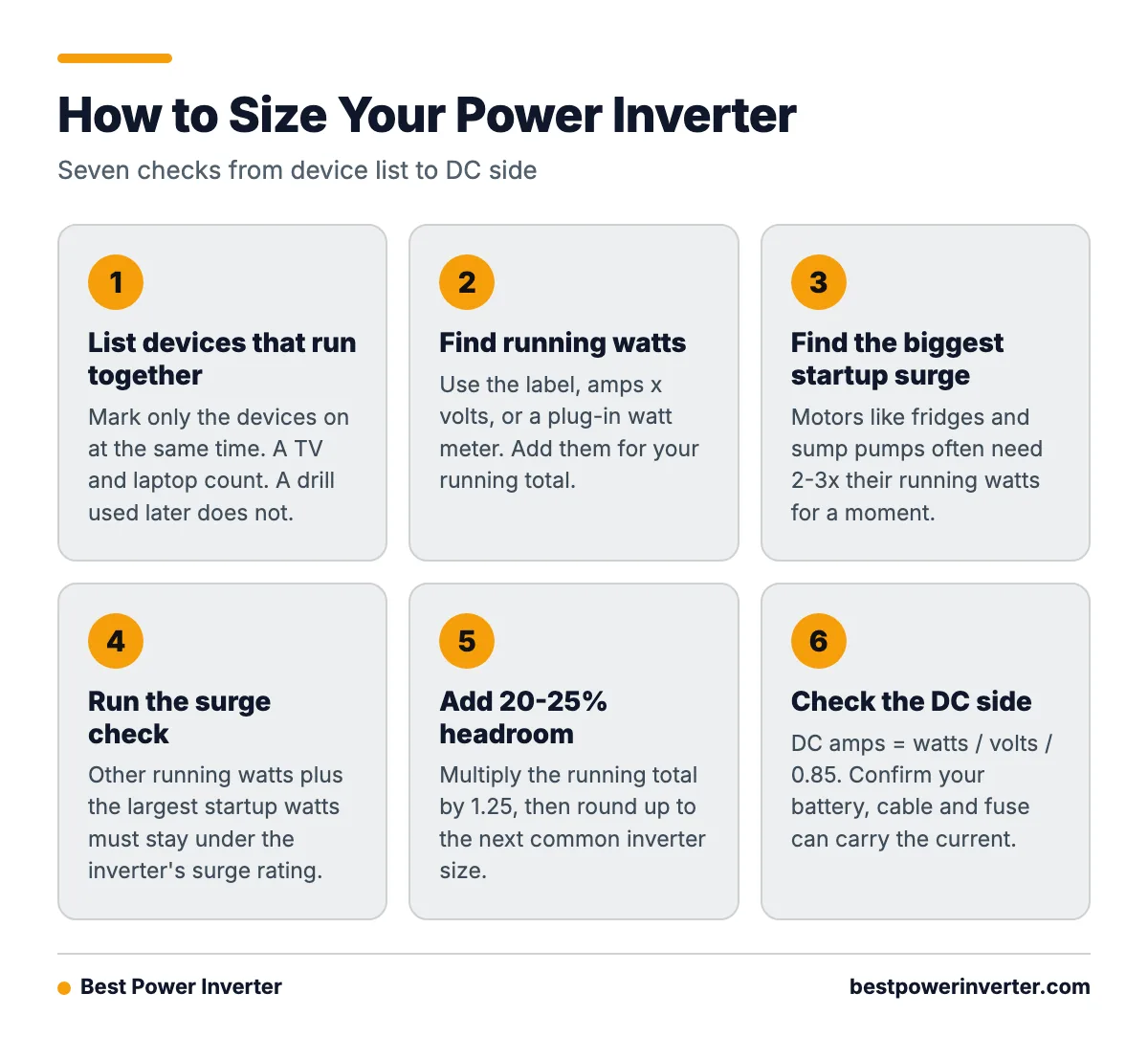
- List every device you want to power.
- Mark which ones run together. A TV and a laptop at once count. A drill you use after lunch does not.
- Write down running watts for each marked device.
- Add them up. This is your running total.
- Find the largest startup (surge) watts among your motor loads.
- Check the surge case: all other running watts + the largest startup watts. This must stay under the inverter’s surge rating.
- Add 20-25% headroom to the running total. Round up to the next common size.
- Check the DC side: battery, cable and fuse (covered below).
How do I find a device’s wattage?
Read the label, multiply amps by volts, or plug the device into a watt meter. The label is fastest. The meter is most accurate.
- Label or manual: Look for “W” on the rating plate. Labels usually show the maximum, not the everyday draw.
- Amps × volts: If the label says 1.5A at 120V, the device uses about 180W.
- Plug-in watt meter: Put it between the device and the wall outlet. Watch the reading at startup and while running. Some meters also hold the peak value.

What is the difference between continuous and surge watts, and why does it matter for motors?
Continuous watts are what the inverter can deliver all day. Surge (or peak) watts are what it can deliver for a second or two. Motors need a burst of power to start turning, so a surge rating that is too low makes the inverter trip.
An induction motor in a fridge, compressor or sump pump often needs 2-3x its running watts at startup. Hard-start loads can need 3-7x. Resistive loads like a coffee maker and electronics need almost no extra.
| Load type | Examples | Typical startup multiplier |
|---|---|---|
| Resistive | Coffee maker, heater, kettle | About 1x |
| Electronics | TV, laptop, inkjet printer | About 1x |
| Induction motor | Mini fridge, fan, sump pump | 2-3x |
| Hard-start motor | Air compressor, large pump | 3-7x |
This is where most undersizing happens. Many calculators show only one wattage number and ignore the startup spike. Always run the surge check from step 6 above.
How big an inverter do I need for a sump pump, mini fridge, drill, printer and 32-inch TV?
Use the table below. Running and startup figures are typical ranges, so confirm with your own label or meter. The last column already includes about 25% headroom.
| Device | Running watts | Startup watts | Minimum inverter |
|---|---|---|---|
| 1/3 hp sump pump | 800-1000W | 1500-2500W+ | 2000W pure sine, surge above 3000W |
| Mini fridge | 50-100W | Often 2-3x running | 500W pure sine |
| 32-inch LED TV | 30-60W | About the same | 150W |
| Inkjet printer | 20-50W | Low | 150W |
| Laser printer | Spikes of 300-1000W+ when warming | Same spike | 1500W |
| Corded drill | 300-700W | Brief spike | 1000W |
| Laptop | 45-100W (charger label) | About the same | 150W |
| Microwave | 1000-1500W input | About the same | 2000W |
| Coffee maker | 600-1200W | About the same | 1500W |
A few notes. The sump pump is the hardest load here, because 1000W running can mean 2500W at startup. Pick pure sine for it. For printers, the laser warm-up spike is the problem, not the idle draw. A microwave’s cooking power on the door is lower than the power it pulls from the outlet, so use the input rating.
If you only run electronics (TV, laptop, inkjet printer), then a 150-300W unit is enough.
If you run a fridge or a drill, then go 500-1000W pure sine.
If you run a sump pump, microwave or laser printer, then go 1500-2000W pure sine and check the surge rating.
Worked example: how do I size an inverter for a mini fridge, TV and laptop?
This setup needs about 270W continuous and about 520W of surge, so a 500W pure sine inverter is the practical choice. Here is the math, step by step, using assumed figures.
| Device | Running watts (assumed) |
|---|---|
| Mini fridge | 100W (startup about 300W) |
| 32-inch TV | 50W |
| Laptop charger | 65W |
| Running total | 215W |
- Headroom: 215W × 1.25 = about 269W. Round up to 300W continuous.
- Surge case: 300W (fridge startup) + 50W + 65W = 415W. With headroom, about 520W. A 500W unit with a higher surge rating covers this.
- DC current at 12V: 215W ÷ 12V ÷ 0.85 = about 21A running. At startup, 415W gives about 41A.
- Fuse and cable: A 500W inverter can pull about 49A at full load, so use a 60A fuse and 8 AWG cable on a short run, and follow the inverter manual.
Runtime on a 100Ah 12V battery (1200Wh nominal): The battery supplies 215W ÷ 0.85 = about 253W. A lead-acid battery used to 50% gives 600Wh, which is about 2.4 hours. A LiFePO4 battery used to 80-100% gives 960-1200Wh, which is about 3.8 to 4.7 hours. In real life the fridge cycles on and off, so actual runtime is usually better.
How much current does an inverter draw from the battery, and what cable and fuse size is needed?
Divide the watts by the battery voltage, then by about 0.85 for efficiency. A 2000W load on 12V draws roughly 175-195A, depending on whether efficiency is 85% or 90%.
| Inverter size | DC amps at 12V | Typical fuse | Typical cable (short run) |
|---|---|---|---|
| 500W | About 49A | 60A | 8 AWG |
| 1000W | About 98A | 125A | 4 AWG (2 AWG for longer runs) |
| 2000W | About 196A | 250A | 2/0 AWG |
These are common rules of thumb: fuse at about 125% of full DC current, and keep cables short and thick. Your inverter’s manual always wins. Cables that are too thin cause voltage drop, heat and low-voltage alarms.
How big of a power inverter can my truck handle on a 12V system?
It depends on how you wire it. The lighter socket handles about 150W. A direct-to-battery connection can handle 1000-2000W, if the cables, fuse and battery are up to it.
How big of power inverter for 12v car?
A cigarette lighter or 12V accessory socket is typically fused at 10-15A. At 12V that limits you to roughly 120-180W, enough for a phone, a laptop or a small TV. For anything bigger, connect the inverter straight to the battery with a fuse.
Engine running vs engine off
- Engine off: You are draining the battery. A starter battery is built for short bursts, so avoid deep discharge. A deep-cycle or LiFePO4 auxiliary battery is safer.
- Engine running: The alternator helps supply the current. Check your alternator’s rating, because 1000W at 12V is about 98A and 2000W is about 196A. That can be more than the alternator can supply, so the battery covers the gap.
If your load is under 150W, then use the lighter socket.
If your load is 150-1000W, then wire direct to the battery, with the engine running for long use.
If your load is 1500W or more, then use a dedicated battery bank, heavy cable and a proper fuse, or move to 24V.
When should I choose 12V, 24V or 48V input, and what do 4000W+ inverters require?
Choose 12V up to about 2000W, 24V for about 2000-3000W, and 48V for 3000W and up. Higher voltage means lower current, which means thinner cable and less heat. Inverters of about 3000W and above are commonly designed for 24V or 48V input for this reason.
| Load | 12V DC amps | 24V DC amps | 48V DC amps |
|---|---|---|---|
| 1000W | 98A | 49A | 25A |
| 2000W | 196A | 98A | 49A |
| 3000W | 294A | 147A | 74A |
| 4000W | 392A | 196A | 98A |
| 5000W | 490A | 245A | 123A |
These figures assume 85% efficiency. At 90%, a 5000W load on 48V is roughly 116A. A 4000 watt power inverter on 12V would need about 392A, which is not practical, so 4000W+ units are normally 24V or 48V. For a 48 volt power inverter, you also need a battery bank that can supply the current, so check the battery’s maximum discharge rating.

What size inverter suits a 5000W battery, and how long will it run?
Size the inverter by your loads, not by the battery. “5000W battery” usually means a 5 kWh (5000Wh) battery. Watts measure power right now. Watt-hours measure stored energy. The battery sets runtime, and the inverter sets how much you can run at once.
The table assumes a LiFePO4 battery used to 80% (4000Wh) and 85% inverter efficiency (3400Wh delivered).
| Load | Approximate runtime on 5 kWh |
|---|---|
| 500W | About 6.8 hours |
| 1000W | About 3.4 hours |
| 2000W | About 1.7 hours |
| 3000W | About 1.1 hours |
| 5000W | About 41 minutes |
A 5 kWh battery is about 100Ah at 48V, or about 400Ah at 12V. A 5000W load on a 100Ah 48V battery asks for around 120A, more than the battery’s 1C rate. Check the battery’s maximum continuous discharge before you pick a big inverter.
How much power does an inverter waste when idle or under load?
Expect to lose about 10-15% as heat while running, and a small constant draw while switched on with nothing plugged in. Inverters typically draw about 0.5-3% of rated power at idle, for example 10-40W on a 2000W unit.
That adds up. A 10W idle draw is 240Wh a day, or 20Ah on a 12V battery. A 40W idle draw is 960Wh a day, or 80Ah. On a 100Ah lead-acid battery with only 50Ah usable, the high figure empties it in under a day. Turn the inverter off with a remote switch when you are not using it. This is also why oversizing costs you: a bigger inverter usually idles higher.
For more on losses, see the Inverter Store FAQs.
Pure sine wave vs modified sine wave: which do I need?
Choose pure sine wave for motors, medical gear and sensitive electronics. Choose modified sine wave only for simple loads, and only to save money.
Pure sine wave inverters produce AC similar to grid power. Modified sine wave units can cause buzzing, heat and reduced efficiency in some devices. Some devices will not run at all.
| Load | Pure sine | Modified sine |
|---|---|---|
| Fridge, sump pump, compressor | Best | Not advised |
| Laptop, TV, printer | Best | May buzz or run hot |
| Medical gear (CPAP) | Required | Avoid |
| Basic lights, simple heaters | Works | Usually works |
What is the difference between a DC to AC inverter, an inverter charger and a portable power station?
A plain inverter only converts battery DC to AC. An inverter charger also charges the battery from shore or generator power. A power station puts the battery, inverter and charger in one box.
| Type | What it does | Best for |
|---|---|---|
| DC to AC inverter | Converts battery power to AC | Vehicles, custom battery banks |
| Inverter charger | Inverts and charges, often with transfer switch | RVs, vans, home backup |
| Portable power station | Battery plus inverter in one unit | Plug-and-play camping, outages |
Sizing chart and product shortlist
| Use case | Suggested size | System voltage |
|---|---|---|
| Phone, laptop, small TV | 150-300W | 12V |
| Mini fridge + TV + laptop | 500W pure sine | 12V |
| Corded drill, small tools | 1000W | 12V |
| Coffee maker, microwave | 1500-2000W | 12V or 24V |
| 1/3 hp sump pump | 2000W pure sine, surge above 3000W | 12V or 24V |
| RV or truck, mixed loads | 2000W pure sine | 12V with heavy cable |
| Cabin or home backup | 3000W-5000W | 24V or 48V |
Product types worth shortlisting: a small plug-in unit for the lighter socket, a 500-1000W pure sine unit for fridges and tools, a hardwired 2000W pure sine unit with a remote switch for RV or truck use, and a 48V inverter or inverter charger for 4000W and above. The Battery Tender inverter sizing guide offers another look at the same method.
Printable sizing checklist
- ☐ List every device you want to power
- ☐ Mark the ones that run at the same time
- ☐ Write down running watts for each (label, amps × volts, or meter)
- ☐ Add them for your running total
- ☐ Find the largest motor startup surge
- ☐ Add 20-25% headroom and round up
- ☐ Calculate DC amps: watts ÷ volts ÷ 0.85
- ☐ Choose cable gauge and fuse for that current
- ☐ Check battery capacity and discharge limit (50% lead-acid, 80-100% LiFePO4)
- ☐ Pick pure sine for motors and electronics
- ☐ Check idle draw and plan a switch
What do owners say?
Owners like
- Pure sine wave output runs sensitive electronics and motors quietly
- Handy for running tools and appliances in trucks, RVs and vans and during power outages
- A remote switch and a clear display for load and battery voltage are appreciated
- Hardwired high-power units deliver their rated power reliably when cabled correctly
Common complaints
- Rated watts are overstated, or the unit shuts down on motor startup surges
- Cooling fan noise under load
- Undersized cables or fuses supplied or recommended, causing voltage drop and low-voltage alarms
- Idle power drain empties the battery if left on
- Cheap modified sine wave units buzz, fail to run some devices, or are damaged
Summarised from owner reviews and long-term user reports; individual experiences vary.
Frequently Asked Questions
How big power inverter to run sump pump?
A 1/3 hp sump pump runs at about 800-1000W and can need 1500-2500W or more at startup. Choose a 2000W pure sine inverter with a surge rating above 3000W, and wire it to a battery bank that can supply about 196A at 12V (or half that at 24V).
48 volt power inverter
A 48V inverter suits loads of 3000W and up because the DC current stays low. A 5000W load draws roughly 110-125A at 48V, against about 490A at 12V. Match the inverter to a 48V battery bank with a high enough discharge rating.
How big of a power drain is an inverter?
Idle draw is typically about 0.5-3% of rated power, so 10-40W on a 2000W unit. That is 240-960Wh per day, or 20-80Ah on a 12V battery. Under load, expect roughly 10-15% lost as heat. Switch the inverter off when not in use.
How big power inverter for 5000w battery?
Size the inverter by your loads, not the battery. If “5000W” means 5 kWh, a 2000W inverter would run a full load for about 1.7 hours on LiFePO4. Pick the inverter for your highest simultaneous load, then check the battery’s discharge limit.
How big of a power inverter can my truck handle?
On a lighter socket, about 150W. Wired directly to the battery, 1000-2000W is common if the cable and fuse are correct. A 2000W load pulls about 196A, so use an auxiliary battery or run the engine, and check your alternator’s rating.
4000 watt power inverter
A 4000W inverter would pull about 392A on 12V, which is impractical. Most are built for 24V (about 196A) or 48V (about 98A). Use thick cable, a properly rated fuse and a battery bank that can supply that current.
How big inverter to power printer?
An inkjet printer uses about 20-50W, so a 150W inverter works. A laser printer can spike to 300-1000W or more when warming up, so choose about 1500W with a pure sine output.
Sources