
Most 12-volt power inverters sound a low-voltage alarm at about 10.5 volts and shut off somewhere between 9.5 and 10.5 volts, depending on the model. This low-voltage protection watches the battery voltage at the inverter’s DC input and cuts power before the battery is drained completely flat. Those built-in numbers stop extreme damage, but they are often too low to give a lead-acid battery a long life. This guide explains what the numbers mean, why the readings can mislead you, and how to set or fix your system.
Quick answer
Low-voltage protection alarms, then shuts the inverter off, when battery voltage falls too far. On 12V models the alarm is usually near 10.5V and the cutoff is between 9.5V and 10.5V. Treat this as last-ditch protection, not battery care.
- Best for lead-acid: an external low-voltage disconnect set near 12.35V resting.
- Best for lithium: an inverter cutoff set above the BMS limit, such as 12V.
- The alarm is a warning. The cutoff is the point where the inverter turns itself off.
- Cutoff values vary by model. Real manuals list 9.5V, 10V and 10.5V on 12V systems.
- Battery voltage drops under heavy load and climbs back when the load stops, so one reading can fool you.
- Thin or long cables and loose terminals can make the inverter see a lower voltage than the battery really has.
- For lead-acid, stopping at about 12.35V at rest (around 67% charged) gives far better battery life than a 10.5V cutoff.
- For lithium, set the inverter to cut off before the battery’s own protection circuit does.
- What does low-voltage protection do on a power inverter?
- What voltage causes a 12V inverter to alarm or shut down?
- Why does my inverter show low voltage when the battery still appears charged?
- How do cable size, cable length, and heavy loads cause low-voltage shutdowns?
- Does low-voltage cutoff protect the battery or only the inverter?
- What is the correct low-voltage disconnect setting for lead-acid batteries?
- What low-voltage cutoff should be used with lithium batteries?
- What should I check when an inverter repeatedly shuts down for low voltage?
- Should I use an external low-voltage disconnect?
- What to look for in cutoff, delay and restart settings
- Charging and reconnecting a drained battery safely
- Frequently Asked Questions
What does low-voltage protection do on a power inverter?
Low-voltage protection watches the DC voltage coming into the inverter. When that voltage drops past a set point, the inverter warns you. If it keeps falling, the inverter shuts off its AC output.
Most inverters do this in two steps:
- Low-voltage alarm: a beep, a light or a code on the screen. The inverter keeps running. It is telling you to cut your load or start charging.
- Low-voltage cutoff (also called LVC, or LBCO for low-battery cutoff): the inverter stops making AC power. This protects the inverter from running badly on too little voltage and stops the battery from being drained to zero.
The gap between the two is usually small, around half a volt to one volt on a 12V inverter. On a battery that is already low and under a big load, you may hear the alarm for only a few seconds before the power cuts out.
What voltage causes a 12V inverter to alarm or shut down?
Most 12V inverters alarm at about 10.5V and shut down between 9.5V and 10.5V. The exact numbers depend on the brand and model, so check your manual. The table below shows real examples from manufacturer manuals, along with battery-care targets for comparison.
| Source | Alarm voltage | Cutoff voltage | Battery type | Type of value |
|---|---|---|---|---|
| 300W inverter manual | About 10.5V | 10V ±0.5V | General 12V | Manufacturer-specific |
| Manufacturer manual (default) | 10.5V | 9.5V | General 12V | Manufacturer default |
| Another inverter manual | 10.5V ±0.5V | 10V ±0.5V | General 12V | Manufacturer-specific |
| Adjustable inverter manual | 11.5V ±0.3V default; 10.5V ±0.3V for vehicle and RV use | See manual | General 12V | Manufacturer-specific, user selectable |
| Lead-acid battery-life target | None | About 12.35V at rest (about 67% charged) | Lead-acid | Battery-care guidance, usually set on an external disconnect |
| Lithium battery guidance | None | 12V (inverter set to trip before the BMS) | 12V lithium | Battery-maker example |
| 24V systems | About 21V | About 19V to 21V | General 24V | Typical example (12V values doubled); check your manual |
| 48V systems | About 42V | About 38V to 42V | General 48V | Typical example (12V values times four); check your manual |
Look at the “±0.5V” in some rows. That means one inverter might cut off at 9.5V and another of the same model at 10.5V. It is a full volt of difference on a 12V battery, which is a big slice of its usable range.
Why does my inverter show low voltage when the battery still appears charged?
Battery voltage is not fixed. It sags when current flows out and bounces back when the load stops. So a battery that reads a healthy 12.6V at rest can drop to 11V or less while it runs a microwave, then climb back up a minute after the inverter shuts off.
This creates a common trap. The inverter trips. You check the battery, see a decent number, and decide the inverter is faulty. In fact, the inverter saw the real voltage at the moment the load was running.
Three things make the sag worse:
- Big loads. More current means a bigger drop inside the battery.
- Old or small batteries. Worn batteries have more internal resistance, so they sag more under the same load.
- Cold. Cold batteries deliver current less easily and sag further.
This is why “resting voltage” matters for lead-acid batteries. Resting voltage is the reading after the battery has sat with no load and no charging for a while. It tells you the state of charge. A reading taken under load mostly tells you about sag.

How do cable size, cable length, and heavy loads cause low-voltage shutdowns?
Every cable has some resistance. When current flows through it, some voltage is lost along the way. The inverter measures voltage at its own terminals, not at the battery, so it always sees a bit less than the battery puts out.
The loss is easy to work out: voltage drop = current × total cable resistance. Total resistance counts both the positive and negative cables, so you double the one-way length.
Worked example
An RV owner runs a 1,000W coffee maker from a 12V inverter. The cables are 10 feet long each way, so the round trip is 20 feet.
Step 1: Find the current. Assume the inverter is about 90% efficient. 1,000W ÷ (12V × 0.90) = about 93 amps from the battery.
Step 2: Find the cable resistance. Standard copper wire tables give these values per 1,000 feet: 8 AWG about 0.628 ohms, 4 AWG about 0.249 ohms, 2 AWG about 0.156 ohms.
- 8 AWG: 20 ft × 0.000628 = 0.0126 ohms
- 4 AWG: 20 ft × 0.000249 = 0.0050 ohms
- 2 AWG: 20 ft × 0.000156 = 0.0031 ohms
Step 3: Find the drop. Multiply by 93 amps.
- 8 AWG: 93 × 0.0126 = about 1.17V lost
- 4 AWG: 93 × 0.0050 = about 0.46V lost
- 2 AWG: 93 × 0.0031 = about 0.29V lost
Step 4: See what the inverter sees. Say the battery sags to 11.6V at its terminals under this load. With 8 AWG cable the inverter sees 11.6 − 1.17 = 10.43V. That is below a 10.5V alarm, so it beeps even though the battery is fine. With 2 AWG it sees 11.31V and runs happily.
A loose or corroded terminal adds more. Just 0.002 ohms of extra resistance at one lug costs another 93 × 0.002 = 0.19V.
Run the same sums with your own numbers. A common design target for DC wiring is to keep the drop to about 3%, which is roughly 0.36V on a 12V system. Shorter, thicker cables are the cheapest fix for most nuisance shutdowns. Moving the inverter closer to the battery helps more than almost anything else.
Does low-voltage cutoff protect the battery or only the inverter?
It mainly protects against extreme discharge. It does not give most batteries the care they need for a long life. The SIL guide to choosing a low-voltage disconnect points out that an inverter’s cutoff can be set too low to give the preferred protection for some battery types.
Here is why. A 10.5V cutoff under load might match a lead-acid battery that is nearly empty. Draining lead-acid that far, again and again, wears it out fast. The inverter will happily let you do that. It only steps in at the very bottom.
There is a second gap. The inverter only controls itself. Fridges, lights, pumps and USB chargers wired straight to the battery keep draining it after the inverter shuts off.
What is the correct low-voltage disconnect setting for lead-acid batteries?
For good service life, aim to stop at about 12.35V at rest on a 12V lead-acid battery. The SIL guidance recommends using no more than about one-third of rated capacity for cost-effective life. That leaves the battery at about 67% state of charge, which matches roughly 12.35V at rest.
That number is a resting value. Under load, the same battery will read lower. So you cannot just type 12.35V into an inverter cutoff and expect it to work. It would trip every time you start a big load.
Better options for lead-acid:
- Use an external low-voltage disconnect with a time delay, so short sags do not trip it.
- Use a battery monitor that counts amp-hours, and stop by charge level rather than voltage.
- If you only have the inverter’s cutoff, pick the highest setting your loads can live with.
On a 24V lead-acid bank, double the figures (about 24.7V at rest). On 48V, multiply by four (about 49.4V at rest).
What low-voltage cutoff should be used with lithium batteries?
Set the inverter to cut off before the battery’s BMS does. The BMS (battery management system) is the protection circuit inside a lithium battery. It cuts the battery off completely if voltage gets too low.
The Volthium Group 24 battery manual recommends programming the inverter’s low-battery cutoff to trip first, and gives 12V as the example for a 12V inverter system.
Why it matters: when the inverter shuts down, it does so in a controlled way and you get an alarm first. When the BMS trips, everything on that battery loses power at once, with no warning. Some batteries then need a charger connected before they will switch back on.
Default inverter cutoffs of 9.5V to 10.5V were designed with lead-acid in mind. On many lithium setups, that leaves the BMS doing the real work. If your inverter is adjustable, raise the cutoff to match your battery maker’s advice.
What should I check when an inverter repeatedly shuts down for low voltage?
Measure voltage in three places and compare them. The difference between readings tells you where the problem is. Use a digital multimeter and run the same load each time.
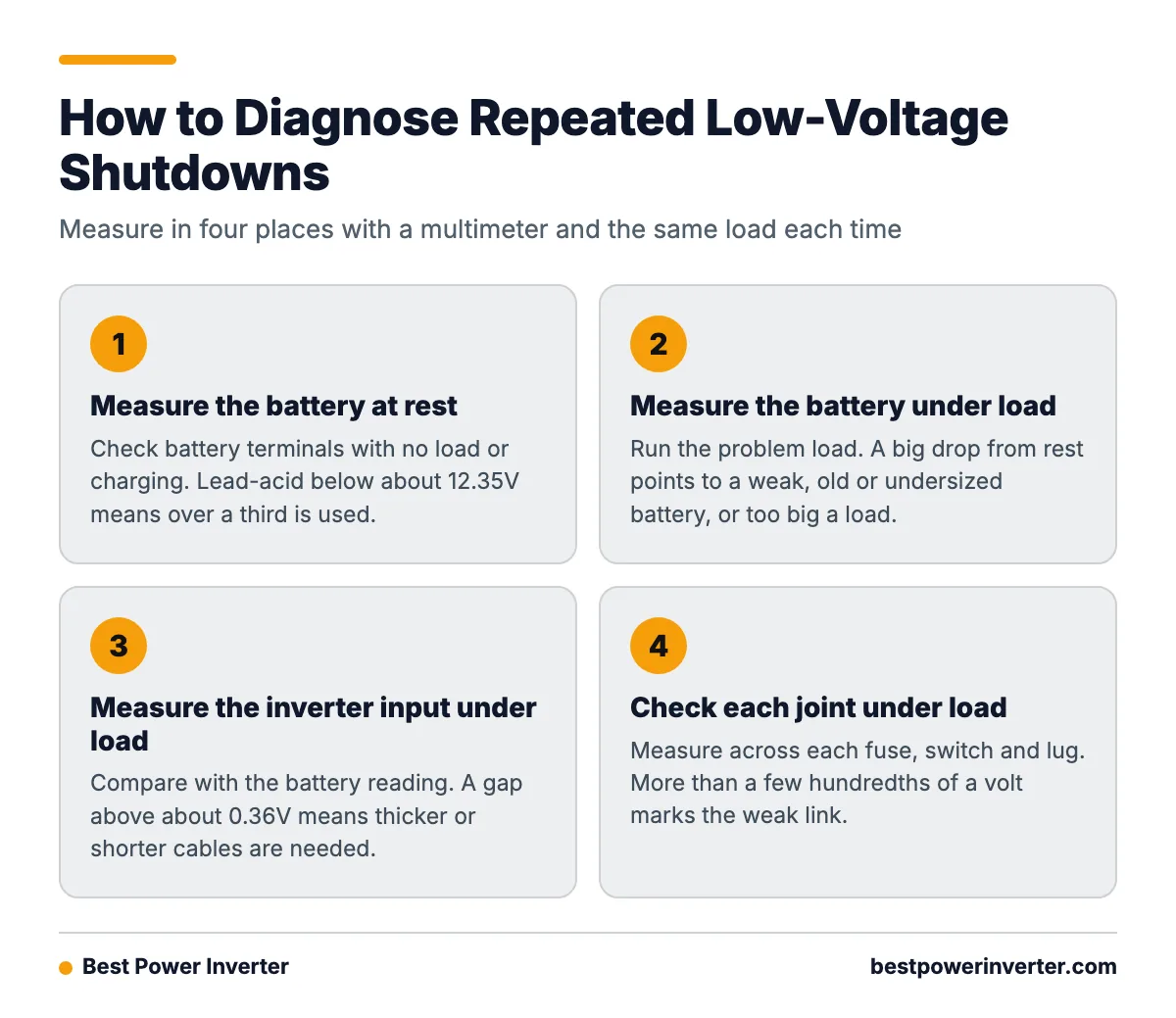
| Step | Where and when to measure | What it tells you |
|---|---|---|
| 1. At rest | Battery terminals, no load, no charging, after the battery has settled | State of charge. Lead-acid below about 12.35V means more than a third is used. |
| 2. Battery under load | Battery terminals while the inverter runs the problem load | Battery sag. A big drop from step 1 points to a weak, old or undersized battery, or too big a load. |
| 3. Inverter under load | Inverter DC input terminals, same load | Compare with step 2. The gap is your cable, fuse and connection loss. |
| 4. Each joint under load | Across each fuse, switch and lug | A joint that shows more than a few hundredths of a volt is the weak link. |
Then work through this list:
- Is the battery fully charged? Charge it and repeat the test.
- Is the step 2 to step 3 gap above about 0.36V? Use thicker or shorter cables.
- Are lugs crimped well, clean and tight?
- Is the fuse holder or breaker getting warm?
- Is the load bigger than the battery can supply? Motors and compressors draw a surge at start-up.
- Is the cutoff set higher than you think? Check the setting in the manual or menu.
Should I use an external low-voltage disconnect in addition to the inverter’s built-in protection?
Yes, for most lead-acid systems and any setup with DC loads wired straight to the battery. An external low-voltage disconnect (LVD) sits between the battery and the loads. According to the SIL guide, it automatically disconnects those loads when its measured voltage reaches the threshold you choose.
Lead-acid system:
- If you want long battery life → add an adjustable external LVD with a time delay, set to protect around the 67% charge level.
- If DC loads connect directly to the battery → add an external LVD, because the inverter cannot switch those off.
- If the battery is a cheap engine-start battery you will replace often → the inverter’s own cutoff may be enough, but expect short battery life.
Lithium system:
- If your inverter’s cutoff is adjustable → set it above the BMS cutoff (for example 12V on 12V systems, per one battery maker) and skip the external LVD.
- If your inverter’s cutoff is fixed at 9.5V to 10.5V → an external LVD set above the BMS limit stops the BMS from being your only protection.
- If you have DC loads on the battery → an external LVD keeps them from draining it to the BMS trip point.
Most readers with lead-acid batteries should add an external LVD. Most lithium users with an adjustable inverter can rely on the inverter setting alone.

What to look for in cutoff, delay and restart settings
If you are buying an inverter or an LVD, these features decide how well it fits your battery:
- Adjustable cutoff. A fixed 10V cutoff suits neither long lead-acid life nor most lithium batteries. Adjustable lets you match the battery.
- Adjustable alarm. One manual offers an 11.5V default alarm and a 10.5V vehicle and RV setting. A higher alarm gives you more warning.
- Time delay. A delay of a few seconds stops a short surge, like a pump starting, from tripping the cutoff.
- Restart or reconnect voltage. This is the voltage the battery must reach before power comes back. Set too close to the cutoff, the inverter will switch on and off over and over.
- Voltage display. A screen showing input voltage makes the three-point test much easier.
- Tolerance. A spec of ±0.5V means the real trip point can vary. Measure where yours actually trips.
Charging and reconnecting a drained battery safely
Charge the battery as soon as you can after a low-voltage shutdown. Lead-acid batteries left sitting flat lose capacity they may never get back.
- Turn the inverter off, or remove its loads, before you start charging.
- Charge flooded lead-acid batteries in a well-ventilated space. They can give off hydrogen gas while charging.
- Use a charger set for your battery type. Lithium and lead-acid need different charge voltages.
- If a lithium BMS has tripped, follow the battery maker’s steps to wake it.
- Check that the main fuse sits close to the battery positive terminal before you reconnect anything.
- Let the battery reach a full charge before running heavy loads again.
Frequently Asked Questions
Can an inverter restart automatically after a low-voltage shutdown?
Some can. Many inverters switch back on by themselves once the battery voltage climbs above a reset level, for example when solar or a charger tops it up. Others stay off until you turn them off and on again. Your manual will say which type you have. Auto-restart is handy for solar setups, but make sure the reconnect voltage is well above the cutoff so it does not cycle on and off.
What voltage causes a 12V inverter to alarm or shut down?
Most 12V inverters alarm at about 10.5V. Shutdown is usually between 9.5V and 10.5V. One 300W inverter manual lists 10V ±0.5V for shutdown and about 10.5V for the alarm, while another manufacturer uses a 9.5V default cutoff.
Does low-voltage cutoff protect the battery or only the inverter?
It protects against extreme discharge, which helps both. But it is often set too low for good lead-acid life and too close to the BMS limit on lithium. It also cannot stop DC loads wired directly to the battery.
What low-voltage cutoff should be used with lithium batteries?
Set it high enough that the inverter trips before the battery’s BMS does. One battery maker gives 12V as the example for a 12V inverter system. Always check your own battery’s manual for its BMS cutoff.
Sources