

For most buyers, the LANDERPOW 3000W pure sine wave inverter is the best 3000 watt power inverter in this group. It outputs clean AC power for sensitive electronics and ships with 1AWG copper cables. A 3000 watt inverter can run refrigerators, microwaves, TVs, laptops, lights and some small power tools, but startup surge and battery and cable sizing decide whether it works in practice. Many manufacturer guides also suggest treating about 2500W as the practical continuous limit.
This guide compares five 12V models using their listed specifications and the features buyers see on Amazon. It also covers what each size can run, how to size cables and fuses, and whether a 3000 watt inverter makes sense in a truck, RV or off-grid setup.
Our Winner: LANDERPOW 3000W Pure Sine Wave Inverter 12V DC to 120V AC
It is the only model in this group listed as pure sine wave, which is the safer choice for refrigerators, CPAP machines, laptops and anything with a motor or sensitive electronics. The listing adds 1AWG pure copper cables, a hardwired AC terminal, a wired remote with an LED screen, and a 3-year coverage plan.
How We Compared These Models
Four criteria matter most for a 3000W inverter: waveform type (pure or modified sine), included cable gauge, protection features, and warranty. Waveform decides which devices run safely. Cables and protections decide whether a 250 amp class DC load can be handled safely. This comparison is based on listing specifications and patterns in buyer feedback.
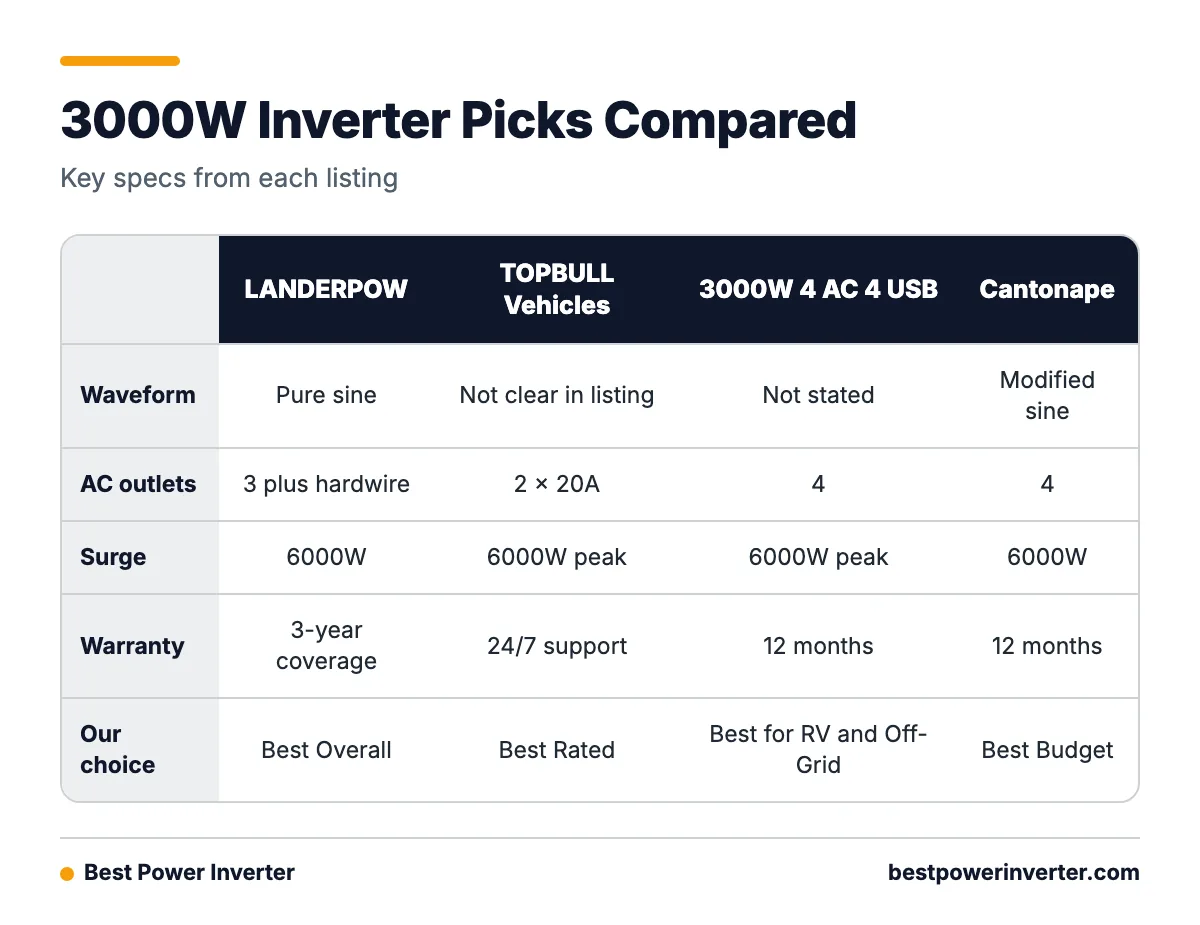
| Product | Key Specs | Our Choice | Action |
|---|---|---|---|
| LANDERPOW 3000W Pure Sine Wave | Pure sine, 6000W surge, 3 AC outlets plus hardwire terminal, 1AWG cables, 3-year coverage | Best Overall | |
| TOPBULL 3000W (Vehicles, 4.6 stars) | 6000W peak, 2 x 20A outlets, 30W USB-C, 10 protections, wireless remote | Best Rated | |
| TOPBULL 3000W (Car/Home) | 6000W peak, 200 ft remote, dual fans, color LED display, 24/7 support | Best Remote Range | |
| 3000W Inverter with 4 AC Outlets and 4 USB | 6000W peak, LCD display, wireless remote, built-in fuse, 12-month warranty | Best for RV and Off-Grid | |
| Cantonape 3000W | Modified sine, 6000W surge, 4 AC outlets plus 4 USB, 6 protections | Best Budget |
In-Depth Reviews

1. LANDERPOW 3000W Pure Sine Wave Inverter – Best Overall
Our Verdict: The most complete package for people who want to run refrigerators, CPAPs and electronics without worrying about waveform quality.
The listing states more than 91% efficiency, 3000W continuous output and 6000W surge. Pure sine wave output matches grid-quality power, so inductive loads such as refrigerators and coffee machines should run with less hum and heat than on modified sine units. The two 1AWG, 2 foot copper cables are a short, sensible match for a close-mounted install. A 3-year coverage plan is longer than the 12-month warranties on most other models here.
Why We Like It
- Pure sine wave output for sensitive electronics
- Three AC outlets plus a hardwired terminal for high-current tools
- 5V/3.1A USB and 30W PD ports
- 15 ft wired remote with an LED screen for battery level, output and errors
- Full metal shell and six listed protections
Pros & Cons
Pros
- Clean power for refrigerators, CPAPs and laptops
- Heavy-gauge cables included
- Longest coverage in this group
Cons
- Rated 4.4 stars, slightly below the TOPBULL models
- Only three AC outlets
- Still needs a properly fused, heavy DC run

2. TOPBULL 3000W Inverter for Vehicles – Best Rated
Our Verdict: The highest-rated model in the group at 4.6 stars, with a strong protection list and modern charging ports.
The listing describes 3000W continuous and 6000W peak output, two 20A AC sockets, a 3.4A USB port and a 30W Type-C port. It lists ten protections, including ground fault, overcurrent and leakage protection. The color display shows voltage, power and status, and a remote is included. The listing does not clearly state the waveform type in the text provided, so confirm it on the product page before powering sensitive gear.
Why We Like It
- Highest buyer rating of the five
- Ten listed safety protections
- Pure copper flexible cables included
- 24/7 online customer support
Pros & Cons
Pros
- Broad protection feature set
- USB-C fast charging
- Metal housing with a clear display
Cons
- Only two AC outlets
- Waveform type not clear in listing text
- Cable gauge not stated in the provided data

3. TOPBULL 3000W Car/Home Inverter – Best Remote Range
Our Verdict: A good fit if you want to switch the inverter off from inside a camper, cab or cabin.
This version lists a 200 ft wireless remote with one-button shutdown and restart, plus dual silent smart fans. It supports 12V and 12.8V batteries, which covers common lead-acid and LiFePO4 packs. It shares the two 20A outlet layout and the ten protections with the other TOPBULL model. Like that one, the waveform type is not stated in the provided text.
Why We Like It
- 200 ft wireless remote range
- Compatible with 12V and 12.8V batteries
- Dual fans designed for lower noise under load
- Includes a grounding terminal
Pros & Cons
Pros
- Long remote range
- Complete accessory kit
- 30W USB-C port
Cons
- Two AC outlets only
- Waveform not confirmed in listing text

4. 3000W Inverter with 4 AC Outlets and 4 USB – Best for RV and Off-Grid
Our Verdict: A practical multi-outlet unit for RVs, trucks and small solar systems.
The listing prices it at $120.00 and claims over 90% efficiency, 3000W continuous and 6000W peak output. The LCD shows input and output voltage, battery capacity, load and error codes. It lists a built-in fuse plus overcurrent, short circuit, overload, overheat and overvoltage protections. Two battery cables and a 12-month warranty are included.
Why We Like It
- Four AC outlets and four USB ports
- LCD with error codes for easier troubleshooting
- Marketed for RVs, trucks, boats and solar systems
Pros & Cons
Pros
- Many outlets for shared loads
- Clear status display
- Cables included
Cons
- Waveform type not stated in provided text
- Wireless remote range listed at 16 feet
- Only 12 months of warranty

5. Cantonape 3000W Power Inverter – Best Budget
Our Verdict: A lower-cost option for resistive loads, tools and charging, as long as you accept modified sine wave output.
The listing is explicit: 3000W continuous modified sine wave power with 6000W surge, over 90% efficiency, an aluminum body and a temperature-controlled fan. It has four AC outlets, four USB ports, an LCD with error codes (E-1 for low voltage, for example) and a remote that needs its own battery. Six protections are listed, and the warranty is 12 months.
Why We Like It
- Four AC outlets and four USB ports
- Six protections including reverse polarity
- Detailed LCD with fault codes
Pros & Cons
Pros
- Useful for tools, lights and chargers
- Clear diagnostics
- Rated 4.5 stars
Cons
- Modified sine wave can cause hum or heat in some devices
- Not ideal for CPAPs or some refrigerators
- 12-month warranty
How a 3000 Watt Inverter Works
An inverter converts 12V DC from a battery into 120V, 60Hz AC. The models above are rated for 3000W continuous output and 6000W surge. Continuous watts are what the unit can supply for hours. Surge watts are a short burst, typically for motor startup.
Continuous vs. Surge Wattage and the 2500W Rule
Treat 6000W as a startup allowance, not extra running capacity. Some manufacturer guidance suggests about 2500W as a safe continuous load for a 3000W unit. That leaves headroom for heat, voltage sag and cable losses. Add up running watts for everything on at once, then confirm the largest startup surge fits inside the surge rating.
What Can a 3000 Watt Power Inverter Run?
A 3000W inverter can usually handle small appliances like coffee makers, kettles, lights, laptops and routers, provided the total stays within capacity. Typical refrigerators run around 150 to 400W but can need a much higher startup surge. Microwaves commonly range from 800 to 2000W. TVs and entertainment gear often use roughly 100 to 500W. For more appliance examples, see this 3000W inverter guide from EcoFlow.
What Will a 3000 Watt Power Inverter Run at Once?
Use this simple load calculator. Add the running watts of everything that will be on together. Then check the single biggest startup number against the surge rating.
| Appliance | Typical Running Watts | Startup Watts |
|---|---|---|
| LED lights | 10 to 60 | Same as running |
| Laptop charger | 45 to 100 | Same as running |
| TV | 100 to 500 | Same as running |
| Refrigerator | 150 to 400 | Often several times running watts |
| Microwave | 800 to 2000 | Near rated watts |
| Small power tool | Varies by model | Check nameplate |
Can a 3000 Watt Power Inverter Run a Refrigerator or Microwave?
Yes, either one, but a large microwave plus a refrigerator plus a kettle together can push past the practical 2500W limit. Run heavy heating loads one at a time.
How Do I Tell Whether an Appliance’s Startup Surge Will Overload the Inverter?
Check the appliance nameplate for amps, then multiply by 120V for running watts. Motor appliances often need roughly two to three times that at startup. If the manual lists starting watts, use that figure. If the surge exceeds the inverter’s surge rating, choose a larger unit or a soft-start model.
3000W vs. 2500W vs. 1000W Inverters
| Size | Realistic Use | Typically Not For |
|---|---|---|
| 1000W | Laptops, lights, TV, phone chargers, small fan | Microwaves, kettles, most refrigerators with high surge |
| 2500W | Refrigerator, coffee maker, many tools, small microwave | Several heavy loads at once |
| 3000W | Refrigerator plus electronics, larger microwave, tools, with surge headroom | Air conditioning plus other large loads on one 12V battery |
If your loads stay under about 800W, a 1000W unit is cheaper and easier to wire. If you only ever pull around 2000W, a 2500W model is a fair match. Choose 3000W for surge headroom and for a practical 2500W working limit. The same comparison applies to a 300 watt power inverter, which only suits phones, laptops and small lights.
Pure Sine Wave vs. Modified Sine Wave
Pure sine wave matches household power and is the safer choice for refrigerators, CPAPs, audio gear and battery chargers. Modified sine wave works for simple resistive loads such as heaters and incandescent bulbs but may add noise or heat in motors and electronics. Of the five models here, only the LANDERPOW is clearly listed as pure sine, and the Cantonape is explicitly modified sine.
What Size Cables Do I Need for a 3000 Watt Power Inverter?
At 12V, 3000W draws roughly 250 amps before losses, and about 280 amps at 90% efficiency. At a 2500W load, expect about 230 amps. These are large currents, so keep cables short and heavy. Always follow the cable gauge and fuse size in your inverter’s manual. Use this checklist for 12V vehicle installs:
- Keep the battery-to-inverter run as short as possible, ideally under 3 feet.
- Use pure copper cable. Many installers use 4/0 AWG for full-power use, and the supplied 1AWG cables suit shorter runs or lighter average loads.
- Install a fuse or breaker rated for the cable and inverter, close to the positive battery terminal.
- Use crimped lugs and tight connections. Loose terminals overheat.
- Ground the inverter chassis as directed in the manual.
- Mount it where air can flow around the fan and heat sink.
How Much Battery Capacity Do I Need?
For battery guidance, see this battery storage guide for 3000W inverters. A rule of thumb: divide watts by 12 for amps, then divide by about 0.9 for losses. Multiply by hours of use to get amp-hours. Lead-acid batteries should only be discharged about 50%, while LiFePO4 can usually use 80% or more.
Worked Example: Fridge, Laptop and Lights in a Truck
- Refrigerator 150W + laptop 65W + LED lights 30W = about 245W running.
- 245W / 12V / 0.9 = about 23A from the battery.
- Eight hours of constant draw is about 180Ah. A fridge cycles on and off, so real use is lower.
- On lead-acid, that suggests 360Ah or more of total capacity to stay at 50%. LiFePO4 needs less.
This load is far below 3000W. A 3000W inverter works here, but it will idle with some self-consumption. A smaller unit would do the job unless you also plan to add tools or a microwave.
Will a 3000 Watt Inverter Work in a Truck or Car?
Yes, but not through a cigarette lighter socket. Those sockets are typically limited to around 15A. A 3000 watt car inverter must connect directly to the battery with heavy cable and a fuse. Run the engine during heavy loads so the alternator supports the battery, and use a deep cycle house battery bank if you plan to run appliances overnight.
Safety Protections and Installation Tips
Look for low and high voltage, overload, short circuit, overheat and reverse polarity protection. Fuse the positive cable, ventilate the unit and never mount it in a sealed compartment. For more use-case details, see Experts Electrical’s inverter overview.
Common Mistakes When Buying a 3000 Watt Inverter
- Ignoring startup surge on fridges, compressors and pumps.
- Running the unit at 3000W continuously instead of staying near 2500W.
- Using undersized cables or skipping the fuse.
- Buying modified sine wave for sensitive electronics.
- Pairing it with a battery bank that is too small.
Frequently Asked Questions
What can a 3000 watt power inverter run?
Refrigerators, microwaves, TVs, laptops, lights, routers, coffee makers and some small power tools, as long as the total stays near or below 2500W and startup surge fits within the surge rating.
What can 3000 watt inverter power in an RV?
Lights, TV, laptops, a refrigerator and a microwave, though not usually a rooftop air conditioner on a single 12V battery bank. Heavy loads drain batteries quickly.
Is a 3000 watt power inverter for truck use better than a 1000 watt power inverter?
Only if you need to run larger appliances. For laptops, lights and chargers, a 1000 watt power inverter is simpler and needs thinner cables. For a microwave, tools or a fridge plus other loads, choose 3000W.
Is a 3000 watt inverter better than a 2500 watt power inverter?
It gives more surge headroom and room to grow. If your real loads stay under about 2000W, a 2500 watt power inverter may be enough and cost less.
What size are 3000 watt power inverter cables?
Use the gauge listed in your manual. Many installers use 4/0 AWG for full-power use, and the 1AWG cables supplied with some units are best for short runs and lower average loads. A fuse is required either way.
Conclusion
The LANDERPOW 3000W pure sine wave inverter is the best overall choice for most buyers because of its clean output, heavy cables and 3-year coverage. The TOPBULL models suit buyers who value remote range, ports and protections, while the $120 four-outlet model and the Cantonape cover RV and budget needs. Match the inverter to your real running watts, size your cables and fuse properly, and keep continuous load near 2500W for the best results. For a deeper look at capacity and use cases, see this EcoFlow 3000W inverter guide.
Affiliate Disclosure: As an Amazon Associate, we may earn commissions from qualifying purchases from Amazon.com. This comes at no extra cost to you and helps support our research.