
Choose an inverter whose continuous watt rating is 20-25% above the combined running watts of your devices, and whose surge rating covers your biggest motor start-up. That one rule prevents most overload shutdowns, dead batteries and overheated cables. This guide explains every number on the label and shows the math step by step.
Quick answer
Add up the running watts of everything you will use at once, then add 20-25%. Check that the surge rating covers the largest motor start-up. Pick pure sine wave for motors and electronics.
- Best for phones, laptops, a small TV: 150-300W unit in the 12V socket
- Best for a mini fridge or drill: 1000-2000W pure sine, wired to the battery
- Best for a sump pump or 3000W+: 24V or 48V system
- Continuous watts are what the inverter can supply for hours. Surge watts last only a moment.
- Motors can need 2-3x their running watts to start, so size for the start-up, not the label on the motor.
- DC amps = watts / volts / efficiency. A 1000W load at 12V pulls about 92A at 90% efficiency.
- A car’s 12V socket is fused at roughly 10-15A, so it limits you to about 120-180W.
- Above roughly 2000-3000W, move to 24V or 48V to keep current and cable size under control.
- A battery’s Wh rating is stored energy. An inverter’s W rating is how fast it can deliver power.
- What is inverter power rating?
- What do the voltage numbers on the label mean?
- Continuous vs surge watts
- How big of a power drain is an inverter?
- How do I calculate the inverter size I need?
- How big an inverter for common devices?
- How big of a power inverter can my truck handle?
- When to choose a 48 volt power inverter
- Matching an inverter to a 5000Wh battery
- Pure sine wave vs modified sine wave
- Is a power inverter safe?
- What do owners say?
- Frequently Asked Questions
What is inverter power rating?
An inverter’s power rating is the continuous AC output, in watts, that it can supply for hours without overheating. It is the big number on the box, like 300W, 1000W or 3000W.
Most labels list four things: continuous watts, surge (peak) watts, DC input voltage and AC output voltage. Some also list efficiency and idle draw. The continuous number is the one that matters most for sizing. Surge is a short burst on top of it.
What do the voltage numbers on the label mean?
The input voltage (12V, 24V or 48V DC) must match your battery system. The output (in the US, 120V AC at 60Hz) is what your devices plug into.
Never connect a 12V inverter to a 24V battery. It will likely destroy the unit. Also check the input range and the low-voltage cutoff on the label. The cutoff is the battery voltage at which the inverter shuts itself off to protect the battery.
Continuous vs surge watts: what is the difference?
Continuous watts are the load the inverter can carry all day. Surge, or peak, watts are the higher load it can handle for a very short time, usually just long enough for a motor to start.
Motors are the reason surge exists. Sump pumps, compressors, drills and fridges can need 2-3x their running watts, or more, at start-up. A fridge that runs on 100W may ask for 400-700W for a split second.
Size for the start-up, not the running number. Also be careful with the printed surge figure. Owners often report that surge ratings are overstated and that motors fail to start. Leave extra headroom rather than sizing right at the limit.
How big of a power drain is an inverter?
An inverter drains power in two ways: efficiency loss while it works, and idle draw while it sits switched on with nothing plugged in.
Quality inverters are typically 85-95% efficient. So DC input watts = AC output watts / efficiency. A 100W load at 90% efficiency pulls about 111W from the battery.
Idle (no-load) draw is commonly about 10-50W for mid-size units, though it varies by model. Say your inverter idles at 30W. That is 2.5A at 12V. Over 10 hours it uses 300Wh, or about 25Ah from a 12V battery, and you ran nothing. Owners often complain that idle draw drains batteries more than expected.
Check the idle number in the spec sheet. Switch the inverter off when nothing needs it, or use a low-power or eco mode if the unit has one.
How do I calculate the inverter size I need?
Add the running watts of every device you will use at the same time, add a 20-25% margin, then check that the surge rating covers the biggest start-up. Sizing guides such as this one from CS Inverter use the same basic approach.
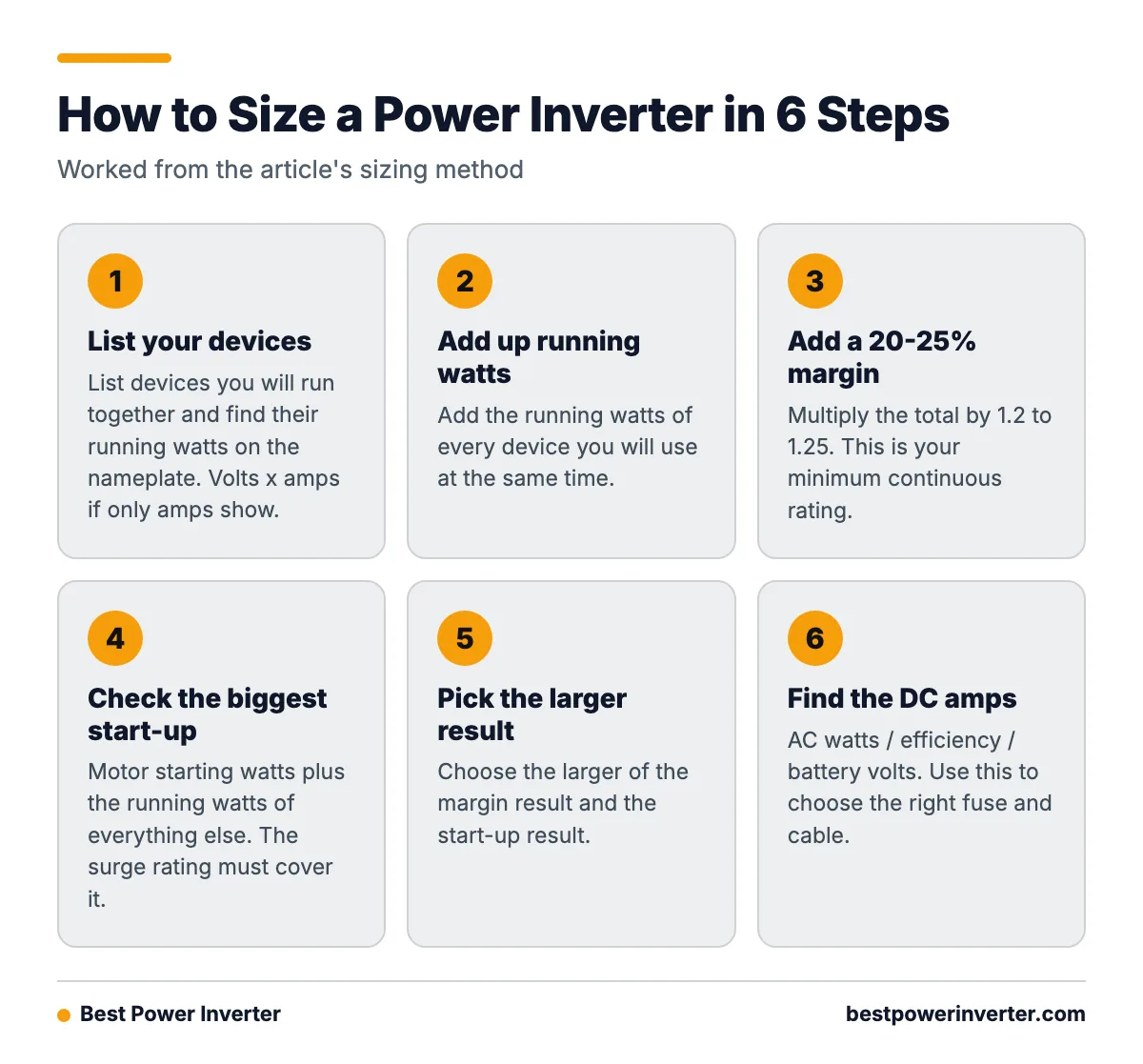
- List devices you will run together and find their running watts on the nameplate. If you only see amps, multiply volts by amps (120V x 5A = 600W).
- Add them up.
- Multiply by 1.2 to 1.25 for margin. This is your minimum continuous rating.
- Find the largest start-up (starting watts of the motor plus the running watts of everything else). The surge rating must cover it.
- Pick the larger of steps 3 and 4.
- Find DC amps: AC watts / efficiency / battery volts.
Worked example: a mini fridge on 12V
Assume a mini fridge that runs on 100W and needs about 700W to start. These are example numbers, so check your own nameplate.
- Running load: 100W x 1.25 = 125W. Easy.
- Start-up: 700W x 1.2 = 840W. That sets the size: a 1000W pure sine inverter.
- Running DC draw: 100W / 0.9 = 111W, or 111 / 12 = about 9.3A.
- Start-up DC draw: 700W / 0.9 / 12 = about 65A for a moment.
- Fuse and cable: A 1000W inverter can pull about 93A at full load (1000 / 0.9 / 12). Fuse the positive cable near the battery for that, typically a 100-125A fuse. Many 1000W manuals call for about 4 AWG cable on short runs. Follow your manual’s chart.
- Runtime: Take a 100Ah 12V lithium battery with about 1,000Wh usable. Add an assumed 20W idle to the 111W load: 131W. That is about 7.6 hours if the fridge ran nonstop. Fridges cycle on and off, so real runtime is usually longer. Treat this as the worst case.
How big an inverter do I need for a sump pump, mini fridge, drill, 32-inch TV or printer?
The table below shows typical ranges, not measured values. Real devices vary a lot, so always check the nameplate. The last column includes the 20-25% margin and rounds up to a common inverter size.
| Device | Typical running watts | Typical starting watts | Minimum inverter |
|---|---|---|---|
| 32-inch LED TV | 30-60W | About the same | 150W |
| Laptop | 45-90W | About the same | 150W |
| Inkjet printer | 20-50W | Under 100W | 150-300W |
| Laser printer | 400-600W | 1,000W+ at warm-up | 1500W |
| Mini fridge | 50-100W | 400-700W | 1000W |
| Corded drill | 500-800W | 1,000-1,500W | 2000W |
| 1/3 hp sump pump | About 800W | 1,600-2,400W | 3000W |
For a sump pump, plan on a 3000W pure sine inverter or larger, and check the pump’s nameplate. At 3000W on 12V the battery side would draw about 278A. Use 24V or 48V for that load. For a 32-inch TV, a small 150-300W inverter is plenty, and it can even run from a car socket.

How big of a power inverter can my truck handle?
Through the 12V accessory socket, about 150-180W. Sockets are typically fused at 10-15A, which caps them at about 120-180W. Anything bigger must connect directly to the battery with fused cables.
Direct to the battery, the limits are the battery, the cables, and the alternator. A 1000W load pulls about 92A at 12V. A 100Ah lead-acid starter battery should not be drained deeply, so that load would only last a short while without the engine running. With the engine on, the alternator has to cover the inverter plus the vehicle’s own needs, so check your alternator’s rated output first.
Vehicle inverter checklist
- Under 150W: use the socket. Check the fuse rating.
- Over 150W: use battery clamps or, better, a fused permanent install.
- Run the engine for loads above a few hundred watts.
- Check your alternator rating against the inverter’s DC amps.
- Use the cable gauge and fuse size in the manual. Keep cables short.
- For a dedicated battery (van or RV), size the battery bank for the runtime you want.
- Charging a phone or laptop? Use a socket inverter.
- Running a drill or small fridge? Wire a 1000-2000W inverter to the battery.
- Need over 2000-3000W? Move to a 24V or 48V battery system.
When should I choose a 48 volt power inverter?
Choose a 48 volt power inverter when your load is above roughly 2000-3000W. Higher voltage means lower current, which means thinner cable, less heat and less voltage drop. The table uses DC amps = watts / volts / efficiency, with 90% efficiency assumed.
| AC load | DC amps at 12V | DC amps at 24V | DC amps at 48V |
|---|---|---|---|
| 300W | About 28A | About 14A | About 7A |
| 1000W | About 93A | About 46A | About 23A |
| 2000W | About 185A | About 93A | About 46A |
| 4000W | About 370A | About 185A | About 93A |
Even without losses, a 4000W inverter on 12V would draw over 330A. That is why a 4000 watt power inverter is almost always a 24V or 48V unit. A 12V system at that power needs very thick cable and a very large fuse. This buyer’s guide covers the same voltage trade-off in more detail.
How big power inverter for a 5000W battery?
Most people asking about a “5000W battery” mean 5000Wh (5kWh) of stored energy. Wh is how much energy the battery holds. W is how fast the inverter can pull it. Both matter.
A 2000-3000W inverter suits a 5kWh battery well. A 4000W inverter can work, but it would drain the battery in about an hour at full load. Assuming 90% usable capacity and 90% inverter efficiency, 5000Wh gives about 4050Wh at the outlet. That is about 2 hours at 2000W, and about 1 hour at 4000W.
Before pairing the two, check the battery’s maximum continuous discharge rating (the BMS limit). At 48V, a fully loaded 4000W inverter pulls about 93A, so the battery must allow that. At 24V it is about 185A. Heat can also lower what an inverter delivers. Some sizing guides, such as this off-grid derating article, suggest adding extra margin in hot spaces.
Pure sine wave vs modified sine wave: does it change what I can run?
Yes. Pure sine wave inverters produce power similar to utility power. They suit sensitive electronics and motors better than modified sine wave units.
Modified sine wave can work for simple loads, such as basic lights or a charger. It can make motors run hot and noisy, and some electronics, medical devices and variable-speed tools may not run properly. For fridges, pumps, TVs and laptops, choose pure sine wave. Owners also say pure sine models run sensitive electronics and motors quietly without buzzing.

Is a power inverter safe?
Yes, when it is sized correctly, fused, ventilated and installed to the manual. Most problems come from thin cable, no fuse, or a blocked fan.
- Fuse: Fit a fuse on the positive cable close to the battery, rated for the inverter’s full DC current.
- Cable gauge: Use the gauge in the manual and keep the run short. Owners often say included cables are too thin or short for the rated power.
- Ventilation: Leave space around the unit and keep the fan clear. Heat is the top cause of shutdowns.
- Grounding: Follow the manual’s grounding instructions for the chassis or ground lug.
- Low-voltage cutoff: Choose a unit with one, so it does not drain the battery flat.
- Protections: Look for overload, over-temperature and short-circuit protection.
- Certification: Look for UL 458 (mobile and marine inverters) or UL 1741 (grid-interactive and stationary inverters), or an equivalent listing.
What do owners say?
Owners like
- Pure sine wave models run sensitive electronics and motors quietly without buzzing
- Built-in protections (overload, low-voltage, over-temperature shutdown) give peace of mind
- A remote switch or display showing load and battery voltage is convenient
- Compact units with USB ports are handy for camping and road trips
Common complaints
- Stated wattage is not delivered in practice, or units overheat and shut down under sustained load
- Cooling fans are loud
- Idle draw drains batteries more than expected
- Surge ratings are overstated and motors fail to start
- Included cables are too thin or short for rated power
Summarised from owner reviews and long-term user reports; individual experiences vary.
Frequently Asked Questions
What is inverter power rating?
It is the continuous AC watts an inverter can supply for hours, such as 1000W. Most units also list a higher surge rating for short motor start-ups, plus the DC input and AC output voltage.
How big power inverter to run sump pump?
A 1/3 hp pump runs on about 800W but may need 1,600-2,400W to start. Plan on a 3000W pure sine inverter on 24V or 48V, and check your pump’s nameplate.
How big of a power drain is an inverter?
Efficiency losses are roughly 5-15%, since quality units are typically 85-95% efficient. Idle draw is commonly about 10-50W for mid-size units. Turn the inverter off when you are not using it.
How big power inverter for 5000w battery?
A 2000-3000W inverter suits a 5kWh battery well. A 4000W inverter works if the battery’s continuous discharge rating allows about 93A at 48V, but it would drain the battery in about an hour at full load.
How big an inverter to power a 32 tv?
A 150-300W inverter is enough, since a 32-inch LED TV typically uses 30-60W. It can run from a car socket if the fuse allows.
How big of a power inverter can my truck handle?
About 150-180W through the 12V socket. Larger inverters must connect directly to the battery, with the engine running for bigger loads and a fuse sized for the inverter’s DC current.
4000 watt power inverter: what battery voltage do I need?
Use 24V or 48V. At 90% efficiency, a 4000W inverter draws about 185A at 24V and about 93A at 48V. On 12V it would pull over 330A, which is impractical.
Sources