

Most mini fridges draw only 40 to 100 watts while the compressor runs, but they can pull 120 to 400 watts for a moment at startup. For most standard compressor models, a 500- to 1,000-watt pure sine wave inverter is a practical choice, as long as its surge rating covers that startup spike. This guide shows how to read your fridge label, do the math, and pick a size without overspending.
Quick answer
Choose a pure sine wave inverter with a continuous rating above the fridge’s running watts and a surge rating above its startup watts. For many mini fridges that means 500W. A 300W unit can work for small ones.
- Best for small, efficient fridges: 300W pure sine, if surge covers startup
- Best for most buyers: 500W pure sine, for headroom
- Best for fridge plus other devices: 1,000W pure sine
- Typical running draw is about 40 to 100 watts. Startup is often two to four times higher.
- Startup surge, not average use, is what trips an undersized inverter.
- Inverter size decides compatibility. Battery watt-hours decide runtime.
- Pure sine wave output is the safer match for compressor motors.
- Measure the real load with a plug-in watt meter, then add 20 to 30% headroom.
- Running Watts vs. Startup Watts
- How Do I Read the Mini Fridge’s Wattage Label?
- Is a 300W, 500W, or 1,000W Inverter Enough?
- Do I Need a Pure Sine Wave Inverter?
- Sizing Checklist and Worked Example
- How Long Will a Battery Run a Mini Fridge?
- What Else Can I Power at the Same Time?
- Why Inverters Shut Down
- Thermoelectric and 12V DC Fridges
- Frequently Asked Questions
What Wattage Does a Typical Mini Fridge Use, and How Many Startup Watts Does It Need?
A typical mini fridge uses about 40 to 100 watts while the compressor is running. Reported startup demand is about 120 to 400 watts, commonly two to four times the running figure, according to PowerStationMatch’s mini-fridge power guide.
The compressor does not run all the time. It cycles on, cools, and shuts off. Each time it restarts, the motor needs a short burst of extra power to overcome pressure in the system. That burst lasts a fraction of a second, but an inverter with a weak surge rating will shut down on it.
Real use varies. Age, room temperature, door openings, and design all change how often the compressor runs and how hard it pulls. A listing is only a guide. Your own meter reading is better.
How Do I Read the Mini Fridge’s Wattage Label?
Find the rating plate, usually inside the cabinet or on the back. Look for watts (W), or amps (A) and volts (V). If it lists only amps, multiply amps by volts to get watts.
A label reading 0.8A at 120V means about 96 watts. Many labels do not list startup watts. Some list locked-rotor amps (LRA), which is the surge current when the motor starts. Multiply LRA by voltage for a rough surge figure. If neither is listed, assume startup could reach three to four times the running watts, then confirm with a meter.
Is a 300W, 500W, or 1,000W Inverter Enough for a Mini Fridge?
A 300W pure sine inverter can run a mini fridge under 100W if its surge rating exceeds the fridge’s measured startup demand. A 500W inverter is the safer pick for most people. A 1,000W unit makes sense when other devices share the inverter. Sizing charts such as the Ave Battery inverter size chart also suggest a 500 to 1,000W range for a mini fridge or small refrigerator system.
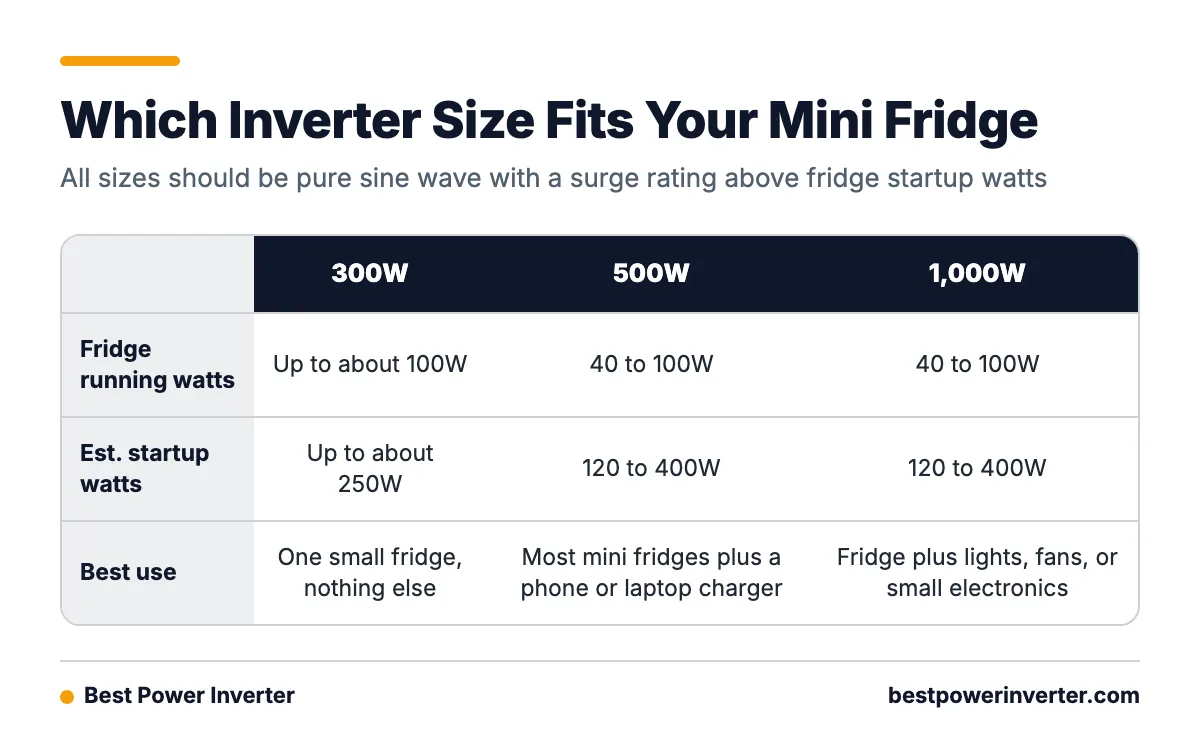
| Inverter (continuous) | Fridge running watts | Est. startup watts | Best use |
|---|---|---|---|
| 300W | Up to about 100W | Up to about 250W, if surge rating is higher | One small fridge, nothing else |
| 500W | 40 to 100W | 120 to 400W | Most mini fridges plus a phone or laptop charger |
| 1,000W | 40 to 100W | 120 to 400W | Fridge plus lights, fans, or small electronics |
Buyers often assume a 300W inverter always fails. It does not. It fails only when the fridge’s startup draw beats the inverter’s surge rating. Two fridges can both read 75W running, yet one starts at 200W and the other at 350W. The first suits a 300W unit. The second does not.
Avoid oversizing by a lot. Guides written for full-size refrigerators often point to 1,500W or more. That is far beyond what a compact unit needs, and larger inverters waste more power at idle.

Do I Need a Pure Sine Wave Inverter for a Mini Fridge?
Pure sine wave is the better choice. Compressor motors run smoother and cooler on clean power. Modified sine wave units can make motors hum, run hotter, and sometimes fail to start the compressor. They may work for a while, but they add risk to an appliance you want to keep cold. The price gap is smaller than it used to be, so there is little reason to save money here.
How Much Inverter Surge Capacity Does a Mini Fridge Need?
The surge rating must exceed the fridge’s startup watts. It must also hold for the time the compressor needs, so check the stated surge duration. Use this checklist:
- Read the nameplate and note the running watts.
- Find startup or locked-rotor information, or measure it with a watt meter.
- Add the running watts of anything else on the inverter.
- Confirm the surge rating covers the largest startup spike.
- Check the surge duration.
- Leave about 20 to 30% headroom on the continuous rating.
Headroom of 20 to 30% matches common sizing advice, including the Ave Battery chart linked above.
Worked Example
A mini fridge is rated at 75W running with a measured 250W startup. A 300W pure sine inverter with a surge rating above 250W will run it. Running load is 75W, far under 300W. Now add a 60W laptop charger: 135W total, still fine. But if you want margin or more devices, step up to 500W. The extra cost is small compared with a shutdown that warms your food.
If your fridge starts under 250W and runs alone, then a 300W pure sine inverter with a higher surge rating works.
If startup is 250 to 400W or you add devices, then choose 500W.
If you power several devices or don’t know the startup draw, then choose 1,000W.
Can a Car Battery or Power Station Run a Mini Fridge, and for How Long?
Yes, both can. But the inverter does not set the runtime. Battery watt-hours (Wh) do. Watts and surge watts decide whether the fridge will start at all.
Here is an example with assumed numbers. A 100Ah, 12V lithium battery holds about 1,200Wh. Say 1,000Wh is usable. An inverter at about 90% efficiency delivers roughly 900Wh. A 75W fridge with a 40% duty cycle averages 30W (75 x 0.4). That gives 900 / 30 = about 30 hours. If the compressor ran all the time, you would get only 12 hours. Duty cycle matters.
Inverters also draw power at idle, so real runtime is a little lower. Do not drain a car starting battery. It is not built for deep discharge, and you risk a car that will not start. A deep-cycle or lithium battery, or a portable power station, is a better source.

What Else Can I Power at the Same Time as the Mini Fridge?
Add up the running watts of each device. Then make sure the total, plus the fridge’s startup surge, stays inside the inverter’s limits. A phone charger (about 10W), LED lights, and a small fan fit easily on a 500W unit. A laptop works too. Avoid heating devices such as kettles and hair dryers. They draw far more than a mini fridge and can overload a small inverter.
Why Do Inverters Shut Down With a Mini Fridge?
Common causes include:
- Surge rating lower than the fridge’s startup draw
- Low battery voltage, which makes the inverter trip under load
- Thin or long cables that drop voltage
- Too many devices running during a compressor start
- A modified sine wave unit struggling with the motor
Use a plug-in watt meter between the fridge and inverter to see the real running and peak watts. Most meters hold a peak reading, which shows your actual startup spike.
What About Thermoelectric and 12V DC Fridges?
Thermoelectric coolers use no compressor, so there is no startup spike. They draw steadily, often under 60W, and a small inverter handles them. They also cool less and run constantly, so they use more energy over time. A 12V DC compressor fridge skips the inverter entirely. It runs straight from the battery, avoiding inverter losses. If you only use it off-grid, it is often the more efficient option.
Frequently Asked Questions
How big of a power inverter for a mini fridge?
For most standard compressor mini fridges, use a 500- to 1,000-watt pure sine wave inverter. A 300W model can work for a small fridge if its surge rating exceeds the fridge’s startup watts. Check the label or measure with a watt meter.
Is a 300-watt inverter enough for a mini fridge?
Sometimes. A 300W pure sine inverter can handle a mini fridge under 100W if the surge rating is above the measured startup demand. If startup reaches 300 to 400W, it will not be enough.
Is a 500-watt inverter enough for a mini fridge?
For most mini fridges, yes. It covers typical running watts of 40 to 100W and startup draws of 120 to 400W, with room for a small extra device.
Do I need a pure sine wave inverter for a mini fridge?
It is strongly preferred. Pure sine wave power is gentler on compressor motors and starts them more reliably than modified sine wave power.
How long will a battery run a mini fridge?
Divide usable battery watt-hours, after inverter losses, by the fridge’s average draw. Average draw is running watts times duty cycle. A 900Wh usable battery and a 30W average gives about 30 hours.
Sources