
Most people should not build a mains-output inverter. They should buy a certified pure-sine inverter and size it from running watts, startup surge, and battery voltage. A homemade unit can teach you how inverters work, but it can also start a fire or deliver a lethal shock.
Quick answer
An inverter turns battery DC into AC with an oscillator, switching transistors, a transformer or converter, and a filter. Build only a low-power prototype to learn. For real loads, buy a certified pure-sine unit, add 20-30% headroom, and use an electrician for fixed systems.
- Best for learning: a low-voltage, low-power prototype
- Best for TVs and printers: a certified pure-sine inverter
- Best for home backup: a licensed electrician’s install
- An inverter has five jobs: oscillate, switch, step up, filter, and protect.
- A homemade mains-output inverter has no safety certification. Use it for learning, not for powering your home.
- Size by this method: add running watts, add the largest startup surge, then add 20-30%.
- Battery current is AC watts divided by battery volts, divided by efficiency.
- Motors can need roughly 3-5 times their running watts at startup.
- A 5,000 Wh battery tells you stored energy. Its maximum discharge power sets the inverter limit.
- Fixed and grid-connected installs need qualified personnel and must follow local electrical rules.
- How an Inverter Converts DC to AC
- What Parts Make an Inverter
- How to Build an Inverter at Home Safely
- Modified Sine vs Pure Sine
- How to Calculate Inverter Size
- Sump Pump, TV, and Printer Examples
- How Big an Inverter Can a Truck or Car Handle
- Inverter Size for a 5,000 Wh Battery
- Installation Time and Electrician Rules
- Troubleshooting Common Problems
- Frequently Asked Questions
How Does an Inverter Convert Battery DC into Household AC?
An inverter switches DC on and off very fast, flips its direction, then smooths the result into an AC waveform. In North America, household AC is 120 V at 60 Hz. So the inverter must flip direction 120 times per second.
Here is the path the power takes:
- DC input: Current flows in from the battery through fuses and thick cables.
- Oscillator: A small circuit creates a 60 Hz timing signal.
- Switching stage: Power transistors (MOSFETs or IGBTs) turn on and off to push current in alternating directions.
- Transformer or converter: This raises the low battery voltage to mains level. Older designs use a heavy iron-core transformer. Newer ones use a high-frequency converter.
- Filtering: Inductors and capacitors smooth the output into a cleaner wave.
- Protection: Sensors watch for overload, low battery voltage, high temperature, and short circuits.
Heat is the by-product. No inverter is 100% efficient, so a part of the battery power turns into heat. That is why cooling matters.
What Parts Make an Inverter, and How Is an Inverter Made?
An inverter is made from a control board, power switches, a magnetic or converter stage, an output filter, protection circuits, a heat sink, and a case. Factories add testing and certification on top. Here is what each part does and why it is hard to get right.
| Part | What it does | Common failure point |
|---|---|---|
| Oscillator / controller | Sets frequency and switching pattern | Timing errors that cause both switches to turn on at once |
| Power MOSFETs / IGBTs | Switch heavy current | Overheating, shoot-through, poor gate drive |
| Transformer or HF converter | Steps voltage up to mains level | Saturation, overheating |
| Output filter | Smooths the waveform | Wrong values give a noisy or distorted wave |
| Protection circuits | Cut power on overload or low voltage | Missing or slow trip points |
| Heat sink and fan | Move heat away | Blocked vents, weak airflow |
| Enclosure and grounding | Keep users away from live parts | Exposed terminals, poor insulation |
A factory unit is designed, tested, and certified as a whole. A home build usually skips that last step, and it is the step that protects you.

How Can I Build an Inverter at Home Without Creating a Shock or Fire Hazard?
Keep it small, keep it low voltage, and never connect it to house wiring. A learning prototype should stay at a low power level with a protected output. Anything that makes 120 V mains power needs proper insulation, fusing, grounding, and testing that most hobby builds do not have.
Why a homemade mains inverter is risky
- Shock: Mains AC voltage can be deadly.
- Fire: Battery current can be hundreds of amps. A loose cable or a missing fuse can melt wire in seconds.
- Equipment damage: A bad waveform can harm TVs, chargers, and motors.
- No protection: Home builds often lack overload, thermal, and low-voltage cutoffs.
How to build an inverter at home for learning
If you still want to learn by building, start with a safer path:
- Use a low-voltage battery source and a small, current-limited supply.
- Keep the output low power and low voltage, such as a lamp or a test load.
- Put a fuse close to the battery on every build.
- Use an insulated enclosure and keep your hands off live parts.
- Never plug it into a wall outlet or a home circuit.
How to build an inverter generator
Do not build one. An inverter generator is an engine, an alternator, and inverter electronics in one frame, with fuel, exhaust, and electrical hazards all together. Buy a certified unit and run it outdoors, away from windows.
- If you want to learn how inverters work: build a low-power, low-voltage prototype.
- If you need to run a TV, tools, or a pump: buy a certified pure-sine inverter.
- If you need home backup or solar: buy a certified system and hire a licensed electrician.
- If you are weighing cost: a certified unit is usually safer and cheaper once you count the transformer, filter, enclosure, cooling, and protection circuits.
What Is the Difference Between a Modified-Sine and Pure-Sine Inverter?
A pure-sine inverter makes a smooth wave like utility power. A modified-sine inverter makes a blocky, stepped wave. Pure sine is the safer choice for most loads. Modified sine costs less but can cause problems.
| Load | Modified sine | Pure sine |
|---|---|---|
| Simple heaters, basic lights | Usually fine | Fine |
| Motors (pumps, fridges, tools) | May run hotter, louder, less efficient | Best choice |
| TVs, laptops, chargers | May buzz or interfere | Best choice |
| Laser printers | Risky; check the maker’s advice | Best choice |
| Medical or sensitive gear | Avoid | Use only as the maker allows |
Inverter makers such as Samlex explain these waveform differences in their inverter FAQ. If budget allows, pick pure sine and skip the guesswork.
How Do I Calculate the Inverter Size from Running Watts and Startup Surge?
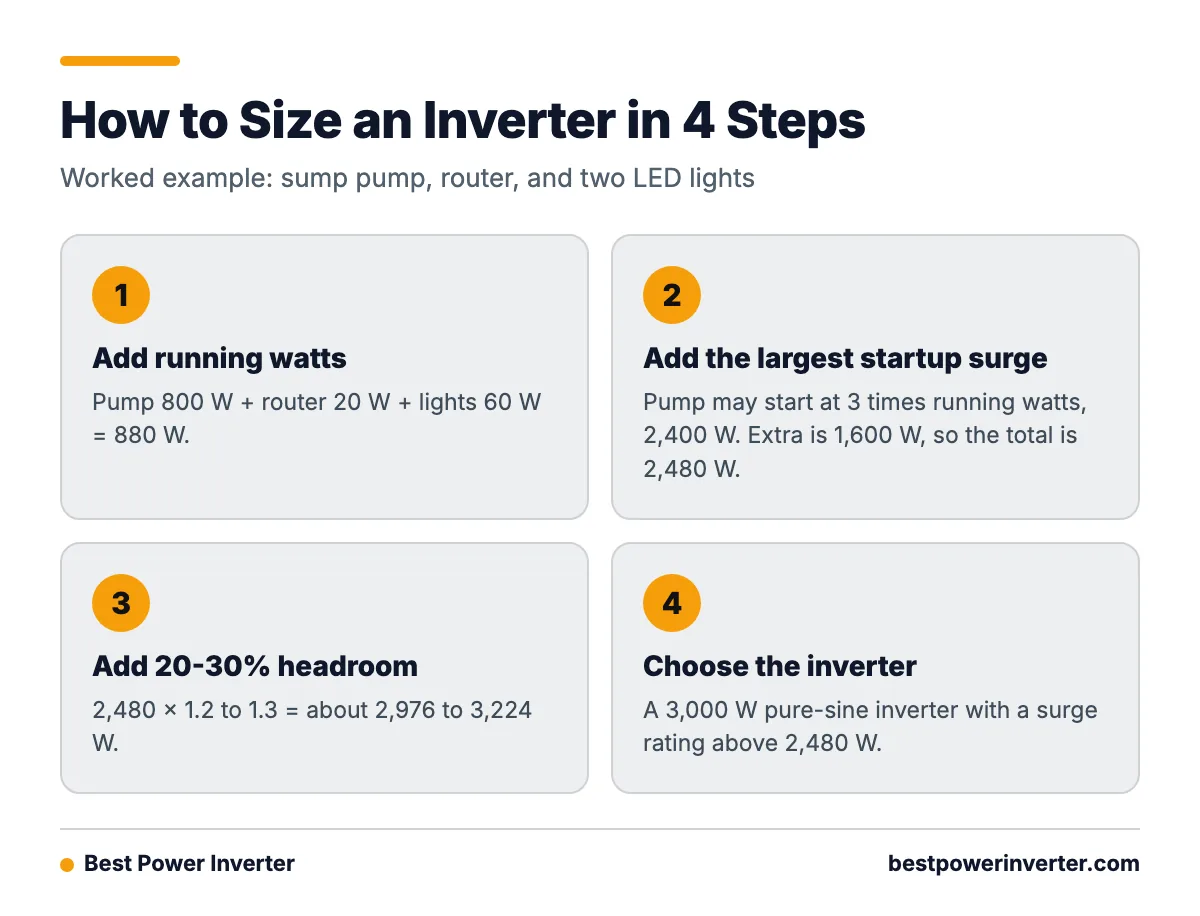
Add up the running watts of everything that will run at once. Then add the largest extra startup surge. Then add 20-30% headroom. The total starting surge is the normal running power plus the extra power needed during startup, and this method is common in sizing guides such as the AVE Battery inverter size chart.
Motors are the trap. Motor-driven loads can need roughly 3-5 times their running watts during startup, depending on the motor and equipment. Check the nameplate and the maker’s data.
Sizing table (approximate values)
These are typical figures. Always check your own label, because real products vary. Current assumes a 12 V battery and 85% inverter efficiency.
| Load | Typical running watts | Likely startup surge | Suggested pure-sine inverter | Approx. 12 V current (running) |
|---|---|---|---|---|
| 32-inch TV | 40-60 W | Low | 150-300 W | About 5 A |
| Inkjet printer | 20-40 W | Low | 150-300 W | About 3 A |
| Laser printer | Often 400-1,000 W while warming | High at warm-up | 1,500 W or more | 40-100 A |
| Sump pump (1/3 hp class) | About 800 W | About 2,400-4,000 W | 3,000 W | About 78 A |
| Refrigerator | About 150-200 W | About 600-1,000 W | 1,000-1,500 W | About 15-20 A |
| Circular saw or similar tool | About 1,400 W | Can be 2-3 times running | 3,000 W | About 137 A |
Worked calculation
Say you want to back up a sump pump, a router, and two LED lights.
- Running watts: pump 800 W + router 20 W + lights 60 W = 880 W.
- Largest startup surge: the pump may start at 3 times its running watts, which is 2,400 W. The extra is 2,400 – 800 = 1,600 W.
- Total: 880 + 1,600 = 2,480 W.
- Headroom (20-30%): 2,480 x 1.2 to 1.3 = about 2,976 to 3,224 W.
- Result: a 3,000 W pure-sine inverter with a surge rating above 2,480 W.
Battery current
Use this formula for battery-side current: DC current = AC power / battery voltage / inverter efficiency.
- 880 W running at 12 V and 85%: 880 / 12 / 0.85 = about 86 A.
- At the 2,480 W peak: about 243 A at 12 V.
- The same 2,480 W at 24 V: about 121 A. At 48 V: about 61 A.
Higher inverter power means higher battery-side current. Battery discharge limits, BMS limits, cable size, and fuses must all match the inverter. This is why large inverters use 24 V or 48 V systems. Lower current means thinner cable, less heat, and less voltage drop.
How Big Power Inverter to Run a Sump Pump, TV, or Printer?
How big a power inverter do I need to run a sump pump?
Most home sump pumps need a pure-sine inverter of around 2,000-3,000 W, with a surge rating that covers startup. The pump may draw about 800 W while running but 3-5 times that for a moment at start. Check the pump’s label for amps or watts, and use pure sine because the load is a motor. A pump you rely on during storms is a fixed backup job, so involve an electrician for any hard-wired connection.
How big an inverter do I need for a 32-inch TV, printer, or small appliance?
A 150-300 W pure-sine inverter covers a 32-inch TV, an inkjet printer, a laptop charger, and similar small loads. The exception is a laser printer. Its fuser heater can draw far more power while warming up, so size by the label and give it a bigger unit.

How Big of a Power Inverter Can My Truck or 12 V Car Handle?
A cigarette-lighter or accessory socket usually handles only small inverters, roughly 100-180 W, because many sockets are fused at 10-15 A. Check your vehicle manual for the real rating. For anything larger, connect the inverter straight to the battery with a fuse and correctly sized cable.
The math shows why. A 1,000 W load at 12 V and 85% efficiency pulls about 98 A from the battery. No accessory socket can supply that.
12 V vehicle checklist
- Socket rating: read the fuse rating in the manual. Keep socket loads small.
- Direct-battery wiring: use it for loads above the socket limit.
- Fuse placement: put a fuse on the positive cable as close to the battery as practical.
- Cable gauge: follow the inverter maker’s cable chart. Keep runs short to limit voltage drop.
- Ventilation: leave clear space around the fan and vents. Do not bury the unit under bags or blankets.
- Engine and alternator: run the engine for bigger loads. Check your alternator rating, since a large inverter can use most of its output.
- Low-voltage cutoff: pick a unit with one, so you do not drain the starting battery.
Truck and car batteries are made to start engines. Deep draws can leave you stranded. For regular use, a separate deep-cycle battery is a better plan.
How Large an Inverter Is Suitable for a 5,000 Wh Battery?
A 5,000 Wh battery states how much energy it holds, not how much power it can deliver. Pick the inverter by the battery’s maximum discharge power and your AC load. A common match is a 3,000-5,000 W inverter, but only if the battery and BMS allow that current.
Check three numbers on the battery sheet:
- Battery voltage (such as 12, 24, or 48 V).
- Maximum continuous discharge current set by the BMS.
- Maximum surge discharge and for how long.
Multiply voltage by continuous discharge amps to get battery power. The inverter should not ask for more than that, after you account for efficiency. For runtime, divide usable watt-hours by your load. A 1,000 W load on a 5,000 Wh battery lasts a little under 5 hours at best, and less after inverter losses and usable-capacity limits.
How big of a power drain is an inverter?
An inverter draws some power even with nothing plugged in. That idle draw varies by model, from a few watts to tens of watts on bigger units. Look for the no-load current on the spec sheet. Over a full day, a small idle draw can use a surprising amount of battery, so turn the inverter off when you do not need it.
How Long Does It Take to Install an Inverter, and When Is an Electrician Required?
A plug-in inverter takes minutes. A direct-battery vehicle install usually takes a few hours. A fixed home, solar, or backup system often takes a day or more, plus inspection. A licensed electrician is required or strongly advised for any fixed or grid-connected system, depending on your local rules.
Makers of solar and storage inverters state that installation should be done by qualified personnel, with voltage sources isolated and the right protective gear worn. See the SMA safety instructions for an example. Fixed installs also need correct grounding, wiring, clearances, and ventilation under local electrical rules.
Installation workflow
- Plan the site: choose a dry, ventilated spot close to the battery with clear space around the unit.
- Mount it: fix the inverter to a solid surface, as the manual directs.
- Isolate power: switch off and disconnect all sources before working.
- Ground it: bond the chassis as the manual and local code require.
- Wire the DC side: use the specified cable size, short runs, tight lugs, and a fuse or breaker.
- Wire the AC side: for a fixed system, a qualified electrician does this and sets up any transfer switch.
- Inspect: check polarity, torque, and clearances before power-up.
- Commission: turn on with no load first, then add loads one at a time and watch voltage and temperature.
Troubleshooting Overloads, Low Voltage, and Overheating
| Problem | Likely cause | What to check |
|---|---|---|
| Overload alarm or shutdown | Load or startup surge too high | Add up watts again; run fewer loads; move to a larger unit |
| Low-voltage shutdown | Weak battery or voltage drop | Battery charge, cable length and gauge, loose lugs |
| Overheating | Poor airflow or heavy load | Clear vents, fan operation, room temperature |
| Nuisance alarms | Loose terminals or sagging battery | Tighten connections; test under load |
| Hot cables | Cable too thin or too long | Compare to the maker’s cable chart; shorten the run |
Voltage drop is the quiet cause of many faults. Heavy current through thin cable drops voltage before it reaches the inverter, and the unit trips even though the battery is full.
Frequently Asked Questions
How to build inverter?
Learners can build a low-power, low-voltage prototype with an oscillator, switching transistors, a transformer or converter, and a filter. For real household power, buy a certified pure-sine inverter instead. Homemade mains-output units lack safety protections.
How to build inverter at home?
Keep it a small learning project: low voltage, low power, fused at the battery, and in an insulated case. Never connect it to home wiring or a wall outlet.
How to build inverter generator?
Do not build one. It combines an engine, alternator, fuel, exhaust, and inverter electronics, which adds fire, fume, and shock risks. Buy a certified inverter generator and run it outdoors.
What make inverter?
An inverter is made of a controller or oscillator, power switches, a transformer or high-frequency converter, an output filter, protection circuits, a heat sink, and an enclosure.
How is an inverter made?
Manufacturers design the circuit, build the boards, add the power stage and cooling, then test for protection, heat, and safety before certification. That last testing step is what a home build usually lacks.
How can I build an inverter?
Start by learning how the stages work, then build only a safe, low-power demo. If you need to run actual appliances, buy a certified unit and size it from your loads.
How long does it take to install an inverter?
A plug-in unit takes minutes and a direct-battery vehicle install takes a few hours. A fixed home or solar system often takes a day or more, plus inspection, and should be done by qualified personnel.
How big power inverter to run sump pump?
Most home pumps need about 2,000-3,000 W of pure-sine inverter, because startup surge can be 3-5 times running watts. Check the pump label and use the surge rating of the inverter, not just the continuous rating.
How big of a power drain is an inverter?
Idle draw varies by model, from a few watts to tens of watts. Under load, battery current is AC watts divided by battery voltage and efficiency, so a 1,000 W load pulls about 98 A at 12 V.
How big power inverter for 5000w battery?
Match the inverter to the battery’s maximum discharge power, not its stored energy. Many 5,000 Wh batteries pair with a 3,000-5,000 W inverter, if the BMS, cables, and fuses support that current.
Sources