
Most readers should buy a certified inverter for anything near 1000W and build a 12V to 220V circuit only as a small learning project. A basic circuit uses an oscillator such as the SG3525 or CD4047 to switch MOSFETs that drive a step-up transformer, turning 12V DC into about 220-240V AC at 50Hz. This guide explains each stage, gives realistic 1000W numbers, and shows when building makes sense.
Quick answer
A 12V to 220V inverter chops DC into pulses, steps them up with a transformer, and outputs 50Hz AC. A small DIY build is a good project. At 1000W, the current, heat and mains risk make a certified unit the better choice.
- Best for learning: a 100-300W SG3525 or CD4047 build
- Best for real appliances: a bought pure sine inverter
- Core stages: oscillator, driver, MOSFET switches, transformer, output.
- 1000W at 12V pulls roughly 93-98A from the battery, so cable and fuse choice matter.
- Square wave and modified sine can harm motors, chargers and sensitive electronics.
- A 12V 100Ah battery gives only about 30-35 minutes at 1000W.
- Idle draw is often 0.5-2% of rated power, or roughly 5-20W on a 1000W unit.
- Every DIY inverter needs a fuse, low-voltage cutoff, overload and thermal protection.
- How Does a 12V to 220V Inverter Circuit Work?
- Two Architectures: Low-Frequency vs High-Frequency
- What Components Do You Need?
- A Simple 100-300W Circuit Example
- How Do You Build a 12V to 220V 1000W Inverter?
- How Much Current, Cable and Battery Do You Need?
- How Much Power Does an Inverter Use at Idle?
- Square, Modified Sine or Pure Sine?
- 12V to 120V vs 220V/240V
- Safety Risks and Required Protections
- DIY or Buy?
- Frequently Asked Questions
How Does a 12V to 220V Inverter Circuit Work, Step by Step?
It works by switching the battery’s DC on and off in alternating directions, feeding that to a transformer, and letting the transformer raise the voltage to mains level. Each stage has one job.
| Stage | Role | Typical part or value |
|---|---|---|
| Oscillator | Sets the output frequency | CD4047 or SG3525, tuned to 50Hz |
| Driver | Gives the MOSFET gates enough current to switch fast | Transistor pair or gate driver IC |
| MOSFET stage | Switches battery current through each half of the transformer | Low-RDS(on) N-channel MOSFETs |
| Transformer | Steps 12V up to about 220-240V | 12-0-12V primary, 220V secondary |
| Output and feedback | Delivers AC to the load; feedback can hold voltage steady | Fuse, optional filter, feedback divider |
Here is the flow. The oscillator makes two opposite-phase signals at 50Hz. The driver boosts them. The MOSFETs turn on one at a time, so current flows through one half of the primary, then the other. That alternating flux induces a higher voltage in the secondary. The turns ratio sets the voltage. The oscillator sets the frequency.
Two Architectures: Low-Frequency vs High-Frequency
There are two common designs, and they differ in size, weight and complexity.
- Low-frequency transformer type: MOSFETs switch at 50Hz straight into a heavy iron-core transformer. It is simple and tough, but heavy.
- High-frequency DC-DC plus H-bridge: A small ferrite transformer boosts 12V to about 300-400V DC at tens of kHz. An H-bridge then turns that DC into 50Hz AC. It is lighter and more efficient, but harder to design and tune.
Most hobby circuits use the first type. Most modern commercial inverters use the second, often with PWM to shape a sine wave.
What Components Do You Need for a Basic DIY 12V to 220V Inverter?
A basic build needs an oscillator IC, a pair of power MOSFETs, a center-tapped transformer and a battery. Add protection parts before you add anything else.
- Oscillator: CD4047 multivibrator or SG3525 PWM controller. Both are common in hobby inverter circuits.
- MOSFETs: N-channel, rated well above battery current, with low on-resistance. Mount them on heatsinks.
- Transformer: 12-0-12V primary and 220V secondary. Its VA rating must exceed your load.
- Battery: 12V lead-acid or LiFePO4, sized for the load (see the table below).
- Protection: inline fuse, low-voltage cutoff, overload sense and a thermal sensor.
- Wiring: heavy-gauge cable with crimped lugs. Thin wire is a fire risk.
A Simple 100-300W Circuit Example
The easiest first build is a CD4047 driving two MOSFETs. Its Q output frequency follows the formula f = 1 / (4.4 × R × C). For 50Hz with a 0.1µF capacitor, R works out to about 45kΩ. Use a 39kΩ resistor in series with a 10kΩ trimmer, then trim the output to 50Hz with a frequency meter.
The SG3525 works differently. Its two outputs alternate, so each output runs at half the oscillator frequency. Set the oscillator near 100Hz to get 50Hz at each output pin. It also offers soft start and shutdown inputs, which help with protection. A published 12V to 230V MOSFET inverter circuit shows a typical layout for this small class.
Expect a square or modified output from these builds. They suit lamps and resistive heaters in the lower power range, not sensitive electronics.

How Do You Build a 12V to 220V 1000W Inverter, and What Changes From a 100W One?
The circuit idea stays the same. The hardware changes a lot, because the battery side carries around 95A.
- MOSFET count: Many parallel devices per side share the current. Each needs its own gate resistor and a shared heatsink.
- Heatsinking: Conduction losses become real heat. Use large finned heatsinks and often a fan.
- Transformer: It must be rated for at least 1000VA continuous, with a primary winding thick enough for the current. These are heavy and costly.
- Cabling and fuse: Use thick battery cable, short runs, and a fuse sized as shown below.
- Protection: Overload, over-temperature and low-battery shutdown are no longer optional.
How Much Current Does a 1000W Inverter Draw From a 12V Battery, and What Cable and Fuse Size Is Needed?
A 1000W load draws about 93-98A from a 12V battery at 85-90% efficiency. The formula is watts divided by volts, divided by efficiency. The table uses 88% efficiency. Cable, fuse and battery values are typical rules of thumb for short runs under about 1.5m. Always check the cable maker’s ampacity chart.
| Load (W) | 12V input (A) | Cable (AWG / mm²) | Fuse | Battery for 1 hour at 50% discharge |
|---|---|---|---|---|
| 100 | about 9.5 | 14 / 2.5 | 15A | about 20Ah |
| 300 | about 28 | 10 / 6 | 40A | about 57Ah |
| 500 | about 47 | 8 / 10 | 60A | about 95Ah |
| 1000 | about 95 | 2 / 35 | 125A | about 190Ah |
| 1500 | about 142 | 1/0 / 50 | 200A | about 285Ah |
What battery capacity and runtime can you expect?
A 12V 100Ah battery holds about 1200Wh. A lead-acid battery should generally not go below 50% discharge, so you get roughly 600Wh. A 1000W load drains that in about 30-35 minutes once inverter losses are counted. Divide usable watt-hours by load watts, then trim a bit for losses.
How Much Power Does a 12V to 240V Inverter Use at Idle?
Idle draw for typical inverters is often around 0.5-2% of rated power. That is roughly 5-20W for a 1000W unit, depending on design. It sounds small, but 10W for 24 hours is 240Wh, or about 20Ah from a 12V battery each day. Turn the inverter off when nothing is running. Simple DIY circuits often draw more at idle than a well-made commercial unit.
What Is the Difference Between Square Wave, Modified Sine and Pure Sine?
Pure sine is the smooth wave you get from the grid. Square and modified sine waves are rougher approximations, and they can cause heating, noise or failure in motors, some chargers and sensitive electronics.
| Waveform | Works well with | Risky for |
|---|---|---|
| Square wave | Incandescent bulbs, simple heaters | Motors, fridges, chargers, audio, medical gear |
| Modified sine | Many resistive loads, some power tools | Some motors, laser printers, dimmers, sensitive chargers |
| Pure sine | Nearly everything | Very little |

How Does a 12V to 120V Inverter Differ From a 12V to 220V/240V One?
The design is the same. Only the secondary voltage and frequency change. Household mains is 220-240V at 50Hz in much of Europe, Asia, Africa and Australia. In North America it is 120V at 60Hz.
- Frequency: Retune the oscillator to 60Hz instead of 50Hz.
- Turns ratio: A 120V secondary needs fewer turns than a 220-240V one.
- Feedback: The voltage divider is set for a lower output target.
- Current: For the same watts, 120V loads draw about twice the output current, but the 12V input current is the same.
- If you want to learn how inverters work, build a 100-300W circuit.
- If you need to run a fridge, pump, laptop or tools, buy a pure sine unit.
- If you need around 1000W or more, buy a certified unit with built-in protections.
What Safety Risks Apply to DIY Builds, and What Protections Are Needed?
The main risks are electric shock from the 220V output, fire from overloaded wiring, and battery short circuits. Occupational safety bodies such as OSHA publish electrical hazard guidance that explains how shock and burn injuries happen. A lead-acid battery can deliver hundreds of amps into a short, so an unfused cable can melt or ignite.
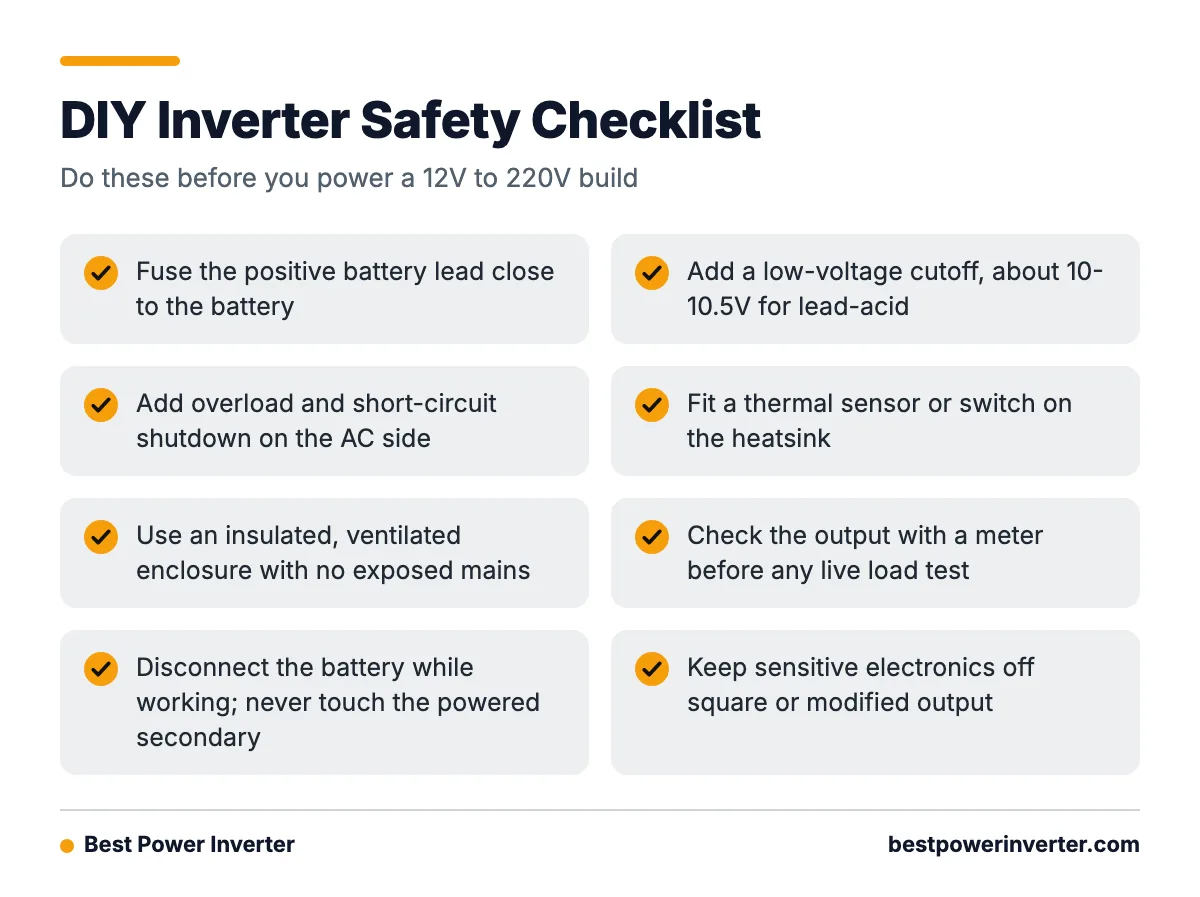
Pre-build safety and protection checklist
- Fuse the positive battery lead close to the battery, rated for the load as in the table above.
- Add a low-voltage cutoff. For lead-acid, typical cutoff is around 10-10.5V.
- Add overload and short-circuit shutdown on the AC side.
- Fit a thermal sensor or thermal switch on the heatsink.
- Use an insulated enclosure with ventilation and no exposed mains terminals.
- Never test with a live load before checking the output with a meter.
- Work with the battery disconnected, and never touch the secondary while it is powered.
- Keep sensitive electronics off a square or modified output.
When Is It Smarter to Buy a Ready-Made Inverter?
Buy when the load matters, the power is high, or safety certification matters. DIY wins for learning and for cheap, simple loads. Based on typical designs and specifications, the trade-offs look like this.
| Factor | DIY square wave | DIY SG3525 modified | Bought pure sine |
|---|---|---|---|
| Cost | Lowest | Low to moderate | Moderate to high |
| Efficiency | Fair | Fair to good | Usually the best |
| Waveform quality | Poor | Better, still rough | Clean sine |
| Safety features | Only what you add | Only what you add | Built in, often certified |
| Suitable loads | Bulbs, heaters | Resistive loads, some tools | Almost any appliance |
When buying, look for a pure sine output, a continuous rating above your load with headroom for surge, low idle draw, low-voltage and overload shutdown, and a recognized safety mark. Check that the input range suits your battery type. Product listings such as 12V to 230V inverter listings show the range of ratings and features on the market.
Frequently Asked Questions
What is a 12v 220v inverter circuit?
It is an electronic circuit that converts 12V DC from a battery into about 220V AC. It uses an oscillator, MOSFET switches and a step-up transformer, or a DC-DC boost stage plus an H-bridge.
How does a 12v to 120v inverter work?
It works like a 220V unit, but with a lower turns ratio and a 60Hz oscillator. The MOSFETs switch battery current through the transformer primary, and the secondary produces about 120V AC.
How does a 12v to 240v inverter work?
An oscillator creates alternating 50Hz drive signals. MOSFETs switch the 12V through a transformer, which steps it up to roughly 240V. A better design adds feedback to hold voltage steady under load.
How much power does a 12v to 240v inverter use?
At idle, often 0.5-2% of rated power, or about 5-20W for a 1000W unit. Under load, input power equals output power divided by efficiency, so 1000W at 85-90% efficiency draws about 93-98A at 12V.
Is a DIY 12v to 220v inverter worth building?
It is worth it for learning and for small, simple loads. For 1000W or sensitive appliances, a certified pure sine inverter is usually safer, more efficient and more reliable.
How to make a 12v dc to 220v ac inverter?
Build an oscillator at 50Hz with a CD4047 or SG3525, drive two MOSFETs, and connect them to a 12-0-12V to 220V transformer. Add a fuse, low-voltage cutoff and overload protection before you power it.
Can a 12v inverter to 220v run a fridge or power tools?
Only with a pure sine unit that has enough continuous and surge rating. Motors in fridges and tools can overheat or fail on square or modified sine output.
Sources