
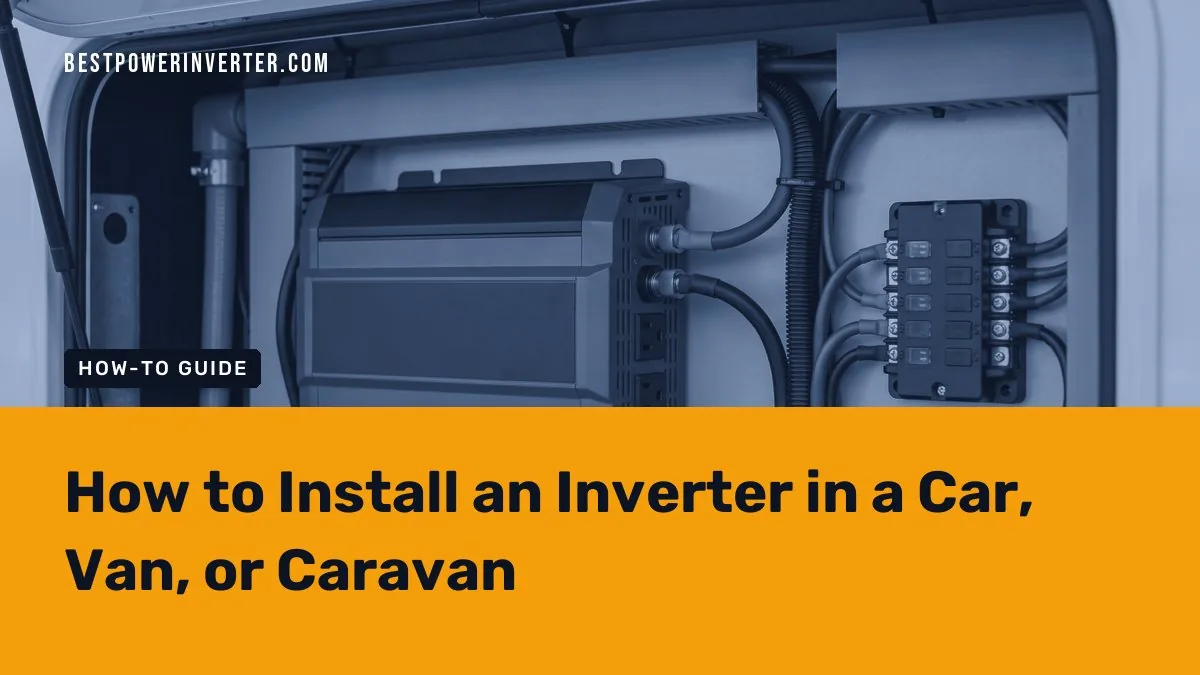
Car, van, and caravan owners who want mains-style power on the road can plug a small inverter into a 12V socket, but anything larger must be wired straight to the battery through a fuse. A 3000W unit can pull roughly 250 to 300A from a 12V system, so it is generally unsuitable for a standard car without a high-output alternator, a battery bank, heavy cables, and professional installation.
Quick answer
Use an accessory-socket inverter only for small loads. For anything bigger, hard-wire the inverter to the battery with short, thick cables and a fuse placed close to the battery positive terminal. Follow the inverter manual for cable and fuse sizes.
- Best for phones and laptops: plug-in socket inverter
- Best for tools and small appliances: direct battery wiring
- Best for sustained heavy loads: auxiliary battery system
- Small plug-in inverters use the 12V accessory socket. Larger ones must be hard-wired to the battery.
- Divide watts by 12, then add about 10% for losses, to estimate the battery current.
- A 3000W inverter needs about 278A at full load. Most cars cannot supply that for long.
- Keep cables short, fit a fuse near the battery positive, and always follow the manufacturer’s manual.
- Fixed AC wiring in a caravan, including transfer switches and RCDs, belongs with a qualified electrician.
- What This Guide Covers
- How Big of a Power Inverter Can a 12V Car Safely Run?
- Can I Plug a 3000W Inverter Into a 12V Car Socket?
- Which Connection Method Fits Your Load?
- Can a Car Alternator Power a 3000W Inverter?
- How Long Will a Car Battery Run an Inverter?
- What Size Fuse and Cable Do I Need?
- How Do I Install a Power Inverter in a Car?
- Where Should I Mount an Inverter?
- Pure Sine Wave vs Modified Sine Wave
- How Do I Install an Inverter in a Caravan?
- Window Air Conditioner Inverters Are a Different Job
- When Should You Call a Qualified Electrician?
- Printable Installation Checklist
- What Do Owners Say?
- Frequently Asked Questions
What This Guide Covers
Vehicle inverter installs go wrong in the same few places: the unit is too big for the battery, the cables are too long or too thin, or the fuse is missing. This guide walks through each one in order, so you can size the system first and then wire it.
How Big of a Power Inverter Can a 12V Car Safely Run?
The safe size depends on your wiring, battery, and alternator, not just the socket. For plug-in use, stay within the fuse rating of the accessory socket. For hard-wired use, the limit is what your battery, cables, and charging system can supply for as long as you need.
Start with running and starting loads
Every appliance has a running watt figure on its label. Motors, such as those in fridges, compressors, and power tools, also pull a short surge when they start. Add up the running watts of everything you will use at the same time. Then check the largest starting surge against the inverter’s peak rating. Choose an inverter whose continuous rating covers the running total with some margin.
Convert watts to battery amps
A 12V battery has to supply far more current than the mains would. Divide the inverter’s watts by 12, then add about 10% for inverter losses. The table shows the approximate current at full load.
| Inverter size | Approx. 12V input current (with 10% loss allowance) | Typical connection |
|---|---|---|
| 300W | about 28A | Accessory socket may work, check the socket fuse |
| 1000W | about 93A | Direct battery wiring |
| 2000W | about 185A | Direct wiring, strong battery, charging support |
| 3000W | about 278A | Auxiliary battery bank and professional install |
These are full-load figures. Your real draw is lower if you run lighter loads, but the wiring and fuse must still be built for the inverter’s maximum.
Can I Plug a 3000W Inverter Into a 12V Car Socket?
No. A 12V accessory socket is wired with thin cable and a small fuse, and it cannot carry the roughly 250A or more that a 3000W inverter would pull. Larger vehicle inverters should be hard-wired directly to the battery instead.
Many product pages show 3000W inverters with a cigarette-lighter plug in the photo. That plug only works for the small loads the socket was built for. Pushing more through it can blow the fuse, melt the plug, or heat the wiring behind the dash. If your inverter came with ring terminals and thick cables, that is the clue that it belongs on the battery.

Which Connection Method Fits Your Load?
Match the connection to how much power you need and for how long. Use this chart to pick a starting point.
- If you only charge phones, cameras, or a laptop: use a small plug-in inverter in the accessory socket.
- If you run a power tool, a small appliance, or moderate loads for short periods: hard-wire the inverter to the starter battery with a fuse near the battery.
- If you run heavy loads for long periods, such as a microwave, coffee machine, or induction hob: add an auxiliary battery with proper charging, and wire the inverter to that bank.
- If the inverter is 3000W: plan for an auxiliary battery bank, high-output charging, and professional installation.
Can a Car Alternator Power a 3000W Inverter?
Generally no. A 3000W inverter at full load needs about 278A from a 12V system. Many passenger car alternators are rated well below that, so the battery would drain quickly unless a very large charging system is fitted. Charging guidance such as this article on powering an inverter from a car alternator makes the same point about matching alternator output to inverter demand.
The alternator also has to run the vehicle’s own systems. Whatever is left over goes to the battery. If the inverter pulls more than that, the battery makes up the difference until it runs flat.
Do the alternator math
Check your alternator’s rated output in the vehicle manual. Subtract what the engine, lights, and electronics already use. The remainder is the most you can supply without draining the battery. Keep the engine running during heavy use, and never run a large inverter from a battery that is also needed to start the vehicle.
How Long Will a Car Battery Run an Inverter?
Runtime equals the usable battery energy divided by the load plus inverter losses. A small load can run for hours. A large load can flatten a starter battery in minutes.
Here is a worked example. A 100Ah, 12V lead-acid battery holds about 1200Wh. Using only half of that, about 600Wh, protects the battery’s life. A 300W load needs about 330W from the battery after a 10% loss allowance. That gives roughly 600 ÷ 330, or about 1.8 hours. Lithium batteries can usually give more usable energy, but they are limited by the discharge rating of their battery management system.
Now take a 3000W inverter running flat out. It needs about 278A. A 100Ah battery would be empty in well under half an hour in theory, and most batteries cannot deliver that current at all without voltage sag. Starter batteries are built for short bursts, not long deep discharge, so use a deep-cycle or lithium auxiliary battery for sustained loads.
What Size Fuse and Cable Do I Need for a Vehicle Inverter?
Use the cable and fuse sizes in your inverter’s manual. They take precedence over any generic chart. The cable must carry the inverter’s full input current, and the fuse must not exceed the cable’s ampacity.
Why cable length matters
Shorter runs mean less resistance, less heat, and less voltage drop. Some installation guidance recommends keeping the battery-to-inverter run no longer than about 3m. At high current, even a small drop in voltage can make the inverter hit its low-voltage alarm and shut down. Thin or long cables are a common cause of nuisance shutdowns.
Where the fuse goes
Fit the main fuse or circuit breaker on the positive cable, close to the battery positive terminal. Caravan guidance commonly says within about 30cm, or 12 inches. The fuse protects the cable from a short circuit, so a fuse far from the battery leaves a live, unprotected length of heavy cable.
For a 3000W unit, the fuse has to be rated above the roughly 278A full-load draw but still within what the cable can safely carry. That usually means very thick cable and a high-current fuse or breaker. Use the exact values from the manual, and check that the fuse holder and terminals are rated for that current too.
How Do I Install a Power Inverter in a Car?
For a hard-wired install, mount the inverter, run fused positive and negative cables to the battery, connect the inverter last, and test with a light load. The steps below follow the order most manuals use.
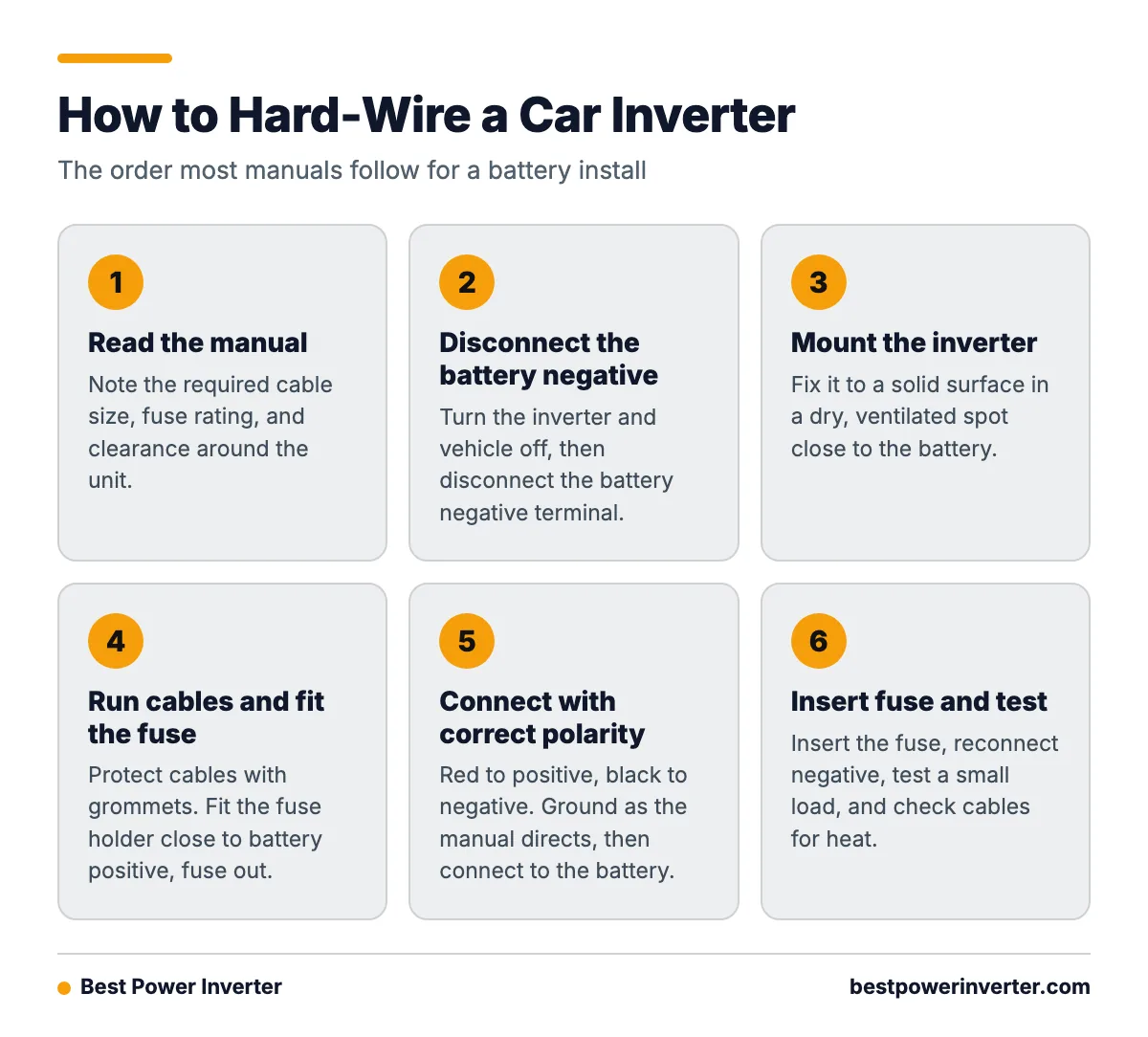
- Read the manual. Note the required cable size, fuse rating, and clearance around the unit.
- Turn the inverter off and switch off the vehicle. Disconnect the battery negative terminal before you start.
- Choose a mounting spot close to the battery, dry, and ventilated.
- Fix the inverter to a solid surface so it cannot shift in a turn or bump.
- Run the cables along a protected path. Use grommets where they pass through metal, and keep them away from heat, sharp edges, and moving parts.
- Fit the fuse holder on the positive cable close to the battery positive terminal. Leave the fuse out for now.
- Connect the cables to the inverter with the correct polarity: red to positive, black to negative. Reverse polarity can destroy the unit.
- Ground the inverter as the manual directs, using the chassis ground point if specified.
- Connect the cables to the battery, then insert the fuse and reconnect the negative terminal.
- Test with a small load first, then step up. Check cables and terminals for heat.
A battery isolator switch on the positive side is worth adding. It lets you cut power fully when the vehicle is parked.
Where Should I Mount an Inverter in a Car or Van?
Mount it in a dry, ventilated spot as close to the battery as practical, with clear space around it for heat to escape. Keep it away from flammable materials, fuel lines, and loose cargo.
- Ventilation: Inverters make heat, and their fans need to move air freely. Do not bury the unit under bedding or inside a sealed cupboard.
- Vibration: Use proper fixings and check them after the first drives. Loose inverters and loose terminals both cause trouble.
- Cable routing: Protect cables with conduit or sleeving and keep them tidy. Avoid tight bends on thick cable.
- Moisture: Keep it away from wheel arches, boot seals that leak, and any spot that gets wet.
- Access: Place the on/off switch or remote where you can reach it. Buyers frequently mention that a remote control makes hard-wired setups easier to live with.

What Is the Difference Between Pure Sine Wave and Modified Sine Wave?
Pure sine wave inverters produce smooth AC power much like the mains. Modified sine wave inverters produce a stepped, blockier waveform that costs less but suits fewer devices.
| Feature | Pure sine wave | Modified sine wave |
|---|---|---|
| Power quality | Smooth, close to mains | Stepped, rougher |
| Sensitive electronics | Works well | May hum, run hot, or fail |
| Motor-driven appliances | Run reliably | Can be noisy or less efficient |
| Price | Higher | Lower |
For laptops, medical devices, audio gear, and anything with a motor, choose pure sine wave. Owners often praise it for working reliably with sensitive electronics and motor-driven appliances. Modified sine wave can be fine for simple heating or basic chargers, but check the appliance label.
How Do I Install an Inverter in a Caravan?
Install the inverter close to the caravan battery, with a fuse near the battery positive and short, correctly sized cables. Then connect the AC output only through approved wiring, with a transfer switch and RCD protection where required.
The caravan battery bank must support the inverter’s continuous current, its surge demand, and the battery management system’s discharge limit. If the BMS cuts out below the inverter’s peak draw, the system will shut down under load. Manufacturer guides such as this pure sine wave inverter caravan installation article show typical fuse placement and cable routing.
The AC side is where the risk changes
On the DC side, the danger is high current and heat. On the AC side, the danger is shock. Never feed an inverter’s output into a fixed mains circuit or the caravan’s shore power inlet without a proper transfer switch. If the inverter and mains can be live together, you can back-feed power into a supply and injure someone. Fixed caravan AC wiring, transfer switches, and integration with mains-style circuits should be completed or inspected by a qualified electrician. Local rules may require RCD protection.
Window Air Conditioner Inverters Are a Different Job
Searches for installing a window-type aircon inverter, such as a Carrier unit, are about something else. That is the inverter electronics inside a home air conditioner, which controls compressor speed. It is not a vehicle DC to AC inverter.
Installing a window air conditioner means fitting it in the window frame, sealing the gaps, and plugging it into a suitable mains outlet. Follow the unit’s own manual for that. Do not try to run a window air conditioner from a car inverter. Its compressor draws a large starting surge, and the total load is far beyond what a normal car electrical system can supply.
When Should Vehicle Inverter Installation Be Done by a Qualified Electrician?
Call a qualified electrician for any fixed AC wiring, any connection to a caravan’s mains circuits, and any large system around 2000W or 3000W. Also call one if you are unsure about fuse ratings, grounding, or local rules.
Professional installation adds cost, and owners often complain that high-current cables, fuses, auxiliary batteries, and labor make large systems expensive. Even so, the wiring carries hundreds of amps and any mistake can start a fire. Paying for a correct install is cheaper than repairing a burnt vehicle. An inverter and charger install guide from a commercial installer shows how much planning a proper setup involves.
Printable Installation Checklist
Tick each item before you use the inverter under load.
- ☐ Inverter size matches the combined running watts, with margin for surge.
- ☐ Polarity checked: red to positive, black to negative.
- ☐ Fuse or breaker fitted on the positive cable, close to the battery.
- ☐ Fuse rating does not exceed cable ampacity and matches the manual.
- ☐ Cable size and length follow the manual, with the run kept as short as possible.
- ☐ Cables protected from heat, sharp edges, and rubbing.
- ☐ Inverter mounted in a dry spot with clear ventilation space.
- ☐ Grounding done as the manual specifies.
- ☐ Mounting and terminals secure against vibration.
- ☐ Battery isolation switch fitted, or a clear way to disconnect.
- ☐ Load test done with a small load first, then stepped up, checking for heat and voltage drop.
- ☐ Any fixed AC wiring checked by a qualified electrician.
What do owners say?
Owners like
- The convenience of running small electronics and chargers away from mains power
- Pure sine wave output that works reliably with sensitive electronics and motor-driven appliances
- Remote on/off controls that make hard-wired installations easier to operate
- Clean installation, adequate ventilation, and dependable high-load operation in caravans
Common complaints
- 3000W claims can be misleading when the vehicle battery, alternator, or wiring cannot sustain full output
- High-current cables, fuses, auxiliary batteries, and professional installation make large systems expensive
- Inverters may shut down from low voltage or overheating under sustained loads
- Fans can be noisy during heavy use
- Improperly sized or excessively long cables can cause voltage drop, heat, and nuisance shutdowns
Summarised from owner reviews and long-term user reports; individual experiences vary.
Frequently Asked Questions
How to install car inverter?
For a small unit, plug it into the 12V accessory socket. For a larger unit, mount it near the battery and run fused, heavy-gauge cables straight to the battery terminals. Put the fuse close to the battery positive, check polarity, and follow the manual for cable and fuse sizes.
How to install carrier inverter window type aircon?
That is a home appliance job, not a vehicle inverter job. Fit the air conditioner in the window frame, seal the gaps, and plug it into a suitable mains outlet. Follow the manufacturer’s manual. Do not power a window air conditioner from a car inverter.
How to install caravan inverter?
Mount the inverter near the caravan battery, fit a fuse close to the battery positive, and use short, correctly sized cables. Make sure the battery bank can support the continuous and surge current. Have a qualified electrician handle any fixed AC wiring, transfer switch, and RCD protection.
How big of power inverter for 12v car?
Small loads such as phone and laptop chargers suit a plug-in inverter of a few hundred watts. Moderate loads suit a hard-wired inverter of around 1000W to 2000W, if the battery, cables, and charging can support it. Add up your running watts, check surge needs, and use the table above to find the battery current.
Car inverter 3000W: is it practical?
Generally not for a standard car. A 3000W inverter, whether sold as a car power inverter, a 3000 watt car inverter, or a power inverter for car 3000 watt use, draws roughly 250 to 300A at 12V. It needs direct battery wiring, very short heavy cables, a high-current fuse, a battery that can discharge at that rate, and alternator support. Vans and caravans with a large lithium bank and professional install are a better fit.
What is a vehicle inverter install likely to cost?
Cost depends on the inverter size, cable, fuse, battery, and labor. Small plug-in units are cheap. Large hard-wired systems with auxiliary batteries and professional work can cost far more than the inverter itself.
Sources