
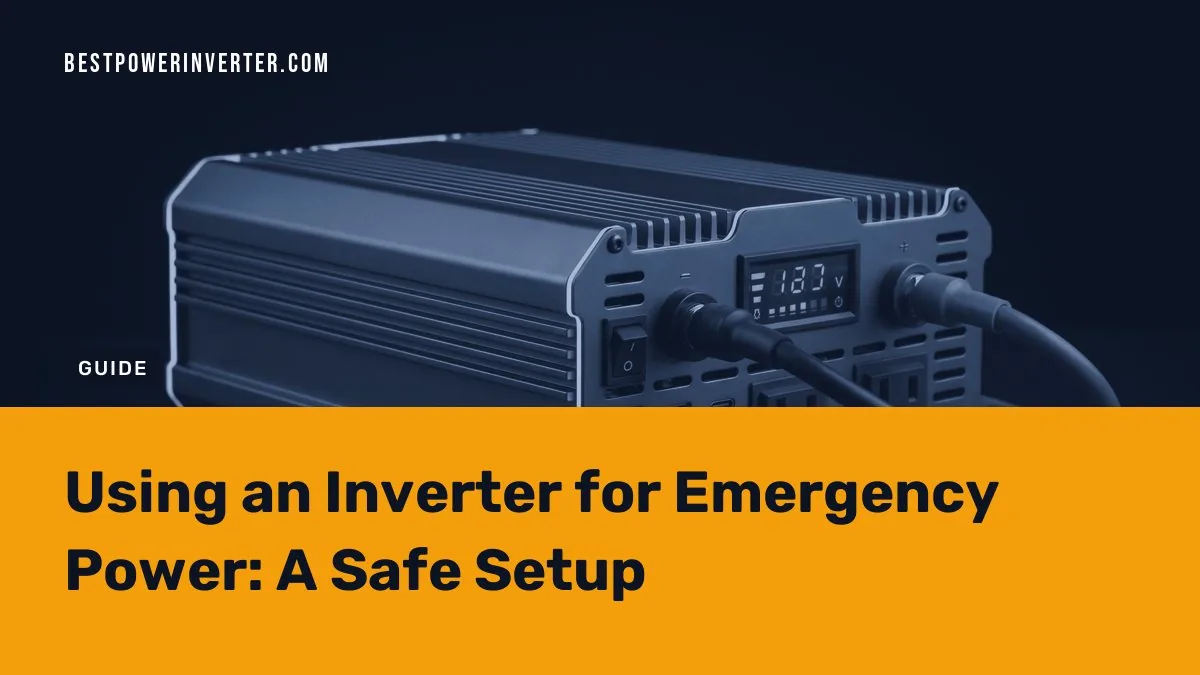
Bigger inverters belong on the battery with a fuse, not in the dashboard socket. Small ones can run phones, lights and radios in an emergency if the vehicle stays outdoors and the engine runs during longer use.
Quick answer
Use a car inverter for small loads like chargers, lamps, and a router. Park outside, keep exhaust away from the house, and run the engine for long use. Stay under the socket rating or wire to the battery.
- Best for phones and lights: a plug-in inverter in the accessory socket
- Best for larger loads: a fused, direct-battery inverter
- Accessory sockets are commonly rated 10-20 A, or about 120-240 W at 12 V. Your manual and fuse set the real limit.
- Add up your loads, then add about 20% for startup surges.
- A starter battery is not a deep-cycle battery. Keep a reserve to start the car.
- Keep the vehicle outdoors, at least 15 feet from the house, per Consumer Reports.
- Never connect an inverter to a wall outlet. Use extension cords instead.
- Can I use a power inverter in my car during a power outage?
- What can a car inverter run during an emergency?
- Can I plug a high-wattage inverter into the cigarette-lighter socket?
- How do I calculate the inverter size I need?
- How many watts can a car battery or alternator support?
- Should the engine be running while using an inverter?
- How long can an inverter run before it drains the car battery?
- Is a pure sine wave inverter necessary?
- How do I connect an inverter directly to a car battery safely?
- Can I use a car inverter to power appliances inside my house?
- Inverter, power station, or generator?
- Emergency-use checklist
- What do owners say?
- Frequently Asked Questions
Can I use a power inverter in my car during a power outage?
You can, for short-term needs. A car inverter turns 12 V battery power into 120 V AC, so you can charge devices and run a few small items. It is a stopgap. It is not a replacement for a properly rated home backup system.
Think of it as a bridge. It keeps your phone alive, your radio on, and a lamp lit until the grid returns. Anything with a heating element or a big motor is the wrong job for it.
What can a car inverter run during an emergency?
It can run low-power devices: phone and laptop chargers, LED lamps, a Wi-Fi router, a radio, a CPAP-free small fan, and similar items. Check each device label for watts. If it lists only amps, multiply amps by 120 to get watts.
| Good emergency loads | Loads to avoid |
|---|---|
| Phone and tablet chargers | Space heaters |
| LED lamps | Hair dryers and toasters |
| Router and modem | Microwaves and kettles |
| Radio | Refrigerators and freezers |
| Laptop charger | Power tools with big motors |
| Small fan | Window air conditioners |
Anything that makes heat pulls a lot of power. A refrigerator compressor adds a startup surge on top. Both can trip a fuse or shut the inverter down.

Can I plug a high-wattage inverter into the cigarette-lighter socket?
No. Plug-in inverters must stay within the socket’s rating. Vehicle accessory sockets are commonly rated 10-20 A, about 120-240 W at 12 V, according to the guidance in the research for this article. Your vehicle manual and the socket fuse decide the actual limit.
This is where many buyers get tripped up. A box that says “400 W peak” does not mean the socket can feed it. The socket blows its fuse first. Buyers often report that the socket, not the inverter, sets the practical output.
If your total load is over it: use a direct-battery inverter with a fuse and correct cable.
If you are not sure of the socket rating: read the manual and check the fuse label before plugging in.
How do I calculate the inverter size I need?
Add the watts of every device that runs at the same time. Then add roughly 20% for startup surges and unexpected draw. That is the sizing method in the source material for this guide.
Worked example
- Phone charger: 20 W
- LED lamp: 10 W
- Router: 15 W
- Small fan: 45 W
Total: 20 + 10 + 15 + 45 = 90 W. Add 20%: 90 x 1.2 = 108 W. Pick an inverter with at least 108 W of continuous output, and make sure the socket rating still covers it.
Look at continuous watts, not peak watts. Owners often say the peak number on the box misled them. Peak is a short burst. Continuous is what the unit holds.
How many watts can a car battery or alternator support?
It depends on the vehicle. There is no universal number. Check your alternator’s output at idle and the inverter manual before you plan a big load.
Alternators put out less at idle than at higher engine speed. Your headlights, fan, and engine electronics also take a share. What is left over is what the inverter can use without pulling the battery down. For small loads like the 90 W example, most vehicles have room. For loads in the hundreds of watts, look up your alternator rating first.
Should the engine be running while using an inverter?
For extended use, yes. Keeping the car running prevents battery depletion, per the guidance this article draws on. But exhaust carries carbon monoxide (CO), which is deadly. So the engine can only run safely when the car is outside.
- Park outdoors. Never use a garage, even with the door open.
- Keep the vehicle at least 15 feet from the house, as Consumer Reports recommends.
- Point the tailpipe away from doors, windows, and vents.
- Keep snow and debris clear of the tailpipe.
The U.S. Consumer Product Safety Commission explains the same risk for engine-driven equipment in its guide to generators and engine-driven tools. A battery-powered CO alarm inside the home adds a useful warning.
From the Shop
A common pattern in outage stories: someone runs the car for hours with the tailpipe near a door because it is cold and dark outside. The cord reaches, so the car gets parked close. Reach is the wrong thing to optimize. Buy a longer, heavier extension cord and park farther away.
How long can an inverter run before it drains the car battery?
With the engine off, not long, and you must save enough charge to start the car. A starter battery is built for short, strong bursts. It is not designed for deep discharge. Running a large load can leave the car unable to start and may damage the battery.
Use this formula for a rough estimate:
Runtime (hours) = battery voltage x usable amp-hours x inverter efficiency / load watts
Here is an example with assumed numbers. Say the battery is 12 V and 50 Ah. Only about 10 Ah is safe to use, so you keep a reserve. Inverter efficiency is 85%. The load is 90 W.
12 x 10 x 0.85 / 90 = about 1.1 hours.
Your battery size, age, and temperature will change this. The point is to use only a small slice of the rated amp-hours. Many people plug in the full number and get a runtime far too long. Start the engine and let it charge before the battery gets low.
Is a pure sine wave inverter necessary for emergency appliances?
Not for everything, but it is the safer pick for sensitive gear. Pure sine wave output matches household power. Modified sine wave is a rougher approximation.
Owners report that modified sine wave can make some chargers, motors, and sensitive electronics run noisily or inefficiently. Basic items like simple lamps often work fine. For laptops, medical-adjacent devices, or anything with a motor, choose pure sine wave if the budget allows. The Eaton power inverter buying guide covers how waveform types differ.
How do I connect an inverter directly to a car battery safely?
Use heavy-gauge cable, put a fuse or breaker close to the positive battery terminal, and follow the inverter manual’s cable chart. Direct connection is the right path for higher-power inverters.
- Turn the inverter off and keep the engine off while you wire.
- Size the cable to the inverter’s manual. Thin cable overheats.
- Install the fuse near the positive terminal, on the positive cable.
- Connect positive to the battery (through the fuse) and negative to the battery negative or a solid chassis ground, as the manual directs.
- Tighten all connections. Loose ones cause heat and voltage drop.
- Check polarity twice before switching on.
Keep cables as short as practical. Leave space around the cooling vents. Owners note that cooling fans can be loud during long runs, so plan for noise.

Can I use a car inverter to power appliances inside my house?
Yes, by running safe extension cords from the inverter to the appliance. But never plug the inverter into a wall outlet or try to feed household wiring. That is called backfeeding. It can energize lines and hurt utility workers or anyone touching them.
- Run the cord from the outdoor inverter through a cracked window or door gap, keeping the gap small.
- Use cords that are undamaged, dry, and rated for the load.
- Do not run cords under rugs or through pinch points.
- Keep connections off wet ground and out of rain or snow.
Moisture is a real danger. Keep plug connections covered and raised. If water gets in, shut everything off first.
Inverter, power station, or generator?
Each has a place. The figures below are typical ranges, not promises. Check your own product’s specs.
| Option | Typical wattage | Runtime | Connection | Safety limits |
|---|---|---|---|---|
| Accessory-socket inverter | About 120-240 W, set by socket | Short with engine off; longer with engine on | Plug into 12 V socket | Socket fuse and rating; engine needs outdoor placement |
| Direct-battery inverter | Higher; set by inverter, cable, and alternator | Limited by battery and engine running | Fused cables to battery | Correct cable, fuse, ventilation; CO risk with engine |
| Portable power station | Varies by model | Set by built-in battery size | Plug in; recharge ahead of time | Keep dry and cool; no exhaust |
| Generator | Varies widely | As long as fuel lasts | Cords, or a proper transfer switch | CO hazard; outdoors only, away from the home |
If outages are frequent where you live, a power station or properly installed backup system is a better long-term answer. A car inverter fits rare, short events.
Emergency-use checklist
Print this and keep it with the inverter.
- ☐ Vehicle parked outdoors, at least 15 feet from the house
- ☐ Tailpipe pointed away from doors, windows, and vents
- ☐ Battery-powered CO alarm working inside
- ☐ Engine on for extended use
- ☐ Fuse and cables inspected, no cracks, no heat marks
- ☐ Total load under socket or inverter rating, with 20% margin
- ☐ Inverter dry, cool, and well ventilated
- ☐ Extension cords undamaged and rated for the load
- ☐ No connection to any wall outlet
- ☐ Shutdown: unplug loads, switch inverter off, then turn off engine
Troubleshooting and battery recovery
- Inverter beeps or shuts off: low voltage or overload. Cut the load and start the engine.
- Socket stops working: check the vehicle fuse. High loads can blow it.
- Inverter feels hot: clear the vents and reduce the load.
- Car will not start: the battery may be too low. Jump-start it, then drive or idle to recharge. A deeply drained battery may need testing.
For more background on sizing and limits, the Bluetti guide to what car inverters can power is a useful read.
What do owners say?
Owners like
- Useful for charging phones, laptops, lights, radios, and other small emergency devices.
- Simple plug-and-play operation for low-power loads through the vehicle accessory socket.
- Convenient as a compact backup option for travel, outages, and roadside emergencies.
- Direct-battery models can support substantially higher loads than socket-powered models when installed correctly.
Common complaints
- The accessory socket limits practical output more than the inverter’s advertised peak wattage suggests.
- High loads can blow vehicle fuses, trigger low-voltage shutdown, or drain the battery quickly.
- Cooling fans may be loud during sustained operation.
- Modified sine wave output can cause some chargers, motors, or sensitive electronics to run noisily or inefficiently.
- Users often discover that advertised peak watts do not equal continuous usable watts.
Summarised from owner reviews and long-term user reports; individual experiences vary.
Frequently Asked Questions
Can I use a power inverter in my car during a power outage?
Yes, for short-term needs like charging phones and running a lamp or router. Park outdoors, keep exhaust away from the house, and stay within your socket or inverter rating.
Should the engine be running while using an inverter?
For extended use, yes, to keep the battery from running down. Only do it outdoors, because exhaust contains carbon monoxide. For a brief phone charge, the engine may not be needed.
Can I plug a high-wattage inverter into the cigarette-lighter socket?
No. Sockets are commonly rated 10-20 A, about 120-240 W at 12 V. Higher-wattage inverters should connect directly to the battery with heavy-gauge cable and a fuse near the positive terminal.
How do I calculate the inverter size I need?
Add the watts of all devices running together, then add about 20%. For 90 W of loads, that is 108 W. Choose continuous watts, not peak, and check the socket limit.
Can I use a car inverter to power appliances inside my house?
You can run appliances through safe, undamaged extension cords from an outdoor vehicle. Never plug the inverter into a household outlet, because backfeeding is dangerous. Avoid heaters, kettles, and refrigerators.