
An inverter turns DC power into AC power, and it usually steps the voltage up while doing it, such as 12 V DC to 120 V or 230 V AC. But the output is fixed by design, so you cannot safely turn it up, and it never creates extra power. If your voltage looks low, the cause is usually on the battery side.
Quick answer
Yes, an inverter raises voltage inside, but only to one set value. You cannot turn it up. Low output almost always points to battery sag, thin cables or overload, not a weak inverter.
- Best for low AC output: fix battery, cables and load first
- Best for a different voltage: buy the right inverter or a transformer
- An inverter converts DC to AC and steps voltage up to a fixed nominal value.
- Voltage up means current down. Watts do not increase.
- Most inverters have no output voltage adjustment, and tampering is risky.
- Low output is usually battery sag, voltage drop in cables, overload or a meter that cannot read modified sine wave.
- A stabilizer, transformer or UPS does a different job than an inverter.
- Can an inverter increase voltage?
- How does an inverter step up voltage?
- How does a boost converter increase voltage?
- Worked example: 1000 W from 12 V
- Can you increase inverter output voltage?
- Why is inverter output voltage low?
- Inverter vs stabilizer, transformer and UPS
- What happens when voltage increases?
- Grid-tied inverters and voltage rise
- How to choose the right inverter
- Frequently Asked Questions
Can an inverter increase voltage, or does it only convert DC to AC?
It does both. A 12 V battery cannot run a 120 V appliance, so the inverter must raise the voltage as well as change DC to AC. The result is a fixed output, commonly 120 V at 60 Hz in North America or 230 V at 50 Hz in Europe and much of Asia and Africa.
Think of it as a converter with one target. It does not give you a dial for more voltage. And it cannot add power. Power in watts equals volts times amps, so when voltage goes up, current goes down.
How does an inverter step 12, 24 or 48 V DC up to 120 V or 230 V AC?
There are two main designs. Both reach the same goal in different ways.
- High-frequency inverters: a DC-DC boost stage first lifts the battery voltage to a high DC bus, often a few hundred volts. An H-bridge with PWM switching then builds the AC wave. These units use a small transformer and are light.
- Low-frequency inverters: the H-bridge switches the battery voltage directly, and a heavy iron-core transformer steps it up to mains level. They weigh more but handle surge loads, like motors and compressors, better.
How does a boost converter increase voltage?
A boost converter stores energy in an inductor, then releases it at a higher voltage. A switch turns on and off very fast. When the switch is on, current builds in the inductor. When it turns off, the inductor pushes that energy through a diode into the output.
The duty cycle (D) sets the gain. In continuous conduction mode, an ideal boost converter follows Vout = Vin / (1 – D). Texas Instruments explains the design steps in its boost converter application note.
The trade-off is simple. Output current is lower than input current by about the same ratio. Real converters also lose roughly 5-15% as heat, so output power is always less than input power.
Worked example: a 1000 W load on a 12 V battery
Take a 1000 W load. At 120 V AC, the current is about 8.3 A (1000 / 120). On the 12 V battery side, the same power needs about 83 A (1000 / 12). With inverter losses, expect about 85-95 A.
| Side | Voltage | Current for 1000 W |
|---|---|---|
| AC output | 120 V | about 8.3 A |
| DC input (ideal) | 12 V | about 83 A |
| DC input (with losses) | 12 V | about 85-95 A |
That is why cables matter. Common 12 V wiring guidance keeps voltage drop under about 3% for sensitive circuits. At 90 A, thin or long cables waste volts fast, and the inverter sees a lower input voltage than the battery shows.
Can I increase the output voltage of my inverter, and is there an adjustment?
Usually no. Most inverters regulate to a fixed nominal value. Pure sine wave models typically hold about +/-5-10% of nominal. A few specialty units offer a set voltage or frequency option, but that is a menu choice made by the maker, not a trim pot to crank up.
Opening the case and changing feedback parts is risky. You can break the regulation, overheat the transformer or stress insulation. It can also void the warranty and create a fire hazard.
If you truly need a different voltage, use the right tool:
- Need 230 V from a 120 V inverter? Buy a 230 V inverter, or add a step-up transformer rated above your load.
- Need more battery voltage? Use a DC-DC boost converter before the inverter, or a 24 V or 48 V system.
- Need more power? Buy a higher-watt inverter. Voltage will not fix this.
Why is my inverter output voltage low?
The cause is usually on the DC side. Work through this order:
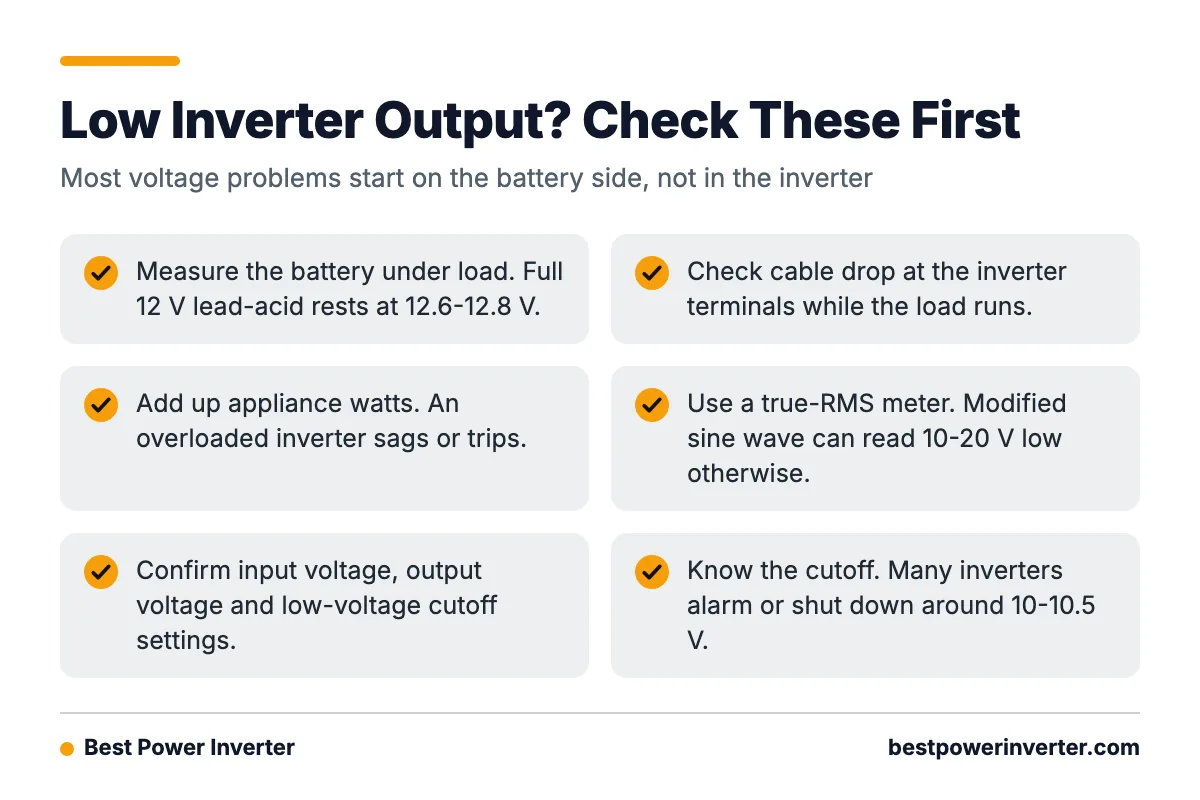
- Measure the battery under load. A 12 V lead-acid battery rests around 12.6-12.8 V when full and near 11.8 V or lower when nearly empty. Many inverters alarm or shut down around 10-10.5 V.
- Check cable drop. Measure volts at the inverter terminals while the load runs. A big gap from the battery means cables are too thin, too long or have loose lugs.
- Check load wattage. An overloaded inverter sags or trips. Add up your appliances.
- Check the meter. Modified sine wave output can read about 10-20 V low on a non-true-RMS multimeter even when the inverter works properly. Use a true-RMS meter.
- Check inverter settings. Confirm the input voltage, output voltage and low-voltage cutoff match your system.
From the Shop
A common pattern: the battery reads 12.7 V at rest, so the owner blames the inverter. Under a 1000 W load, the voltage at the inverter drops to 11 V because of long, thin cable. Replacing the cable fixes it. The inverter was never the problem.

Can an inverter stabilize voltage, and how is it different from an AVR or UPS?
A quality pure sine wave inverter regulates its own output within a set band, so it holds steady while the battery is healthy. But it does not fix poor grid voltage. A voltage stabilizer (AVR) corrects an incoming AC supply. A UPS adds a battery backup and often regulation too.
| Device | Input | Output | What it changes | Typical use |
|---|---|---|---|---|
| Inverter | DC | AC | Converts and steps up | Battery or solar power |
| Boost converter | DC | Higher DC | Raises DC voltage | Low battery to higher bus |
| Buck-boost | DC | Higher or lower DC | Raises or lowers DC | Voltage matching |
| Step-up transformer | AC | Higher AC | Raises AC, current falls | 120 V to 230 V loads |
| AVR / stabilizer | AC | AC (steady) | Corrects swings | Weak mains supply |
| UPS | AC + battery | AC | Backup and some regulation | Computers, networks |
A charge controller is different again. It manages battery charging from solar panels and does not make AC at all.
What happens when voltage increases above the rated level?
Appliances run hotter, insulation is stressed and parts wear out sooner. Motors, power supplies and heating elements are most at risk. Severe overvoltage can destroy electronics at once.
Inverters protect themselves. Most have overvoltage shutdown on both the DC input and AC output, plus overload, overtemperature and short-circuit protection. A charger or solar array pushing too high a battery voltage can trip the DC input alarm. Texas Instruments covers how power stages manage voltage in this power design resource.
Grid-tied inverters and voltage rise
Grid-tied inverters push current into the grid. To do that, their output voltage must sit slightly above the local grid voltage at the connection point. On a street with many solar homes, this can lift local voltage on sunny afternoons.
To limit this, many modern inverters use voltage-watt control. As voltage climbs toward a set limit, the inverter cuts its power output. This keeps the grid within its allowed range.
How to choose the right inverter for your voltage needs
- Input voltage: Match your battery bank: 12, 24 or 48 V. Higher input voltage means lower DC current and thinner cables for the same watts.
- Output voltage: Pick 120 V/60 Hz or 230 V/50 Hz to match your appliances.
- Waveform: Pure sine wave suits electronics, motors and medical gear. Modified sine wave works for simple loads but can run some devices hot or noisy.
- Continuous and surge watts: Size above your total load. Motors need extra surge headroom.
- Cable gauge: Use thick, short cables to keep drop near 3% or less.
- Topology: Low-frequency for heavy surge loads, high-frequency for light weight and lower cost.

Frequently Asked Questions
Can inverter increase voltage?
Yes, but only to its fixed design value. It steps a low DC voltage up to mains-level AC. It cannot go beyond that, and it cannot add power.
How does an inverter increase voltage?
It uses either a DC-DC boost stage with a small transformer, or a large low-frequency transformer after an H-bridge. Both raise voltage while current falls.
How to increase inverter output voltage?
You generally cannot adjust it. First fix battery charge, cable drop and overload. If you need a different voltage, use a suitable inverter or a step-up transformer.
How to increase output voltage of an inverter safely?
Do not modify the circuit. Add a properly rated step-up transformer on the AC side, or pick a model made for the voltage you need.
How does a boost converter increase voltage?
It stores energy in an inductor and releases it at a higher voltage through a diode. In continuous mode, Vout = Vin / (1 – D). Current drops as voltage rises.
Can inverter stabilize voltage?
It holds its own output within a set range, usually +/-5-10% on pure sine wave units. It does not correct a poor mains supply. Use an AVR for that.
What happens when voltage increases?
Equipment runs hotter and wears faster, and severe overvoltage can cause damage. Inverters shut down on overvoltage to protect themselves and your loads.
Sources