
Inverter short circuit protection is a built-in electronic circuit that spots a dead short or extreme overcurrent on the AC output and cuts power within milliseconds. Then it either retries on its own or waits for you to reset it. It protects the inverter and the AC wiring only. It does nothing for the thick cables between your battery and the inverter, so you still need a correctly sized fuse or breaker close to the battery. This guide explains how the protection works, why it sometimes trips when nothing is shorted, and how to size that battery fuse with the numbers shown.
Quick answer
Built-in short circuit protection keeps the inverter’s output safe. It does not protect your battery cables. Add a DC fuse sized at about 125% of the inverter’s input current, rated no higher than the cable can carry, and mounted close to the battery.
- Best for lithium banks: Class T fuse, commonly rated to interrupt about 20,000A DC.
- Best for motor-heavy loads: a low-frequency inverter, which handles longer surges.
- Short circuit protection only watches the AC output. A short in the battery cable is the real fire risk, and only a DC fuse stops it.
- Electronic protection usually shuts the output down within milliseconds, much faster than a normal AC breaker.
- Auto-retry (“hiccup”) inverters click on and off while a fault is present. Latching inverters stay off until you reset them.
- Many ‘short circuit’ trips come from start-up surges: motors, compressors, microwaves, cold bulbs and thin DC cables.
- Fuse size = inverter watts ÷ (battery volts × efficiency) × 1.25, and never larger than the cable’s rating.
- With lithium batteries, the fuse’s interrupt rating (AIC) matters as much as its amp rating.
- What does short circuit protection on an inverter actually do?
- What is the difference between short circuit, overload, and surge protection?
- Why does my inverter say ‘short circuit’ when nothing is shorted?
- Does the inverter’s built-in protection protect the battery cables?
- What size fuse do I need between the battery and the inverter?
- Do I need a GFCI with an inverter?
- How do I reset an inverter after a short circuit fault?
- What to look for when buying an inverter
- Frequently Asked Questions
What does short circuit protection on an inverter actually do?
It watches the current leaving the inverter and shuts the output off when that current jumps far too high. That’s the whole job. It keeps the inverter from destroying itself when something on the AC side shorts.
Inside every inverter is an output stage. This is a set of power transistors, called MOSFETs or IGBTs, that switch the battery’s DC power on and off very fast to build AC power. These parts are tough, but they can’t survive a dead short for long. So the inverter measures output current all the time, using a tiny sensing resistor or a current sensor.
When a short happens, three things follow:
- Current limiting. The controller first clamps the current so it can’t keep rising.
- Shutdown. If the high current doesn’t drop away, the output turns off. Most inverters show a fault light, a code such as ‘SHORT’, or an alarm beep. Codes vary by brand.
- Restart or wait. What happens next depends on the design.
Auto-retry vs latching shutdown
Some inverters use auto-retry, also called “hiccup” mode. They wait a moment, turn back on, and test again. If the short is still there, they shut off again. You hear clicking or beeping over and over. That is normal while a fault is plugged in. It is not normal if it keeps happening with nothing plugged in. That points to an internal fault or a wiring problem at the inverter itself.
Other inverters latch. They stay off until you press a reset button, switch them off and on, or use a remote panel. Latching is a little less convenient. But it stops the inverter from hammering a fault again and again.
How fast does it shut off?
Electronic short circuit protection typically acts within milliseconds. A thermal-magnetic breaker on the AC side is much slower. So in many inverter systems, the inverter shuts down before any downstream AC breaker trips. That’s why your breaker may still look fine after a short.
What is the difference between short circuit, overload, and surge protection?
They react to different problems at different speeds. A short circuit is a sudden, huge current. An overload is too much load for too long. A surge is a brief spike, usually when something starts up. Most inverters have several more protections too. The table below puts them side by side.
| Protection | What triggers it | Typical response | What it protects | Typical reset | What you notice |
|---|---|---|---|---|---|
| Short circuit | Dead short or extreme current on the AC output | Milliseconds | Output stage and AC wiring | Auto-retry or manual | Output dies instantly; ‘SHORT’ code or alarm |
| Overload | Load above the continuous rating for too long | Seconds to minutes | Output stage, against heat | Remove load, then reset | ‘OLP’ or overload light after a big load runs a while |
| Surge / peak | Start-up demand above the surge limit | Very short; depends on design | Output stage | Usually auto once the load is removed | Trips the moment a motor or microwave starts |
| Over-temperature | Internal heat sink gets too hot | Builds over minutes | Electronics | Auto after cooling | Shuts down on hot days or in closed cupboards |
| Low voltage | Battery voltage falls below the cut-off | Seconds, often with a delay | Battery | Auto when voltage recovers, or manual | Warning beeps, then shutdown |
| Ground fault (GFCI) | Current leaking to ground | A fraction of a second | People, against shock | Press reset on the GFCI outlet | Outlet goes dead, inverter stays on |
Surge limits differ a lot by design. Many high-frequency inverters advertise about 2× their continuous rating for a very short time. Low-frequency, transformer-based inverters often handle about 3× for several seconds. That longer window is why they trip less often on motor starts.
Why does my inverter say ‘short circuit’ when nothing is shorted?
Usually a load is pulling a huge burst of current as it starts. To the inverter, that burst looks like a short. Some loads are well known for this:
- Motors and compressors. Fridges, freezers, air conditioners, pumps and power tools can draw several times their running current to get moving.
- Microwaves. Their large transformer pulls a big burst at switch-on.
- Capacitor-input power supplies. Laptops, TVs and LED drivers charge internal capacitors (small energy stores) the instant you plug them in.
- Incandescent and halogen bulbs. A cold filament has much lower resistance than a hot one. It draws many times its normal current for a split second.
Thin DC cables cause trouble too. When a big load starts, current through an undersized cable drops the voltage at the inverter. That sag can make the inverter fail to hold its output, and some models report it as a short or overload. Long runs and loose lugs make this worse.

How to tell a real short from a surge trip
- Real short: it trips every time with that one item, even when it is the only thing plugged in. It trips at once, not just at start-up.
- Surge trip: it only trips when the item starts. It often works if other loads are off first.
- Damaged cord: it trips when you move or bend an extension cord. Look for crushed or melted spots.
Does the inverter’s built-in protection protect the battery cables?
No. The protection sits inside the inverter, after the DC input terminals. It can only see current flowing out of the AC side. A short in the cable between the battery and the inverter happens before the inverter. The inverter never knows.
Picture a battery cable that rubs through on a sharp metal edge and touches the chassis. Now the battery is shorted straight through that cable. The current is limited only by the battery’s own internal resistance and the cable itself. A lithium bank can push thousands of amps. The cable heats in seconds, the insulation melts, and nearby materials can catch fire.
Only a fuse or DC breaker placed close to the battery can stop this. Its job is to protect the cable, not the inverter. Marine rules show how close is close. ABYC E-11, the standard for boat DC systems, generally requires overcurrent protection within 7 inches of the battery connection. Longer runs are allowed only when the cable is sheathed or enclosed. It’s a good rule to copy in an RV or van too.
What size fuse do I need between the battery and the inverter?
Work out the inverter’s maximum input current, multiply by 1.25, and round up to the next standard fuse size. Then check that the cable is rated to carry more than that fuse. If it isn’t, use thicker cable. Never pick a fuse larger than the cable’s rating.
The input current formula is:
DC amps ≈ AC watts ÷ (battery volts × efficiency)
Efficiency is how much of the battery’s power turns into AC power. Use the figure from your inverter’s spec sheet. The examples below use 90%.
Worked example
A van owner has a 2,000W inverter on a 12V battery. The inverter is about 90% efficient.
- Input current: 2,000 ÷ (12 × 0.9) = 2,000 ÷ 10.8 ≈ 185A
- Add 25%: 185 × 1.25 ≈ 231A
- Next standard size up: 250A fuse
- Cable: must be rated above 250A. For a short run, that usually means 4/0 AWG.
Now the same inverter on 24V: 2,000 ÷ (24 × 0.9) ≈ 93A. Times 1.25 is about 116A, so a 125A fuse. On 48V: 2,000 ÷ (48 × 0.9) ≈ 46A. Times 1.25 is about 58A, so a 60A fuse.
| System voltage | Input current (2,000W, 90%) | × 1.25 | Fuse size |
|---|---|---|---|
| 12V | ≈ 185A | ≈ 231A | 250A |
| 24V | ≈ 93A | ≈ 116A | 125A |
| 48V | ≈ 46A | ≈ 58A | 60A |
See the pattern? Double the voltage and the current halves. Lower current means thinner cable, smaller fuses and less heat. If you are planning a system above about 2,000W, a 24V or 48V bank makes protection much easier.
Which fuse type should you use?
| Type | Good for | Check before buying |
|---|---|---|
| Class T | Lithium banks and large systems | Needs its own holder; costs more |
| MRBF | Mounting right on the battery terminal | Interrupt rating on the label vs your bank’s fault current |
| ANL | Smaller lead-acid systems | Lower interrupt rating; often not enough for lithium |
| MEGA | Compact bolt-down fuse blocks | DC voltage and interrupt ratings |
| DC breaker | Protection plus an off switch | Must be DC-rated with a suitable interrupt rating |
Never use an AC-only breaker on the DC side. DC arcs are harder to put out, and an AC breaker may not break them safely.
Do I need a GFCI with an inverter?
Yes, anywhere people might touch a faulty device near water: kitchens, bathrooms, outdoors and on boats. A GFCI (ground fault circuit interrupter) does a different job from short circuit protection. It watches for tiny current leaks to ground, like current flowing through a person. Class A GFCI devices under UL 943 trip at about 4-6 mA. Short circuit protection would never notice a leak that small.
Some inverters have a GFCI outlet or an AC output breaker built in. If yours does not, add GFCI protection in the AC wiring.
Neutral-ground bonding and transfer switches
In AC wiring, neutral and ground must be joined (bonded) at exactly one point: the power source. When the inverter is the source, the bond belongs at the inverter. When shore or grid power is the source, the bond belongs there instead. Many RV inverters and transfer switches move this bond on their own. Two bonds at once can cause GFCI trips and odd faults. No bond at all can stop a GFCI or breaker from working. Your inverter manual should say how it handles bonding. Follow it exactly.
How do I reset an inverter after a short circuit fault?
Remove the cause first, then reset. Resetting with the fault still plugged in just trips it again. Work through these steps in order:
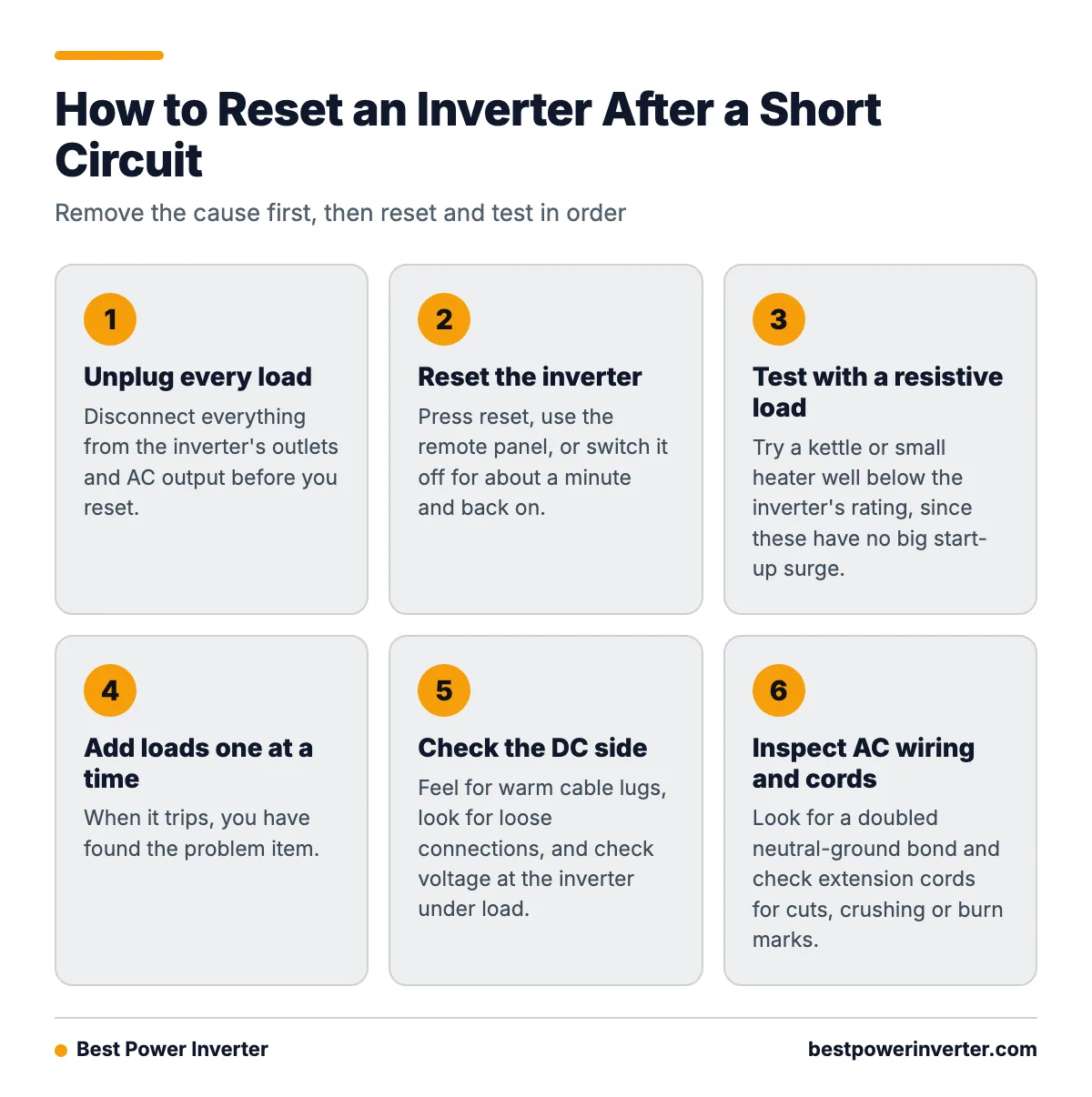
- Unplug every load from the inverter’s outlets and AC output.
- Reset the inverter. Press the reset button, use the remote panel, or switch it off for about a minute and back on. Your manual gives the exact method.
- Test with a simple resistive load, such as a kettle or a small heater well below the inverter’s rating. These have no big start-up surge.
- Add loads one at a time. When it trips, you have found the problem item.
- Check the DC side. Feel for warm cable lugs and look for loose connections. If you have a meter, check the voltage at the inverter terminals while a load runs. A big drop from the battery reading means the cable is too thin or a connection is poor.
- Inspect the AC wiring for a doubled neutral-ground bond, especially after adding a transfer switch.
- Check extension cords for cuts, crushing or burn marks.

If it trips with nothing plugged in: stop using it. Check the AC output wiring, then contact the maker. This points to an internal fault.
If it trips only when one item starts: that item’s surge is too high. Use a larger or low-frequency inverter, or a soft-start device for motors.
If it trips with any big load: check DC cable size and connections before blaming the inverter.
If it trips when a cord moves: replace the cord.
Manufacturer manuals list each protection and its reset method. For one example, see this Samlex inverter owner’s manual, which shows how makers describe their protection features.
What to look for when buying an inverter
Look past the wattage. How an inverter protects itself decides how often it trips and how easy it is to live with. Check these points on the spec sheet or manual:
- Published surge rating and duration. “2× surge” means little without a time. A few seconds matters more than a big peak number if you run fridges or pumps.
- Low-frequency vs high-frequency. Low-frequency models are heavier and cost more. They often handle about 3× surge for several seconds. High-frequency models are lighter but less forgiving of motor starts.
- Reset type. Know whether it auto-retries or latches. If the inverter sits in a locker, a remote reset panel saves crawling in to press a button.
- AC output breaker or GFCI. Built-in protection means less wiring for you to add.
- Safety listing. In the US, look for UL 458, the standard for inverters in land vehicles and boats. In Canada, look for CSA C22.2 No. 107.1. Grid-interactive inverters are covered by UL 1741 instead. Outside North America, many makers test to IEC 62477-1, the safety standard for power electronic converter systems.
For most RV and van owners, a listed pure sine wave inverter with a clear surge spec and a remote reset is the right choice. If you run a big fridge or a water pump, lean toward a low-frequency model.
Frequently Asked Questions
How fast does an inverter shut off when there is a short?
Electronic short circuit protection typically shuts the output down within milliseconds. That is much faster than a thermal-magnetic breaker on the AC side. It is why an inverter often shuts off before any AC breaker in the system trips.
Can a short circuit damage an inverter even if it has protection?
Yes, it can. Protection lowers the risk, but repeated shorts, shorts under heavy load, or a failed sensing circuit can still damage the output transistors. The protection also does nothing for faults on the DC side. That’s why the battery fuse matters so much.
Are pure sine wave and modified sine wave inverters protected differently?
Not really. Both use the same kind of current sensing and shutdown. The bigger difference is low-frequency vs high-frequency design, which changes surge tolerance. Some loads run hotter or draw odd current on modified sine wave power. That can lead to more overload or surge trips.
Is it safe to keep using an inverter after a short circuit fault?
Usually, if you find and remove the cause first. If it resets and runs a simple test load normally, the protection did its job. If it trips with nothing plugged in, smells hot, or shows damage, stop using it and contact the maker.
Sources