
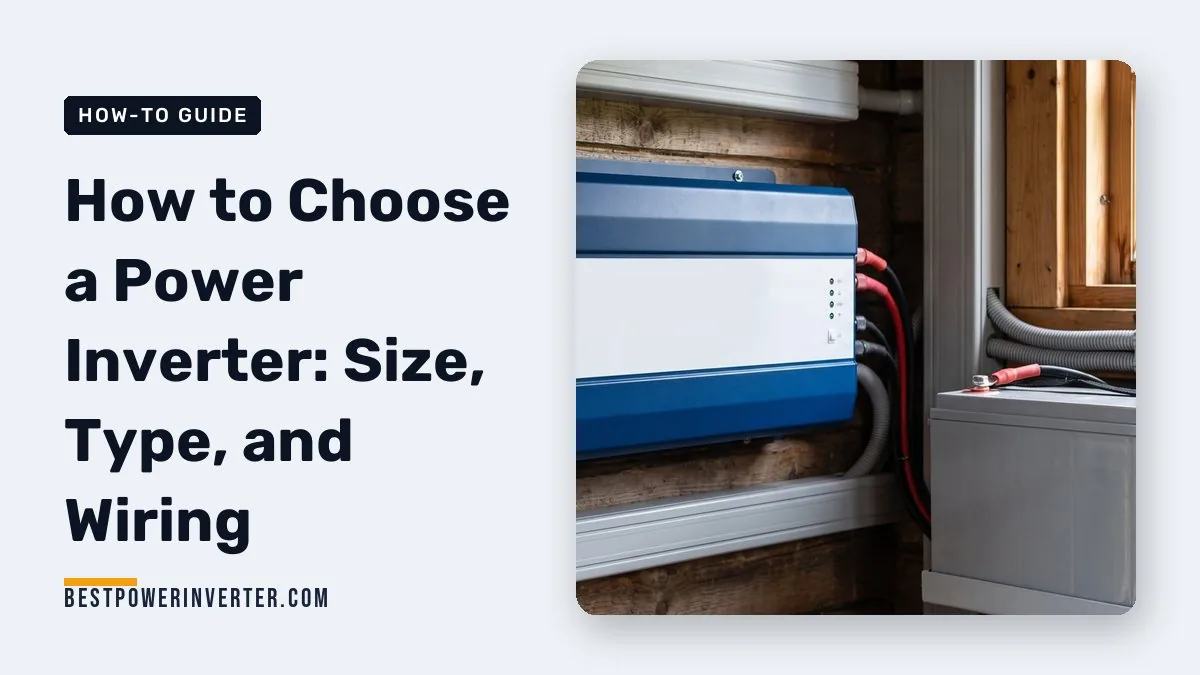
Choose a power inverter by adding the running watts of every device you will use at the same time, then adding 20-25% headroom. Next, check that the surge rating covers the biggest motor startup, and match the inverter’s voltage, waveform, cables, and fuse to your battery or vehicle.
Quick answer
Total your simultaneous running watts and add 20-25%. Make sure the surge rating covers the largest motor startup. Pick pure sine wave for motors and electronics, and size the cables and fuse for the DC current.
- Best for motors and electronics: pure sine wave
- Best for loads above 1,000W: 24V or 48V systems
- Best for small gadgets in a car: a plug-in unit under 150W
- Add running watts of devices that run together, then multiply by 1.20-1.25.
- Compare the largest startup surge with the inverter’s surge rating separately.
- Watts measure power. Watt-hours measure stored energy. Amp-hours depend on battery voltage.
- Pure sine wave is the safer choice for pumps, fridges, tools, and sensitive electronics.
- Higher system voltage (24V or 48V) cuts DC current and cable size for large loads.
- Most troubleshooting starts with the battery, fuse, and connections, not the inverter.
- How Does a Power Inverter Work?
- Continuous Watts vs. Surge Watts
- How Do I Choose a Power Inverter?
- How Big of an Inverter Do I Need for Common Appliances?
- Pure Sine Wave or Modified Sine Wave?
- How Much Battery Power Does an Inverter Use?
- How Big of a Power Inverter Can My Truck Handle?
- What Inverter Size Suits a 5000Wh Battery?
- How Do I Choose the Best Off-Grid Power Inverter?
- Pre-Purchase Checklist
- Why Is My Inverter Not Giving Power?
- Frequently Asked Questions
How Does a Power Inverter Work?
A power inverter converts direct current (DC) from a battery into alternating current (AC), the kind of power a wall outlet supplies. Inside, fast electronic switches flip the DC back and forth. A transformer or other circuitry then raises the voltage, typically to 120V AC in North America, and shapes the output into a waveform.
The conversion is not free. Some energy turns into heat, so the battery always supplies more power than the appliance receives. Many inverters are rated at roughly 85-95% efficiency at good load levels, according to typical manufacturer specifications. The exact figure is on the spec sheet.
This matters when you choose a unit. The battery side, the AC side, and the wiring between them all have limits. Ignore any one of them and something overheats, trips, or blows a fuse.
What Is the Difference Between Continuous Watts and Surge Watts?
Continuous watts are what an inverter can deliver for as long as you need. Surge watts, also called peak or starting watts, are a short burst for startup demand.
Many motor-driven items pull extra power for a moment when they start. Pumps, refrigerators, and compressors can draw about 2-7 times their running power during startup, depending on the equipment. Total starting demand equals the normal running power plus the additional starting power.
Surge ratings usually last a very short time. If a load has a long or repeated startup, size against the inverter’s continuous rating unless the maker clearly states the surge can last long enough. That is the part many buyers miss. A “3,000W peak” label does not mean 3,000W is available for a few seconds every time you need it.
How Do I Choose a Power Inverter?
Use a simple method. Total the running watts of devices that may operate at the same time, then choose about 20-25% more continuous capacity. After that, check the largest startup surge on its own.
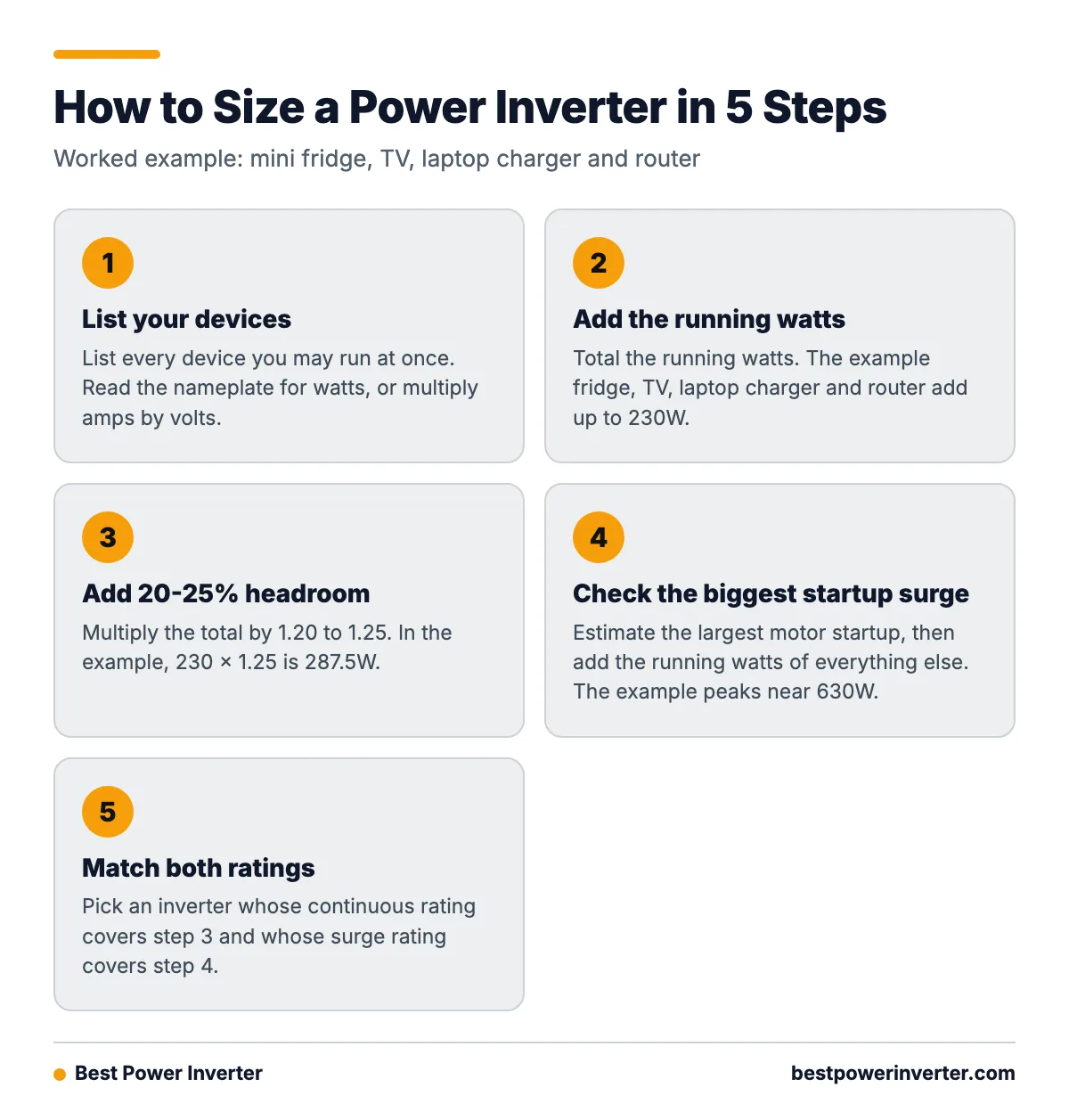
Step-by-step sizing formula
- List every device you may run at once. Read the nameplate or label for watts. If it shows only amps, multiply amps by volts.
- Add the running watts.
- Multiply the total by 1.20 to 1.25 for headroom.
- Find the single largest motor or compressor. Estimate its startup watts, then add the running watts of everything else that is already on.
- Pick an inverter whose continuous rating covers step 3 and whose surge rating covers step 4.
Worked example
Say you want to run a mini fridge, a 32-inch TV, a laptop charger, and a router.
- Mini fridge: 100W running
- 32-inch TV: 50W
- Laptop charger: 65W
- Router: 15W
- Running total: 230W
- With 25% headroom: 230 × 1.25 = 287.5W
Now the surge check. If the fridge compressor starts at about 5 times its running power, that is roughly 500W. The other three items add 130W. The peak is about 630W. A 300W continuous inverter looks fine on the first test but fails the second. A 600-1,000W pure sine wave unit with a surge rating above 630W fits both tests.

How Big of an Inverter Do I Need for Common Appliances?
The table below gives typical ranges for five common items. These are estimates, not guarantees. Always verify the appliance nameplate, because actual values vary by brand, age, and model.
| Appliance | Typical running watts | Startup consideration | Suggested minimum inverter |
|---|---|---|---|
| 32-inch TV | 40-60W | Small surge, if any | 150-300W continuous |
| Inkjet printer | 20-50W | Low. Laser printers can spike far higher while warming up | 300W (inkjet); 1,000W+ (laser) |
| Corded drill | 500-800W | Moderate surge when the trigger is pulled | 1,000-1,500W |
| Mini fridge | 60-120W | Compressor can pull about 3-7x on start | 600-1,000W |
| Sump pump (about 1/3 hp) | 600-1,000W | Often 2-3x or more on start | 2,000W continuous with a high surge rating |
How big power inverter to run a sump pump?
Plan on a pure sine wave inverter of about 2,000W or more for a typical 1/3 hp pump. Check the pump’s nameplate first. A 1/2 hp pump needs more. Pumps are inductive loads, so startup surge is the number that decides, not the running watts. Sump pumps matter in storms, so also check that the battery can run the pump for the whole outage.
How big an inverter to power a 32-inch TV?
A 32-inch TV usually runs on around 40-60W, so a 150-300W inverter is enough for the TV alone. Add a streaming box or game console and the total rises. Do the addition before you buy.
Should I Choose a Pure Sine Wave or Modified Sine Wave Inverter?
Choose pure sine wave if you can afford it. It produces smooth power like a utility outlet and works with nearly everything. Modified sine wave inverters cost less but make a blocky, stepped waveform.
Modified sine wave can be fine for simple resistive loads such as basic work lights or some heaters. Problems show up with motors, which can run hotter and louder, and with some chargers, audio gear, medical devices, dimmers, and laser printers. Samlex America’s inverter FAQ covers the differences between the two output types.
If you run pumps, fridges, power tools, or electronics: buy pure sine wave.
If you only power simple lights or a basic heating element on a tight budget: modified sine wave may work, but check the appliance manual first.
If the device has a motor speed control or a sensitive charger: buy pure sine wave.
How Much Battery Power Does an Inverter Use?
The battery supplies the appliance’s watts plus the inverter’s losses, and the current depends on system voltage. Use this formula: DC amps ≈ AC watts ÷ (battery volts × efficiency).
Here is 1,000W of output at 90% efficiency:
- 12V: 1,000 ÷ (12 × 0.9) ≈ 92.6A
- 24V: 1,000 ÷ (24 × 0.9) ≈ 46.3A
- 48V: 1,000 ÷ (48 × 0.9) ≈ 23.1A
More examples using the same formula:
| AC load | 12V draw | 24V draw | 48V draw |
|---|---|---|---|
| 300W | about 27.8A | about 13.9A | about 6.9A |
| 1,500W | about 138.9A | about 69.4A | about 34.7A |
| 3,000W | about 277.8A | about 138.9A | about 69.4A |
See how fast the 12V numbers climb. At 140A or more, cables get thick, connections get hot, and fuses must be rated for high current. This is why larger systems move to 24V or 48V. Use the inverter maker’s cable and fuse chart, and size the fuse to protect the wire. Add surge current on top when you size the wiring.
How big of a power drain is an inverter when nothing is plugged in?
Even an idle inverter draws power. This no-load draw is listed on the spec sheet, often in amps or watts, and some models have a low-power or sleep mode. Over a day or a week, that idle draw can empty a small battery. Turn the inverter off when you are not using it.
How Big of a Power Inverter Can My Truck or 12V Car Handle?
It depends on how you connect it. A plug-in unit in a 12V accessory socket is limited by that socket’s fuse, often 10-15A. At 12V, that is only about 120-180W before losses, so keep these to small loads like phone chargers or a laptop. Your owner’s manual lists the exact fuse.
Anything larger should connect directly to the battery with correctly sized cable and an inline fuse near the battery. As the table above shows, 1,000W pulls about 93A. That is a lot for any vehicle’s wiring if it is not upgraded.
- Engine off: a starting battery has limited usable energy. Heavy loads can leave you unable to start the truck.
- Engine running: the alternator must supply the vehicle’s own needs and the inverter. Check the alternator’s amp rating in the manual and keep a margin.
- Better setup: a separate deep-cycle or lithium house battery with an isolator or DC-to-DC charger for big loads.
What Inverter Size Is Suitable for a 5000Wh Battery?
A 5,000Wh battery is an energy size, not an inverter size. The inverter must still match your loads’ continuous watts and highest startup surge. Many people pair a battery like this with a 2,000-3,000W inverter, but your own load list decides.
Two limits matter:
- Battery discharge rate. Check the battery’s maximum continuous discharge current or power. An inverter that asks for more will trip the battery protection.
- Runtime. Runtime ≈ battery Wh × usable fraction × inverter efficiency ÷ load watts.
Example: 5,000Wh × 0.8 usable × 0.9 efficiency = 3,600Wh. At a 1,000W load, that is about 3.6 hours. At 500W, about 7.2 hours. Lead-acid batteries often allow a smaller usable fraction than lithium, so check what your battery maker recommends.
To convert to amp-hours: 5,000Wh is about 104Ah at 48V, about 208Ah at 24V, and about 417Ah at 12V.
How Do I Choose the Best Off-Grid Power Inverter?
Start with three numbers: daily energy use in watt-hours, maximum continuous demand in watts, and peak surge demand. Then allow for efficiency losses and other derating. Guides like Off Grid Collective’s load calculation guide walk through the daily load step.
Many articles stop at daily energy. That is only half the job. Daily watt-hours size the battery and solar array. Continuous and surge watts size the inverter. Both must work together.
Features worth checking
- Built-in charger and transfer switch: useful if a generator or shore power will be connected.
- MPPT compatibility: if the inverter is an all-in-one, confirm the solar charge controller’s input voltage and current limits match your panels.
- Monitoring: an app or display for voltage, load, and faults saves guesswork.
- Low-voltage protection: cut-off settings should match your battery type.
- Surge duration: look for the number of seconds the surge rating is held.
- Temperature derating: output may fall in a hot shed or engine bay. Check the derating curve.
If your loads are under about 1,000W: 12V can work.
If your loads are 1,000-3,000W: choose 24V when possible.
If you plan to run larger loads or expand later: choose 48V to keep current and cable size down.

Pre-Purchase Checklist
- Waveform: pure sine wave for motors and electronics.
- Input voltage: 12V, 24V, or 48V, matching the battery bank.
- Continuous rating: at least 20-25% above your simultaneous running load.
- Surge rating and duration: above your largest startup demand, with a stated time.
- Efficiency: check the peak figure and the figure at your usual load.
- Protections: overload, short circuit, over-temperature, low and high voltage, and reverse polarity.
- Cable and fuse sizing: match the maker’s chart for your DC current and cable length.
- Certifications: look for a recognized safety listing such as UL or ETL where required.
- Cooling: allow airflow around the unit and check fan noise.
- Installation location: dry, ventilated, close to the battery, and away from fuel and flammables.
For a broader view of how to compare models, the Power Inverters buyer’s guide is a helpful second read.
Why Is My Inverter’s Main Power Output Not Working?
Check the battery, fuse, and connections first. Most no-output problems come from the DC side, not a dead inverter. Resetting an overload is only one step.
| Symptom | Likely cause | What to check |
|---|---|---|
| No output, no lights | Flat battery, blown fuse, loose terminal | Measure battery voltage at the inverter terminals while it is on. Inspect the fuse and clean connections. |
| Low battery alarm | Battery drained or voltage sag under load | Recharge. Check cable size and length. Reduce the load. |
| Overload alarm or trip | Load too large or startup surge too high | Unplug devices, reset, add loads one at a time, starting with the motor. |
| Overheating shutdown | Blocked vents, hot location, heavy load | Clear airflow, move the unit, cut the load, let it cool. |
| Works with some devices only | Unsuitable load or waveform | Try a lower-wattage device. Check if the device needs pure sine wave. |
| Blown fuse again | Short circuit, undersized wiring, wrong fuse | Stop and inspect the wiring. Do not install a bigger fuse to “fix” it. |
A quick test: with the inverter off, measure the battery voltage. Turn it on with a small load and measure again. A big drop points to a weak battery or a poor connection. Warm cables or terminals mean high resistance. Fix the connection before anything else.
Frequently Asked Questions
How to choose a power inverter?
Add the running watts of devices that will run together and add 20-25% headroom. Check the surge rating against the largest motor startup. Then match the battery voltage, pick pure sine wave for sensitive or motor loads, and size cables and fuses for the DC current.
How does a power inverter work?
It takes DC power from a battery and switches it rapidly to create AC power. Circuitry raises the voltage and shapes the output into a sine or modified sine waveform. Some energy becomes heat, so the battery supplies more power than the appliance uses.
How can I use the main power of an inverter if it is not working?
Check the battery voltage, the DC fuse, and all connections first. Then unplug every load and reset any overload. Add devices one at a time to find the one that trips it. If it still fails, look up the fault code in the manual.
How can I choose the best off-grid power inverter?
Calculate daily watt-hours, maximum continuous watts, and peak surge watts. Pick an inverter with a matching battery voltage, strong low-voltage protection, a stated surge duration, and monitoring. If you use solar, confirm charge controller compatibility.
How big power inverter to run a sump pump?
A typical 1/3 hp sump pump often needs a pure sine wave inverter of about 2,000W or more, because startup can be 2-3 times running watts or higher. Check the pump nameplate and the inverter’s surge duration.
How big of a power drain is an inverter?
An idle inverter draws a small amount of power, listed as no-load draw on the spec sheet. Under load, add efficiency losses. A 1,000W load at 90% efficiency draws about 92.6A from a 12V battery.
How big power inverter for 5000W battery?
The battery size in Wh does not set the inverter size. Choose the inverter from your loads’ continuous watts and startup surge. Then check that the battery can deliver the needed current. Many setups use around 2,000-3,000W, but verify with your own load list.
How big an inverter to power a 32 TV?
A 32-inch TV usually uses around 40-60W, so a 150-300W inverter is typically enough. Add other devices to the total, and check the TV’s label.
How big of a power inverter can my truck handle?
A plug-in inverter is limited by the accessory socket fuse, often 10-15A, which is roughly 120-180W at 12V. Larger inverters need direct battery wiring with the right cable and fuse. Check your alternator rating and battery capacity first.
Sources