
Power inverter installation starts with two choices: the inverter’s size and the wiring that feeds it. Pick an inverter whose continuous rating is above your combined running watts and whose surge rating covers the biggest motor start. Then match its DC voltage to your battery and wire it with the cable, fuse, and clearances the manufacturer specifies.
Quick answer
Add up the running watts of everything that will run at once, then add the largest startup surge. Divide AC watts by battery volts and about 0.9 efficiency to find DC amps, and size the cable and fuse for that current, following the inverter manual.
- Best for small electronics: 300-600W, simple wiring
- Best for pumps, drills, fridges: 1,500-2,000W pure sine
- Best for 2,000W and up: 24V or 48V system
- Running watts set the continuous rating. Motor startup surge sets the surge rating.
- A 2,000W load pulls about 185A at 12V but only about 46A at 48V.
- Battery size (watt-hours) sets runtime. It does not set inverter size.
- A car accessory outlet is not a safe source for a large inverter.
- Fuse and cable sizes come from the manufacturer, not from wattage alone.
- Leave the inverter off when you are not using it. Idle draw empties batteries.
- How Does a DC-to-AC Power Inverter Work?
- Continuous Watts, Surge Watts, and Starting Loads
- How Big an Inverter Do I Need? Load by Load
- Pure Sine Wave vs Modified Sine Wave
- 12V, 24V, or 48V: Which System Fits?
- Battery Size, Runtime, and Idle Drain
- Power Inverter Installation Guide
- How Big of a Power Inverter Can My Truck Handle?
- Inverter Sizing Worksheet
- Renogy 2000W Inverter Considerations
- What Do Owners Say?
- Frequently Asked Questions
How Does a DC-to-AC Power Inverter Work?
A power inverter turns direct current (DC) from a battery into alternating current (AC), the kind that comes out of a wall outlet. Inside, switching transistors flip the battery’s DC back and forth thousands of times a second. A transformer or boost stage raises the voltage, and filters shape the result into a usable AC waveform.
That conversion is not free. Heat is the cost. Most inverters run at roughly 85 to 95 percent efficiency, which is why the math later in this guide uses 90 percent. The lost energy becomes heat, and that heat is why ventilation matters.
Continuous Watts, Surge Watts, and Starting Loads
Continuous watts are what the inverter can deliver all day. Surge (peak) watts are what it can deliver for a second or two. Motors and compressors pull far more power for that first moment than they do while running.
This is where many installs fail. A sump pump might run at 800W but need two or three times that to start. If the inverter’s surge rating is too low, it trips on overload and shuts down. The load never starts, and the owner blames the battery.
How Big an Inverter Do I Need? Load by Load
The table below lists typical figures for common loads. These are general estimates, not measurements of a specific product. Always read your own appliance label, because models differ.
| Load | Typical running watts | Estimated startup watts | Recommended inverter | Pure sine advisable? |
|---|---|---|---|---|
| Sump pump (1/3 hp) | 600-800W | 1,500-2,400W | 2,000W or more | Yes |
| 32-inch LED TV | 30-60W | Close to running | 300W | Preferred |
| Mini fridge | 50-100W | 300-600W | 800-1,000W | Yes |
| Inkjet printer | 20-50W | Low | 300W | Preferred |
| Laser printer | 300-600W | Up to about 1,000W warming up | 1,500W | Yes |
| Corded drill | 500-800W | Up to about 2x running | 1,500W | Yes |
How big power inverter to run a sump pump?
Plan on a 2,000W pure sine inverter or larger for a typical 1/3 hp pump. The running load is moderate, but the startup surge can double or triple it. A pump is also a backup-power load, so the inverter will be called on during storms, when failure costs the most. Wire it to a battery bank sized for hours of cycling, not minutes.
How big an inverter do I need for a 32-inch TV?
A 300W inverter covers a 32-inch LED TV with room to spare. Most draw well under 100W. If you add a streaming box or game console, add their watts and keep a margin.
How big of a power inverter do I need for a mini fridge?
Choose 800 to 1,000W. The fridge may run at under 100W, but the compressor surges when it starts. A pure sine inverter treats the compressor motor more gently and runs cooler.
How big of an inverter do I need to run a printer or drill?
An inkjet printer needs only about 300W. A laser printer needs far more because its fuser heats up at once, so choose around 1,500W. A corded drill is a motor load, so 1,500W is a safer choice than 1,000W. A cordless drill is different. You are only running its charger, usually under 200W.
From the Shop
Here is a pattern that shows up again and again in owner discussions. Someone buys a 1,000W inverter because the pump label says 700W. The pump starts once, trips the inverter, and stays dead. The label was right about running watts. The startup surge was the missing number. The fix is a bigger surge rating, not a bigger battery.

Pure Sine Wave vs Modified Sine Wave
Pure sine wave output matches the smooth AC from the grid. Modified sine wave output is a stepped, blocky approximation. Simple heating loads and many chargers accept it. Motors, compressors, TVs, audio gear, and medical devices run better on pure sine. Modified units can make motors hum, run hot, and lose efficiency.
The price gap has narrowed. For anything with a motor or sensitive electronics, buy pure sine. It is the safer default.
12V, 24V, or 48V: Which System Fits?
The inverter’s DC voltage must match the battery bank. According to the Renogy 2000W 12V inverter product page, a 12V bank needs a 12V-compatible inverter. Plugging a 12V unit into a 24V bank destroys it.
What is a 48-volt power inverter, and when is it better than a 12-volt inverter?
A 48-volt inverter runs from a 48V battery bank. It is better when loads reach about 2,000W or more. The same watts need far fewer amps at higher voltage, so cables get thinner, cheaper, and cooler.
Worked example: a 2,000W load
The formula is: DC amps = AC watts ÷ (battery volts × efficiency). Using 90 percent efficiency:
| Battery voltage | Calculation | DC current |
|---|---|---|
| 12V | 2,000 ÷ (12 × 0.9) | About 185A |
| 24V | 2,000 ÷ (24 × 0.9) | About 93A |
| 48V | 2,000 ÷ (48 × 0.9) | About 46A |
The 48V figure matches the roughly 46.3A cited in the ElectricalFlux inverter system sizing guide, which uses about 2,222W of DC input to account for inverter losses. At 12V, nearly 180A is needed just for an 1,800W load, before extra losses. That is welding-cable territory.
What is the difference between a 4000-watt inverter and a 2000-watt inverter?
A 4,000W inverter can run twice the load, and it draws twice the DC current. At 12V, that would be over 370A by the same formula, which is impractical for most installs. Most 4,000W units are therefore built for 24V or 48V banks. A 2,000W unit suits one motor load plus small items. A 4,000W unit suits power tools, a well pump, or several appliances at once. Buy the bigger one only if your worksheet total needs it. Larger units also waste more energy at idle.
If your largest sustained load is under 1,000W: a 12V system is fine.
If it is 1,000-2,000W: 12V works with heavy cable, but 24V is easier.
If it is over 2,000W: choose 24V or 48V.
Battery Size, Runtime, and Idle Drain
How big power inverter for a 5,000Wh battery?
The battery does not set the inverter size. The loads do. A 5,000Wh battery stores energy. A 1,000W inverter and a 3,000W inverter can both run from it. The difference is how fast they empty it and how much current the battery can safely deliver. Check the battery’s maximum discharge rating before pairing it with a large inverter.
For runtime, use usable energy. Say a lithium battery allows about 90 percent usable capacity, or 4,500Wh. Multiply by 0.9 inverter efficiency to get about 4,050Wh at the outlet. A steady 500W load would then run about 8 hours. Lead-acid batteries have much less usable capacity, so the same label holds less.
How much power does an inverter drain from a battery?
Even with nothing plugged in, an inverter draws idle (no-load) power. The number is on the spec sheet and varies by model. As an example, a 1A idle draw at 12V is 12W, or 288Wh over a day. That can flatten a small battery over a few days. Owners of several brands report this problem, so switch the unit off when you are not using it.
Power Inverter Installation Guide
This section is a general power inverter installation guide. Your manual always wins. For more detail on mounting and ventilation, see the DMX Power inverter installation overview.
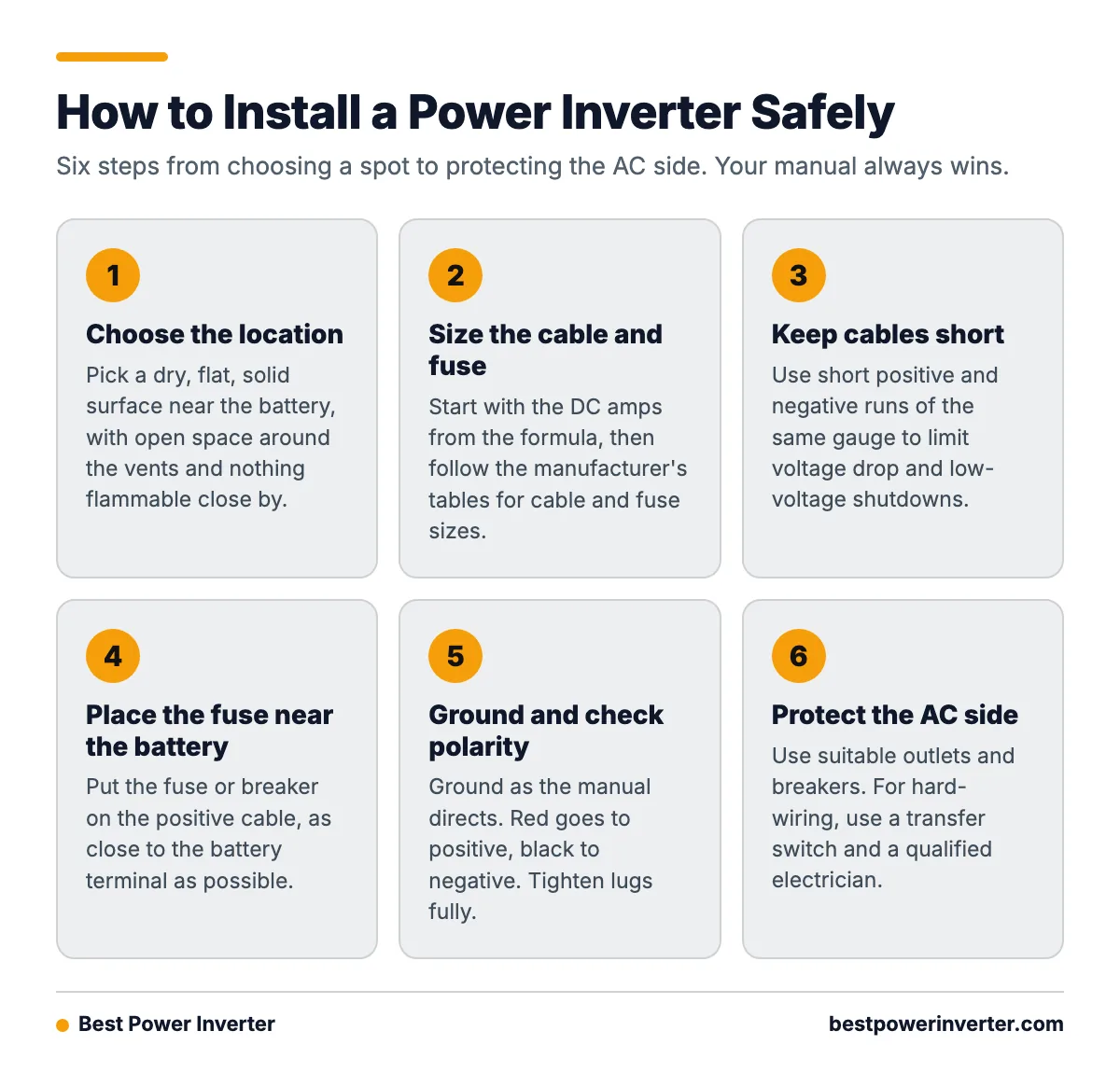
Step 1: Choose the location
Pick a dry, flat, solid surface. Keep the inverter close to the battery. Leave open space around the vents so heat can leave, and keep it away from anything flammable. Installation requires enough surrounding space for ventilation and must avoid fire hazards. Do not bury it in a closed cabinet, and do not mount it in a battery box where flammable gases can collect.
Step 2: Size the cable and fuse
Use the DC current from the formula above as your starting point, then follow the manufacturer’s tables. The Renogy PCL series operation manual points users to its technical specifications for maximum wire sizes and allowable wire current. The fuse exists to protect the cable from overheating, so fuse and conductor sizing must follow the installation requirements, not inverter wattage alone.
Step 3: Keep cables short and limit voltage drop
Long cables lose voltage under load. At 185A, a small drop in volts is a lot of wasted watts, and the inverter may shut down on low-voltage alarms. Keep both the positive and negative runs as short as practical, and use the same gauge on both. Never use undersized cable because it was handy.
Step 4: Place the fuse near the battery
Install the fuse or breaker on the positive cable, as close to the battery terminal as possible. If the cable shorts anywhere along its length, the fuse is what stops it. A fuse placed at the inverter end leaves the whole cable unprotected.
Step 5: Ground and check polarity
Connect the chassis ground terminal as the manual directs. Red goes to positive and black to negative. Reverse polarity can destroy an inverter instantly, and many units are not protected against it. Tighten lugs fully, since loose high-current connections get hot.
Step 6: Protect the AC side
Use outlets and breakers suited to the inverter’s output. If you are hard-wiring to RV or home circuits, use a transfer switch so the inverter never connects to shore or grid power at the same time. That work should be done by a qualified electrician.
How Big of a Power Inverter Can My Truck Handle?
The wiring limits it before the engine does. A cigarette-lighter or accessory outlet is usually fused at a modest current. Check your vehicle’s manual for the figure. At 12V, a 15A fuse supports only about 180W at best. Anything larger needs a direct battery connection with its own fuse.
What size inverter is appropriate for a 12V car?
For a plug-in unit, stay at about 150W or whatever the outlet fuse allows. That covers laptop and phone charging. For 300W to 1,000W, connect straight to the battery. Above that, you need heavy cable, and the alternator and battery start to matter. A typical alternator may deliver a few dozen amps beyond the vehicle’s own needs, and a 1,500W load asks for well over 100A. Your battery covers the gap, but only for a short time.

Vehicle installation checklist
- Battery connection: Connect directly to the battery terminals or a proper distribution post, not to the accessory circuit.
- Fuse placement: Install it on the positive cable close to the battery.
- Cable length: Keep it short, and use the same size for positive and negative.
- Ventilation: Leave clear space around the vents. Do not cover the inverter with bags or gear.
- Grounding: Ground to bare chassis metal as the manual describes.
- Engine running: Run the engine for loads above a few hundred watts so the battery is not drained.
- Shutdown: Switch the inverter off before turning off the engine, and switch it off whenever it sits unused.
Inverter Sizing Worksheet
Use these steps in order:
- List the loads that run at the same time. Add their running watts.
- Find the biggest startup surge. Take only the largest motor, not all of them. Add its extra surge watts (startup minus running) to the total.
- Compare with the inverter’s ratings. The running total must fit under continuous watts. The total with surge must fit under surge watts.
- Add a margin. Many installers leave about 20 percent spare, so the inverter does not run at its limit.
- Find DC amps. Divide AC watts by battery volts and 0.9.
- Check the battery. Multiply usable watt-hours by 0.9, then divide by load watts to get hours of runtime.
Example: a mini fridge (80W), a TV (50W), and a laptop charger (65W) run together at 195W. Add the fridge’s extra surge, perhaps 400W. The total is about 595W. A 1,000W pure sine inverter gives a comfortable margin. At 12V, the DC current at 195W is only about 18A.
Renogy 2000W Inverter Considerations
The Renogy 2000W inverter is marketed for 12V battery systems and for uses including RVs and off-grid power. Owner reports repeatedly praise its capacity and ease of setup. Some also report reliability failures, battery drain when left on, limited instructions, and difficulty fitting its large enclosure.
Turn those reports into a neutral checklist before you buy:
- Measure first. The case is large, so confirm the mounting space and the ventilation clearance around it.
- Read the full manual. The short instructions leave gaps for beginners. The manual covers the wire and fuse specs.
- Check the supplied cables. Compare them with the manual’s requirements. Replace them if they fall short.
- Plan a shutoff. Use a switch or remote so the unit is not left idling.
- Keep your paperwork. Save receipts and photos in case of a warranty claim.
- Consider 24V. A 12V 2,000W system needs about 185A at full load, as shown earlier.
What do owners say?
Owners like
- Runs several common RV and household loads when correctly installed
- Good power capacity for a 2000W unit
- Straightforward setup for experienced installers
- Low idle consumption is reported by some owners
- Pure sine wave output performs better with sensitive appliances than older modified-sine units
Common complaints
- Some owners report units failing after several months
- Leaving the inverter on can drain the vehicle or house battery
- Included instructions can be limited or unclear for beginners
- The enclosure is large and difficult to fit into some van or RV installations
- Some owners report concerns about supplied cables, mounting guidance, or customer-service and return delays
Summarised from owner reviews and long-term user reports; individual experiences vary.
Frequently Asked Questions
How big power inverter to run sump pump?
Use a 2,000W pure sine inverter or larger for a typical 1/3 hp pump. Running watts may be 600 to 800W, but startup can reach two or three times that. Check the pump’s nameplate.
What is a 48 volt power inverter?
It is an inverter that runs from a 48V battery bank. It suits loads of about 2,000W and up because it needs about a quarter of the current of a 12V system. A 2,000W load draws about 46A at 48V versus about 185A at 12V.
How big of a power drain is an inverter?
It depends on the model. Every inverter draws idle power even with no load, and the figure is on its spec sheet. For example, 1A at 12V is 12W, or about 288Wh a day. Switch it off when unused.
How big power inverter for 5000w battery?
Size the inverter to your loads, not the battery. A 5,000Wh battery sets runtime. Check its maximum discharge current, and make sure it can supply the DC amps your inverter will pull.
How big an inverter to power a 32 tv?
A 300W inverter is plenty. Most 32-inch LED TVs use well under 100W. Add any console or streaming box to the total.
How big of a power inverter can my truck handle?
Through the accessory outlet, only about as much as its fuse allows, often around 150W. With a direct, fused battery connection and the engine running, larger inverters are possible. The limit then becomes cable, battery, and alternator capacity.
4000 watt power inverter: is it worth it?
Only if your loads need it. A 4,000W inverter runs twice the load of a 2,000W unit but draws twice the current, which is why most are 24V or 48V designs. It also idles higher.
How big inverter to power printer?
A 300W inverter handles most inkjet printers. A laser printer needs about 1,500W because of its warm-up surge.
How big of power inverter for 12v car?
Stay near 150W for a plug-in outlet. For 300 to 1,000W, wire directly to the battery with a fuse and keep the engine running.
How big power inverter to run drill?
Choose about 1,500W for a corded drill, since motors surge at startup. A cordless drill only needs enough for its charger, usually under 200W.
Sources