

The best power inverter under $20 is a 150W to 200W modified sine wave unit that plugs into a 12V cigarette-lighter socket. It suits phone chargers, laptop adapters and other small loads, but not appliances with motors or heating elements. The vehicle’s accessory-socket fuse, usually 10 to 15 amps (roughly 120 to 180 watts at 12V), caps real output no matter what the label says.
Quick answer
Most readers should buy the 150W unit from the Top Pick below, keep laptop and phone loads under about 100W, and check the socket fuse in the owner’s manual first. Anything larger needs battery clamps.
- Best for most drivers: 150W inverter, B08YTH66FN, $15.99
- Best for tightest budget: FAMIDGE 200W, $9.99
- Best for compact storage: FOVAL 150W
Our Winner: 150W Power Inverters for Vehicles 12V DC to 110V AC Car Plug Adapter Outlet
Based on the listing, it states 150W continuous and 300W peak output, which is a realistic rating for a socket-powered unit. It adds a smart chip plus a built-in fuse, a metal housing and two USB ports at $15.99, with a 4.4/5 rating.
How We Compared These Models
This comparison is based on listing specifications and buyer feedback patterns, not hands-on testing. The criteria were: whether the wattage claim is realistic for a 12V socket, the protections listed (fuse, overload, over/under voltage, overheating), USB output, and the size and build of the housing. Price mattered too, since the target is under $20.
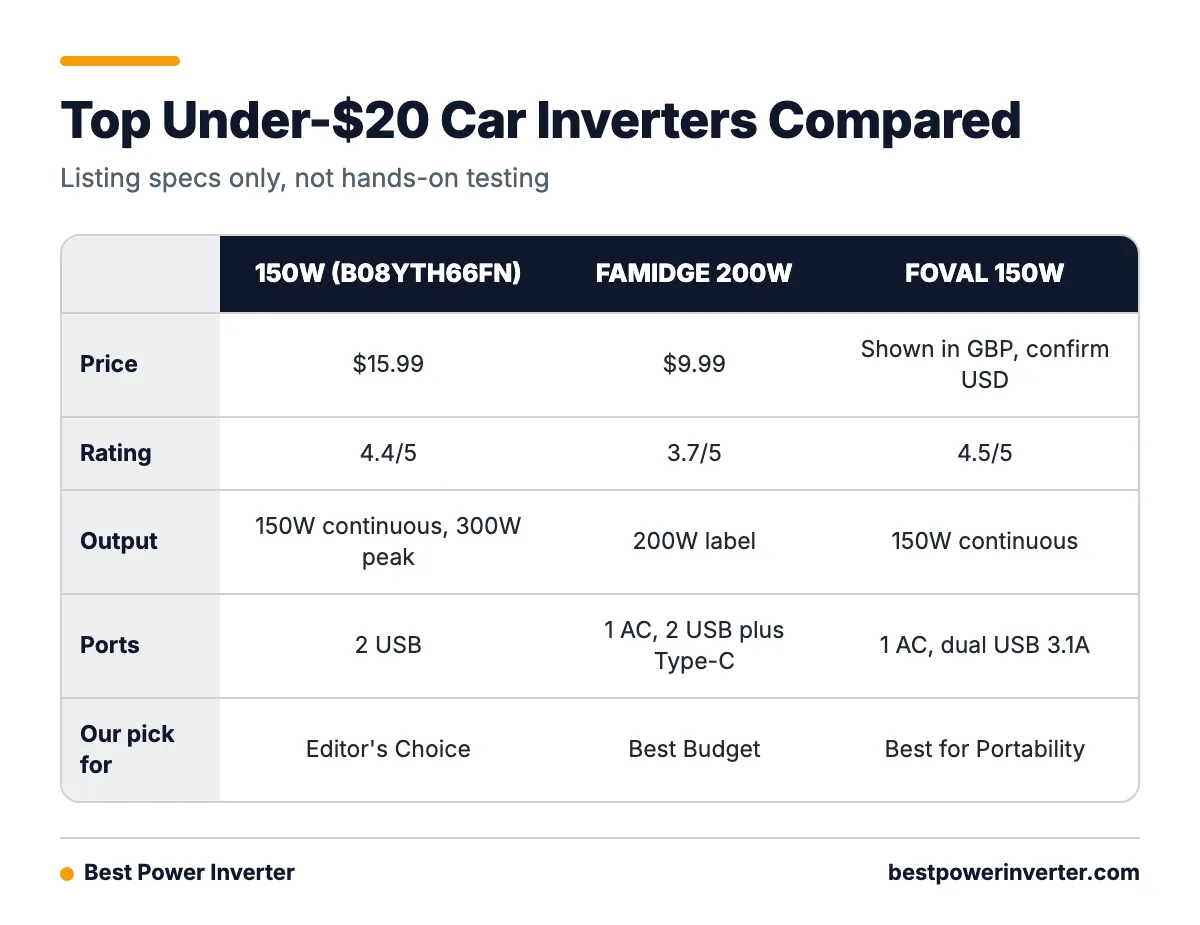
| Product | Key Specs | Our Choice | Action |
|---|---|---|---|
| 150W Power Inverter (B08YTH66FN) | 150W continuous, 300W peak, 2 USB, $15.99, 4.4/5 | Editor’s Choice | |
| FAMIDGE 200W | 1 AC, 2 USB (3.0A) plus Type-C, $9.99, 3.7/5 | Best Budget | |
| FOVAL 150W | 150W, 3.1A dual USB, 3.2 x 2.5 x 1.5 in, 8 oz, 4.5/5 | Best for Portability | |
| 150W Inverter, 2 AC Outlets (B0D47PHLQR) | 2 AC, 2.4A dual USB, 4.4/5 | Best for Extra Outlets | |
| Car Power Inverter with 3.1A Dual USB (B0F995HKVD) | Full protection suite, 3.1A dual USB, $52.99, 5.0/5 | Best Premium |
Two listings (FOVAL and B0D47PHLQR) showed prices in British pounds in the scraped data. Confirm the current USD price on Amazon before buying. The premium pick is well over $20 and is included for readers who want to see what extra money buys.
What Can a 12 Volt Inverter Power, and What Can’t It?
A 150W socket inverter can run small electronics: phone chargers, laptop adapters, camera battery chargers, LED lights and mini fans. It cannot run anything with a motor or heating element, such as hair dryers, coffee makers, microwaves, power tools or space heaters.
| Device | Typical watts | OK on a 150W socket inverter? |
|---|---|---|
| Phone charger | 5 to 20W | OK |
| Laptop charger | 45 to 90W | OK |
| Camera battery charger | 10 to 20W | OK |
| LED string lights | 5 to 30W | OK |
| Mini fan | 10 to 30W | OK (motor, check startup) |
| Game console | Varies widely | Check the power brick label; many exceed 100W |
| Hair dryer or heater | 1,000W+ | No |
| Power tools, compressors | Surge of 2 to 7x running watts | No |
Wattages are typical ranges. Always read the label on your own charger.
How Do I Calculate the Inverter Power (Watts) I Need?
Add up the watts of everything you will run at once, then add 20% headroom. Watts equal volts times amps, so the label on each device’s power adapter gives you the number.
Worked example: a 65W laptop charger plus a 15W phone charger is 80W. Add 20% and you get about 96W. Most inverters are roughly 85 to 90% efficient, so the DC current drawn from the 12V socket is about 96 / (12 x 0.9) = 8.9A. At 85% efficiency it is about 9.4A. That fits a 15A socket but sits close to the limit of a 10A one.
Motors, compressors and heaters can draw 2 to 7 times their running watts at startup, so size for that surge. Peak ratings on cheap units, such as 300W peak on a 150W inverter, describe only brief surges.
Can I Use a Cigarette-Lighter Inverter in My Truck, and How Many Watts Is the Socket Good For?
You can, as long as your load stays inside the socket’s fuse rating. At 12V, a 10A socket gives about 120W and a 15A socket about 180W before losses. Typical vehicle accessory sockets are fused around 10 to 20A.
This is the point many listings skip. A 200W label on a plug-in unit does not change what the fuse allows. The inverter’s own protection or the vehicle fuse will trip first under sustained heavy load.
How Do I Connect a Power Inverter to a 2026 Chevy Silverado RST?
For a plug-in unit, push it fully into the accessory socket, switch it on, then plug in your device. Check your owner’s manual for the fuse rating of the socket you plan to use, since outlets on the same truck can differ.
- Step 1: Find the accessory outlet and its fuse rating in the owner’s manual.
- Step 2: Keep your total load under about 80% of that rating.
- Step 3: Plug in the inverter first, then the device.
- Step 4: For anything above roughly 150 to 200W, skip the socket and use a battery-clamp inverter with fused cables connected directly to the battery.
Keep the engine running when drawing more than a phone charger. A loose fit in the socket is a known complaint on cheap units, so confirm the inverter seats firmly.
Is a Modified Sine Wave Inverter Safe for Laptops and Phone Chargers?
Generally yes. Laptop and phone chargers use switching power supplies that tolerate a stepped waveform. Modified sine wave output can cause buzzing or extra heat in some electronics, though.
Be cautious with audio gear, some chargers, CPAP machines and anything with a motor. Several listings here mention CPAP use, but a medical device deserves a pure sine wave source and the manufacturer’s guidance. Pure sine wave mimics grid power and is the safer choice for sensitive equipment.
Will an Inverter Drain My Truck Battery, and Can I Run It With the Engine Off?
It can drain the battery, so run it with the engine on for anything beyond a brief phone top-up. An idle inverter also draws a small current.
Runtime formula: battery Ah x 12V x 0.5 usable x 0.85 efficiency, divided by load watts. Lead-acid batteries should generally not be discharged below about 50% to protect lifespan.
Example with a hypothetical 60Ah battery: 60 x 12 x 0.5 x 0.85 = about 306Wh. At a 96W load that is roughly 3.2 hours in theory. Leave a reserve to start the engine, so plan for far less.
What Is the Difference Between Continuous and Peak Watts?
Continuous watts are what the inverter can sustain. Peak watts are a short surge, often for a fraction of a second. Cheap units often advertise peak figures prominently, so judge them on the continuous number and the socket fuse.
What Safety Features Should a Cheap Inverter Have?
Look for a replaceable or built-in fuse, overload protection, over- and under-voltage shutdown, short-circuit protection and thermal shutdown. UL or ETL listing is a plus, though none of the provided listings states one.
- Real continuous watts, not just peak
- Fuse type and protections
- USB output amps (2.4A to 3.1A total here)
- Cord length and a snug socket plug
- Ventilation: do not cover the unit
In-Depth Reviews

1. 150W Power Inverters for Vehicles 12V DC to 110V AC Car Plug Adapter Outlet – Editor’s Choice
Our Verdict: The most realistic spec sheet in the under-$20 group, with solid protections at $15.99.
The listing states 150W continuous and 300W peak, which sits within what a 12V socket can feed. It uses a smart chip plus a built-in fuse. On a fault it shuts off output and lights a red indicator, so you may avoid replacing a fuse. The metal housing is credit-card sized at 3.4 x 2.5 x 1.5 inches and about 8 oz. It also lists protection against overheating, reverse connection, under voltage, over voltage, overload and short circuit.
Why We Like It
- Continuous rating matches socket limits
- Fault indicator and automatic shutoff
- Compact metal housing with two USB ports
Pros & Cons
Pros
- Under $20 with a 4.4/5 rating
- Dual protection design
- Portable
Cons
- Modified sine wave output is not ideal for sensitive gear
- Limited to small loads by socket fuse

2. FAMIDGE 200W Car Power Inverter, 12v to 110v – Best Budget
Our Verdict: The cheapest option at $9.99 and the only one with a Type-C port, but its 3.7/5 rating suggests more variability.
The listing offers one AC outlet, two 3.0A USB ports and one Type-C port, so up to four devices can charge at once. It measures 2.5 x 2.5 x 2.9 inches and fits a cup holder. The listing itself notes it is not for appliances above 200W. Treat the 200W label cautiously: a plug-in socket fuse will usually limit you to well under that.
Why We Like It
- Lowest price
- Type-C plus two USB ports
- Cup-holder-friendly shape
Pros & Cons
Pros
- Four charging ports total
- Very affordable
Cons
- Lowest rating of the group (3.7/5)
- 200W claim exceeds typical socket capacity

3. FOVAL 150W Car Power Inverter – Best for Portability
Our Verdict: The highest-rated unit in the budget range (4.5/5), and the easiest to store.
It lists 150W continuous output, one AC outlet and two USB ports with 3.1A total. The aluminum shell measures 3.2 x 2.5 x 1.5 inches and weighs about 8 oz. Protections listed include a built-in fuse, overheating, over/under voltage, short circuit and overload. The scraped price appeared in pounds (GBP12.57), so verify the USD price.
Why We Like It
- Highest rating among sub-$20 candidates
- Small, light metal housing
- Cooling fan described as quiet
Pros & Cons
Pros
- 150W rating fits socket limits
- Good protection list
Cons
- Price shown in GBP, so USD price is unconfirmed
- Only one AC outlet

4. 150W Power Inverter 12V DC to 110V AC Car Plug Adapter (B0D47PHLQR) – Best for Extra Outlets
Our Verdict: Two AC outlets are useful, but the listing’s claims are inconsistent.
The title says 150W, yet the description cites 300W continuous and 600W peak, plus a 40A fuse. Those figures do not fit a cigarette-lighter input, so treat them as marketing and plan around 150W at most. It has two AC outlets, two USB ports at 2.4A and an aluminum alloy casing. The scraped price was GBP11.36, so confirm the USD price.
Why We Like It
- Two AC outlets
- Protection list covers overheating, voltage and short circuit
Pros & Cons
Pros
- Rated 4.4/5
- Extra outlet for two chargers
Cons
- Contradictory wattage claims
- USB output lower (2.4A)

5. Car Power Inverter with 3.1A Dual USB Car Charger (B0F995HKVD) – Best Premium
Our Verdict: The only option here above the $20 budget at $52.99, with a 5.0/5 rating.
The listing describes built-in fuses, LC filter circuits and protection against overvoltage, undervoltage, overload, short circuit and overheating. USB output is 3.1A total. The provided data does not state a wattage, so check it on the product page. The perfect rating may reflect a small number of reviews, so read recent feedback.
Why We Like It
- Most detailed protection description
- LC filter circuit mentioned
Pros & Cons
Pros
- Full protection suite
- 3.1A dual USB
Cons
- Far above $20
- Wattage not stated in the data
When Should I Spend More or Choose a Battery-Clamp Inverter?
Spend more when you need over about 150 to 200W, want to run sensitive electronics, or need steady power for hours. Roughly, under $20 buys a small socket-powered modified sine wave unit. Around $50 gets better filtering and protections. Around $100 and up starts to cover larger battery-clamp or pure sine wave models.
What Do Owners Say?
Owners like
- Compact and handy for charging phones and laptops on the road
- Built-in USB ports are convenient
- Cheap enough to keep as an emergency backup in the glovebox
Common complaints
- Real output is lower than advertised wattage and the socket fuse blows under load
- Cooling fan is noisy
- Units fail or overheat after limited use
- Interference or buzzing with audio devices or some chargers
- Short cords or loose fit in the socket
Summarised from owner reviews and long-term user reports; individual experiences vary.
Frequently Asked Questions
How to connect power inverter for 2026 Silverado RST?
Plug a small unit into the accessory socket after checking its fuse rating in the owner’s manual. Larger inverters need fused cables to the battery terminals.
What can a 12 volt inverter power?
Phone and laptop chargers, camera chargers, LED lights and small fans. Heaters, hair dryers and power tools are out of range for these units.
How to calculate inverter power?
Add the watts of all devices, add 20% headroom, and make sure the DC current (watts divided by about 12 x 0.85) stays under your socket fuse rating.
Conclusion
For most drivers, the 150W unit (B08YTH66FN) at $15.99 is the best value, with the FAMIDGE as the cheapest option and the FOVAL as the best-rated compact pick. Keep your load under about 100W, confirm the socket fuse, and move to battery clamps for anything larger.
Affiliate Disclosure: As an Amazon Associate, we may earn commissions from qualifying purchases from Amazon.com. This comes at no extra cost to you and helps support our research.