
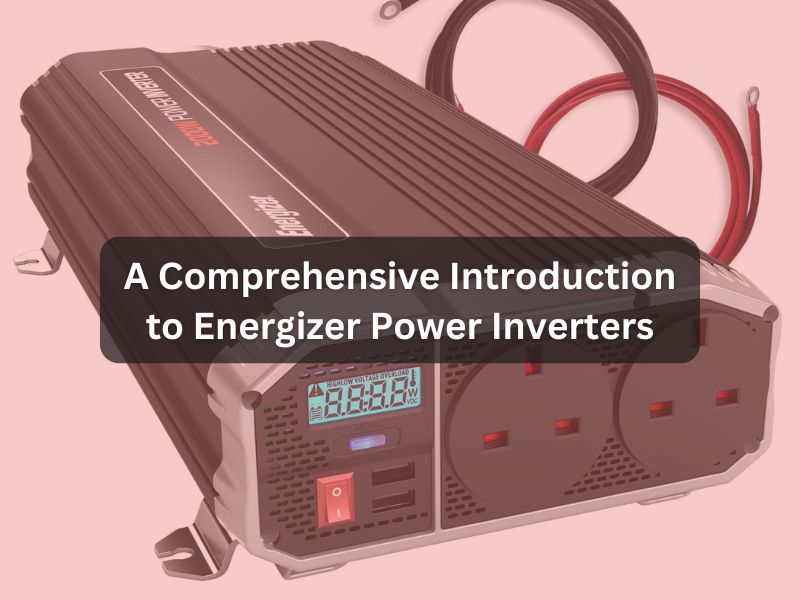
Energizer power inverters convert 12-volt DC battery power into roughly 110-120-volt AC power. Models range from compact 100-180-watt vehicle units to 1,100-4,000-watt units. The right choice depends on continuous wattage, startup surge, waveform, battery and cable capacity, and whether your equipment needs pure sine wave output.
Quick answer
Total your running watts, add the largest startup surge, and leave about 20% spare. Under roughly 150 watts, a plug-in unit is enough. Above that, use a direct battery connection with heavy, fused cable.
- Best for phones and laptops in a vehicle: EN100 or EN180, compact and modest draw
- Best for tools, TVs and small appliances: ENK1100 or ENK1500
- Best for large or motor loads: ENK2000 to ENK4000 with a large battery
What is an Energizer power inverter and how does it work?
An Energizer power inverter takes DC power from a battery and converts it into AC power so ordinary plug-in devices can run where there is no wall outlet. Inside, an electronic circuit switches the battery’s DC power rapidly and shapes it into AC. An Energizer Power Inverter takes energy stored in a battery (inverters in general work from 12V or 24V DC) and produces 110V or 220V AC depending on the design. The Energizer models covered here are 12-volt input units with about 115-volt AC output.
Because the inverter only converts energy and does not create it, everything it delivers comes out of the battery. That is why battery size and cabling matter as much as the inverter’s wattage label.
What Energizer inverter sizes and model ranges are available?
The lineup runs from the 100-watt EN100 to the 4,000-watt ENK4000. The table below uses the ratings published by Energizer and its manuals. Where a detail is not stated in the sources used for this article, the cell says to confirm it on the model’s specification page.
| Model | Continuous watts | Peak watts | Waveform | USB ports | Display | Input voltage | Recommended use |
|---|---|---|---|---|---|---|---|
| EN100 | 100 | 200 (surge) | Modified sine | Confirm on spec page | Confirm on spec page | 12 V DC | Phone and small electronics charging in a vehicle |
| EN180 | 180 | 360 | Modified sine | 4 shared ports, 2.1 A | Confirm on spec page | 12 V DC | Laptop plus USB charging in a vehicle |
| ENK1100 | 1,100 | 2,200 | Confirm on spec page | Confirm on spec page | Confirm on spec page | 12 V DC (10.5 to 15.5 V range) | Small tools, TV, small appliances |
| ENK1500 | 1,500 | 3,000 | Confirm on spec page | Confirm on spec page | Confirm on spec page | 12 V DC (10.5 to 15.5 V range) | Mixed loads, mid-size tools |
| ENK2000 | 2,000 | 4,000 | Confirm on spec page | Confirm on spec page | Confirm on spec page | 12 V DC (10.5 to 15.5 V range) | Larger tools, some motor loads |
| ENK3000 | 3,000 | 6,000 | Confirm on spec page | Confirm on spec page | Confirm on spec page | 12 V DC | Heavy loads with a large battery bank |
| ENK4000 | 4,000 | 8,000 | Confirm on spec page | Confirm on spec page | Confirm on spec page | 12 V DC | Largest loads, dedicated battery system |
The ENK1100, ENK1500 and ENK2000 manuals specify 12-volt DC input, approximately 115-volt AC output, and an input operating range of 10.5 to 15.5 volts DC. The Energizer ENK1100/ENK1500/ENK2000 English manual is the document to check before wiring one.
What is the difference between continuous wattage and peak or surge wattage?
Continuous wattage is the load the inverter can supply indefinitely, and peak (surge) wattage is a short burst, typically about twice the continuous rating on these models. Every Energizer model listed above has a peak rating of twice its continuous rating, for example 1,500 watts continuous and 3,000 watts peak for the ENK1500.
Size the inverter on continuous watts. Peak watts only cover the moment a motor or compressor starts. Refrigerators, pumps, compressors and power tools draw several times their running watts for a fraction of a second, so an inverter sized only to the running figure can trip on startup.
How much battery current does an Energizer inverter draw at full load?
At full load, an inverter draws roughly its wattage divided by battery voltage and efficiency. This is the number that sets your battery and cable requirements, and product pages rarely show it.
Worked example for a 1,500-watt load at about 90% efficiency (an assumed figure, not a manufacturer rating):
- Power taken from the battery: 1,500 W / 0.90 = about 1,667 W.
- Current at 12 V: 1,667 W / 12 V = about 139 A.
- As the battery sags toward the 10.5 V low end of the ENK input range, the same load needs about 159 A.
| Model | Full continuous load | Approx. battery current at 12 V, 90% efficiency |
|---|---|---|
| EN100 | 100 W | about 9 A |
| EN180 | 180 W | about 17 A |
| ENK1100 | 1,100 W | about 102 A |
| ENK1500 | 1,500 W | about 139 A |
| ENK2000 | 2,000 W | about 185 A |
| ENK3000 | 3,000 W | about 278 A |
| ENK4000 | 4,000 W | about 370 A |
Can a vehicle accessory socket run an Energizer inverter?
Only the small units. Many vehicle accessory sockets are fused at roughly 10 to 15 amps (check your owner’s manual), which is only about 120 to 180 watts at 12 volts before conversion losses. An EN180 at full load pulls about 17 amps, so keep it below full load on a 15 A circuit. The 1,100-watt and larger models need a direct battery connection.
How large a battery and what cable size does a high-wattage Energizer inverter require?
Choose cable gauge and fuse size from the table in the manual or on the model’s specification page, not from a guess. At 100 amps or more, undersized cable heats up, drops voltage and can trigger low-voltage shutdown or a fire.
Practical rules that follow from the current figures above:
- Keep the battery cables as short as possible and use the heaviest gauge the manual specifies.
- Fit a fuse close to the battery positive terminal, rated per the manual.
- For the 1,100-watt class and above, use a battery or bank able to deliver the full current without heavy voltage sag. A car starter battery is a poor fit for sustained loads, while deep-cycle or lithium batteries suit them better.
- For the 3,000 and 4,000-watt models, plan on a dedicated battery bank, since the current runs to several hundred amps.
The battery’s voltage and capacity determine how long the inverter will provide power. The inverter also performs best within a specific temperature range, and excessive heat can affect its efficiency.
How long will a 12-volt battery run an appliance through an Energizer inverter?
Runtime is usable battery watt-hours divided by the load in watts, reduced by inverter losses. The examples below are illustrative calculations, not measured results.
- Battery watt-hours = amp-hours x 12 V. A 100 Ah battery holds about 1,200 Wh.
- Usable share: about half for lead-acid to protect its life (about 600 Wh), more for lithium.
- Apply 90% efficiency: about 540 Wh delivered to the load.
- Divide by the load. A 60 W laptop-and-lights load runs about 9 hours. A 300 W load runs about 1.8 hours.
Heavy loads shorten runtime faster than the arithmetic suggests, because high current causes voltage sag and earlier low-voltage shutdown.
How do I size an inverter for my loads?
Use this worksheet to find the continuous rating you need and to check the surge.
- List running watts for everything that will run at the same time, from the device labels.
- Total them.
- Find the largest startup surge (usually a motor) and subtract that device’s running watts from it. That is the extra surge on top of your total.
- Add reserve: multiply the running total by 1.2 to 1.25 for the continuous rating.
- Check peak: running total plus the extra surge must stay under the model’s peak rating.
Example with assumed device figures (read your own labels): a 65 W laptop, a 100 W TV and a 150 W small refrigerator give 315 W running. If the fridge surges to 450 W, the extra is 300 W, so the peak need is 615 W. With 20% reserve the continuous need is about 380 W. That is beyond the EN180, so the ENK1100 (1,100 W continuous, 2,200 W peak) covers it comfortably.
Which Energizer inverter should I use for phones, laptops, TVs, tools, or appliances?
- Phones and tablets: The EN100 or EN180 is enough. The EN180 has four shared USB ports rated at 2.1 amps.
- Laptops: EN100 or EN180, as long as the charger’s wattage is within the rating.
- TVs and game consoles: Add up the label watts; most fit an ENK1100.
- Tools: Convert the nameplate amps to watts (amps x 115 V) and size for the starting surge.
- Appliances: Size for startup surge and use a model with real headroom.
Can an Energizer inverter run a refrigerator, microwave, CPAP machine, or power tool?
Often yes, if the inverter’s continuous and peak ratings cover the load and the battery can deliver the current.
- Refrigerator: Possible with an ENK-series unit sized for the compressor’s startup surge.
- Microwave: The label usually lists cooking watts, while input power is often noticeably higher. Size from the input rating, so a 1,000 W microwave typically needs well above 1,000 W of inverter capacity.
- CPAP machine: The draw is low, but this is medical equipment. Check the device manufacturer’s guidance on waveform and use a pure sine wave source if they recommend one.
- Power tool: Check the starting current, which can be a multiple of running current. Larger saws and compressors need the 2,000-watt class or above.
Are Energizer inverters pure sine wave or modified sine wave?
The EN100 and EN180 use a modified sine wave, according to the manufacturer information. For the ENK models, confirm the waveform on the model’s specification page, such as the Energizer ENK1100 product specifications, before connecting sensitive equipment.
Pure sine wave inverters provide the cleanest form of power and are better for sensitive electronics, while modified sine wave inverters are typically more affordable and suitable for basic devices.
Modified sine wave inverters
These offer a cheaper alternative for powering non-sensitive devices. They work for basic appliances such as fans, lights and many power tools. Some devices, especially sensitive electronics, may not work well on them.
Pure sine wave inverters
Pure sine wave inverters produce a smoother and more reliable flow of electricity, making them ideal for computers, televisions and medical equipment.
What protections and safety features do Energizer inverters provide?
The documented operating window for the ENK1100, ENK1500 and ENK2000 is 10.5 to 15.5 volts DC input. Beyond that, read the manual for the model’s low-voltage, overload and over-temperature protections, and do not rely on them as a substitute for correct sizing.
Safety checklist:
- Connect high-wattage models directly to the battery, not through an accessory socket.
- Keep cables short and heavy, and fuse the positive cable near the battery.
- Ventilate the inverter and keep its vents clear, because excess heat reduces efficiency and can cause shutdown.
- Do not exceed the inverter’s maximum wattage rating.
- Monitor battery levels so the battery is not over-discharged, and respect low-voltage shutdown.
- Do not overload vehicle outlets; stay within the socket’s fuse rating.
- Use the inverter in dry areas and indoors only with proper ventilation.
How do I install an Energizer power inverter?
Installation is generally straightforward, but follow the manual for the exact cable and fuse specification.
- Choose the location: Pick a dry, ventilated area near the battery to keep cables short.
- Connect the inverter to the battery: Use appropriate cables and fuse to connect the DC input to the battery terminals, with the inverter switched off.
- Plug in your devices: Once the inverter is connected, plug appliances into the AC outlets.
- Turn on the inverter: Flip the switch to start powering your devices.
What warranty coverage and operating limits apply to Energizer inverter models?
The EN100 carries a 24-month limited warranty. The ENK1100, ENK1500 and ENK2000 manuals state a 36-month limited warranty. Warranty terms for the ENK3000 and ENK4000 should be confirmed on their product pages, such as the Energizer ENK4000 product specifications. Operating limits to remember are the 10.5 to 15.5 volt input window and the continuous watt rating.
How do I maintain and troubleshoot an Energizer inverter?
- Clean regularly: Dust and debris can cause the inverter to overheat.
- Check cables: Inspect for wear or fraying, which can cause short circuits.
- Test the inverter: Run it periodically with a small load to confirm it works.
Common issues:
- No output: Make sure the inverter is properly connected to the battery, the fuse is intact, and the battery has sufficient charge. Voltage below the input range will stop it.
- Overheating: Check for blocked airflow or excessive load.
- Noise: A noisy inverter might indicate a malfunction or stress from an excessive load.
How much do Energizer power inverters cost?
Cost varies with model, power output and features. Expect to pay anywhere from $50 for smaller, lower-wattage models to over $300 for larger, pure sine wave inverters. Check current retail listings, as prices change.
What are the common uses for Energizer inverters?
- Home use: Powering lights, fans and computers during blackouts.
- Outdoor activities: Camping, RV trips or boating where conventional power is limited. Compact models are easy to carry.
- Industrial use: Larger models can supply tools and machinery at remote job sites.
Buying checklist
- Total running watts and the largest startup surge.
- Pick a continuous rating with 20% or more reserve.
- Decide whether any device needs pure sine wave output and confirm the model’s waveform.
- Convert watts to battery amps and confirm your battery and cabling can supply them.
- Check warranty terms for the model family.
FAQs
What is the difference between modified and pure sine wave inverters?
Modified sine wave inverters are cheaper but can cause problems with sensitive electronics. Pure sine wave inverters provide cleaner power, ideal for sensitive devices.
How long will an Energizer power inverter last?
The lifespan of an inverter depends on usage, maintenance and the quality of the battery. Proper maintenance can extend its lifespan for several years.
Can I use an Energizer power inverter with a car battery?
Yes, but the battery needs enough charge and capacity for the devices. Small models can plug into a vehicle socket within its fuse limit, while larger models need a direct battery connection. Run the engine for sustained loads so the starter battery is not drained.
Are Energizer power inverters safe to use indoors?
Yes, as long as you ensure proper ventilation and avoid overloading them. Keep the battery in a ventilated space too.
What is the best size inverter for a home?
The best size depends on the number and type of devices you plan to power. For essential home appliances, a 1000W to 2000W inverter is usually sufficient, which corresponds to the ENK1100, ENK1500 and ENK2000 class.
How many amps does a 1,500-watt inverter draw?
About 139 amps from a 12-volt battery at roughly 90% efficiency, and more as the battery voltage falls.
Sources