
Inkjet printers draw roughly 15 to 75W, while laser printers can draw 500 to 2000W, according to Eaton. For a small inkjet, a 150W to 300W pure sine wave inverter is usually enough. Many laser printers need far more, because startup and printing surges run well above the label rating.
- Inkjet printers: plan for a 150W to 300W inverter.
- Laser printers: plan for 1000W or more, with strong surge capacity.
- Add 20% to 30% headroom above the largest load.
- Pure sine wave is the safer choice, especially for lasers.
- Inverter efficiency and idle draw make battery drain higher than the printer’s watts.
How Many Watts Does a Printer Need?
Start with the label on the back of the printer or the spec sheet. It lists watts, or volts and amps. Multiply volts by amps to get watts. A 120V printer rated at 1.5A is about 180W.
Be careful, though. A nameplate number may reflect peak or surge demand, not steady running power. It tells you the worst case, which is useful for sizing, but it is not what the printer pulls all day.
Inkjet vs Laser Sizing Chart
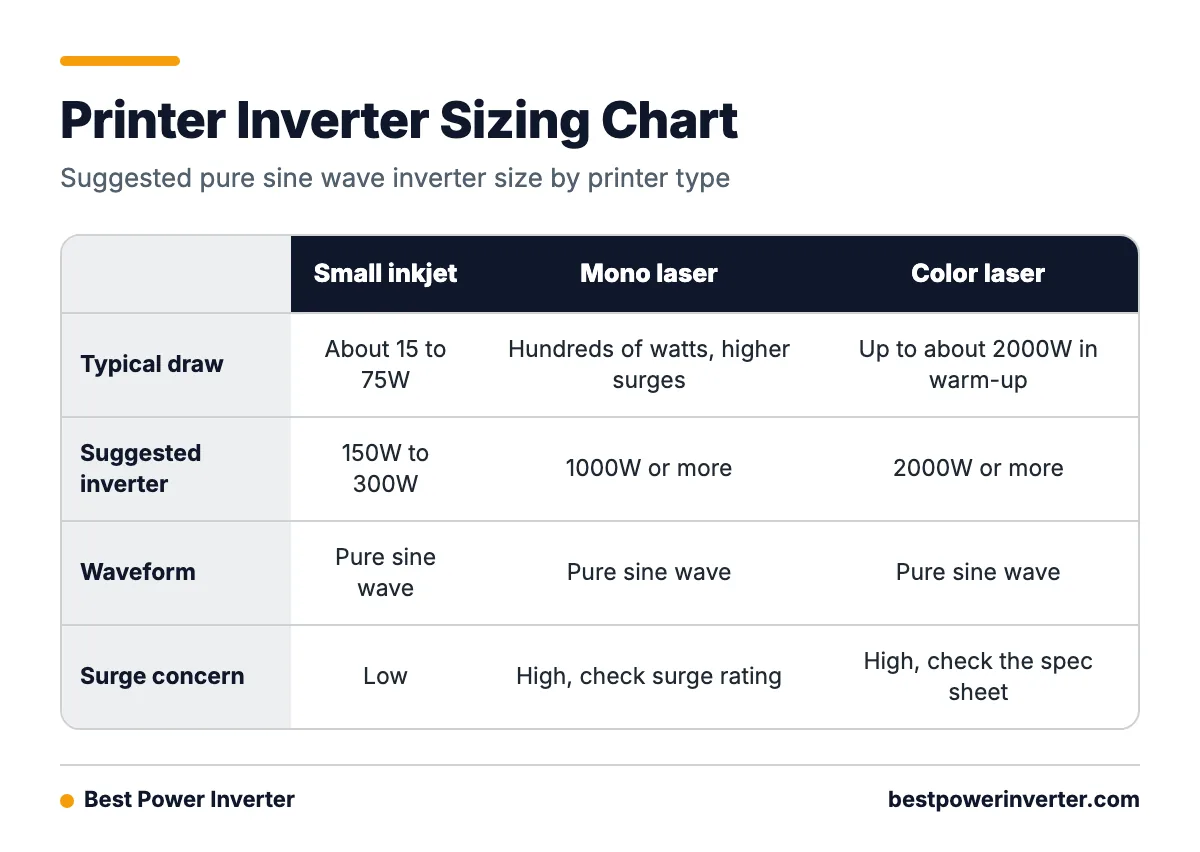
Inkjet and laser printers are very different loads. Lasers heat a fuser to bake toner onto paper, and that takes a lot of power. Based on Eaton’s published ranges and typical inverter sizes, use this chart as a starting point.
| Printer Type | Typical Draw | Suggested Inverter (Pure Sine) |
|---|---|---|
| Small inkjet | About 15 to 75W | 150W to 300W |
| Mono laser | Hundreds of watts, with higher surges | 1000W or more |
| Color laser | Up to about 2000W during warm-up | 2000W or more, check the spec sheet |
Always confirm with your own model’s spec sheet. Ranges vary a lot between brands.
Why Laser Printers Need a Bigger Inverter Than the Label Suggests
A real-world office printer example measured standby power around 14 to 15W. During warm-up, it surged to about 800W. Even after entering power-saving mode, it showed intermittent spikes near 750W.
That is why a small inverter can look fine while the printer sits idle, then shut off the moment you press print. The inverter’s overload protection trips on the spike. Look for the inverter’s surge or peak rating, not only its continuous rating.
Is a Pure Sine Wave Inverter Necessary for a Printer?
For an inkjet, a modified sine wave unit may work, but the power adapter can run hot or hum. For a laser printer, pure sine wave is the safer choice. Lasers use heaters and motors that dislike rough waveforms. Pure sine wave costs more, but it protects a printer that costs more still.
If you run a laser printer: choose pure sine wave with a surge rating above the printer’s warm-up spike.
If you are unsure of the waveform: pick pure sine wave.
How to Calculate Inverter Size From Printer Watts or Amps
MotorTrend advises choosing an inverter with 15% to 20% more capacity than the largest expected load. For printers, 20% to 30% is a safer margin because of surges. Here is the method:
- Find the printer’s watts (or volts × amps).
- Add every other device on the inverter, such as a laptop.
- Multiply the total by 1.2 to 1.3.
- Check that the inverter’s surge rating covers the printer’s warm-up spike.
Worked Example 1: Inkjet and Laptop
An inkjet at 40W plus a laptop charger at 65W is 105W. Times 1.3 is about 137W. A 150W inverter works on paper, but 300W leaves more room and runs cooler.
Worked Example 2: Laser Printer
Say a mono laser lists 500W. Times 1.25 is 625W. But if warm-up spikes reach 800W, as in the office printer example, the inverter must handle that too. A 1000W pure sine wave inverter with a higher surge rating is the practical pick. Add a 65W laptop and the load is still within range.
Battery Drain and Inverter Efficiency
Inverters waste some power as heat. Efficiency is commonly 85% to 95%, so a 1000W AC load can pull more than 1000W from the battery. The Power Inverter Efficiency Guide covers this in more detail. Idle draw adds more, roughly 5 to 25W depending on size and design.
Runtime Example
Take the 105W inkjet and laptop load. At 90% efficiency, that is about 117W. Add 10W idle draw for about 127W from the battery. A 12V battery with 600Wh of usable energy would run this for roughly 4.7 hours. At 85% efficiency, the same load drains it faster.
Turn the inverter off when you are not printing. Idle draw adds up over a long day.
Using a Printer in a Car, Truck, or RV
Can a cigarette lighter inverter run a printer? Only a small inkjet. Most lighter sockets are limited to about 10 to 15A at 12V, which is roughly 120 to 180W before fuse trouble. A laser printer needs an inverter wired straight to the battery with proper cable and a fuse.

From the Shop
A common complaint in buyer reviews is an inverter that powers a printer on standby but shuts off with an overload alarm during a print job. The cause is nearly always the warm-up surge, not a faulty inverter. Moving to a larger pure sine unit with a higher surge rating typically fixes it.
What happens if the inverter is too small? It may trip, shut down mid-print, beep, or in the worst case overheat. Repeated overloads shorten the life of both the inverter and the printer.
Common Mistakes and a Buying Checklist
- Sizing for standby watts instead of warm-up surge.
- Ignoring the laptop, lights, or phone chargers sharing the inverter.
- Buying on continuous rating alone.
- Using thin cables that drop voltage at high current.
Before you buy, check:
- Printer rated watts, or volts × amps, from the label.
- Printer surge or warm-up demand, if listed.
- Other devices on the same inverter.
- Inverter continuous and surge ratings.
- Waveform: pure sine wave preferred.
- Battery capacity and cable gauge.
For more on matching loads to inverters, see Eaton’s power inverter buying guide.
Frequently Asked Questions
How big inverter to power printer?
For a small inkjet, use a 150W to 300W pure sine wave inverter. For a laser printer, start at 1000W and confirm the surge rating covers warm-up spikes. Add 20% to 30% headroom.
How big of a power drain is an inverter?
An idle inverter can draw roughly 5 to 25W, depending on size and design. Under load, efficiency of about 85% to 95% means the battery supplies more than the device uses.
How big of a power inverter can my truck handle?
It depends on the battery and wiring. Small inverters can use the lighter socket, but larger ones need direct battery connections. Keep the engine running for loads that pull heavy current, such as a laser printer.
How big of power inverter for 12v car?
A 150W to 300W inverter suits an inkjet printer and a laptop in a car. Anything above the lighter socket’s limit should be wired to the battery with a fuse.