

Motion-sensor solar floodlights and solar spotlights solve different problems, and picking the wrong type is the most common reason buyers end up disappointed. The best outdoor solar lights pair a large panel with a quality rechargeable battery and an IP65 or higher rating. Budget units typically last 2 to 4 years, while well-built ones can last 5 or more, with the battery usually failing first. This guide compares four models on Amazon and explains how to size, place, maintain and troubleshoot solar lights so they last.
Quick answer
For most homeowners, the Tuffenough 2-pack is the best choice because it combines high advertised output, a wide motion-sensing angle and a remote. Choose spotlights for accent lighting and multi-light bundles for covering more wall space on a budget.
- Best for security: Tuffenough 2500LM 2-pack
- Best for low cost per light: HMCITY 6-pack
- Best for accents: AUDERWIN Spot Lights
Our Winner: Tuffenough Solar Outdoor Lights 2500LM 210 LED Security Lights (2 Packs)
Based on the listed specifications, this set offers the most light output of the group, three adjustable heads, a 270° detection angle, a 26-foot sensing distance and a remote control for switching modes. It carries a 4.4/5 rating and an IP65 rating, which suits garages, driveways and entrances.
How We Compared These Models
This comparison is based on listed specifications, manufacturer claims and patterns in verified buyer reviews, not hands-on testing. The criteria that matter most are light output and how it is delivered (motion-triggered or constant), waterproof rating, panel type and battery information, and cost per light. Runtime modes and mounting flexibility also affect how well a light fits a real yard.
| Product | Key Specs | Our Choice | Action |
|---|---|---|---|
| Tuffenough 2500LM Security Lights (2 Pack) | 2500 lm claimed, 210 LEDs, 1800mAh battery, 270° PIR, IP65, remote, $27.99 | Best Overall | |
| HMCITY 120 LED Motion Sensor Wall Lights (6 Pack) | 120 LEDs each, monocrystalline panel, 3 modes, IP65, about $4 per light at $23.99 | Best Budget | |
| AUDERWIN Solar Spot Lights, Cool White (4 Pack) | 63 LEDs, 6500K, polycrystalline panel, 3 modes, IP65, $22.49 | Best for Accent Lighting | |
| AUDERWIN Solar Spot Lights, Warm White (4 Pack) | 63 LEDs, 3000K, polycrystalline panel, 3 modes, IP65 | Best for Ambience |
Which Outdoor Solar Lights Are Best for Each Job?
The right light depends on the task. Brightness needs vary widely, so match the type to the use before comparing brands.
| Use | Typical Lumens | Best Light Type | Battery to Look For | Minimum IP | Motion Sensor | Price Tier |
|---|---|---|---|---|---|---|
| Garden paths | 10 to 100 | Stake lights | Replaceable NiMH or LiFePO4 | IP44 to IP65 | Not needed | Low |
| Security and driveways | 400 to 1500+ | Motion floodlights | Lithium or high-mAh pack | IP65 | Yes | Mid |
| Trees, fences, facades | 100 to 500 | Spotlights | Lithium or NiMH | IP65 | Optional | Low to mid |
| Patios and decks | 20 to 200 | String, lantern or deck lights | Replaceable cells | IP44 to IP65 | Rare | Low to mid |
| Shaded locations | Varies | Separate-panel kits | Lithium | IP65 | Optional | Mid |
The lumen ranges above are general guidelines. Path lights commonly fall in the 5 to 100 lumen range, while motion-sensor security floodlights commonly advertise 500 to 2,000 lumens or more. Many listings quote peak output, not sustained output, so treat large numbers as an upper limit.
In-Depth Reviews
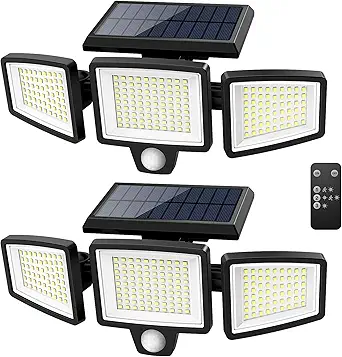
1. Tuffenough Solar Outdoor Lights 2500LM (2 Pack) – Best Overall
Our Verdict: The strongest all-around option for security and driveway lighting, thanks to its three adjustable heads, wide sensing angle and remote control.
Each unit lists 210 LEDs at 6500K, a built-in 1800mAh rechargeable battery and IP65 construction. The listing states a 270° lighting angle and a 26-foot sensing distance. Three modes are offered: strong light sensor, dim light sensor and strong long light.
The 2500 lumen figure is a manufacturer claim and is most likely peak output. Expect real-world brightness to be lower, especially after the battery has been drained. The listing recommends mounting at 6.5 to 8 feet with the panel facing direct sun, and setting the switch to OFF on cloudy days so the panel can charge. The battery chemistry is not stated, so check what is inside if you plan to replace it.
Why We Like It
- Remote control makes mode changes easy once the light is mounted high.
- Three adjustable heads cover a corner, garage door or side yard from a single mount.
- Two-pack pricing of $27.99 works out to about $14 per light.
Pros & Cons
Pros
- Highest advertised output in this group
- Wide 270° detection angle
- IP65 rating for rain and snow exposure
Cons
- Lumen figure likely reflects peak output
- Battery type not specified
- Sensor placement is height-sensitive

2. HMCITY 120 LED Outdoor Solar Lights (6 Pack) – Best Budget
Our Verdict: The lowest cost per light here, suited to fences, sheds, garage walls and gates where you want many small motion-activated lights.
At $23.99 for six, each light costs roughly $4. The listing describes a monocrystalline silicon panel with efficiency of up to 30% (a manufacturer claim), an ABS body and IP65 protection. Each light measures about 3.74 by 3.38 inches and mounts with included screws.
Read the mode details before buying. The motion sensor works in Mode 1 (full brightness on motion) and Mode 3 (dim light with motion boost). Mode 2, constant medium light, does not use the sensor. The manufacturer advises charging 6 to 8 hours in direct sun before first use and keeping lights away from other light sources that could confuse the sensor.
Why We Like It
- Six lights let you cover a whole fence line or perimeter.
- Monocrystalline panel is a good sign for charging in lower light.
- Compact size is easy to hide under eaves.
Pros & Cons
Pros
- About $4 per light
- Three modes with motion options
- Screw-mount installation
Cons
- Small units, so coverage per light is limited
- Mode 2 disables motion detection
- Battery capacity not listed

3. AUDERWIN Solar Spot Lights, Cool White (4 Pack) – Best for Accent Lighting
Our Verdict: A flexible spotlight set for trees, fences, house walls and walkways that works as either a ground stake light or a wall light.
Each light has 63 LEDs at 6500K and a polycrystalline panel. The manufacturer claims 25% conversion efficiency. The listing gives three brightness modes with stated runtimes of 24 hours (low), 18 hours (medium) and 12 hours (high). In high mode, output starts at 100% for 4 hours, dims to 40% for 2 hours, then drops to 20%. That tapering is typical of solar designs and means peak brightness does not last all night.
The listed operating range is -4°F to 140°F, with IP65 protection and an ABS body. The listing suggests covering the panel and switching the light on to test it before placing it outside. A 12-month assurance is included.
Why We Like It
- Dual-purpose mounting (landscape or wall).
- Clear runtime figures for each mode.
- Stated cold-weather operating range helps with winter planning.
Pros & Cons
Pros
- Four lights for $22.49
- Three modes with published runtimes
- 12-month assurance
Cons
- No motion sensor listed
- Lower 4.2/5 rating than the other picks
- Cool white can feel harsh near seating areas

4. AUDERWIN Solar Spot Lights, Warm White (4 Pack) – Best for Ambience
Our Verdict: The same hardware as the cool white set with a 3000K color temperature, better suited to patios, entryways and planting beds.
Per the listing, it has the same 63 LEDs, polycrystalline panel, three modes, IP65 rating and 12-month assurance as the cool white set. The difference is the warmer light, which tends to flatter brick, wood and foliage and is less glaring near seating. Check the current price on Amazon, as it may vary by marketplace.
Why We Like It
- Warm 3000K light suits relaxed spaces.
- Same published runtimes as the cool white version.
- Works as a stake or wall light.
Pros & Cons
Pros
- Warm tone for ambience
- Four-pack coverage
- IP65 and a wide temperature range
Cons
- No motion sensor listed
- Not intended as security lighting
- Warm light can look dimmer at the same output
How Do Outdoor Solar Lights Work?
Outdoor solar lights charge a rechargeable battery through a photovoltaic panel during the day, then power an LED at night. A photoresistor detects darkness and switches the LED on at dusk.
- Panel: converts sunlight to electricity. Monocrystalline and high-grade polycrystalline are the common types.
- Charge controller: protects the battery from overcharge.
- Battery: stores the energy. This is usually the first part to wear out.
- LED: commonly rated 25,000 to 50,000 hours, so batteries and seals typically fail first.
- Light sensor: turns the light on and off.
Are Outdoor Solar Lights Waterproof? IP44 vs IP65 vs IP67
Many are, but the rating matters. Under the IEC 60529 standard, IP44 protects against splashes only, IP65 is dust-tight and protected against low-pressure water jets, and IP67 withstands temporary immersion.
For exposed walls, driveways and open yards, IP65 is a sensible minimum. IP44 may be fine for covered porches. Choose IP67 for spots that flood or sit in standing water. Even with a good rating, owners report condensation over time, so a gasket that looks thin is a red flag.
How Long Do Outdoor Solar Lights Last?
Budget units typically last 2 to 4 years and well-built ones 5 or more. Typical garden lights use 1.2V NiMH cells of roughly 300 to 800 mAh that often need replacing after 1 to 3 years. LiFePO4 cells generally tolerate more charge cycles.
Failure usually comes from battery degradation, water ingress, hazy panels and corroded contacts, not the LED. That is why replaceable batteries and good seals matter more than peak lumens.
How Many Solar Lights Do You Need?
- Paths: one 10 to 30 lumen stake light every 6 to 8 feet gives a gentle glow. Space them closer for a brighter path.
- Porch or entry: one or two lights in the 100 to 300 lumen range.
- Driveway: one or two floodlights at 500+ lumens, mounted 6.5 to 8 feet high.
- Security: cover each entry point and blind corner with a motion-sensor light.
These are practical guidelines, not code requirements. Plan for roughly 6 to 8 hours of direct sun for a full charge. Overcast days reduce charging substantially, so shade-prone spots may need a separate-panel kit.
Why Are My Outdoor Solar Lights Not Working?
Work through this order before replacing anything:
- Switch: confirm it is ON (or the correct mode, since some units need OFF to charge).
- Sun test: give the panel a full day of direct sun.
- Panel: wipe off dust, pollen or film.
- Battery: swap in a fresh matching cell.
- Contacts: clean any corrosion with a cotton swab and a little vinegar, then dry.
- Sensor confusion: a streetlight or porch light near the panel can keep the light from switching on.
- Seals: look for moisture inside the housing.
Can Outdoor Solar Lights Be Fixed?
Often yes. A battery swap fixes most short-runtime problems, and cleaning contacts fixes many no-power issues. Resealing with silicone can help minor water ingress, but a unit that is flooded or has a swollen cell should be replaced.
Replacement Battery Guide
- 1.2V NiMH (AA/AAA): common in stake lights. Match size and chemistry.
- 3.2V LiFePO4: longer cycle life, used in better lights.
- 3.7V Li-ion: common in floodlights. Do not substitute for 3.2V or 1.2V cells.
Always match voltage and chemistry, and avoid mixing old and new cells.
How to Clean Outdoor Solar Lights (Including Sensor Models)
Wipe the panel every month or two with a damp, soft cloth and mild soap. Avoid abrasive pads that scratch the surface and reduce output.
For lights with motion or dusk-to-dawn sensors, clean the lens and sensor window gently with a dry or barely damp cloth. Keep water out of seams and do not spray with a pressure washer. Make sure no leaves, webs or paint cover the sensor.
Can Outdoor Solar Lights Stay Out in Winter?
Most can, if they have a solid IP rating. The AUDERWIN listings state a working range of -4°F to 140°F. Lithium-ion and LiFePO4 cells should not be charged below about 0°C (32°F) without protection circuitry, which can reduce winter charging. Shorter days and a low sun angle also cut runtime.
- Clear snow off panels.
- Angle panels toward the low southern sun where possible.
- Bring in lights with unprotected or aging batteries if hard freezes are expected.
Can Outdoor Solar Lights Catch Fire?
The risk is low but real. It increases if cells are damaged, overheated or poorly protected. Remove any unit that is hot, swollen or leaking and take it to a battery recycling point. Do not toss it in household trash.
Are Outdoor Solar Lights Good, or Are Wired Lights Better?
Solar lights win on easy installation and zero running cost, which is why they suit renters. Wired or low-voltage systems deliver consistent brightness regardless of weather. For critical security or long, shaded runs, wired lighting is more reliable. For accent, path and secondary security lighting, solar is practical.
Buyer Checklist
- Match lumens to the job, and treat peak figures with caution.
- Look for IP65 or higher.
- Prefer replaceable batteries and a stated chemistry.
- Check the panel type and whether it can be placed in sun.
- Confirm which modes use the motion sensor.
- Choose 3000K for ambience and 6500K for security.
What Do Owners Say?
Owners like
- No wiring is needed, so installation takes minutes and works well for renters.
- Motion-sensor floodlights deter intruders and animals and are bright when triggered.
- Separate-panel models work well where the light is in shade.
- Warm-white string and lantern lights create good ambience with no running costs.
- Replaceable batteries extend the life of better models.
Common complaints
- Cheap lights dim or die after one season, usually from weak batteries.
- Condensation or water ingress despite waterproof claims.
- Short runtime in winter or after cloudy days.
- Advertised lumens are overstated compared with actual brightness.
- Plastic stakes snap or panels haze and yellow after a year or two in strong sun.
Summarised from owner reviews and long-term user reports; individual experiences vary.
Frequently Asked Questions
Which outdoor solar lights are best?
The best choice depends on the job. For security, the Tuffenough 2-pack is the top pick here. For many small wall lights, the HMCITY 6-pack costs the least per light. For accents, the AUDERWIN spotlights are the better fit.
What are outdoor solar lights?
They are self-contained lights with a solar panel, rechargeable battery and LED that need no wiring. They charge by day and light up at night.
What are good outdoor solar lights?
Look for IP65 or higher, a large panel, a replaceable or quality lithium battery and honest brightness claims.
How do outdoor solar lights work?
A panel charges a battery in daylight. A light sensor switches the LED on in the dark, and motion models add a PIR sensor to trigger full brightness.
How to clean outdoor solar lights?
Wipe the panel with a soft damp cloth and mild soap every month or two. Avoid abrasives.
How to clean outdoor solar lights with sensor?
Use a dry or barely damp cloth on the sensor lens, avoid soaking seams, and make sure nothing blocks the sensor.
Can outdoor solar lights be fixed?
Usually, yes. Replace the battery, clean the contacts and panel, and check the seals.
Can outdoor solar lights stay out in winter?
Generally yes, but charging drops in freezing temperatures and short days, and lithium cells should not charge below about 32°F without protection.
Can outdoor solar lights catch fire?
It is uncommon, but damaged or overheated lithium cells can be a hazard. Remove and recycle swollen or hot units.
Why outdoor solar lights not working?
The common causes are a switch left off, too little sun, a dirty panel, a worn battery, corroded contacts or a nearby light confusing the sensor.
Conclusion
For most homes, the Tuffenough 2-pack is the best all-rounder for security and driveway coverage. The HMCITY 6-pack is the budget pick for covering more wall space, and the AUDERWIN spotlights are the choice for accent and ambient lighting. Whichever you choose, place the panel in direct sun, keep it clean, and plan on replacing the battery after a few years.
Affiliate Disclosure: As an Amazon Associate, we may earn commissions from qualifying purchases from Amazon.com. This comes at no extra cost to you and helps support our research.